THE FORBIDDEN HISTORY OF ANCIENT ELECTRICITY
History is written by the victors. We know this. But sometimes, history is just lazy. We get a timeline that fits neatly into a textbook, and anything that sticks out? Anything that doesn’t fit the narrative of “primitive” ancestors slowly banging rocks together until they invented the iPhone? It gets tossed aside.
Ignored.
Buried.
But the stones remember. If you look closely at the corners of the ancient world, you start to see cracks in the official story. Big cracks. The kind that suggest we are missing a massive chunk of the human timeline. We aren’t talking about aliens here. We are talking about us. What if humanity hit a peak thousands of years ago that we are only just now beginning to understand?
Look at the evidence. It’s sitting right there in the museums. It’s carved into the walls of temples that have stood for millennia. Today, we are going to rip apart the “official” explanations and look at three specific anomalies that suggest the Pharaohs might have had power. Literal power. Electricity.
THE DENDERA LIGHTS: ART OR BLUEPRINT?
Let’s take a trip to Egypt. Specifically, to the Temple of Hathor at Dendera. It’s massive. Impressive. But the real secret isn’t in the main hall where the tourists snap selfies. You have to go down. Deep down. Into the claustrophobic crypts beneath the temple.
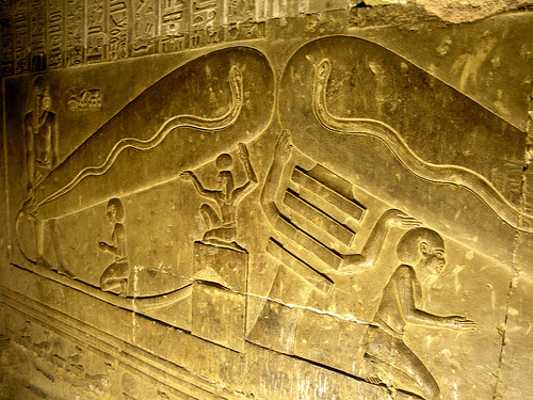
The air is stale. The walls are pressing in on you. And there, etched into the limestone with laser-like precision, is a relief that shouldn’t exist.
Mainstream Egyptologists—the guys with the tenure and the comfortable offices—will tell you this is a religious scene. They say it depicts the creation of the cosmos. They claim the “snake” is a symbol of a god emerging from a lotus flower. A scent bubble. A mythological fantasy.
Look at the image above again. Really look at it.
Does that look like a flower to you? Or does it look like a piece of high-voltage hardware?
The Engineering Breakdown
Let’s strip away the mythology for a second and look at this with the eyes of an engineer. What do we actually see? We see a transparent, bulb-shaped object. Inside that bulb, a snake writhes in a wavy line. If you were drawing a filament inside a lightbulb, how would you draw it? A wavy line.
But it gets stranger.
The “bulb” is plugged into a socket. That socket is attached to a cable. A physical, braided cable that trails along the floor and connects to a box. The text next to it speaks of “glowing” and “power.” The base of the bulb is supported by a “Djed” pillar. In Egyptian myth, the Djed stands for stability. But visually? It looks exactly like a modern high-voltage insulator. The kind you see on power lines today to stop electricity from grounding out.
Then you have the “entities” holding it up. Are they priests? Or are they technicians? There is even a creature—often identified as a baboon deity—holding two knives. The official story says this is a protective spirit. But in the language of symbols, could “knives” represent danger? High voltage? A warning to keep back?
The “Soot” Paradox
Here is the smoking gun. Or rather, the lack of smoke.
The tombs of the Valley of the Kings and the crypts at Dendera are carved out of solid rock, hundreds of feet underground. It is pitch black down there. Absolute darkness. To carve these intricate reliefs and paint them with such vibrant colors, the artists needed light.
So, what did they use?
Torches? If you burn a torch or an oil lamp in a confined space for hours, you get soot. Thick, black, greasy soot. It coats the ceiling. It chokes the air. Yet, nowhere in these pristine tombs do we find soot residue on the original ceilings. They are spotless.
Mirrors? The skeptics love this one. They suggest the Egyptians used a system of polished copper mirrors to reflect sunlight from the entrance down into the tunnels. Have you ever tried to reflect light around five or six corners? Physics bites back. The light loses intensity with every reflection. By the time you get 300 feet into a tomb, you’d be painting by the light of a dying glow stick. It doesn’t work.
So, no soot. No mirrors. How did they see?
Maybe, just maybe, they flipped a switch. The Dendera reliefs might not be worshiping a god. They might be a manual. A diagram of the technology that kept the lights on while they built the afterlife.
THE BAGHDAD BATTERY: IMPOSSIBLE HARDWARE

You can argue about interpretations of carvings all day long. “It’s a flower,” says the professor. “It’s a lightbulb,” says the engineer. It’s subjective. It’s art.
But you can’t argue with physical hardware. You can’t argue with a pot that generates voltage.
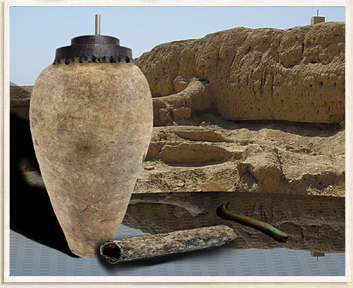
In 1938, a German archaeologist named Wilhelm König was digging through the dusty archives of the National Museum of Iraq. He wasn’t looking for trouble. He was just organizing. But then he found a box of junk labeled as “ritual objects.”
Inside were a series of yellow clay jars. They were small, about the size of a human fist (around 13 cm). They looked boring. Totally unremarkable. Until König looked inside.
Anatomy of an Oopart (Out of Place Artifact)
Inside the clay pot was a copper cylinder. Suspended inside the copper cylinder—but not touching it—was an iron rod. The rod was held in place by an asphalt stopper (bitumen). This wasn’t a vase. This wasn’t for storing grain.
If you know anything about basic chemistry, the hair on the back of your neck should be standing up right now.
Two dissimilar metals (copper and iron). A housing unit. All you are missing is an electrolyte. An acid. Pour some grape juice, vinegar, or lemon juice into that jar, and a chemical reaction occurs. Electrons flow from the iron to the copper. That is a battery. There is no other word for it.
This isn’t a theory. It has been tested. MythBusters did it. College professors do it in labs. Reproductions of the Baghdad Battery, when filled with an acidic liquid (which was readily available in ancient Mesopotamia), produce between 0.8 and 2 volts of electricity.
The “Scroll Container” Excuse
The skeptics, desperate to keep the timeline safe, claim these were just storage vessels for papyrus scrolls. They say the scrolls wrapped around the rod. But why the copper? Why the iron? Why seal it with asphalt so you can’t get the scroll out? Why use two metals that corrode when they touch?
It makes zero sense.
The battery theory is the only one that fits the physical evidence. The artifacts date back to the Parthian or Sassanid periods (roughly 250 BC to 640 AD). That is two thousand years before Alessandro Volta “invented” the battery in 1800.
What Were They Powering?
Okay, so they had batteries. They didn’t have iPhones. So what was the point?
The leading theory—one that König himself proposed—is electroplating. We find ancient jewelry that looks like solid gold but is actually silver with a microscopic layer of gold bonded to it. Today, we do that with electricity. Did they do it with these pots? By linking ten or twenty of these clay jars together in a series, you could generate enough voltage to electroplate a statue or a necklace.
Imagine the power of the priesthood. You bring them a dull silver cross. They dip it in a bubbling vat, chant a few words, and pull it out gleaming with gold. Magic? No. Science.
Or maybe it was medical. The Greeks and Romans used electric torpedo fish to numb pain. Perhaps these batteries were used for a localized “shock therapy” to treat arthritis. We don’t know for sure. But the fact that the device exists proves that our ancestors understood the principles of electricity long before Ben Franklin flew his kite.
THE ABYDOS MACHINES: TIME TRAVEL OR LOST TECH?

Now we travel 450 kilometers south of Cairo to the holy city of Abydos. This was the burial ground of the first kings. The cult center of Osiris, the god of the dead. It is sacred ground.
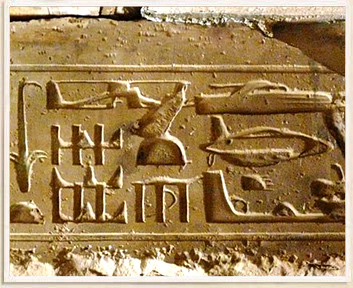
In the Temple of Seti I, there is a lintel—a heavy stone beam above a doorway—that has caused more arguments on the internet than almost any other image. Look at the photo above. Don’t squint. Just look.
What do you see?
On the left, that is a helicopter. A modern, rotor-bladed, tail-finned helicopter. It’s unmistakable. Next to it? That looks like a tank or a submarine. Above that? A dirigible or a spaceship.
These aren’t vague shapes. These are specific mechanical profiles.
The Mainstream Rebuttal: Palimpsest
This is where the battle gets heated. Egyptologists scream “Palimpsest!” every time this image comes up. It’s their shield.
Here is their explanation: Pharaoh Seti I started the temple. He had his royal titles carved into the stone. Then he died. His son, Ramesses II (the Great), took over. Ramesses, having a massive ego, decided to plaster over his dad’s name and carve his own titles on top. Over thousands of years, the plaster fell off. The two sets of hieroglyphs—the old ones and the new ones—merged together.
They claim it’s a visual accident. A “typo” in stone.
They say the “helicopter” is just the result of the name “Who repulses the Nine Bows” overlapping with the title “Who protects Egypt and overthrows the foreign countries.”
Why the “accident” theory fails the smell test
It’s a convenient explanation. Too convenient. Consider the odds. Out of millions of hieroglyphs in Egypt, out of acres of carved wall space, these specific overlaps just happened to create a perfect profile of a 20th-century attack helicopter? And a tank? And a plane?
All right next to each other?
The statistical probability of that happening by random erosion and overlapping text is astronomical. It’s like throwing a bucket of Scrabble tiles on the floor and accidentally spelling out the entire text of the Declaration of Independence.
Furthermore, digital analysis suggests that the “overlap” theory requires some serious mental gymnastics to make the shapes fit. The curves of the helicopter blade are smooth and intentional. The tail rotor is distinct.
The Cargo Cult Theory
If it’s not an accident, what is it? Did the Egyptians have helicopters? Probably not. We would have found the rusted wreckage in the sand by now.
But did they see them?
There is a concept called a “Cargo Cult.” In World War II, island tribes in the Pacific saw American planes land and bring supplies. They didn’t know what the planes were or how they worked. They just knew they were powerful gods. So, they built wooden mock-ups of the planes to worship them.
What if the Egyptians were doing the same thing? What if they were recording objects they had seen? Perhaps from a civilization that existed before them? Or, if you want to get really wild, visitors from the future? Time travel? The possibilities make your head spin.
THE BIGGER PICTURE
We are taught a linear history. Cavemen -> Farmers -> Pyramids -> Romans -> Dark Ages -> Industrial Revolution -> Us. A straight line up.
But the Dendera Light, the Baghdad Battery, and the Abydos carvings scream that the line is jagged. It loops. It breaks.
Could it be that we are a species with amnesia? We know that the Library of Alexandria burned down, taking countless volumes of ancient knowledge with it. How much did we forget? Did the ancients understand acoustics, electricity, and machining in ways we are too arrogant to admit?
When you put these three anomalies together, a pattern emerges. They had the vessel (the battery). They had the application (the light). And they had the memory of machines (Abydos). We aren’t looking at magic. We are looking at the remnants of a science that was lost, buried under the sands of time, waiting for us to wipe off the dust and turn the switch back on.
Keep your eyes open. The truth is out there, but you won’t find it in a textbook.
READ MORE about the mysteries they don’t want you to solve.
Originally posted 2016-03-11 20:29:02. Republished by Blog Post Promoter
![Temple-of-Dendra-Egypt-light-lamp-carving[1]](https://coolinterestingnews.com/wp-content/uploads/2012/07/temple-of-dendra-egypt-light-lamp-carving1.webp)