Tuesday, June 9, 2026

Ancient nuclear war proof

Annihilation in the Indus Valley: The Atomic Bombing of Ancient Mohenjo-Daro?

History is written by the victors. We’re told that. But what if a history is so terrifying, so completely outside our understanding of the past, that there are no victors left to write it? What if the story is simply… erased?

We’re going to a place where the dust itself whispers of an impossible ending. A place where a civilization, as advanced as any in the ancient world, vanished in the blink of an eye. Forget what you learned in school about pottery and trade routes. We’re talking about a cold case that’s 4,000 years old. A mystery etched not in stone tablets, but in melted rock and radioactive bone.

This is the story of Mohenjo-Daro. And a final day so horrific, it sounds less like archaeology and more like a warning from the past.

Unearthing a Ghost World

Imagine it’s the 1920s. Colonial India. Archaeologists are digging in the dusty plains of what is now Pakistan. They expect to find pottery. Maybe some small ruins. Instead, they stumble upon something staggering.

A city. Not just any city. A masterpiece of urban planning that would make a modern engineer weep. This was Mohenjo-Daro, the jewel of the Indus Valley Civilization. A metropolis of brick, laid out in a perfect grid. It had a complex sewer system, public baths, multi-story homes, and a population of thousands. These people weren’t primitive. They were brilliant.

For decades, the world marveled at the sophistication. At the trade, the art, the organization. But as the digging went deeper, a much darker picture began to emerge. A picture that didn’t fit the neat and tidy timeline of human progress. As excavators reached the original street level, they didn’t just find pots. They found people.

A Snapshot of Terror, Frozen in Time

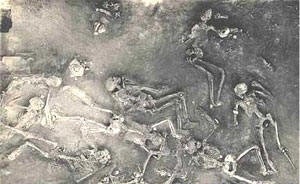
This wasn’t a graveyard. It wasn’t a tomb. The skeletons were scattered all over the city. Sprawled in the streets. Lounging in death as if some instant, horrifying doom had descended upon them from the sky.

They were just… left there. Lying unburied in the open.

20131118-164906.webp

The official digs uncovered 44 of these souls, frozen at the moment of their obliteration. The scene is chilling. A father, a mother, and their child found flattened on the pavement, face down. Their arms were outstretched, still holding hands after four millennia. A final, futile gesture of comfort against an unimaginable force.

What could do this? What kind of event happens so fast that people can’t even get inside? So total that there’s no one left to bury the dead?

The questions get stranger. The bodies showed no signs of being eaten by wild animals. They didn’t even seem to decay in the normal way. They were preserved by something else. And here’s the kicker: there was no apparent cause of a physically violent death. No sword marks. No crushed skulls from falling buildings. Just… death. Instant and absolute. An entire city, silenced.

The Radioactive Smoking Gun

For years, this was just a grim puzzle. But then, a few brave researchers—the kind not afraid of academic ridicule—started looking at the evidence that everyone else was ignoring. The evidence that pointed to the unthinkable.

The skeletons are radioactive. Not just a little bit. They are among the most radioactive human remains ever found, with radiation levels comparable to the victims of Hiroshima and Nagasaki in 1945.

Let that sink in. These bones, thousands of years old, are sizzling with radiation on par with the birth of the atomic age.

The anomalies kept piling up. At one specific site, Soviet researchers who were allowed access to the ruins reportedly found a single skeleton that had a radioactive level 50 times greater than normal background radiation. Fifty times. That’s not an accident of geology. That’s a hot zone.

This one finding, often dismissed or buried in academic footnotes, throws a wrench into the entire accepted history of the world. It suggests that a power we thought we invented in the 20th century was unleashed on an unsuspecting population thousands of years ago.

The Glass Cities of Ancient India

The skeletons were the human cost. But what about the city itself? The physical evidence points to a blast of heat so intense it defies conventional explanation.

Mohenjo-Daro wasn’t the only city to suffer this fate. Archaeologists have found other sites in northern India that show signs of massive, high-temperature explosions. One such city, discovered between the Ganges River and the Rajmahal mountains, looks like it was put through a divine furnace.

Huge sections of the ancient city’s walls and foundations are fused together. They’re vitrified.

What is vitrification? It’s what happens when you subject rock or clay to heat so extreme—we’re talking thousands of degrees—that it melts and turns into a glass-like substance. You see this inside a nuclear blast crater. You do not see it from a normal house fire or even a pottery kiln.

The epicenter of the blast at Mohenjo-Daro seems to have flash-melted everything within a certain radius. The clay vessels, the bricks, the very foundations of the city were liquefied and then instantly re-solidified into glassy, bubbled stone. So what could generate that kind of heat?

The easy answer would be a volcano. But there is absolutely no indication of a volcanic eruption anywhere near Mohenjo-Daro or the other sites. No lava flows, no massive ash deposits. Nothing. The “intense heat” came from above, not from below.

When you eliminate the impossible, whatever remains, however improbable, must be the truth. With no volcano, the heat required to melt rock and irradiate skeletons points to one terrifying conclusion: an atomic blast or a weapon of similar, and currently unknown, power.

Deep Dive: The Mahabharata’s Forbidden Verses

This is where the story pivots from a strange archaeological find to something far grander and more terrifying. For those who say this is impossible, that ancient man couldn’t have this technology, we have to look at their own words. The ancient texts of India, specifically the epic poem The Mahabharata, don’t just hint at such a weapon. They describe it in bone-chilling detail.

The Mahabharata is one of the foundational texts of Hinduism. It’s a sprawling epic of gods, heroes, and a cataclysmic war. For centuries, it was read as mythology. As allegory. But what if it was history?

Consider this passage describing the use of a weapon called the Brahmastra:

“…(it was) a single projectile
Charged with all the power of the Universe.
An incandescent column of smoke and flame
As bright as the thousand suns
Rose in all its splendor…”

Sounds familiar, doesn’t it? A column of smoke and flame, bright as a thousand suns. J. Robert Oppenheimer, the father of the atomic bomb, famously quoted a different Hindu text upon seeing the first nuclear test, but he might as well have been reading from this passage. It’s a perfect description of a mushroom cloud.

The text continues to describe the after-effects:

“…it was an unknown weapon,
An iron thunderbolt,
A gigantic messenger of death,
Which reduced to ashes
The entire race of the Vrishnis and the Andhakas.”

It describes the effects on people with horrifying precision. Hair and nails falling out. Pottery breaking without cause. Food becoming contaminated. Birds falling from the sky. These are the classic, textbook symptoms of intense radiation poisoning and the shockwave from a nuclear blast.

Is this all a coincidence? A wild poetic fantasy that just happens to perfectly match the physics of a thermonuclear explosion thousands of years before it was “invented”? Or were the ancient poets simply chroniclers, writing down what they saw? A history of a war fought with weapons that could tear the fabric of the universe.

What Do the Gatekeepers of History Say?

Of course, mainstream archaeology has an answer for everything. They have to. Their entire worldview depends on a slow, linear progression of human history. The idea of a lost, high-tech age is a threat to the foundations of their discipline.

So, what’s their explanation for Mohenjo-Daro? It’s a mix of theories, all of them somehow less satisfying than the “impossible” one.

  • The Skeletons: They claim the skeletons were not all killed at once. They say they represent haphazard, hurried burials during a period of the city’s final decline. The “family holding hands,” they argue, is just a random placement of bones from different time periods. It’s an explanation that feels sterile, an attempt to strip the humanity and terror from the scene.
  • The Radioactivity: This is the big one they attack. The official line is that the claims of high radiation are unfounded, based on shoddy science from fringe authors like David Davenport. They say that no peer-reviewed study has ever confirmed these high radiation levels. But here’s the question: have they truly looked? Or have they simply refused to test for evidence they don’t want to find? It’s easy to find no evidence when you don’t run the right tests. The absence of proof is not proof of absence.
  • The Vitrification: The melted rock? Oh, that’s just melted pottery, they say. The result of intense fires in pottery kilns that got out of control. This explanation completely ignores the scale. We are not talking about a few melted pots. We are talking about fused masses of brick and foundation, something a simple kiln fire struggles to explain. They are explaining away a forest fire by pointing to a single matchbook.

The mainstream explanation is that the Indus Valley Civilization just sort of… faded away. Climate change. A river changing its course. Disease. Maybe an invasion from nomadic tribes with bronze-age weapons. These are all plausible factors in the decline of a civilization over centuries. They do not explain a city full of people who dropped dead in the street, their bones super-charged with radiation and their city melted into glass.

The Question That Changes Everything

So we are left at a crossroads. Two paths. Two histories of our world.

In one version, the story is simple. A city died out slowly. A few unburied bodies were found. Some researchers with overactive imaginations made up a story about bombs and radiation. It’s a neat, tidy, and boring explanation that preserves our comfortable timeline of progress.

In the other version, the story is terrifying. A brilliant civilization reached a level of technological power that we are only now beginning to understand. They harnessed the power of the atom, and like us, they used it to wage war. They unleashed hell on Earth, and in a flash of light brighter than a thousand suns, their cities, their people, and the very memory of their power were wiped from the face of the planet.

All that’s left are the whispers. The radioactive skeletons holding hands in the dust. The glassy stone that was once a mighty wall. And the ancient verses that read less like poetry and more like a user manual for a weapon of mass destruction.

What really happened in Mohenjo-Daro? The evidence is there, scattered in the dust for anyone brave enough to look. The story it tells might rewrite not just the past, but our understanding of the future. After all, if it happened once, who’s to say it can’t happen again?

Amit Ghosh
Amit Ghoshhttps://coolinterestingnews.com
Aloha, I'm Amit Ghosh, a web entrepreneur and avid blogger. Bitten by entrepreneurial bug, I got kicked out from college and ended up being millionaire and running a digital media company named Aeron7 headquartered at Lithuania.
RELATED ARTICLES
- Advertisment -

Most Popular

Recent Comments

Warren Pan Abbott on The legend of the Devil Monkey !
chris davies on The McPherson Tape Mystery
Reed Reedly on ET has Internet!
Bea Houseoffashion on Proof Of Time Travellers – Gallery
Marcus2012 on ET has Internet!
Reed Reedly on ET has Internet!
LaughsAtConspiracyNuts on The 9/11 Conspiracy – Myths and Facts
Alex Sliverman on Did the ancients fly?
Doctor Wholigan on Time Traveler in 1938 film
chris davies on The McPherson Tape Mystery
Archie1954 on 10 secret UFO hideouts
chris davies on Ghosts of flight 401
Marcus2012 on ET has Internet!
jason Macdonald on Proof of Time Travel? – China
chris davies on Long-Lost Pyramids Found?
Reed Reedly on ET has Internet!
Milkman on Connected Universe
Tenmiles on Baigong Pipes Mystery
Simon Foster on Sirius – The Documentary
From the 1st April on 2013 – Alien Contact date ?
SkyWatcher on Is ET ignoring us?
I Come From The Future on Obama to make UFO Alien disclouser soon ?
Just another person on 2013 – Alien Contact date ?
Malcolm Windowcleaner on The strange case of Rudolph Fentz
Mason Servio on Strange Things on Mars
Marke Wisdom Seeker on What will we find as arctic melts?
Andrea A Elisabeth Levyne on Aliens Captured in Varginha, Brazil
Mitch Grouyeki on Amazing Space Shuttle pictures