The Silent Architects: Did Extraterrestrials Build Our Ancient World?
Let’s get one thing straight. The history you learned in school is a story. It’s a nice, neat story with a beginning, a middle, and an end. But what if it’s just that? A story. A simplified, sanitized version of a past so bizarre, so profound, it would shatter our entire understanding of reality.
They tell us our ancestors were primitive. Grunting cavemen who stumbled out of the Stone Age, figured out farming, and then slowly, painstakingly, built civilizations with copper chisels and hemp ropes. It’s a good story. Simple. But it has holes. Big ones.
Holes so big you could fly a starship through them.
All across our planet, a silent testament stands against that simple story. It’s written in stone. Megalithic structures. Monuments so massive, so precise, so mathematically perfect that they defy explanation. And here’s the kicker: they’re everywhere. From the windswept plains of Europe to the high-altitude deserts of South America, from the fertile crescent to remote Pacific islands, the same impossible fingerprints are found.
Are these just coincidences? The random, independent achievements of disconnected tribes? Or are they echoes of a single, global project? A forgotten chapter of human history, orchestrated by architects who were not of this world?

The Global Pattern Mainstream Science Ignores
If ancient aliens visited Earth, the proof isn’t just in grainy UFO photos. It’s in the foundations of our oldest and most mysterious structures. Think about it. We see inexplicably similar building styles on continents separated by vast oceans, long before humanity supposedly had the means to cross them.
You have the Great Pyramid of Giza in Egypt, a mathematical marvel aligned almost perfectly with true north. Then you travel thousands of miles to Peru and find Sacsayhuamán, with its colossal, interlocking polygonal stones that fit together without a single drop of mortar. How?
You see precision-drilled holes in the hardest granite at both sites. You see stones weighing hundreds of tons lifted and placed with an accuracy we would struggle to replicate today, even with our most advanced cranes. Mainstream archaeology tells us it was done with ramps, rollers, and endless manpower. But does that really add up? Moving a 100-ton block is one thing. Lifting it hundreds of feet and placing it with millimeter precision is something else entirely.
Something is missing from the official explanation. The equation doesn’t balance. There’s a variable we’re not being told about.
Deep Dive: Göbekli Tepe, The Site That Breaks History
For decades, the story was simple: humans learned to farm, then they settled down, then they built temples. Cause and effect. But then, in the 1990s, an archaeologist digging in southeastern Turkey stumbled upon something that blew that entire timeline to pieces. Its name is Göbekli Tepe.
Get this: Göbekli Tepe is 12,000 years old.
Let that sink in. Twelve. Thousand. Years. That’s 7,000 years before the Pyramids. It’s 6,000 years before Stonehenge. This was a time when humans were supposed to be hunter-gatherers, living in small, nomadic bands, with no knowledge of writing, metal tools, or even pottery. Yet here, on this barren hilltop, they built the world’s first known temple complex.
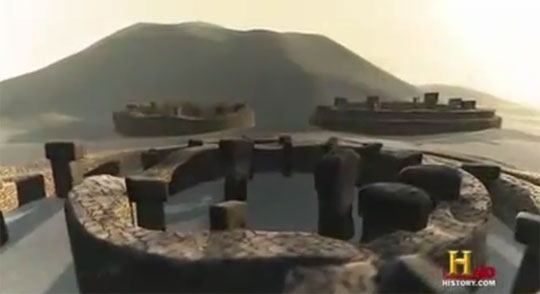
And it wasn’t some crude pile of rocks. Göbekli Tepe is a stunningly sophisticated series of circular enclosures, built around massive, T-shaped limestone pillars weighing up to 20 tons each. These pillars are covered in finely chiseled, high-relief carvings of animals: foxes, lions, snakes, and vultures. The artistry is breathtaking. The engineering is impossible for the supposed skill level of the people who built it.
How did a society of hunter-gatherers, without the wheel or beasts of burden, quarry, transport, and erect these monolithic pillars? Where did they get the complex astronomical knowledge often associated with the site’s layout? Some theorists have called it a “Noah’s Ark in stone,” a kind of catalogue of the world’s fauna. Why? Was it a warning? A message? A time capsule?
And then there’s the biggest mystery of all. After about a thousand years of use, the people who built Göbekli Tepe did something extraordinary. They deliberately and carefully buried the entire complex under tons of earth, preserving it perfectly for millennia. Why would they bury their own cathedral? Were they hiding it from someone… or something? Or were they preserving a sacred message for a future generation to find? A generation like ours.
Deep Dive: The Carnac Stones, An Ancient Cosmic Airport?
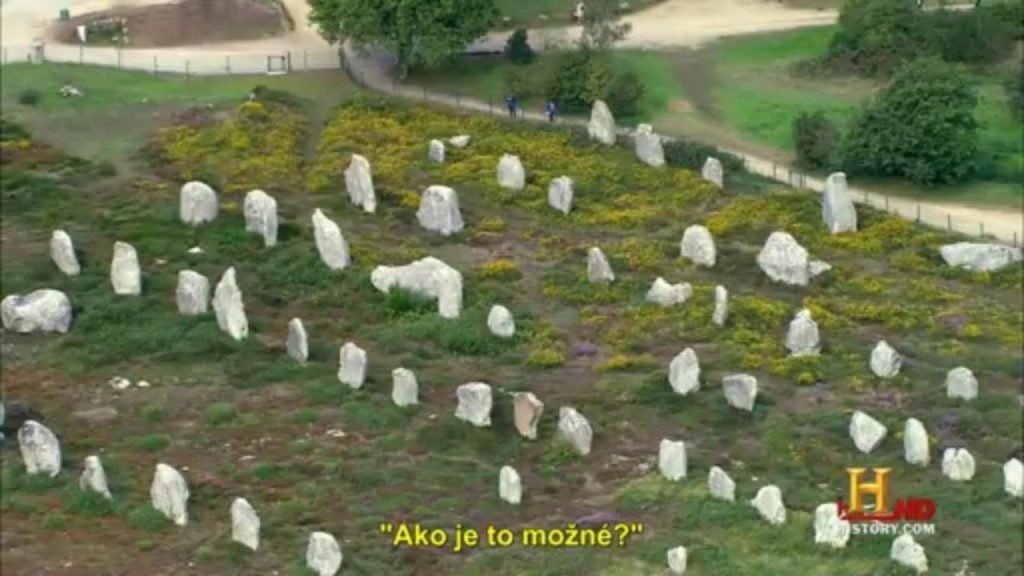
Now, let’s fly over to the coast of Brittany, France, to a place called Carnac. Here, you’ll find the largest collection of megalithic stones in the world. We’re not talking about a dozen stones. We’re talking about over 3,000 of them. Standing stones, or “menhirs,” arranged in mind-bogglingly perfect lines that stretch for nearly three miles.
Three. Miles.
The official story is that they are ancient burial sites or perhaps a complex lunar and solar calendar. And they certainly do have astronomical alignments. But the scale of it is just staggering. It feels like overkill for a simple calendar. Ancient astronaut theorists propose a much more radical idea: what if it wasn’t for looking at the sky, but for being seen *from* the sky?
Could the Carnac alignments have been a navigational system? A type of ancient GPS for flying machines? From the air, these massive, parallel lines would be unmistakable. They could have served as landing strips, guiding markers, or even a power grid of some kind, channeling Earth’s natural geomagnetic energies.
It sounds like science fiction, until you look at the sheer logistical nightmare of its construction. Who organized the labor to quarry and move 3,000 multi-ton stones? Why arrange them in these specific, long, and perfectly parallel lines? If it was just for ritual, wouldn’t a simple circle, like Stonehenge, have been enough? The design of Carnac implies function. A purpose built on a scale that seems more technological than religious.
The Impossible Precision of the Andes
High in the Bolivian Andes, at an altitude of 13,000 feet, lies the ruin of Puma Punku. It is, without a doubt, one of the most baffling archaeological sites on Earth. Forget rough-hewn blocks. What you find here looks less like a temple and more like the wreckage of a giant, futuristic machine.
The stones are made of andesite and diorite, two of the hardest types of rock on the planet, just shy of diamond on the Mohs scale of hardness. Yet they are cut with a precision that is simply astounding. We’re talking perfectly flat surfaces, razor-sharp right angles, and complex interlocking joints that would be a challenge for modern power tools, let alone the primitive tools available to the Tiwanaku culture who supposedly built it.

The famous “H-blocks” are the star of the show. They are all identical in dimension, as if they came off a factory assembly line. They have intricate grooves and drill holes that seem to serve no decorative purpose. It looks for all the world like they were designed to be modular components, pieces of a larger structure that were meant to be slotted together. Local legends say the site was built by giants, or that the gods moved the stones through the air with sound.
Are we supposed to believe that ancient people, with no written language, achieved this level of modular construction and stone-cutting precision? Or is Puma Punku the evidence we’ve been looking for? The shattered remains of a high-tech outpost, a landing platform, or a processing plant built by visitors with technology far beyond our own?
What Was the Purpose of These Grand Projects?
So, we have impossible structures, built with impossible technology, all over the world. This begs two massive questions: How did they do it, and why?
The “How”: Lost Arts or Alien Tech?
If we reject the “copper chisels and elbow grease” theory, what are the alternatives?
- Acoustic Levitation: Numerous ancient legends, from Tibet to South America, speak of using sound, chants, or specific frequencies to make massive stones weightless. Could our ancestors have mastered a form of sonic technology that we are only now beginning to rediscover?
- Geopolymer Concrete: Some researchers suggest that many “carved” stones, like those in the pyramids, weren’t carved at all. They were cast, using a kind of advanced, ancient concrete made from liquefied rock. This would explain the perfect fits and unusual chemical signatures found in some blocks.
- Direct Intervention: The simplest explanation is often the most profound. What if they didn’t use lost human technology? What if they used tools we can’t even imagine? Laser cutters, tractor beams, anti-gravity devices. The kind of tech you’d expect from a civilization capable of interstellar travel.
The “Why”: The Ultimate Question
This is where things get really interesting. If extraterrestrials helped build these sites, what was their endgame?
- Cosmic Beacons: Were these sites navigational aids, marking important locations on a galactic map? Energy hotspots? Or perhaps distress signals?
- Resource Extraction: Could Earth have been a simple mining outpost? These massive structures might have been power plants or processing facilities for rare minerals needed by an alien civilization.
- The Great Experiment: Perhaps we were part of a grand social or genetic experiment. These “gods” came down, kick-started human civilization, taught us the basics of mathematics, astronomy, and architecture, and then left, leaving these monuments as a kind of graduation present—or a test. A puzzle for their pupils to one day solve.
The Modern Cover-Up and The Great Awakening
For years, these ideas were dismissed as fringe nonsense. But the internet has changed everything. Communities on Reddit, YouTube, and countless blogs are now connecting the dots, sharing photos, and pointing out the glaring inconsistencies in the official narrative. The information is no longer controlled by a handful of academics.
It makes you wonder: is the resistance from mainstream archaeology simply intellectual stubbornness, or is it something more? Are they actively suppressing evidence that doesn’t fit? Is there a reason we are discouraged from asking these questions? Perhaps the truth is so destabilizing that the powers that be believe we can’t handle it.
The evidence is out there, presented in documentaries, books, and endless online discussions.
The final truth remains elusive, buried under thousands of years of sand and dogma. But the stones themselves don’t lie. They are silent. They are patient. They hold a secret about our true origins, a secret that challenges the very core of what it means to be human.
The official story is crumbling. The questions are getting louder. And the silent architects of our ancient past might not have been so silent after all. Their message is written across the globe for anyone willing to look up from their history books and see. The only question left is: are you brave enough to read it?
Originally posted 2013-08-07 19:22:33. Republished by Blog Post Promoter