Who are the Anunnakis?
Are the Anunnaki real? Are they aliens? Or are they part of a bigger picture?
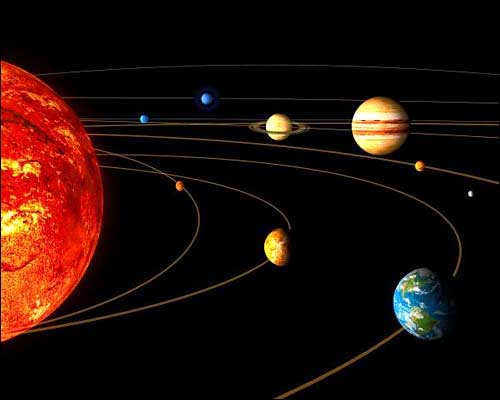
The “Anunnaki” are the major players in a paradigm making its way into popular folklore, via the work of the late Zecharia Sitchin, an economist by education and profession, and the author of several best-selling books, including Genesis Revisited, that explore ancient mythology and the mysterious megalithic ruins found around the globe. These various books also seek to demonstrate that there was in ancient times an extraterrestrial race that genetically manipulated mankind for various reasons. The Sitchin thesis (“Sitchinism”), now embraced by numerous other writers, who have incorporated it into what is apparently a new worldview, essentially asserts that these ancient Sumero-Babylonian gods, the Anunnaki, are aliens from the planet Nibiru (Sitchin’s “12th Planet”), which passes by the earth every 3,500 years or so, at which time they planet-hop to the earth and create mischief.
 Although the idea of the ancient gods being aliens may seem novel, the tendency to make the gods of old into “real people” or “flesh and blood” is not at all new, dating to before the time of the Greek historian Herodotus (5th c. BCE) and developed by the Greek philosopher Euhemeros or Evemeras (c. 300 BCE). This tendency is called, in fact, “euhemerism” or “evemerism,” which claims that the numerous gods of various cultures were not “mythical” but were in reality kings, queens, warriors and assorted heroes whose lives were turned into fairytales with the addition of miraculous details to their biographies. The current Anunnaki thesis is a modern version of evemerism, although it seeks to explain the miracles as not fabulous “additions” to the tales but genuine attributes of advanced extraterrestrials.
Unfortunately for those who would wish to see concrete evidence of such exciting notions as extraterrestrial visitation in Earth’s remote past, the Anunnaki will not be the place to look, as the true nature of these various gods and goddesses was already known long before the era of modern revisionism.
Ancient Astronaut Theory
The tireless researcher Charles Fort was widely known as the chronicler of what are now called “Forteana,” bizarre anomalies and mysteries that throw the current perception of reality on its ear, whether it be religious or scientific. In an attempt to explain these anomalies, which include weird stories or “myths” and enormous, astonishing ruins worldwide, a 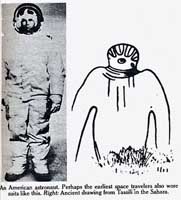 number of people, including Swiss writer Erich von Daniken and Zecharia Sitchin, have created the “ancient astronaut theory,” which dictates that alien visitors have been influencing human life for thousands if not millions of years, even to the point of genetic manipulation. von Daniken, it should be recalled, was one of the first moderns to put forth the ancient astronaut theory and was widely ridiculed and vilified for his observations. Because of Sitchin’s apparent scholastic training, he becomes more credible for many, even though he is one of those renegades not scholastically trained in his field. Furthermore, it should be noted that neither man came up with the ancient astronaut theory, which was largely developed by a German occultic society, for one, during the 19th century.
Supporters (“Sitchinites”) claim that Sitchin is one of the few people who read the Sumerian language and that because he can read Sumerian, he must be interpreting the data properly. The assertion that he is one of the few scholars of Sumerian is not true. Moreover, the idea that someone may be able to read a language and therefore can interpret its data properly is a specious argument, because the one certainly does not guarantee the other. Years before Sitchin, biblical and Dead Sea scrolls scholar John Allegro studied Sumerian intimately and came to very different conclusions: To wit, that many of the words revolved around sex and drugs. Hence, it is not the “mere” ability to read the Sumerian that will produce an accurate rendering of it.
Biblical Bias?
 Like so many other paradigms that make it into popular culture, the alien astronaut theory has been agenda-driven. In fact, it seems that the most recent attempt may be prompted by the same type of motivation that produced the Bible, a chronicle largely consisting of the plagiarized myths of other cultures that were reconstituted as “humans” of a particular ethnicity. It appears that the Anunnaki thesis has now led to the conclusion that, while the Bible is not infallible, its god Yahweh is valid and its various characters are the superhuman alien-hybrid progenitors of “the chosen.”
In reality, there was no reason to recreate the ancient gods as aliens or humans, because the ancients themselves were quite clear about what it was exactly they were worshipping and fancifully describing in epic poetry. The speculation is not needed, as, for example, the Sumero-Babylonians themselves said that the gods were the planets, not people, and that their stories were mythsrepresenting personifications of these bodies.
 It is believed that by “dismissing” the myths of the ancients asmyths, we are somehow robbing them of their “history.” This claim is ludicrous, as it is those who insist that there are no myths who are actually defaming the ancients. It seems as if everyone has already forgotten the work of the learned and esteemed mythologist Joseph Campbell. Campbell knew that major biblical tales, such as that of Moses and the Exodus, were mythical. In his book Occidental Mythology, following a discussion of the Bible, Campbell turns to the “Gods and Heroes of the European West,” and says, with apparent resentment:
“Fortunately, it will not be necessary to argue that Greek, Celtic or Germanic myths were mythological. The peoples themselves knew they were myths, and the European scholars discussing them have not been overborne by the idea of something uniquely holy about their topic.”
Perhaps mythology is simply not as exciting as the UFOlogical paradigm, whereby ancient astronauts were buzzing all over the place, being worshipped for their extraordinary capacities. However, the desire to see such a “history” often seems to be coming from exposure as a youth to comic books and sci-fi movies—and even the History Channel these days, featuring “Ancient Aliens” shows!
Astrotheology of the Ancients
The ancients were not the dark and dumb rabble commonly portrayed. They were, in fact, highly advanced. As such, they developed over a period of many thousands of years a complex astronomical/ astrological system that incorporated the movements and qualities of numerous celestial bodies, which could be called the “celestial mythos.” The celestial mythosis found around the globe in astonishing uniformity. In fact, it served as the manner by which life on Earth was ordered, as it contained information crucial to life, such as the movements and interrelationship of the sun and moon. Without the mythos, no people would have been able to become sea-faring, and planting and harvesting would have been difficult. And the mythos needed no alien intervention to be developed by humans, nor did it need moderns to come along and reinterpret it contrary to what its creators intended.
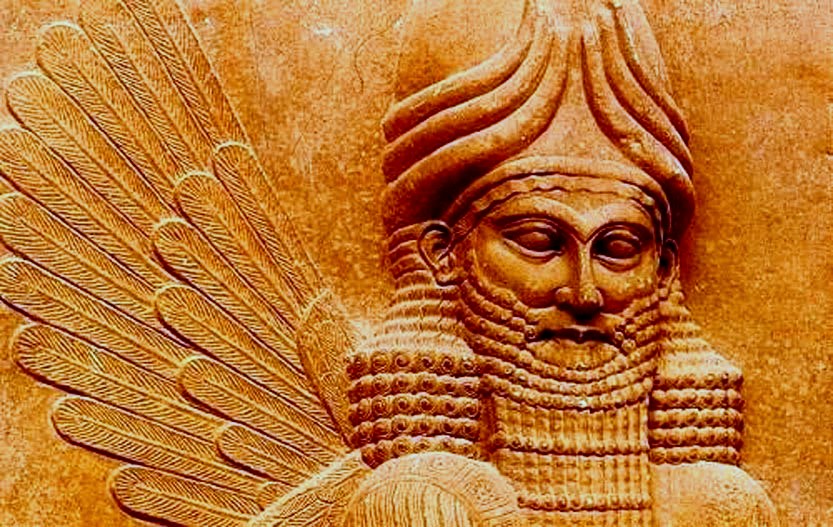
For example, the Anunnaki play a part in the mythos, but they are not “people,” human or otherwise. The Anunnaki, in general, represent the seven “nether spheres” and guardians of the seven “gates” through which the “sun of God” passes into the netherworld or darkness. They are also the “tutelary spirits of the earth.” So, immediately we encounter a problem which reveals that what Sitchin is putting forth is not what the ancients themselves said of the traditions they themselves 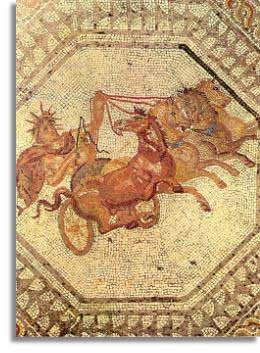 developed. Like so many before him, Sitchin also wants to make the main character of the celestial mythos, the sun, into a person. Actually, he wants to make it into several extraterrestrials. These various gods found around the globe, such as Apollo, Osiris, Horus, Krishna, Hercules, Jesus and Quetzalcoatl, are not people or aliens but personifications of the solar hero, as was stated by the peoples who created them. The ancients were not so dumb that they mistook planets for people, even though they personified those planets and, where the knowledge or gnosis of the mythos was lost, they hoped for “the incarnation,” or the carnalization or appearance of a “god.” There is no need to recreate the wheel here by speculating upon what the ancients “really” meant.
The Anunnaki and Assorted Other Characters
Contrary to popular belief, the Sumerian culture has been known for centuries and did not appear suddenly out of nowhere with the discovery of the cuneiform tablets found at Ur, capitol of Sumeria, for example. If anything, the tablets and others verified what we already knew about Sumeria from its inheritors, the Akkadians and Assyro-Babylonians. The Sumerians were not a lost civilization, except that their older physical remains such as at Ur had not been remembered through the ages but were rediscovered only in the mid-19th century. Their mythology and culture were fairly well preserved in the succeeding civilizations: For instance, some 300,000 tablets of the Babylonians have been found thus far, which include much commentary on their gods.
The main characters in the Sumero-Babylonian religion/mythology are Enlil/Ellil, Utu/Shamash, Marduk/Merodach, Gilgamesh, Nanna/Sin, Inanna/Ishtar, Ea/Enki and Dumuzi/Tammuz. A number of these deities are in the class called “Anunnaki” and/or “Igigi.” The Anunnaki are numbered variously: 7, 50 and 900.
None of these characters is a historical person, as, again, the Sumero-Babylonians correctly identified their own gods as being the “planets,” which, of course, included the sun and the moon to the ancients. Says the Catholic Encyclopedia regarding Babel:
“The storied tower of Birs Nimrud counts seven of these quadrangular platforms painted in seven colors, black, white, yellow, blue, scarlet, silver and gold, and in the same order sacred to the stellar gods, Adar (Saturn), Ishtar (Venus), Merodach (Jupiter), Nebo (Mercury), Nergal (Mars), Sin (the Moon), Shamash (the Sun).”
Enlil/Ellil/Bel
The “king of the Anunnaki,” Enlil is the storm/wind god, also essentially the same as the later Bel or Baal, the Canaanite sun god/solar hero. Enlil and Ninlil give birth to the moon god Nanna, “a major astral deity of the Sumerians,” who was called “Sin” in Babylonian. Sin is the same moon god encamped at Mt. Sinai, as well as worshipped at Ur and Harran, where purportedly lived the mythical Abraham, progenitor of the Hebrews, who “borrowed” many of their gods (Elohim) from Mesopotamia (and Canaan, Egypt, etc.). Obviously, neither the moon nor “his parents” are real persons/aliens; nor are the rest. Regarding Enlil/Bel, the Encyclopedia Britannica says:
“Bel
“(Akkadian), Sumerian Enlil, Mesopotamian god of the atmosphere and a member of the triad of gods completed by Anu (Sumerian An) and Ea (Enki). Enlil meant ‘Lord Wind’- both the hurricane and the gentle winds of spring were thought of as the breath issuing from his mouth, and eventually as his word or command [cf. Christian “logos” (John 1:1)]. He was sometimes called Lord of the Air.
“Although An was the highest god in the Sumerian pantheon, Enlil had a more important role: he embodied energy and force but not authority. Enlil’s cult centre was Nippur. Enlil was also the god of agriculture: the Myth of the Creation of the Hoe describes how he separated heaven and earth to make room for seeds to grow. He then invented the hoe and broke the hard crust of earth; men sprang forth from the hole. Another myth relates Enlil’s rape of his consort Ninlil (Akkadian Belit), a grain goddess, and his subsequent banishment to the underworld. This myth reflects the agricultural cycle of fertilization, ripening and winter inactivity.
“The name of his Akkadian counterpart, Bel, is derived from the Semitic word baal, or “lord.” Bel had all the attributes of Enlil, and his status and cult were much the same. Bel, however, gradually came to be thought of as the god of order and destiny. In Greek writings references to Bel indicate this Babylonian deity and not the Syrian god of Palmyra of the same name.”
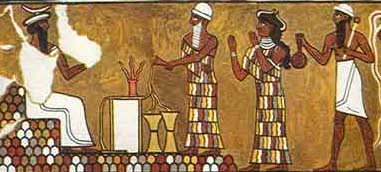
Although there were many Baalim, the singular Baal apparently came to represent the sun in the age of Taurus (c. 4500-2400 BCE), whence, it is said, comes the word “bull.”
Sin and Shamash
The moon god Sin is the father of Shamash, the Babylonian sun god, who was worshipped by the Israelites. Indeed, “sun” in Hebrew is “shamash.” The sun god Shamash was called the “sublime judge of the Anunnaki.”
Enki/Ea
The “commander of the Anunnaki” and son of Enki/Ea, the god of “the waters” (cf. Gen. 1:1), was Marduk, or Merodach, who is apparently the Mordecai of the biblical book of Esther (Ishtar). Also called a “king of the Igigi,” Marduk was the supreme Babylonian god and often represented Jupiter, although as “Bel-Marduk” he incorporated aspects of the sun god as well and was considered as such at a late period in his worship.
One of Marduk’s 50 names was “Nibiru” or “Nebiru,” in which Robert Temple in The Sirius Mystery sees the Egyptian term “Neb-Heru,” meaning “Lord of the sun.” The god Horus or “Heru” is indeed largely a sun god, depicted as a hawk with wings outstretched and the solar orb on his head.
Rather than representing the “12th planet,” the description of Nibiru in the Enuma Elish does indeed seem to depict the personification of the 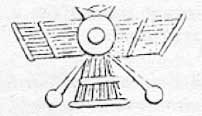 sun and its “exploits.” “Nebo” was the Babylonian version of “Moses,” actually a solar hero, and Nibiru, in fact, is represented by a winged disc, a common motif depicting the sun. According to the consensus of astronomers worldwide, both amateur and professional, there is no evidence for the 12th planet/Nibiru as Sitchin presents it. (In other words, “Planet X” is not a known, astronomical reality.)
Gilgamesh
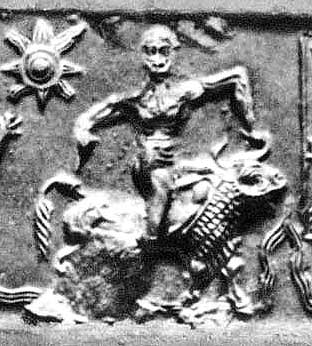 The demigod/hero Gilgamesh is depicted as wrestling the “celestial bull,” said to represent the sign of the age of Taurus and is similar to the motif of the Perso-Roman sun god Mithra slaying the bull. In mourning the death of Enki, Gilgamesh “goes to the mountains of Mashu and passes by the guardian scorpion-demons into the darkness.” Mt. Mashu was where “every evening the sun sought repose.” Per Robert Temple, “Mashu” may be derived from an Egyptian term meaning, “Behold, the sun.” Like “Moses,” derived from mashah in Hebrew (Strong’s h3871), “Mashu” is apparently related to “Shamash” and represents the sun. The “scorpion-demons” or scorpion-men are evidently the stars in the constellation of Scorpio, in the darkness of the night sky. Gilgamesh has also been associated with the Egyptian sun god Osiris, as has the biblical “Nimrod” or “Nemrod.” The Catholic Encyclopedia (CE) states:
“Gilgamesh, whom mythology transformed into a Babylonian Hercules [the Greek solar hero], whose fortunes are described in the Gilgamesh-epos, would then be the person designated by the Biblical Nemrod. Others again see in Nemrod an intentional corruption of Amarudu, the Akkadian for Marduk, whom the Babylonians worshiped as the great God…” (“Babylonia”)
Inanna/Ishtar
One of the “seven who decreed the fates,” Inanna/Ishtar was the 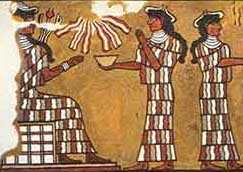 Goddess, alternately Venus, the moon, the constellation of Virgo, the earth, etc. Ishtar was “Astarte” in Phoenicia, and, as Frazer says in The Worship of Nature, “Her Phoenician worshippers identified her with the Moon…” Like the Greek god of the underworld, Hades, who allowed his beloved Persephone to return to the surface in order to create spring, Inanna was the creator of seasons, as she is depicted permitting the solar-fertility god Dumuzi/Tammuz to remain in the underworld for only six months out of the year.
Dumuzi/Tammuz
One of the lesser Anunnaki, the “shepherd god” Tammuz was worshipped also in Jerusalem, per the book of Ezekiel (8:14). As the Babylonian records state concerning their “garden of Eden” or “Edina,” of Eridu: “a dark vine grew; it was made a glorious place, planted beside the abyss. In the glorious house, which is like a forest, its shadow extends; no man enters its midst. In its interior is the Sun-god Tammuz. Between the mouths of the rivers, which are on both sides.” (CE “Babylonia”)
The Netherworld Seven
In the Epic of Gilgamesh, the Anunnaki appear thus:
“The Flood: Nergal pull down the dams of the nether waters, Ninurta the war lord threw down the dykes, and the SEVEN judges of hell, THE ANUNNAKI, raised their torches lighting the land with their vivid fire.”
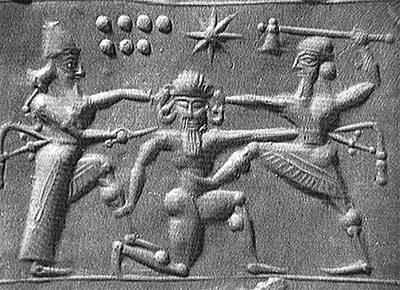 The “nether waters” represent the heavens, and the Anunnaki were called “the fates” and light-bearers of the night sky. They were the “seven judges of hell” and “seven nether spheres,” as Barbara G. Walker relates in her entry on Mary Magdalene (The Woman’s Encyclopedia, 614):
“The seven ‘devils’ exorcised from Mary Magdalene seem to have been the seven Maskim, or Anunnaki, Sumero-Akkadian spirits of the seven nether spheres, born of the goddess Mari. Their multiple birth was represented in her sacred dramas, which may account for their alleged emergence from Mary Magdalene. An Akkadian tablet said of them, ‘They are seven! In the depths of the ocean, they are seven! In the brilliance of the heavens, they are seven! They proceed from the ocean depths [Maria] from the hidden retreat!”
Walker also relates, in The Woman’s Dictionary of Symbols and Sacred Objects, 13:
“A generally accepted view of the universe in antiquity was the doctrine of the planetary spheres, conceived as great crystal domes or inverted bowls nested inside one another over the earth, turning independently of one another at various rates, and emitting the ‘music of the spheres’ with their motions. The theory was evolved to explain the apparently erratic movement of planets against the background of the fixed stars. Reading from the innermost sphere outward, arranging them according to the days of the week, they were the spheres of the moon, Mars, Mercury, Jupiter, Venus, Saturn, and the sun. Outermost was the eight sphere, the Empyrean, the home of fixed spheres and the ultimate God: the highest heaven.
“As a corollary to this theory, it was also assumed that there were seven nether spheres descending under the earth: the ‘seven hells’ to which Dumuzi and Inanna (or Tammuz and Ishtar) journeyed; whose seven gates were guarded by the seven Anunnaki or Maskim, the nether counterparts of the planetary spirits. According to an Akkadian magic tablet, ‘They proceed from the ocean depths, from the hidden retreat.’ From the ancient idea of the seven nether spheres, Dante took his vision of the descending circles of hell.’
“Early Christians taught that each human soul descends from heaven, picking up one of the seven deadly sins from each planetary sphere along the way: lust from Venus, anger from Mars, and so on. After death, the soul returned to the highest heaven, shedding the same sins one by one, while passing the ‘innkeeper’ of the spheres – providing, of course, that the soul was Christianized and therefore properly enlightened.”
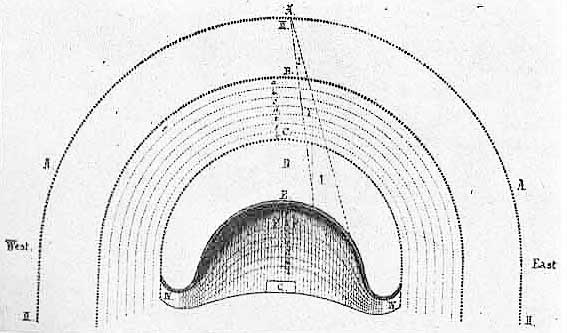
When we study what the ancients said about them, we discover that the Anunnaki, et al., are part of the celestial mythos, not “aliens.” Here the Anunnaki are the “seven nether spheres” or mirror images of the seven “planets.” These seven judges are a common mythical motif, also found in Slavic/Serbian mythology, for example, where they are clearly identified as the planets:
“Among the Serbs the Sun was a young and handsome king. He lived in a kingdom of light and sat on a throne of gold and purple. At his side stood two beautiful virgins, Aurora of the Morning and Aurora of the Evening, seven judges (the planets) and seven ‘messengers’ who flew across the universe in the guise of ‘stars with tails’ (comets). Also present was the Sun’s ‘bald uncle, old Myesyats’ (or the moon).” New Larousse Encyclopedia of Mythology, 284
As we can see, the reality of this issue is much more colorful and luminous than a group of bizarre aliens terrorizing cavemen. This information is what the ancients themselves wrote. They did not write, “And so the Anunnaki were sky people from another planet who landed here and mated with humans, etc.” In fact, “Anunnaki” is a generic term for gods, especially secondary gods, and means “gods of heaven and earth,” not “those who from heaven to earth came.” “An” or “Anu” means “sky” and represents the name of the “god of heaven,” while “Ki” means “earth” and is the name of the earth goddess.
The Host of Heaven and Sons of God
As noted, the Anunnaki were numbered 900 as well, some of whom apparently represented the stars, i.e., the zodiac, or “heavenly host,” as worshipped by the Canaanites and Hebrews. In this regard, Benson writes in The History of God From Abraham to Moses:
“The Anunnaki were analogous to the ‘host of heaven’ of the Hebrews. Marduk allotted portions to the Anunnaki: ‘To the Anunnaki of heaven and earth [Marduk] had allotted their portions.’ Likewise, the Canaanite-Hebrew god El Elyon allotted portions to his sons: ‘When the Most High [Heb. Elyon] gave to the nations their inheritance, when he separated the sons of men, he fixed the bounds of the peoples according to the number of the sons of God. For the LORDs portion is his people, Jacob [Israel] his allotted heritage.’ (Deuteronomy 32:8-9 RSV) These ‘sons of God’ in the following verse are also called the ‘host of heaven,’ to whom God divided to all the nations: ‘And lest you lift up your eyes to heaven, and when you see…all the host of heaven…which the LORD your God has divided to all nations under the whole heaven.’ (Deuteronomy 4:19 KJV) These gods were secondary gods: ‘For the LORD your God is God of gods, and Lord of lords…’ (Deuteronomy 10:17 KJV) ‘O give thanks to the God of gods…’ (Psalm 136:2 KJV)”
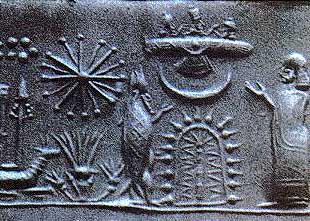
Yahweh
Also, the biblical god Yahweh is not a person, alien or otherwise. “He” too is in large part a solar myth. Regarding Yahweh, the Catholic Encyclopedia says:
“It seems likely that the name of Ea, or Ya, or Aa, the oldest god of the Babylonian Pantheon, is connected with the name Jahve, Jahu, or Ja, of the Old Testament.”
The Babylonian “Ea” is equivalent to Enlil, whom, as we have seen, is a sun god.
(The following regarding Yahweh is an excerpt from The Christ Conspiracy: The Greatest Story Ever Sold .)
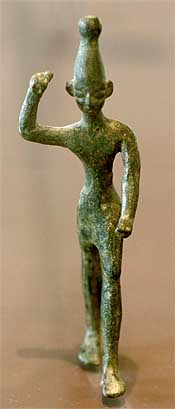 Prior to being labeled Yahweh, the Israelite god was called “Baal.” signifying the sun in the Age of Taurus. When the sun passed into Aries, “the Lord’s” name was changed to the Egyptian Iao, which became YHWH, IEUE, Yahweh, Jahweh, Jehovah and Jah. This ancient name “IAO/Iao” represents the totality of “God,” as the “I” symbolizes unity, the “a” is the “alpha” or beginning, while the “o” is the “omega” or end.
In fact, the name Yahweh, Iao or any number of variants thereof can be found in several cultures:
“In Phoenicia the Sun was known as Adonis…identical with Iao, or, according to the Chinese faith, Yao (Jehovah), the Sun, who makes his appearance in the world ‘at midnight of the twenty-fourth day of the twelfth month.'”
YHWH/IEUE was additionally the Egyptian sun god Ra:
“Ra was the father in heaven, who has the title of ‘Huhi’ the eternal, from which the Hebrews derived the name ‘Ihuh.'”
Thus, the tetragrammaton or sacred name of God IAO/IEUE/YHWH is very old, pre-Israelite, and can be etymologically linked to numerous gods, even to “Jesus,” or “Yahushua,” whose name means “salvation” or “Iao/YHWH saves.”
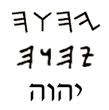 Yahweh had yet another aspect to “his” persona, as at some early stage the “sacred tetragrammaton” of “God” was bi-gendered. As Walker states:
“Jewish mystical tradition viewed the original Jehovah as an androgyne, his/her name compounded as Jah (jod) and the pre-Hebraic name of Eve, Havah or Hawah, rendered he-vau-he- in Hebrew letters. The four letters together made the sacred tetragrammaton, YHWH, the secret name of God…. The Bible contains many plagiarized excerpts from earlier hymns and prayers to Ishtar and other Goddess figures, with the name of Yahweh substituted for that of the female deity.”
Thus, even Yahweh was at one time plural, but “he” eventually became an all-male, sky god. This singular Yahweh was a warrior god, representing the sun in Aries, which is ruled by the warlike Mars and symbolized by the Ram-the same symbolic ram “caught in a thicket” near Abraham and used by him as a replacement sacrifice for his son Isaac. This warrior god Yahweh was not only Jealous but Zealous, as his name is rendered in Young’s Literal Translation:
“…for ye do not bow yourselves to another god-for Jehovah, whose name [is] Zealous, is a zealous God.” (Exodus 34:14)
In fact, the same word in Hebrew is used for both jealous and zealous, although it is transliterated differently, “qanna” being jealous and “qana,” zealous. As El Elyon was but one of the Canaanite Elohim, the Most High God, so was “Yahweh,” as “El Qanna,” the Jealous/Zealous God, which is why in the Old Testament he keeps sticking his nose in and shouting at everyone. The title “Jealous/Zealous” is also appropriate for a god represented by a volcano, as was Yahweh by the smoky and fiery Mt. Sinai. Hence, Yahweh’s followers themselves were intolerant and hotheaded zealots.
Conclusion
There was in reality never any need for sci-fi explanation or speculation as to these various figures and their stories. Nor was there a need to take the Bible as a literal, historical document. Indeed, the behind-the-scenes elite have known the allegorical, mythical and astrological nature of the Bible and its characters from the beginning.
It is evident that the ancients recording these myths were in fact often smarter than they are given credit for by modern critics and researchers. They knew the difference between planets and people/aliens. The architecture, 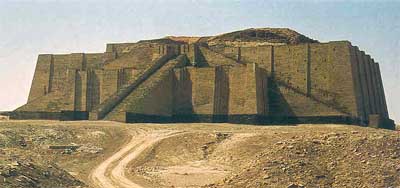 art, writings and traditions of these various ancient cultures, including Sumero-Babylon, India, Egypt, Chaldea, Phoenicia, Canaan, etc., show an advanced degree of civilization surpassing that which followed it. Such later degradation is particularly true when it comes to biblical peoples. The Bible, in fact, represents a dumbed-down version of the mythology of the aforementioned cultures. In reality, in terms of cosmic knowledge, in many important ways modern man has devolved. One of the major problems is the compulsive and irrational historicization and vulgarization of the planetary bodies and of the celestial mythos and ritual, a body of knowledge and wisdom concerning the cosmos and specifically the solar system, which filled the ancients with awe and reverence. This mythos and ritual is found worldwide, reflecting a global culture in ancient times. This body of knowledge is discovered in stone and story all over the world, reflected in the mysterious megalithic ruins.
To reduce this glory to a band of aliens and/or humans is a serious mistake, as it robs the ancients of intelligence and wisdom, among other things, including the quality of humanity itself. Furthermore, part of the brainwashing to get people to accept the story of Jesus Christ, for example—which is significantly the story of the sun—was to make “myths” appear to be foolish stories with no basis in reality. This mental programming or “meme” has been displayed abundantly, but the fact is that myths are not mere fantasies and hallucinations. They are stories designed to pass along vital information from generation to generation. It is easier to remember the “exploits” of the sun, moon and stars, for example, when they are personified and told in a fun story than when presented in a dry dissertation. It is only when the knowledge, or gnosis, has been lost that humans start believing these entities to be real people —and the gnosis was very effectively driven underground by organized religion, such that it was lost to the masses, who now must piece it together, often coming up with erroneous and inaccurate interpretations with occasional hits now and then.