Home Weird World Strange Places Amazing Yosemite ‘firefall’

Amazing Yosemite ‘firefall’

0
64

The Lost Firefall of Yosemite: A Buried History of Man-Made Fire and Natural Magic

What if I told you that for nearly a hundred years, a river of fire poured from the cliffs of Yosemite every single night? Not a metaphor. Not a trick of the light. A literal cascade of burning, glowing, white-hot embers, pushed over the edge of a 3,000-foot granite cliff to the astonishment of thousands below.

It sounds like a fantasy. A forgotten myth.

But it was real.

This was the original Yosemite Firefall, a spectacle so grand and so dangerous it feels impossible by today’s standards. It was a nightly ritual that defined the park for generations, only to be extinguished in a cloud of controversy and suspicion. And then, decades later, nature decided to create its own version, a phantom echo of the past that appears for only a few fleeting moments each year. The story of the two firefalls is a story about us, about our relationship with the wild, and about a secret history hidden in plain sight.

A Volcano on Command: The Birth of a Legend

The year is 1872. Yosemite is still a raw, untamed frontier, a place of staggering beauty and genuine peril. At the top of the colossal Glacier Point, a man named James McCauley built a small hotel, the Glacier Point Mountain House. To attract visitors, he needed more than just a view. He needed a show.

His nightly routine was simple. And insane. He’d build a massive bonfire near the cliff’s edge. As the flames died down, leaving a mountain of glowing embers, he would entertain his guests. Then, at the appointed time, he would simply kick the entire pile of burning coals over the precipice.

What started as a simple campfire stunt for a few hotel guests quickly morphed into something else entirely. Down in the valley, campers and visitors saw what looked like a molten waterfall erupting from the sky. The legend was born.

By the turn of the century, the practice had been taken over by the Curry Company, operators of the popular Camp Curry in the valley below. The Firefall became a formalized, nightly performance. Each evening, a massive bonfire of red fir bark was built at Glacier Point. The bark was perfect; it burned down into a bed of uniform, long-lasting embers. Then, down in the valley, the show would begin. An announcer would engage in a call-and-response with a man stationed high above at the point.

The crowd would fall silent. A voice would echo from above: “Hello, Camp Curry!”

The announcer below would shout back: “Hello, Glacier Point!”

After a few exchanges, the moment everyone was waiting for would arrive. David Curry, the founder of Camp Curry, would stand at the base of the fall and bellow the now-immortal words: “Let the fire fall!”

And it did. High above, workers would begin pushing the colossal bed of embers over the cliff with long-handled steel pushers. For ten to fifteen minutes, a silent, glittering cascade of orange and red would pour through the darkness. It didn’t roar like a waterfall. It didn’t crash. It just… fell. A silent, mesmerizing river of sparks that seemed to defy all logic, painting the granite face of the cliff in impossible colors.

firefall

It became the single most famous attraction in Yosemite. More than the falls. More than the giant trees. People planned their entire cross-country trips around seeing this man-made volcano. It was performed at 9 p.m. every single night during the summer, a guaranteed spectacle that capped off a day of natural wonder with a dose of pure, unadulterated showmanship.

The Party’s Over: Why the Fire Really Fell for the Last Time

For 96 years, the fire fell. Then, in January 1968, the National Park Service (NPS) did the unthinkable. They banned it. Forever.

The world was shocked. Why would they kill their most popular attraction? The reasons given were logical. Almost too logical.

The Official Story: A Park Under Siege

The official line from the NPS was twofold. First, the Firefall was an artificial event. It had nothing to do with the natural state of Yosemite Valley, which the Park Service was now committed to preserving. The era of taming the wilderness for human amusement was over. The new philosophy, driven by a growing environmental movement, was to let nature be nature.

The second reason was more practical. The Firefall was just too popular. Every summer night, massive traffic jams would clog the valley roads as thousands of cars streamed in to get a good viewing spot. Huge crowds would gather in El Capitan Meadow, trampling the delicate grasses and eroding the soil. The park was being loved to death. Ending the Firefall was, in their view, a painful but necessary move to save the valley from its own admirers.

These reasons make sense. They are responsible. But for many, they didn’t quite add up. Something felt missing.

A Coincidence Too Perfect? The Mystery of the Glacier Point Hotel

Here’s where the story gets strange. One year after the final Firefall, in the summer of 1969, the historic Glacier Point Hotel—the very building that birthed the Firefall and served as its command center—burned to the ground in an electrical fire. The entire structure was a total loss.

And the National Park Service simply… never rebuilt it.

Think about that. The Firefall, the hotel’s main draw, is shut down. The hotel’s profitability plummets. A year later, it conveniently burns down. And the Park Service, which now owned the building, decides to just clear the rubble and leave an empty plateau.

Was it just a tragic coincidence? Or was there more to the story? Internet forums and alternative history buffs have whispered about it for years. Did someone, angry about the Firefall’s end, commit an act of protest? Was it an inside job, a way to collect insurance on an obsolete building and neatly erase a piece of history that no longer fit the NPS’s “natural” vision for the park?

We’ll likely never know for sure. The official report is clear: accidental fire. But the timing is so perfect, so narratively convenient, that it leaves a lingering question mark hanging over Glacier Point. The place where men once commanded fire is now just a scenic overlook, its fiery secret all but forgotten.

Nature’s Ghost: The Firefall Reborn

The man-made Firefall was dead. For decades, the name itself was just a memory, a story old-timers would tell to wide-eyed kids. But then, something amazing happened. Nature, it seems, wasn’t done with the show.

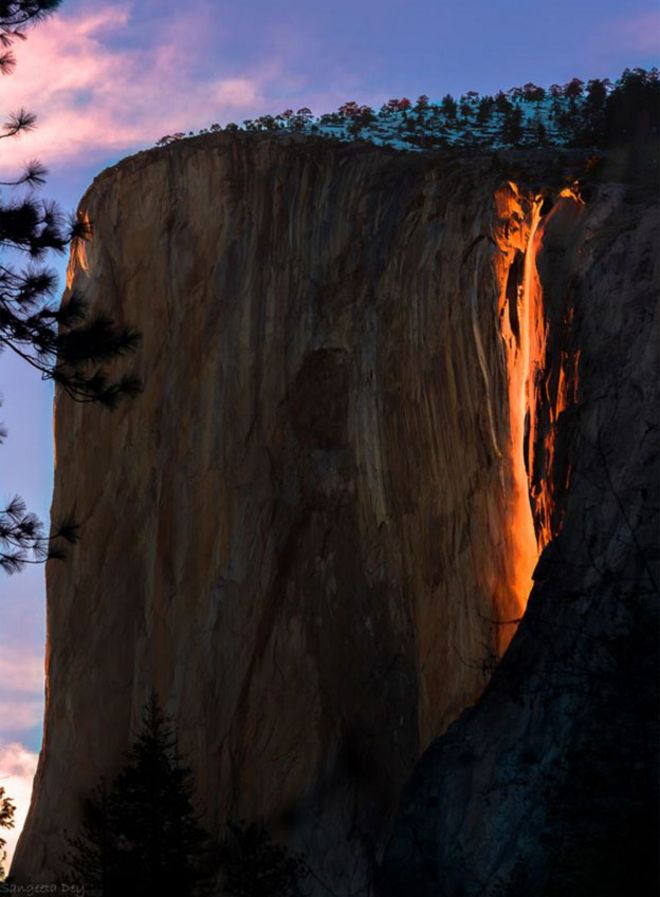
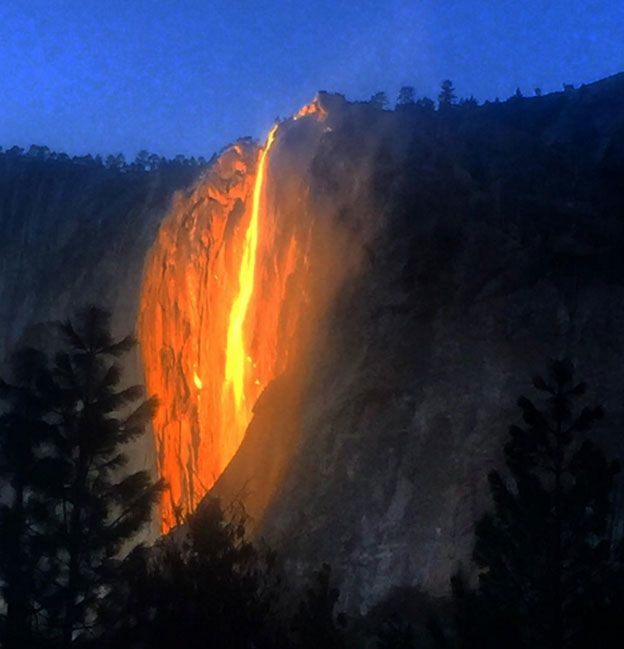
Photographers in the 1970s started noticing a strange and beautiful phenomenon. For a very specific, very short window in mid-to-late February, a small, seasonal waterfall on the eastern face of El Capitan would suddenly catch the last rays of the setting sun. For about ten minutes, if the conditions were absolutely perfect, the water would light up with a fiery, molten orange glow. It looked, for all the world, like a stream of lava pouring down the granite cliff.

They needed a name for it. The choice was obvious. They called it the Firefall.

This new Firefall, located on what is officially known as Horsetail Fall, is the complete opposite of its predecessor. The original was a guaranteed, nightly spectacle of brute force. The new one is a fleeting, ephemeral gift of incredible delicacy.

firefall 1

Deep Dive: The Cosmic Alignment Behind Horsetail Fall

Seeing the natural Firefall isn’t easy. A whole series of cosmic and meteorological events have to align perfectly. It’s a photographer’s ultimate challenge.

  • First, you need water. Horsetail Fall is a temporary waterfall, fed entirely by the snowmelt from the top of El Capitan. If there hasn’t been enough snow during the winter, or if it’s too cold in February for it to melt, the waterfall simply won’t be flowing. No water, no show.
  • Second, you need a clear sky. The effect is caused by the setting sun hitting the water at a very precise angle. Even a single small cloud on the western horizon can block the light at the critical moment, and the waterfall will remain in shadow. The entire event is ruined.
  • Third, you need the right time. The geometry of the sun’s position relative to the valley only works for a couple of weeks in February. Come too early or too late, and the angle will be wrong.

When it all comes together, it’s pure magic. Unlike the chaotic spray of embers from the original, this Firefall is a focused, silent ribbon of light. It’s a natural illusion that feels more profound, more special, precisely because it is so rare and unpredictable.

A Legacy of Fire and Crowds

In a strange twist of irony, the natural Firefall has created the very problem that killed the original. In recent years, social media has turned this once-obscure event into a global phenomenon. Now, every February, thousands of photographers and tourists descend on the valley, creating massive traffic jams and crowding the riverbanks. Sound familiar?

The Park Service has been forced to implement strict restrictions, creating designated viewing areas and requiring permits on the busiest days. History is repeating itself. It seems that whether the fire is man-made or natural, our desire to witness it is so powerful that we risk destroying the very place that creates the magic.

What did we lose when the last embers of the original Firefall winked out in 1968? We lost a piece of our audacious, showy, sometimes-foolish history. We lost a connection to a time when national parks were seen as stages for human entertainment. But what we gained, in its place, is something quieter and perhaps more meaningful. A spectacle not of our own making, but one we are lucky to witness at all.

One was a loud, nightly roar of human ingenuity. The other is a silent, yearly whisper from the universe. Both are called the Firefall. Both tell the incredible story of Yosemite, a place of stone, water, and fire.

Originally posted 2016-03-14 21:34:31. Republished by Blog Post Promoter