Hold Everything: Is That Actually a Living Creature on the Red Planet?
Mars. The Red Planet. For decades, the official story has been consistent, boring, and remarkably dry. We are told it is a desolate wasteland. A frozen desert. A place where the only movement comes from dust devils and the slow, mechanical crunch of rover wheels over rusty rocks. But what if that story is wrong? What if the narrative we’ve been fed is just a thin veil covering a much wilder, much more shocking reality?
Stop scrolling for a second. Look closely.
Every now and then, an image slips through the cracks. A photo comes down from the millions of gigabytes of data transmitted by NASA’s rovers—Curiosity, Opportunity, Spirit—and it stops internet sleuths dead in their tracks. We aren’t talking about a weird shadow or a smudge on the lens. We are talking about shapes that scream “biology.”
One specific sighting has refused to die. It keeps resurfacing on forums, Reddit threads, and conspiracy boards. It’s the “Gorilla on Mars.” And once you see it, you cannot unsee it.

The Discovery That Broke the Internet
Let’s set the scene. The internet is a massive, chaotic place, but few corners are as dedicated and obsessive as the UFO research community. Enter UFO Sightings Daily, a hub for the weird and the unexplained. This isn’t just a hobby blog; it’s a repository of things that shouldn’t exist. A report originally posted there, and later picked up by outlets like The Canadian, dropped a bombshell that challenges everything we think we know about our celestial neighbor.
The claim? Life. Actual, complex, biological life. Not microbes. Not bacteria. A beast.
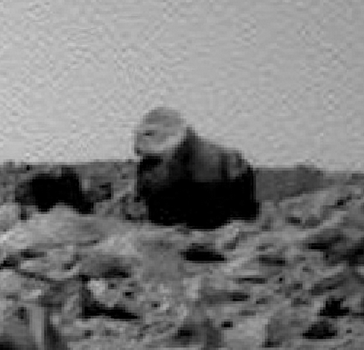
The report highlights a startling find from the official NASA archives. In a panoramic shot sent back by a Mars Rover, amidst the endless sea of jagged stones and red dirt, sits a figure. It doesn’t blend in. It stands out. It possesses the distinct, unmistakable morphology of a primate. A gorilla-like creature, crouching among the rocks.
Who is Watching the Watchers?
This wasn’t found by an algorithm. It was spotted by human eyes. The website responsible for breaking this wide open is coordinated by Scott C. Waring. If you follow the alternative history scene, you know the name. Waring isn’t just a guy in a basement; he has a history. He was affiliated with the United States Air Force at SAC base (USAF flight line). He knows what military-grade technology looks like, and he knows how the government handles sensitive information.
Currently running an ESL school in Taiwan, Waring spends his free time doing the job NASA refuses to do: analyzing every single pixel of the public domain images released by the space agency. He hunts for anomalies. And in this case, he hit the jackpot.
Anatomy of an Anomaly: Breaking Down the “Gorilla”
Let’s get specific. Why are people calling this a gorilla? Why not a bear? Why not a rock? Waring’s analysis is surprisingly detailed. He didn’t just glance at it and tweet; he studied the structure.
According to Waring, the figure displays anatomical features that are impossibly hard to dismiss as random erosion. Rocks break in jagged lines. They crack. They crumble. Biology, on the other hand, has curves. It has symmetry.
Mr. Waring describes the creature with chilling precision:
“I found this interesting video on YouTube and the person seems to have found an actual animal on the surface of Mars. This creature’s face has a mouth, cheeks, firm eyebrow area, and to top it off it has a gorilla-like body.”
Look at the image again. Can you see it? The heavy brow ridge. The way the “shoulders” hunch forward. The shading that suggests a snout. It looks like a silverback gorilla pausing to look toward the camera. Is it possible that a species of primate evolved on Mars? Or maybe, just maybe, it’s not an animal at all. Maybe it’s something arguably more terrifying.
The Statue Hypothesis: A Frozen Monument?
Waring offers a second theory. One that aligns with the “Ancient Aliens” school of thought. What if this isn’t a living, breathing gorilla? What if it is a statue?
“Of course this could just be another ancient carving that survived the test of time. Remember the other famous statue of a woman human-like figure (actually 3) on mars?” he asks.
This opens a completely different can of worms. If this is a statue, who built it? You don’t get gorilla statues without a civilization that knows what a gorilla is. This implies art. It implies culture. It implies a history on Mars that has been wiped clean by war, catastrophe, or time. If it is a carving, it suggests that Mars was once home to intelligent beings who honored the local wildlife—or perhaps worshipped it—through stone masonry.
The NASA Silence: Why Won’t They Zoom In?
Here is the trillion-dollar question. The Rover has high-resolution cameras. It has the ability to zoom, to spectrally analyze, to drive closer. When anomalies like this go viral, when millions of people are pointing at a specific grid coordinate and asking “What is that?”, what does NASA do?
They drive away.
They ignore it. They release the photo, bury it in a sub-directory, and never mention it again. This silence is what fuels the fire. If it’s just a rock, why not drive the Rover up to it, zap it with the laser, and say, “See folks? Basalt. Just a rock.” Proving it is a rock would end the conspiracy instantly. But they never do that. They leave the mystery hanging. Why?
The Brookings Report Factor
Many conspiracy theorists point to the infamous “Brookings Report” commissioned by NASA in the early 1960s. The report suggested that if evidence of extraterrestrial life (or ruins) were discovered, it might be better not to tell the public. The fear? Society might collapse. Religion could crumble. The stock market might tank. Is that policy still in effect today? Is that why we see blurry photos of “gorillas” but never get the 4K close-up?
Pareidolia vs. The Impossible Statistical Odds
Skeptics have a favorite word for this: Pareidolia. It’s a psychological phenomenon where the human brain, hardwired to recognize faces and danger, spots patterns in random noise. We see sheep in clouds. We see Jesus on toast. We see faces in electrical outlets.
“It’s just a rock with shadows,” the skeptics scream.
But here is where the argument gets tricky. Yes, rocks look like things. But how many rocks look exactly like a gorilla? How many rocks look exactly like a rat? Or a floating spoon? Or a pyramid? Mars seems to have an unusually high concentration of rocks that look like terrestrial objects. At a certain point, statistical probability has to kick in. If you walk through a desert on Earth, you don’t see rocks that look like perfectly carved statues every fifty feet. On Mars, it seems to happen in every other photo dump.
Is our brain tricking us? Or is the environment of Mars littered with the fossilized remnants of a dead world?
How to Find It Yourself (Before It Disappears)
Waring is transparent. He doesn’t want you to take his word for it. He wants you to go to the source. He provided instructions on where to find the original image on the official NASA servers, ensuring that this isn’t a Photoshop job created for clicks.
“This has been on my mind for a while and finally felt it was time to put it on the site. If you want to see it on the NASA site it’s in the upper right corner and the source is below. SCW”
This level of transparency is rare. It invites scrutiny. It dares the debunkers to download the raw high-definition TIFF files and explain away the shadow and the shape.
A History of Martian Oddities
To understand the “Gorilla,” you have to understand the context. This isn’t a standalone event. The Red Planet has been teasing us for forty years.
The Face on Mars (1976)
It started with Viking 1. The orbiter snapped a picture of the Cydonia region, and the world gasped. A face. A human face staring up into the void. NASA called it a trick of light and shadow. Decades later, they released higher-resolution photos claiming to debunk it, but many remain unconvinced, arguing the newer images were manipulated to hide the truth.
The Mars Rat
A few years ago, another photo circulated showing what looked distinctly like a rodent—ears, nose, tail—scurrying between rocks. Again, pareidolia? Or is Mars home to extremeophile organisms that have adapted to the harsh radiation?
The Woman on the Rock
Waring mentioned this in his report. The photo of a small, female-like figure, seemingly wearing a dress, resting on a rocky outcrop. It looks like a statue. The scale is small, perhaps only a few inches tall, but the proportions are undeniably human.
Modern Theories: The “Zoo” Hypothesis
Fast forward to today. The theories are evolving. With the rise of AI image analysis, amateur researchers are running these NASA photos through enhancement software. They are finding things the naked eye misses. Some believe Mars isn’t a dead planet, but a dying one. A place where life is clinging to the subsurface, occasionally venturing out.
Others believe in the “Cosmic Zoo” theory. Perhaps Earth and Mars were seeded by the same progenitors. Maybe the gorilla on Mars and the gorillas on Earth share a common ancestor, transplanted by an ancient space-faring civilization millions of years ago. It sounds crazy. But is it crazier than believing the universe is empty?
What Comes Next?
The picture surely looks interesting and we would have to wait and find out if NASA provides any official explanation for this image. Don’t hold your breath, though. NASA operates on its own timeline, and “confirming alien gorillas” is likely not on their PR schedule for this year.
Many researchers and Ufologists have maintained that Mars was inhabited by intelligent life forms. They argue that the evidence is scattered all over the surface, waiting for us to put the puzzle pieces together. The Gorilla is just one piece.

We are entering a new era. Private space companies like SpaceX are aiming for Mars. When Elon Musk puts boots on the ground, will they find just red dust? Or will they find the statues, the fossils, and the remains of the creatures we’ve been spotting in these grainy photos for years?
Until then, keep your eyes on the photos. Download the raw data. Zoom in. The truth is out there, but it’s hidden in the pixels.
What do you think? Is this a trick of the mind? A shadow play? Or are we looking at the undeniable proof that we are not alone in the universe? Share this with a skeptic and watch their reaction.
Originally posted 2016-04-16 16:28:04. Updated for the modern truth-seeker. Republished by Blog Post Promoter