A Cosmic Conspiracy? 64 Supermassive Black Holes Are Spinning in Sync, and Science Has No Idea Why.
Forget what you think you know about the universe. Forget the neat, tidy models of random chance and cosmic chaos. Something is happening in the deep, dark void that defies all explanation. Something so statistically impossible it forces us to question everything.
It’s a discovery that sounds like it was ripped from the pages of a forbidden science fiction novel. A cosmic anomaly that has astronomers whispering in hushed tones and internet forums exploding with wild speculation.
Out there, in a remote corner of the cosmos, 64 supermassive black holes are behaving in a way they shouldn’t. They aren’t just floating around. They are spinning. And they are all spinning in the same direction, perfectly aligned like cosmic soldiers on parade.
Let that sink in.
These are not next-door neighbors. These are the monstrous hearts of ancient galaxies, separated by millions and millions of light-years. They have no way to communicate, no way to influence one another. Yet, they are locked in a silent, synchronized dance across a stage so vast it breaks the mind.
The odds of this happening by chance? Scientists say it’s less than one in a million. A 0.1% probability. In the world of cosmology, that isn’t a coincidence. It’s a clue. A massive, screaming signpost pointing to a force or a history that our current science cannot comprehend. Is it a fossil from the birth of time itself, or is it evidence of something far, far stranger?
What Did Astronomers Actually Stumble Upon?
To really grasp the magnitude of this, you need to understand what we’re looking at. We’re not talking about your garden-variety black holes. We’re talking about Supermassive Black Holes (SMBHs). These are the titans of the universe, gravitational goliaths millions, sometimes billions, of times more massive than our sun. They sit like insatiable spiders at the center of nearly every large galaxy, including our own Milky Way.
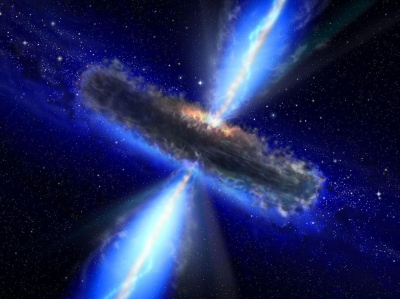
They are engines of creation and destruction. As they feast on surrounding stars, gas, and dust, they get angry. This cosmic meal is superheated into an accretion disk, a swirling vortex of matter hotter than any star. From the poles of these spinning monsters, immense, focused beams of energy and particles are blasted out into the cosmos. They are called radio jets, and they can be larger than the entire galaxy they originate from.
These jets are the key.
We can’t see the black hole itself. We can’t directly measure its spin. But we *can* see its radio jets. And the direction of those jets tells us the spin axis of the black hole that launched them. Using powerful radio telescopes like the Giant Metrewave Radio Telescope (GMRT), a team of astronomers pointed their instruments at a region of the sky called ELAIS-N1. And what they found sent a shockwave through the community.
Galaxy after galaxy, SMBH after SMBH, the radio jets were all pointing in roughly the same direction. A staggering 64 of them, all in lockstep. This wasn’t a small cluster. This was a pattern stretched across billions of light-years. An impossibly ordered system in a universe we’ve always been told is fundamentally random on the largest scales.
A Glitch in the Cosmic Matrix?
So, where is this bizarre formation? Why this specific patch of sky? The answer only deepens the mystery. These aligned black holes weren’t just scattered randomly in a box. They were found along what is known as a large-scale structure, or a filament of the “Cosmic Web.”
Deep Dive: The Cosmic Web Explained
Picture the universe. Don’t picture an even spray of stars and galaxies. That’s wrong. On the grandest scales, the universe looks like a sponge, or a neuron network, or a spider’s web. It’s made of vast, empty regions called “voids” and long, interconnected threads of matter called “filaments.” These filaments are the superhighways of the cosmos, roads paved with dark matter and gas along which galaxies are born and cluster together.
These structures are the biggest things in existence. And the 64 synchronized black holes were found living along one of these titanic threads. The alignment of their spin axes seems to mirror the alignment of the filament they inhabit. This is a huge hint. It suggests that whatever caused this alignment wasn’t an event inside each individual galaxy, but something much, much bigger. Something that influenced an entire region of space as it was forming.
Professor Andrew Russ Taylor, the lead author of the study that blew this whole thing open, put it plainly: “Since these black holes don’t know about each other, or have any way of exchanging information or influencing each other directly over such vast scales, this spin alignment must have occurred during the formation of the galaxies in the early universe.”

He’s talking about an echo. A ghost from the dawn of time, baked into the very fabric of space.
Echoes of Creation: The Mainstream Theories
Science doesn’t like a mystery it can’t solve, so of course, researchers have been scrambling to come up with a natural explanation. They’re trying to figure out what primordial force could have “pre-programmed” an entire cosmic filament to spin in one direction. Two major ideas have emerged from the fray.
Theory 1: A Primordial Spin Field
This is the leading contender. The idea is that in the very first moments after the Big Bang, the universe wasn’t perfectly smooth. There were tiny fluctuations in energy and density. What if there were also fluctuations in angular momentum? Imagine a vast, swirling eddy in the primordial soup of the early universe, a region of space that was born with an inherent, large-scale spin.
As this region expanded and cooled, the matter within it would have retained that initial spin. When the first galaxies began to collapse out of the cosmic gas, they would have naturally formed with their central black holes spinning in alignment with that original, ancient cosmic rotation. The alignment we see today isn’t an active process; it’s a fossil. A remnant of conditions that existed over 13 billion years ago. It’s a compelling idea, but one that is almost impossible to prove directly.
Theory 2: The Grip of Cosmic Magnetic Fields
Another possibility involves another one of the universe’s great, unseen forces: magnetic fields. We know that magnetic fields exist within galaxies and between them, but what about in the very early universe? Some models suggest that powerful, large-scale magnetic fields could have permeated the cosmos in its infancy.
These fields could have acted like cosmic shepherds, herding the charged particles in the protogalactic gas clouds. This magnetic influence could have imparted a uniform spin to the accretion disks of the newly forming black holes, forcing them all into alignment like compass needles pointing north. Like the primordial spin theory, it places the cause at the very beginning of time, but it relies on ancient magnetic fields whose strength and structure are still a matter of intense debate.
When Science Fails, The Imagination Ignites
While the scientists debate primordial fields, the internet has come up with its own, far more sensational explanations. When you’re faced with a 1-in-a-million cosmic anomaly, can you really blame people for looking beyond the standard textbook?
The Galactic Superhighway Hypothesis
What if it isn’t natural? What if it’s *engineered*?
This is the idea that has set forums and social media ablaze. The theory suggests that we’re not looking at a natural phenomenon at all, but at a piece of unimaginably advanced astro-engineering. Could these perfectly aligned radio jets, all pointing in the same direction, form a kind of particle beam highway? A transportation or energy transfer network for a civilization that operates on a galactic scale?
Think about it. We struggle to get from one planet to another in our own solar system. A Type III civilization on the Kardashev scale would command the energy of an entire galaxy. What would a Type IV or V civilization, one that could manipulate the structure of the universe itself, be capable of? Perhaps they don’t travel *through* space; perhaps they create corridors *in* space. A network of aligned quasars could be the power source or the very road itself for faster-than-light travel. We might be looking at the cosmic equivalent of the Roman road system, a clue to an empire so vast we lack the language to even describe it.
A Cosmic Message or a Power Grid?
Taking it a step further, what if the alignment isn’t for travel but for communication? Or power? Could this be a colossal beacon, a directional signal meant to be seen across intergalactic distances? Perhaps the synchronized pulses of 64 quasars encode a message we don’t yet have the ability to decipher. It would be the ultimate “we are here” sign, written in the language of physics.
Alternatively, maybe it’s a power grid. Harnessing the energy of a single star with a Dyson sphere is a concept we can barely wrap our heads around. What would it look like to harness the energy of 64 supermassive black holes? By aligning their jets, could an advanced race be channeling a torrent of energy toward a single point, powering a machine or a project of cosmic proportions?
It sounds like fantasy. But then again, so does a 1-in-a-million cosmic alignment. When faced with the truly impossible, maybe the fantastic is the only thing that makes sense.
The Search Continues: What’s Happened Since?
The original discovery was published years ago, but the hunt is far from over. This single data point is either a complete statistical fluke, or it’s the tip of a cosmic iceberg. The key is to find more. If this alignment in ELAIS-N1 is the only one, it can eventually be dismissed as a bizarre outlier. But if we start finding other cosmic filaments with similarly aligned galaxies, then everything changes.
That would mean our entire understanding of cosmology—the “cosmological principle” that states the universe is the same in all directions on large scales—is wrong. It would prove that there is a hidden order, a large-scale structure to the universe that we never knew existed.
New tools are joining the fight. The James Webb Space Telescope can peer back into the era of galaxy formation with stunning clarity. On the radio front, the upcoming Square Kilometre Array (SKA) will be the most sensitive radio telescope ever built, capable of mapping the cosmic web and the jets of countless black holes with unprecedented precision. These are the instruments that will either find more of these strange alignments or prove this one was a ghost in the data.
The universe is whispering a secret. It’s written in the spin of black holes billions of light-years away. Is it telling us about its own violent birth? Or is it telling us we’re not alone? Whatever the answer, the fact remains: 64 of the universe’s most powerful engines are pointing in the same direction, and nobody, absolutely nobody, knows why.
And that is a mystery worth losing sleep over.