The Moon is a Mirror: How Earth’s Biggest Secret is Broadcast into Space Every Night
Let’s play a game. Forget everything you think you know about searching for aliens. Forget flying saucers. Forget little green men. Forget signals from distant stars.
What if I told you the single greatest piece of evidence for finding life in the universe wasn’t hidden in some faraway galaxy? What if it was hanging right over our heads every single night?
No, not on the Moon. That’s thinking too small.
I’m talking about using the Moon as a *mirror*. A colossal, dusty, cosmic mirror that has been reflecting Earth’s deepest secret for billions of years. And that secret is simple: this planet is crawling with life. Now, scientists have finally figured out how to read the reflection, and in doing so, they’ve stumbled upon a revolutionary—and terrifying—new way to hunt for extraterrestrial life.
They pointed a telescope at the Moon to find life on Earth.
Think about that. It sounds insane. But it worked. And if it worked for us, it means that any advanced civilization with a decent telescope could have done the same thing, at any point in the last few hundred million years. They wouldn’t need to visit. They wouldn’t need to send a probe. They would only need to look at our Moon and see the ghostly light of our world reflected on its surface.
They would know we’re here. The question is, how long have they known?
The Ghostly Light: What Exactly Is Earthshine?
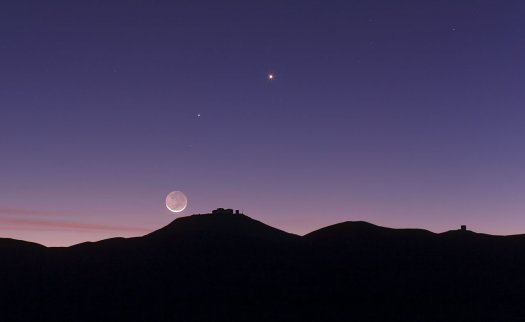
You’ve seen it before, even if you didn’t know what you were looking at. It happens during a crescent moon. You can see the bright, sharp sliver of the moon, but you can also faintly see the rest of the lunar disc, glowing in a soft, ethereal light. It’s sometimes called “the old moon in the new moon’s arms.”
That ghostly glow? That’s Earthshine.
It’s a beautiful, cosmic ricochet of light. Sunlight first travels 93 million miles to Earth. It hits our planet’s surface—our vast blue oceans, our swirling white clouds, our green continents—and a huge amount of that light bounces off, shooting back out into space. Some of that reflected sunlight then travels another 239,000 miles and strikes the dark portion of the Moon. And then, that light bounces *again*, traveling all the way back to our eyes here on Earth.
It is, quite literally, the light of our own world reflected back at us. Leonardo da Vinci figured this out 500 years ago. But it took modern astronomers at the European Southern Observatory (ESO) to realize its profound potential. They asked a brilliant question: If we can see this faint, twice-reflected light, what information is it carrying?
The Ultimate Test: Spying on Ourselves from Space
The challenge of finding life on exoplanets is almost impossible to overstate. An exoplanet is a tiny, dim speck of dust orbiting a star that is a raging, billion-megaton nuclear furnace. Trying to study that speck of dust is, as one astronomer put it, “like trying to study a grain of dust beside a powerful light bulb.” The star’s glare washes everything out.
So the ESO team decided to cheat. They treated Earth as a distant, unknown exoplanet. Their target wasn’t Earth itself, but the dim, Earthshine-lit portion of the Moon. They used the Very Large Telescope (VLT) in Chile, one of the most powerful eyes on the planet, and pointed it at that ghostly glow. They weren’t looking at the Moon; they were looking at Earth’s *reflection*. A faint, smeared-out message from home.
They fed this light into a spectrograph. This amazing device acts like a hyper-advanced prism, breaking light down into its fundamental rainbow of colors. But it’s more than just a rainbow. Tucked within that spectrum are tiny, dark lines—shadows where specific chemicals in our atmosphere have absorbed certain colors of light. It’s a chemical barcode. A fingerprint of our world.
And what they found should send a shiver down your spine.

Deep Dive: Decoding Earth’s Biological Fingerprint
The light from Earthshine wasn’t just a random assortment of chemicals. It was a symphony of biological chaos. The barcode they read was screaming one word: LIFE.
- Oxygen. So. Much. Oxygen. The first major clue was a massive absorption line for oxygen. On a dead, rocky planet, oxygen just doesn’t hang around. It’s an incredibly reactive gas. It loves to bind with other elements, creating rust and oxides. For an atmosphere to be filled with 21% free oxygen, something has to be pumping it out constantly, relentlessly. What is that something? Plants. Algae. Cyanobacteria. In short, life doing photosynthesis.
- The Methane Mystery. They also found methane. Methane is another gas that breaks down quickly in sunlight. If you find a steady supply of it in an atmosphere, something has to be producing it right now. On Earth, the vast majority of methane comes from biological sources. Think microbes in swamps, termites, and yes, even burping cows. Finding both oxygen and methane at the same time is a giant, flashing neon sign. They are chemically incompatible and shouldn’t coexist in large amounts unless two different biological processes are churning them out simultaneously. It’s a smoking gun for a complex biosphere.
- The “Red Edge.” This was the genius part. They found something called the vegetative “Red Edge.” It sounds technical, but it’s simple. Plant cells have a unique defense mechanism. To avoid overheating, they reflect near-infrared light very strongly. So, when you look at Earth’s spectrum, there’s a sudden, sharp spike in this invisible light. It’s a signal unique to photosynthesis as we know it. Finding it in the reflection was like seeing the green of Earth’s vast forests from hundreds of thousands of miles away.
- Water and Ozone. Of course, they found oceans of water vapor and a thick ozone layer (a byproduct of oxygen), both critical components for life as we know it.
The test was a staggering success. By looking at a faint reflection on our dead Moon, science proved beyond any doubt that our home planet was a vibrant, living world. The method works. It’s a viable, powerful tool for astrobiology.
And that’s where the story gets really interesting. And a little terrifying.
A Game-Changer for Alien Hunting
This Earthshine experiment wasn’t just a clever party trick. It was a proof-of-concept for a whole new way of searching the cosmos. Now, instead of just trying to catch the faint glimmer of an exoplanet as it passes in front of its star, we can look for its moon.
Imagine a distant “Earth 2.0” with its own “Luna 2.0.” Even if the planet itself is lost in the glare of its sun, its moon might be orbiting just far enough away to be seen. If we can get a telescope powerful enough—like the James Webb Space Telescope—to capture the faint “exoplanet-shine” on that alien moon, we can run the exact same analysis.
We could decode its atmospheric barcode. We could hunt for the tell-tale signs of oxygen and methane. We could search for the “Red Edge” of alien forests. We wouldn’t just be guessing if a planet *could* have life; we could see the chemical evidence that it *does*. We could discover life 50 light-years away without ever leaving our solar system.
It turns our entire search strategy on its head. Moons are no longer just sidekicks; they might be the cosmic billboards that announce their planet is inhabited.
But this incredible revelation comes with a chilling consequence. A logic that, once you see it, you can’t unsee.
The Conspiracy Corner: They’ve Known All Along
If we, a civilization that has only had powerful telescopes for a few decades, just figured this out, what about a civilization that is a thousand years more advanced? A million years? A billion?
Earth has had an oxygen-rich atmosphere for over two billion years. It’s had widespread vegetation creating a “Red Edge” for over 400 million years. For that entire, unimaginable stretch of time, our Moon has been sitting right next to us, acting as a passive reflector. A cosmic snitch.
It has been broadcasting a crystal-clear, unambiguous signal into the galaxy: “LIFE IS HERE. COMPLEX, PHOTOSYNTHESIZING LIFE.”
Any moderately advanced civilization in our galactic neighborhood could have pointed their own version of the VLT at our solar system. They wouldn’t need to aim for the tiny blue dot of Earth, lost in the Sun’s glare. They could aim for the much easier target of our large, convenient Moon. They could have analyzed our Earthshine centuries ago. Millennia ago. Eons ago.

This single scientific paper opens up a Pandora’s Box of unsettling possibilities.
Maybe the reason we haven’t been visited is because they don’t need to. They can study us from a safe distance. We are a specimen in a cosmic petri dish, and our Moon is the glass through which they peer.
Maybe this is the answer to the Fermi Paradox—the question of “Where is everybody?” They’re everywhere. And they’re watching. Silently. Patiently. The Great Silence we hear in the cosmos isn’t an absence of life; it’s the quiet of the celestial zoo-keepers observing the animals.
What if they’ve been watching our biosphere evolve for millions of years? They saw the dinosaurs come and go. They saw the rise of mammals. And in the last few thousand years, the light reflected from our planet would have started to change again. The spectral lines of nitrogen dioxide from our industrial pollution. The radioactive isotopes from our atomic tests. The glow of our cities on the night side of the planet. They would be seeing the rise of a technological, and self-destructive, species in real-time.
The Fermi Paradox Revisited: A Chilling New Answer
This makes the silence of the universe even more profound. If detecting a biosphere is this easy—if all you need is a nearby moon and a good spectroscope—then life can’t be that hard to find.
So why the silence?
The Earthshine method presents a new, disturbing solution to the paradox, often called the “Dark Forest” theory. In a dark forest, every hunter is silent. You don’t dare make a sound, because you don’t know what other, more dangerous hunters are listening. The first rule of the cosmic forest is to stay hidden. To survive is to be silent.
For billions of years, Earth has been the equivalent of a loud, screaming baby in that dark forest. Our planet’s own biology has been shouting our position to the cosmos, with the Moon acting as the amplifier.
We haven’t been broadcasting radio signals for very long. But we’ve been broadcasting *life* for a very, very long time. It forces us to ask a terrifying question: is the Great Silence we observe not a sign that we’re alone, but a sign that everyone else is smart enough to hide?
And we’re the ones who have been standing under a cosmic spotlight for eons.
The next time you look up at that beautiful, silver disc in the sky, remember what you’re truly seeing. It isn’t just a cratered, lifeless rock. It’s a messenger. A cosmic whistleblower. It is Earth’s own reflection, carrying the story of our living world out into the vast, dark, and possibly listening, universe.
Our planet’s biggest secret has never been a secret at all. The only question left is who’s been watching the show.