Monday, August 10, 2026
HomeUFOs & Alien LifeAlien LifeAliens are extinct! claims scientists

Aliens are extinct! claims scientists

The Great Silence: Is the Universe a Cosmic Graveyard?

Look up at the night sky. What do you see? A billion stars. A trillion galaxies. An endless, sprawling cosmos that screams with possibility. For generations, we’ve stared into that abyss and asked one simple, profound question: Where is everybody?

It’s the ultimate paradox. The numbers say the universe should be teeming with life, a bustling galactic metropolis of civilizations. Yet, all we hear is silence. An unnerving, profound quiet.

We’ve been told the problem is distance. Or maybe we’re not listening on the right frequencies. Maybe they’re hiding. But a terrifying theory, born from the minds of planetary scientists, suggests something far more chilling. The silence isn’t because life is rare. It’s because life is fragile.

The universe isn’t empty. It’s a graveyard.

A graveyard of planets that tried. Worlds where life sparked, took a breath, and was immediately extinguished. According to this idea, known as the Gaian Bottleneck, life almost never makes it past the starting line.

The Deadliest Hurdle: Surviving Your Own Planet

Forget giant asteroids. Forget dying suns or gamma-ray bursts. The single greatest threat to new life isn’t something from the outside. It’s the planet itself.

Think of a brand-new, rocky world. It’s a chaotic place. A violent, primordial soup of volcanic eruptions, fluctuating temperatures, and a toxic atmosphere. When the first, simple microbial life emerges on a world like this, the clock starts ticking. It has entered a cosmic trial by fire. To survive, it can’t just exist. It has to take control.

This is the core of the Gaian Bottleneck hypothesis, proposed by astrobiologists from the Australian National University. They argue that life’s first job is to become a planetary thermostat. It must regulate its own atmosphere and climate, creating stable, life-friendly conditions. If it succeeds, it gets a shot at evolving into something more complex. If it fails? Extinction. Quick and absolute.

The life forms literally have to seize the planetary steering wheel, pumping out the right gases to trap or release heat, stabilizing the water cycles, and terraforming their own home before it kills them. Most, the theory posits, simply can’t. The feedback loops go wrong. A little too much heating becomes a runaway greenhouse effect. A little too much cooling, and you get a global ice age. Game over.

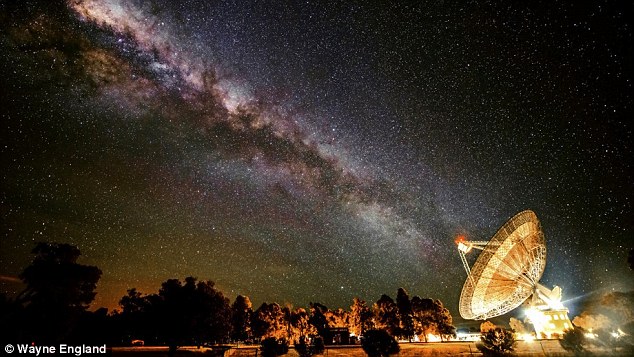
For decades, astronomers at places like the Parkes radio telescope in this picture have been scanning the heavens for signals, for signs of intelligent beings who beat the odds. But the Gaian Bottleneck theory suggests they might be listening for ghosts. The real story of the cosmos might not be written in radio waves, but in the fossilized remains of microbes on a trillion dead worlds.

A Tale of Two Tombs: The Ghosts of Mars and Venus

We don’t even have to look to distant star systems to see evidence of this planetary-scale tragedy. We have two potential cosmic graveyards right here in our own solar system. Two of our closest neighbors may be prime examples of planets that failed the bottleneck.

Deep Dive: The Martian Tragedy

Four billion years ago, Mars was not the cold, red desert we see today. It was a world of possibility. Evidence is carved into its surface. Vast, dried-up riverbeds, deltas, and the mineral signatures of ancient lakes and oceans. Mars had a thicker atmosphere. It had liquid water. It had all the same basic ingredients for life that early Earth did.

So, what happened? Why is it a frozen, barren rock?

Imagine Martian microbes emerging in those ancient seas. They began their existence on a planet that was already losing the fight. Mars is smaller than Earth, so its core cooled faster, and its magnetic field sputtered out. This protective magnetic shield was what deflected the sun’s solar wind, a constant stream of charged particles that strips away a planet’s atmosphere.

Without the shield, the solar wind began sandblasting Mars’s air away into space. The atmospheric pressure dropped. The planet began to cool. Any nascent Martian life was now in a desperate race against time. To survive, it would have needed to pump massive quantities of greenhouse gases, like methane or carbon dioxide, into the thinning atmosphere to trap heat and keep the planet warm. It had to fight the cooling. And it failed.

The temperatures plummeted. The oceans froze solid, and the remaining water was either locked away as ice at the poles or lost to space. The planet died. If we ever find life on Mars, it will likely be the fossilized remnants of these microscopic failures, a silent record of a biosphere that couldn’t regulate its way out of a deep freeze.

Deep Dive: The Venusian Inferno

Venus is even more horrifying. It’s often called Earth’s “twin,” but it’s more like an evil, twisted version. Its surface is hot enough to melt lead, its atmospheric pressure is 90 times that of Earth’s, and it rains sulfuric acid. It is, by all measures, a true hellscape.

But it might not have always been this way.

Like Mars, early Venus could have been a temperate, watery world. Some models suggest it may have had stable oceans for billions of years—far longer than Mars. Life could have easily arisen there. So what went so catastrophically wrong? It failed the bottleneck in the opposite direction.

Being closer to the Sun, Venus received more solar energy. This caused more water to evaporate. Water vapor is a potent greenhouse gas, so this trapped more heat, which caused more water to evaporate, creating a vicious feedback loop. On Earth, this process was kept in check by a complex carbon cycle, where early life and geological processes pulled carbon dioxide out of the atmosphere and locked it away in rocks.

Venusian life, if it ever existed, failed this critical test. It couldn’t pull the CO2 out of the atmosphere fast enough. Perhaps volcanic activity was too intense, pumping out more gas than the fledgling biosphere could handle. The thermostat broke. The planet got hotter. And hotter. And hotter.

The oceans boiled away completely. The immense heat baked carbon dioxide out of the planet’s crust, creating the crushingly thick atmosphere we see today. Venus became a runaway greenhouse inferno. Any life that once existed was boiled, scoured, and utterly erased. A planetary fever dream from which there was no escape.

Earth: The Lottery Winner

So if Mars froze and Venus burned, why are we here? Was it just dumb luck? Almost certainly.

We didn’t just get a lucky address in the “Goldilocks Zone.” We won a cosmic lottery. Life on Earth emerged and immediately started tinkering with the atmosphere. For billions of years, it was a precarious balancing act. But then, one group of microbes pulled off a planetary takeover.

Cyanobacteria. These tiny organisms “invented” a new form of photosynthesis that released a waste product. A toxic, highly reactive gas. Oxygen.

What followed is called the Great Oxidation Event. This was, by far, the most significant climate and environmental change our planet has ever experienced, and it was driven entirely by life. This new oxygen-rich atmosphere was poisonous to most other life on the planet, causing a mass extinction. But it also created the ozone layer, protecting the surface from harmful UV radiation. It changed the chemistry of the oceans. It stabilized our world in a way that paved the path for us. For complex, oxygen-breathing creatures.

We are here because our microscopic ancestors were not passive passengers. They were radical, world-altering engineers. They didn’t just survive on Earth; they *made* the Earth we know. They passed the Gaian Bottleneck, while our neighbors were consumed by it.

Are We Searching for Ghosts in the Machine?

This theory completely reframes our search for extraterrestrial life. It’s a sobering, even depressing, perspective. But it’s also incredibly powerful.

The Great Filter is Behind Us

Scientists often talk about the “Great Filter,” a hypothetical barrier that is so difficult to overcome that it explains why we see no other life. Is it the jump from non-life to life? The jump to complex cells? The jump to intelligence? Or is it a future filter, a technological trap like nuclear war or rogue AI that kills off every civilization before it can reach the stars?

The Gaian Bottleneck suggests the Great Filter is the very first step. It’s not about becoming intelligent. It’s about surviving the first billion years. This would mean the hardest part is already behind us. We made it. But it also means that the vast majority of life-bearing planets never get past the microbial stage. The universe isn’t full of developing civilizations; it’s full of microbial fossils.

A New Way to Search

If this is true, our entire search strategy might be wrong. Listening for radio signals from E.T. could be a fool’s errand. There may be no one to broadcast anything.

The real treasure trove of alien life might be found by new tools like the James Webb Space Telescope. Instead of listening, we should be looking. Looking for the chemical fingerprints in the atmospheres of distant exoplanets. We could look for planets with weird, unstable atmospheres—atmospheres out of chemical equilibrium in a way that suggests a biological process is, or *was*, at war with the planet’s geology.

We might even be able to spot the ghosts of failed biospheres. Imagine finding a planet with an atmosphere rich in oxygen but with no signs of vegetation on the surface. Could that be a world where life produced oxygen but was then wiped out by some other climatic shift, leaving a tell-tale atmospheric ghost behind?

What This Means For Us

This isn’t just an abstract theory about distant worlds. It’s a stark warning.

Our planet is the only known success story in a universe of failures. And the stability we enjoy isn’t a given. It was built by life, over billions of years. Now, one species—us—is tinkering with that ancient thermostat on a scale and at a speed the planet has never seen before.

The silence from the stars isn’t a mystery to be solved. It’s a lesson to be learned. The cosmos is telling us that survival is not guaranteed. That planets are fickle. And that the line between a garden and a graveyard is terrifyingly thin.

The next time you look up at the stars, don’t wonder where the aliens are. Wonder how we’re still here. We are the ghosts of no one. The improbable survivors. And we are living on the knife’s edge, hoping we don’t make a mistake that our microbial ancestors so miraculously avoided.

Arindam Mukherjee
Arindam Mukherjee
Arindam loves aliens, mysteries and pursing his interest in the area of hacking as a technical writer at 'Planet wank'. You can catch him at his social profiles anytime.
RELATED ARTICLES
- Advertisment -

Most Popular

Recent Comments

Warren Pan Abbott on The legend of the Devil Monkey !
chris davies on The McPherson Tape Mystery
Reed Reedly on ET has Internet!
Bea Houseoffashion on Proof Of Time Travellers – Gallery
Marcus2012 on ET has Internet!
Reed Reedly on ET has Internet!
LaughsAtConspiracyNuts on The 9/11 Conspiracy – Myths and Facts
Alex Sliverman on Did the ancients fly?
Doctor Wholigan on Time Traveler in 1938 film
chris davies on The McPherson Tape Mystery
Archie1954 on 10 secret UFO hideouts
chris davies on Ghosts of flight 401
Marcus2012 on ET has Internet!
jason Macdonald on Proof of Time Travel? – China
chris davies on Long-Lost Pyramids Found?
Reed Reedly on ET has Internet!
Milkman on Connected Universe
Tenmiles on Baigong Pipes Mystery
Simon Foster on Sirius – The Documentary
From the 1st April on 2013 – Alien Contact date ?
SkyWatcher on Is ET ignoring us?
I Come From The Future on Obama to make UFO Alien disclouser soon ?
ÛñK?øWn on 2013 – Alien Contact date ?
Just another person on 2013 – Alien Contact date ?
Malcolm Windowcleaner on The strange case of Rudolph Fentz
Mason Servio on Strange Things on Mars
Marke Wisdom Seeker on What will we find as arctic melts?
Andrea A Elisabeth Levyne on Aliens Captured in Varginha, Brazil
Mitch Grouyeki on Amazing Space Shuttle pictures