Friday, April 17, 2026

Alien squid filmed

Imagine the absolute dark.

Close your eyes. Picture a place where the sun hasn’t touched the water in a hundred million years. It is cold. It is crushing. The pressure is enough to turn a pickup truck into a soda can. You are a mile and a half beneath the surface of the ocean, drifting through the midnight zone. Silence. Nothing but the endless, heavy black.

And then, out of the gloom, something appears.

It doesn’t look like a fish. It doesn’t look like a shark. It doesn’t even look like an animal from this planet. It looks like a daddy longlegs spider made of moonlight and nightmares, forty feet tall, hovering in the void. It hangs there. Suspended. Waiting.

This isn’t sci-fi. This isn’t a CGI hoax cooked up by a bored teenager on Reddit. This is the Magnapinna squid.

20131125-174522.webp

The Footage That Broke the Internet

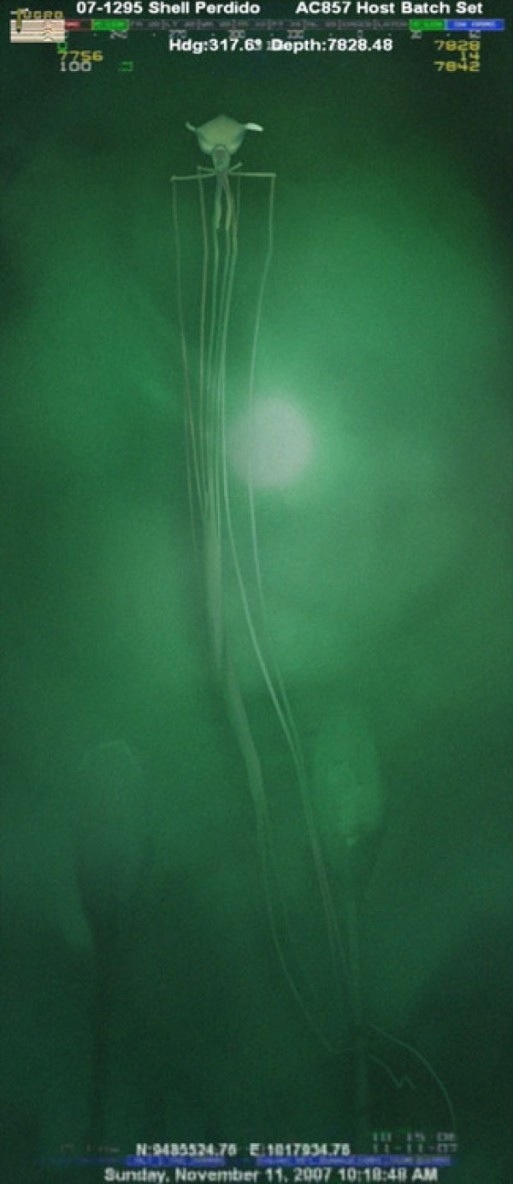
Let’s go back to November 11, 2007. The location? The Perdido development site in the Gulf of Mexico, roughly 200 miles south of Houston, Texas.

It was a routine operation. Or it was supposed to be. Shell Oil Company had a remote-operated vehicle (ROV) prowling the seafloor. These machines are the workhorses of the deep, inspecting pipelines and drilling equipment in places where human divers would die instantly. The ROV was cruising at a depth of 2,386 meters. That is nearly 1.5 miles down. At that depth, you are entering an alien world.

The camera was rolling. Grainy, high-contrast black and white video fed back to the control room on the surface. The operators were likely bored, sipping coffee, watching mud and silt pass by on the monitors.

Then, the creature drifted into the frame.

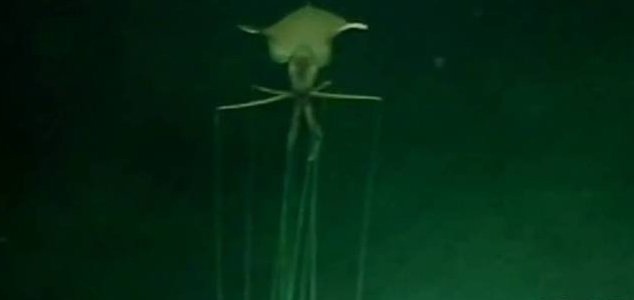
It didn’t dart away like a frightened fish. It didn’t attack. It just… existed. The footage shows a ghostly, pale entity with massive, flapping fins that look like elephant ears. But the fins weren’t the scary part. It was the arms. Oh man, the arms.

They went on forever. Thin, white filaments trailing down into the darkness, seemingly without end. And they were bent. That’s the detail that freaks people out the most. The tentacles weren’t flowing like a normal octopus. They were held out at stiff, sharp 90-degree angles, like elbows. It looked like a puppet with its strings cut. It looked like a tripod from War of the Worlds.

The clip went viral before “viral” was really a thing. It became the stuff of legends. It sparked debates on conspiracy forums, cryptozoology blogs, and terrified YouTube comment sections. What was that thing?

What is the Bigfin Squid?

The scientific name is Magnapinna. In Latin, that translates literally to “Big Fin.” Simple name. Terrifying creature. They belong to a rare family called Magnapinnidae.

Here is the crazy part: We know almost nothing about them. Seriously. We have sent people to the moon. We have robots on Mars right now taking selfies. But down here? In our own ocean? We are clueless.

Magnapinna squids are considered one of the deep sea’s most ethereal and elusive residents. While most squid are muscular jet-fighters of the ocean, blasting around to catch prey, the Bigfin is different. It is a ghost.

They are unusual for two main reasons:

  • The Fins: Their fins are massive, making up nearly 90% of the length of their body mantle. When they flap, they look like a Dumbo octopus or a weird, underwater stingray hybrid.
  • The Arms: This is the signature nightmare fuel. The tentacles are ridiculously long. While the body might be a foot or two long, the arms can stretch out for 20 feet or more. And they hold them in that specific, rigid pose.

Why the elbows? Why the stiffness? Scientists have a theory, but it’s just a guess. They call it the “fishing line” hypothesis.

The Living Cobweb Theory

Imagine being a small shrimp or a deep-sea jelly in the pitch black. You can’t see anything. You are just drifting along the current. Suddenly, you brush against a thin, sticky white line. Snap.

The leading theory is that the Magnapinna feeds by dragging its arms along the seafloor or letting them hang suspended in the water column like a living spiderweb. It doesn’t hunt. It traps. It waits for microscopic prey to bump into its sticky tentacles, and then—game over. It is a passive killer. A drift net made of flesh.

20131125-174757.webp

A History of Ghosts

You might think the 2007 Shell Oil video was the first time we saw this monster. Wrong. That was just the first time the public really paid attention.

The story actually goes back over a hundred years. In 1907, a damaged specimen was found floating near the Azores. It was dead, beat up, and incomplete. Scientists looked at it, shrugged, and filed it away. They didn’t know what they were looking at.

Fast forward to 1988. The crew of the submersible Nautile spotted something weird off the coast of Brazil. They snapped a photo. It was blurry. It showed a strange, long-armed creature. They called it “Thing A.”

Not a scientific name. Just “Thing A.”

For years, “Thing A” was a cryptid. A mystery. It wasn’t until 2001—over a decade later—that scientists finally connected the dots. They realized that the 1907 specimen, the 1988 photo, and new sightings were all the same animal. They officially described the family Magnapinnidae.

Think about that. We didn’t even know this family of animals existed until the 21st century. What else is down there that we haven’t named yet?

Why Does It Look So… Fake?

This is the question that keeps coming up. When you look at the images above, your brain rejects them. It triggers the “Uncanny Valley” effect.

Biology is usually messy. It’s round, organic, flowing. The Bigfin squid looks geometric. The angles of its arms are too perfect. The way it hangs motionless in the water looks like a glitched video game asset. It looks like an animatronic that broke down at a theme park.

This appearance has fueled some wild theories online.

The Alien Connection

Go to any conspiracy board, and you will find a thread about this squid. The argument goes like this: The ocean is the perfect hiding spot. If an extraterrestrial intelligence wanted to observe Earth without being seen, where would they go? The bottom of the Pacific.

Some theorists point out the resemblance between the Magnapinna and the descriptions of “Greys” (long limbs, large heads, pale skin). Is it an alien? Probably not. Is it an ancient biological line that has evolved in a high-pressure environment so different from ours that it might as well be an alien? Absolutely.

The deep ocean is an evolutionary playground where the rules of the surface don’t apply. Down there, animals become giants (Deep Sea Gigantism). They lose their color. They lose their eyes—or grow massive ones. The Bigfin is the result of millions of years of evolution in the dark.

The 2020 Breakthrough

For a long time, the Shell Oil video was the “Zapruder Film” of marine biology. It was the only good look we had. But recently, things changed.

In late 2020, scientists exploring the Great Australian Bight—a massive bay off the southern coast of Australia—hit the jackpot. They didn’t just find one Bigfin. They found five.

Using towed camera systems and ROVs, they managed to get the best high-definition footage of these creatures ever recorded. And this time, they had lasers. (ROVs use parallel laser beams to measure size). We finally got real numbers.

The specimens were found at depths ranging from 9,000 to 10,000 feet. The largest one measured had a body length of about 6 feet, but with its arms fully extended? We are talking about a creature spanning over 20 to 25 feet. That is the length of a stretch limousine, floating vertically in the crushing blackness.

And here is the kicker: Scientists think these are just the juveniles.

The Nightmare Scenario: How Big Do They Get?

This is where we enter the realm of speculation. The specimens we have seen—the Shell Oil squid, the Australian ones—they don’t look fully grown. In the world of squid (Teuthology), mature adults often look vastly different from the younger ones.

If a 25-foot specimen is just a “teenager,” how big is the adult?

We know that the Colossal Squid (Mesonychoteuthis hamiltoni) can weigh as much as a car. We know the Giant Squid (Architeuthis dux) battles Sperm Whales. But the Magnapinna is different. It is spindly. It is fragile.

However, physics in the deep sea allows for massive size. The water supports the weight. There is no gravity to crush your bones. Could there be Bigfins down there with arms that stretch for 50 feet? 100 feet? A living curtain of tentacles spanning a football field?

It’s possible. The ocean covers 70% of our planet, and we have explored less than 5% of it. We know more about the craters of the Moon than we do about the trenches of the Pacific.

Why Are We So Obsessed?

Why does this specific animal grip us so tightly? Why does that Shell Oil photo keep getting reposted every single year?

It’s because it represents the unknown. In a world where every inch of land is mapped by Google Earth, where every mystery is debunked by Snopes in five minutes, the ocean remains the final frontier. It is the last place on Earth where monsters can still exist.

The Magnapinna squid is a reminder that we are not the masters of this planet. We are just guests living on the dry parts of the crust. Down there, in the deep, there are things older than the dinosaurs, drifting in the dark, watching us with eyes we can’t understand.

So, the next time you are swimming at the beach and something brushes against your leg… just remember.

It’s probably just seaweed.

Probably.

Fast Facts: The Magnapinna Cheat Sheet

  • First Visual Confirmation: 1988 (Brazil).
  • Most Famous Sighting: November 11, 2007 (Shell Oil ROV).
  • Depth Range: 1,900 to over 4,700 meters (that we know of).
  • Key Feature: Arms and tentacles are indistinguishable and held at 90-degree angles.
  • Diet: Unknown, but presumed to be a passive suspension feeder (drifting trap).
  • Terror Level: Extreme.

The ocean is deep, dark, and full of secrets. The Bigfin squid is just one of them. Who knows what the cameras will catch next?

Amit Ghosh
Amit Ghoshhttps://coolinterestingnews.com
Aloha, I'm Amit Ghosh, a web entrepreneur and avid blogger. Bitten by entrepreneurial bug, I got kicked out from college and ended up being millionaire and running a digital media company named Aeron7 headquartered at Lithuania.
RELATED ARTICLES
- Advertisment -

Most Popular

Recent Comments

Warren Pan Abbott on The legend of the Devil Monkey !
chris davies on The McPherson Tape Mystery
Reed Reedly on ET has Internet!
Bea Houseoffashion on Proof Of Time Travellers – Gallery
Marcus2012 on ET has Internet!
Reed Reedly on ET has Internet!
LaughsAtConspiracyNuts on The 9/11 Conspiracy – Myths and Facts
Alex Sliverman on Did the ancients fly?
Doctor Wholigan on Time Traveler in 1938 film
chris davies on The McPherson Tape Mystery
Archie1954 on 10 secret UFO hideouts
chris davies on Ghosts of flight 401
Marcus2012 on ET has Internet!
jason Macdonald on Proof of Time Travel? – China
chris davies on Long-Lost Pyramids Found?
Reed Reedly on ET has Internet!
Milkman on Connected Universe
Tenmiles on Baigong Pipes Mystery
Simon Foster on Sirius – The Documentary
From the 1st April on 2013 – Alien Contact date ?
SkyWatcher on Is ET ignoring us?
I Come From The Future on Obama to make UFO Alien disclouser soon ?
ÛñK?øWn on 2013 – Alien Contact date ?
Just another person on 2013 – Alien Contact date ?
Malcolm Windowcleaner on The strange case of Rudolph Fentz
Mason Servio on Strange Things on Mars
Marke Wisdom Seeker on What will we find as arctic melts?
Andrea A Elisabeth Levyne on Aliens Captured in Varginha, Brazil
Mitch Grouyeki on Amazing Space Shuttle pictures