Before Roswell: The Night Los Angeles Went to War with a UFO
Forget what you know about 1947. Forget Kenneth Arnold seeing crescents over Mount Rainier. Forget the rancher in Roswell finding tinfoil in the desert. The real start of the phenomenon didn’t happen in the isolation of the wastelands.
It happened over one of the most populated cities on Earth.
Five years before the term “flying saucer” was even coined. Three years before the Battle of the Bulge. Two years before the beaches of Normandy. We are talking about February 1942. The world was on fire.
And then, something showed up over California.
This is the Battle of Los Angeles. It is arguably the most public, most violent, and most undeniable mass UFO encounter in human history. We aren’t talking about a lonely farmer seeing lights in the swamp. We are talking about hundreds of thousands of witnesses. We are talking about the United States military unleashing absolute hell on an object that simply… refused to fall.
The Context: A City on the Edge of Madness
To understand what happened that night, you have to get inside the headspace of an Angeleno in early 1942. It wasn’t just fear. It was terror. Pure, distilled panic.
Pearl Harbor had happened just weeks prior. The Japanese Imperial Navy seemed like a ghost—unstoppable, invisible, striking from nowhere. The West Coast was naked. Exposed. Everyone knew the enemy was coming. It wasn’t a matter of if. It was when.
Then, on February 23rd, 1942—just roughly 24 hours before the “Battle”—it happened. A Japanese submarine, the I-17, surfaced off the coast of Santa Barbara. It didn’t just look around. It opened fire. The sub shelled the Ellwood oil field. While the damage was minimal, the psychological impact was devastating. The war had arrived. It was on American soil.
Nerves were shattered. Every seagull looked like a bomber. Every fishing boat looked like a destroyer. The military was itchy. Fingers were resting heavy on triggers.
And into this powder keg of paranoia, something massive and silent glided into the sky.
02:25 AM: The Radar Blip That Changed Everything
The night of February 24th was clear. Crisp. A typical California winter night. But the silence didn’t last.
Naval Intelligence issued a warning earlier in the evening: attack expected within ten hours. At 2:25 AM on the morning of the 25th, the air raid sirens began to wail. It wasn’t a drill.
Total blackout. The switch was flipped. From the Hollywood Hills to the coast, the City of Angels went pitch black. Traffic stopped. Lights died. Millions of people held their breath in the dark, waiting for the sound of Mitsubishi Zero engines. Waiting for the bombs.
But they didn’t hear engines. At least, not at first.
At 3:16 AM, the 37th Coast Artillery Brigade began firing. And they didn’t stop.
The Sky Erupts
Imagine the noise. 50-caliber machine guns tearing the air apart. But the big boys were the main event—12.8-pound anti-aircraft shells being pumped into the sky at a rhythmic, deafening pace. Boom. Boom. Boom.
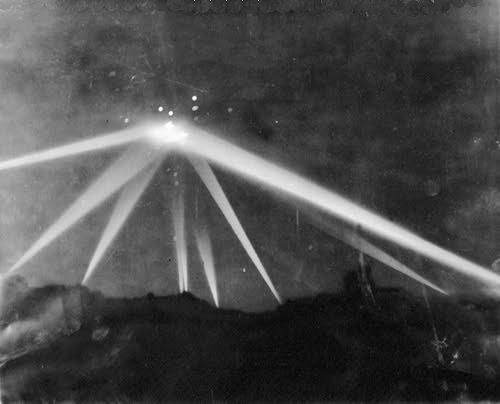
Searchlights—massive, high-powered beams—swept the darkness frantically. Then, they found it.
This is where history gets weird. This is where the “Japanese Plane” theory falls apart.
The beams converged on a single object. It wasn’t a swarm of planes. It wasn’t a formation. It was one single, solitary object hovering directly over Culver City and Santa Monica. Some described it as round. Others said it was lozenge-shaped. But everyone agreed on one thing: It was huge.
And it was glowing.
The anti-aircraft batteries went fully kinetic. They were lobbing 12-pound high-explosive shells directly at this thing. We are talking about rounds designed to shred metal fuselages into confetti. These shells were detonating all around the object. The sky was filled with shrapnel and smoke.
The object? It hung there. Like a lantern. Like a ghost.
The Impossible Durability: 1,400 Rounds vs. One Ship
Let’s crunch the numbers. The firing lasted for nearly an hour. The 37th Coast Artillery Brigade fired over 1,400 rounds of anti-aircraft ammunition.
Think about that. Fourteen. Hundred. Shells.
If this had been a Japanese bomber, it would have been vaporized in seconds. If it had been a commercial airliner lost in the fog, it would have been raining debris over three counties. If it had been a barrage balloon (weather balloon), one single piece of hot shrapnel would have popped it like a cheap party favor.
But the object didn’t pop. It didn’t burn. It didn’t crash.
Witnesses on the ground—Air Raid Wardens, police officers, civilians watching from their backyards—watched in stunned disbelief. They saw the shells bursting. They saw the “direct hits.” The smoke would clear, and the object would still be there, moving slowly, almost lazily, down the coast toward Long Beach.
It treated the US Army’s best weaponry like mosquito bites.
The “Magic Lantern”
The descriptions from that night are haunting. It didn’t move like a plane. It floated. It drifted. One witness described it as a “surreal magic lantern” hanging in the sky. It seemed completely oblivious to the violence it was causing.
It moved at a crawl. This wasn’t a strafing run. It was an observation. It was watching us.
Look at the image at the top of this article again. That is the famous photo published in the Los Angeles Times. Look at the convergence of the searchlights. They are locked on tight. They have the target painted. You can see the bursts of the shells around it. The military wasn’t shooting at shadows. They were shooting at something solid.
The Human Cost
It’s easy to get lost in the mystery and forget the tragedy. This wasn’t a harmless light show. People died.
While the object didn’t drop a single bomb and didn’t fire a single shot back, the chaos on the ground was lethal. Anti-aircraft shells that don’t hit a target have to come down somewhere. Gravity is undefeated. Shrapnel rained down on homes, cars, and streets for miles.
Buildings were damaged. Windows were shattered. But the human toll was worse. Six people lost their lives that night. Some from heart attacks induced by the sheer terror of the “invasion.” Others from traffic accidents in the blacked-out streets. And yes, some from the falling metal of friendly fire.
The Army attacked an unknown visitor, failed to scratch it, and ended up killing their own citizens in the panic. It was a disaster.
The Morning After: The Great Cover-Up Begins
When the sun came up on February 25th, the smoke cleared. The object was gone. It had simply vanished over the Pacific Ocean.
The people of Los Angeles waited for the news. Where was the wreckage? Where were the captured Japanese pilots? Show us the plane!
But there was nothing. No crash site. No debris field. Just a lot of empty brass shell casings and a very embarrassed military.
Then came the explanations. And this is where the conspiracy takes root. The government couldn’t get its story straight. It was a mess of contradictions right from the jump.
Washington vs. The Army
Frank Knox, the Secretary of the Navy, held a press conference shortly after. His explanation? “It was a false alarm.” He claimed it was just war nerves. Nothing was there. Just jittery gunners shooting at clouds.
Imagine telling that to the thousands of people who saw the giant ship. Imagine telling that to the families of the six dead people. “Sorry about your dad, he died of a heart attack because we shot at a cloud for an hour.”
But the Army? They weren’t having it. They had radar logs. They had gun crews who swore they tracked a target. Secretary of War Henry Stimson stated that at least 15 planes were involved. Later, the story shifted to “commercial aircraft.” Then it shifted to “weather balloons.”
Which is it? A hallucination? A fleet of 15 planes? A balloon? Or a false alarm?
General George C. Marshall, a man who didn’t mince words, wrote a memo to President Roosevelt. He stated that the “airplanes” moved at speeds ranging from “very slow to 200 mph.” He admitted they found no bombs and no wreckage.
The official story was leaking water faster than a screen door on a submarine.
Deep Dive: The Photo Controversy
Skeptics love to attack the famous LA Times photo. They point out, correctly, that the version printed in the paper was heavily retouched. In the 1940s, newspaper printing was low quality. Photo editors would often use white paint to enhance contrast so things would show up on the cheap newsprint.
“See!” the debunkers scream. “It’s fake! It was just paint!”
Not so fast. While the contrast was enhanced, the underlying negative tells the true story. The searchlights were real. The convergence was real. The object caught in the trap of light was real. You can paint over a photo to make it pop, but you can’t paint thousands of eyewitness testimonies into existence.
Furthermore, there were other photos. There were reports from all over the Los Angeles basin. This wasn’t a single camera trick.
What If? Analyzing the Theories
So, if we strip away the government excuses, what are we left with? What actually flew over Hollywood that night?
Theory 1: The Japanese Psy-Op
Could it have been a secret Japanese aircraft? Japan did have submarine-launched floatplanes. They famously bombed Oregon (causing a tiny forest fire). But those planes were small, fragile, and noisy. They couldn’t hover silently. And if one took a direct hit from a 12-pound shell, it would be toast.
Also, why not drop a bomb? If you fly a plane over an enemy city and they shoot at you, you drop your payload. You don’t just cruise around sight-seeing.
Theory 2: Secret US Technology
Was it us? Was the US testing a secret anti-gravity craft? This theory falls apart when you look at the reaction. The Army was terrified. They unleashed everything they had. You don’t live-fire high explosives at your own billion-dollar prototype over a populated city. That’s not how R&D works.
Theory 3: The Extraterrestrial Probe
This leaves us with the uncomfortable, thrilling possibility. It was not from here.
Consider the behavior:
- Silence: No engine noise reported, unlike the roar of 1940s radial engines.
- Hovering: Helicopters barely existed and couldn’t fly that high or that long. Harriers didn’t exist. Hovering was impossible for heavy aircraft in 1942.
- Invulnerability: This is the smoking gun. The ability to absorb or deflect kinetic energy. A force field? Super-dense armor? Whatever it was, we couldn’t scratch it.
Modern internet theories suggest this was a scouting mission. Just as we send rovers to Mars, someone sent a probe to check on us. And what did they see? A species that had just plunged itself into a global industrial war. A species that, the moment it saw something it didn’t understand, tried to kill it.
The Modern Connection
Today, we have the “Tic Tac” videos. We have Navy pilots describing objects that move against the wind, hover for hours, and accelerate at impossible speeds. We have the Pentagon admitting that UAP (Unidentified Aerial Phenomena) are real.
The Battle of Los Angeles was the grandfather of the Tic Tac event. It was the same story, just with analog radar and black-and-white film.
The object over LA displayed the same “Observables” that modern Pentagon officials talk about: Instantaneous acceleration (when it finally left), hypersonic capabilities, and trans-medium travel (vanishing over the ocean).
Conclusion: The Mystery Remains
More than 80 years later, the Battle of Los Angeles remains an open wound in the history books. It is a night where the curtain slipped. For one hour, the people of California stared up at something that defied physics, defied logic, and defied the US Army.
They fired 1,433 shells. They killed six of their own people in the panic. They lit up the night sky with the fury of war.
And the visitor? It just watched. It took our best shot, shrugged it off, and glided away into the darkness, taking its secrets with it.
Was it a warning? A test? Or were we just not worth the effort of fighting back?
Originally posted 2016-03-16 00:27:51. Republished by Blog Post Promoter
![maxresdefault[1]](https://coolinterestingnews.com/wp-content/uploads/2012/07/maxresdefault1-1.webp)