The Brutal Wake-Up Machine That Slaps You: More Than a Joke, It’s the Tech They Hope You Forget
Let’s be honest. The sound of your morning alarm is the soundtrack to a tiny, daily defeat. That shrill beeping. That gentle, infuriating melody. It’s a sound of submission. A signal that your precious escape into the dream world is over, and the relentless grind is about to begin anew.
You hit snooze. Once. Twice. Maybe five times.
Each tap is a little white flag. A surrender. You’re not winning the morning; you’re just delaying the loss. You crawl out of bed, a groggy, defeated zombie, reaching for the coffee pot like it’s the only thing tethering you to the world of the living.
But what if there was another way? A more… aggressive way?
What if the solution to our collective morning misery wasn’t a gentler sound, but a sharp, undeniable, physical shock to the system? What if the answer was a slap in the face?
It sounds like a joke. A meme. But the machine exists. And when you dig deeper, you start to see that this bizarre invention isn’t just a gag. It’s a rebellion. It’s a piece of forbidden technology that exposes a truth about our modern lives we’re all too tired to confront.
Meet The Machine That Hates Your Snooze Button
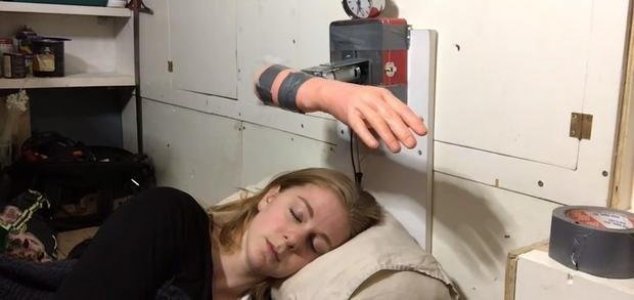
Behold. The Wake-Up Machine. A madcap contraption born from the brilliant, chaotic mind of inventor and robotics enthusiast Simone Giertz. But don’t let the whimsical nature of her work fool you. She’s not just building toys; she’s asking questions no one else dares to.
The device itself is a masterclass in brutal simplicity. A standard alarm clock is wired to a motor. Attached to that motor is a mannequin arm with a floppy, rubber hand. When the alarm sounds, the clock doesn’t just beep. Oh no. It sends a signal that unleashes kinetic fury. The arm begins to spin wildly, flailing and repeatedly slapping the sleeper with surprising force.
There is no negotiation. There is no snooze. There is only the slap.
Giertz, a self-proclaimed “Queen of Shitty Robots” who was living on a houseboat in Sweden at the time, unleashed this monster on the world years ago. She tested it on herself, and the results were… effective. Violently effective. It works. It absolutely gets you out of bed. But it’s not the gentle nudge society tells you that you need. It’s an intervention.
DEEP DIVE: The Snooze Button Conspiracy
Think about the snooze button. Who invented it? General Electric, way back in 1956. They called it “the most humane alarm clock ever.”
Humane?
Or was it the most insidiously brilliant tool for creating a perpetually tired, caffeine-dependent workforce ever conceived? Every time you hit snooze, you’re not getting more restful sleep. Scientists have shown this again and again. You’re fragmenting your sleep cycle, plunging your brain into a state of “sleep inertia” that can leave you feeling groggy and disoriented for hours.
You wake up feeling worse than you would have if you’d just gotten up the first time. You’re less alert. Less productive. More irritable.
So, who profits from this? Ask yourself that simple question. Cui bono?
- Big Coffee: A world of zombies needs a constant IV drip of caffeine just to function. The global coffee market is worth hundreds of billions of dollars. They don’t want you waking up refreshed and energized. They need you desperate.
- The Energy Drink Industry: An even more direct beneficiary of our exhaustion. Billions upon billions spent on canned chemical concoctions to jolt us through the afternoon slump caused by our morning snooze habit.
- Pharmaceutical Companies: Can’t sleep properly because your cycle is a mess? Can’t stay awake during the day? They have a pill for that. For both, actually.
The snooze button isn’t a feature. It’s a bug in our biology, exploited for profit. It’s a tool designed to keep you in a cycle of dependency. Giertz’s machine is the antidote. It’s a declaration of war against sleep inertia. It’s a bootloader for the human brain.
Watch The Terrifying Reality
Words don’t do the machine justice. You need to see the chaos in action. You need to witness the moment the alarm triggers the flailing rubber hand of destiny. It’s hilarious, yes. But it’s also a little terrifying. Watch as the machine doesn’t just wake the sleeper—it attacks. It even manages to get tangled in her hair, adding a layer of genuine peril to the morning routine.
What you’re seeing is more than a funny YouTube video. You’re seeing a pattern interrupt. You’re seeing someone bypass the brain’s lazy, sleepy logic and directly engage the body’s fight-or-flight system. You don’t “gently” wake up from this. You are launched into a state of high alert. Adrenaline floods your system. Your heart rate spikes. You are, for all intents and purposes, awake. Instantly.
An Echo of a Lost, Brutal History?
You might think this is a uniquely modern solution to a modern problem. You’d be wrong. This machine is simply the 21st-century evolution of a forgotten and much more personal profession: the “knocker-up.”
Go back to Industrial Revolution Britain and Ireland. Before alarm clocks were affordable for the common worker, factories and mills still needed their human cogs to be in place at sunrise. To solve this, towns had a knocker-up. This was a person whose entire job was to walk the pre-dawn streets and wake up the workers.
The Tools of the Trade
They didn’t use a gentle knock. These were professionals. They used long, lightweight poles, often made of bamboo, to reach up and tap on bedroom windows on the upper floors. For others, they used a “pea shooter” to fire dried peas at the glass. It was a precise, targeted, and persistent assault on sleep.
The knocker-up wouldn’t leave until they were sure the worker was awake and moving. There was no snooze button. There was only the relentless tap-tap-tapping at your window pane. It was an external force, an unavoidable reality.
Sound familiar?
Simone Giertz, perhaps without even realizing it, didn’t invent a new concept. She resurrected an old one. She automated the knocker-up. She replaced the long bamboo pole with a spinning robot arm, but the principle is identical: a physical, external, and non-negotiable stimulus to force you from slumber.
Are we just rediscovering ancient wisdom that our great-great-grandparents knew? That to truly conquer the dawn, you can’t rely on your own weak will. You need an outside agent of chaos.
The Shocking Psychology: Why a Slap Works When a Beep Fails
Your brain is smart. Dangerously smart. It has learned to filter out the sound of your alarm. It categorizes that beeping as a low-priority, ignorable threat. It knows that a simple hand motion can silence it for another nine minutes of blissful, low-quality sleep.
But your brain cannot, and will not, ignore a physical threat.
A slap to the face, even from a rubber hand, triggers a primal, deep-seated response. It’s unexpected. It’s invasive. It’s a physical violation of your personal space. The brain’s immediate reaction isn’t “Oh, time to wake up.” It’s “DANGER! I AM UNDER ATTACK!”
This is bio-hacking in its most raw and unfiltered form. It bypasses the conscious, bargaining mind and speaks directly to the ancient lizard brain, the part responsible for survival. The part that doesn’t have a snooze button.
Modern “gentle” alarm clocks that use light and soft sounds are trying to coax you out of sleep. They are negotiating with your subconscious. The Wake-Up Machine holds a press conference on your face. It ends all negotiations. Immediately.
The Machine That “They” Don’t Want You to Build
So if this thing works so well, why isn’t it in every store? Why hasn’t some mega-corporation refined it, made it sleek and user-friendly, and sold millions?
Because it is too effective. It solves the problem too well.
An entire ecosystem of industries thrives on the fact that you are tired. A population that snaps to full alertness the second their alarm goes off is a population that might not need that $7 latte. They might not grab that afternoon energy drink. They might have the mental clarity to eat better, exercise more, and fix the root causes of their fatigue.
A device like this disrupts the entire, profitable cycle of exhaustion.
It’s been kept in the realm of a “quirky internet invention” on purpose. It’s laughed off as a madcap project from a wacky inventor. This framing is perfect for those who profit from the status quo. It ensures no one takes the core concept seriously. It ensures no one looks at their pathetic beeping alarm clock and thinks, “You know what? There’s a better, albeit more violent, way.”
This isn’t just a machine. It’s a statement. It’s a middle finger to the gentle tyranny of the morning routine. It’s an open-source blueprint for reclaiming your consciousness from the fog of sleep inertia.
Is it absurd? Absolutely. Is it a little bit dangerous? Probably. But is it just a joke?
Not a chance.
It’s a glimpse of a different path. A future where we stop politely asking ourselves to wake up and start demanding it. The only question is, are you brave enough to face the hand?