Sunday, July 12, 2026
HomeWeird WorldSpaceActive Volcanoes Found on Venus

Active Volcanoes Found on Venus

Earth’s Twisted Sister is ALIVE: The Case for Active Volcanoes on Venus

Forget Mars. Forget the icy moons of Jupiter. The greatest, most terrifying mystery in our solar system might be right next door.

We call it Venus. Earth’s twin. A lie.

It’s a world of crushing pressure, a runaway greenhouse inferno where the sky rains sulfuric acid and the surface is hot enough to melt lead. For decades, we thought it was a dead planet. A geological ghost. A cautionary tale of what could happen to a world gone wrong.

We were wrong. Dead wrong.

Something is happening under those thick, toxic clouds. Something violent. Something… new. The planet isn’t a ghost. It’s a monster, and it’s waking up. Recent evidence, building on years of tantalizing hints, suggests that Venus is not only geologically active, but that its surface might be writhing with fresh lava flows *right now*.

A Flicker in the Dark: The 2014 Revelation

The story begins not with a bang, but with a whisper. A flicker. For years, scientists looked at the second planet from the sun and saw a world whose fiery past was long gone. They suspected volcanoes played a huge role in shaping the hellscape we see today, but assumed they’d been silent for millions of years.

Then came the European Space Agency’s Venus Express orbiter. A lonely probe circling a forgotten world, staring into the abyss.

And it saw something.

Venus surface from orbit, showing a fiery, cracked landscape under thick clouds.

Back in 2014, researchers were sifting through the data, looking for anything out of the ordinary. They focused on a particularly nasty-looking scar on the planet’s face: a rift zone known as Ganiki Chasma. Think of the East African Rift Valley, but on a world that wants to kill you.

The spacecraft’s Venus Monitoring Camera observed this zone 36 separate times. On most passes, nothing. Just the same old superheated rock. But on four occasions, something impossible happened. Four transient bright spots. Flashes of intense heat that appeared and then vanished.

How hot? Well, the normal surface temperature on Venus is a blistering 800 degrees Fahrenheit. These spots, these mysterious flashes, were estimated to be somewhere between 980 and a staggering 1,520 degrees Fahrenheit.

This wasn’t just a warm patch. This was a furnace door swinging open.

“Venus might have ongoing volcanism,” said planetary scientist Alexander Bazilevskiy, with Germany’s prestigious Max-Planck Institute for Solar System Research, at the time. His words were a bombshell dropped quietly in a scientific conference.

He admitted they had been searching for years, combing through endless images. “We were looking for these spots for several years (and) didn’t find anything,” Bazilevskiy confessed. The odds were against them, a slim 8 percent chance of seeing anything. “Then we found something.”

Four somethings. All clustered near a monster of a mountain called Maat Mons, a giant shield volcano that scientists believed last erupted 10 to 20 million years ago. In human terms, that’s an eternity. But in the life of a planet? “Geologically, it’s like yesterday,” Bazilevskiy noted.

The team speculated about what they were seeing. Were they glimpses of massive lava flows, maybe 16 miles long, carving new paths across the surface? Or perhaps a chain of smaller cinder cones popping up in a line? Maybe it was a massive volcanic hotspot, a window into the planet’s molten heart, like those found on Jupiter’s moon Io.

The evidence was compelling. But it was indirect. A ghost in the machine. For years, the mystery lingered, a fringe theory for a world nobody was paying much attention to.

Until they looked at the old files.

Deep Dive: The Crime Scene Photos from Magellan

Before Venus Express, there was Magellan. A NASA probe that arrived at Venus in 1990. It was a cartographer, using powerful radar to pierce the clouds and map the planet’s surface in breathtaking detail. For four years, it painted a picture of a world covered in volcanic features. More volcanoes than any other planet in our solar system. Hundreds of thousands of them.

But the images were static. A photograph of a crime scene long after the event. Magellan showed us *what* had happened to Venus, but it couldn’t tell us if it was *still* happening.

Or could it?

Fast forward to 2023. A scientist named Robert Herrick at the University of Alaska Fairbanks decided to do something agonizingly tedious. He decided to manually compare images from Magellan’s mission, taken months apart, looking for any tiny change. It was a needle-in-a-haystack search, sifting through 30-year-old data files. Most people thought it was a waste of time.

He found it.

In a region near that same massive volcano, Maat Mons—the same neighborhood where Venus Express saw its heat flashes—Herrick found the smoking gun.

A volcanic vent, roughly one square mile in size, had changed shape. In an image from February 1991, the vent appeared as a nearly circular pit. But in an image from October 1991, just eight months later, the vent was deformed. It looked like it had collapsed. And the area around it was dark, as if it had been flooded with something new. Something that radar couldn’t penetrate as well.

Herrick and his team realized what they were seeing. They were witnessing the direct aftermath of a volcanic eruption. The pit had likely overflowed with lava, creating a vast lava lake that then drained, causing the caldera to collapse.

This wasn’t a “maybe.” This wasn’t a “could be.” This was a videotape of the crime. For the first time, we had direct, unambiguous evidence of a recent, large-scale eruption on Venus.

What a Venusian Eruption Actually Looks Like

It’s important to understand this isn’t like an eruption on Earth. Not even close.

On Earth, a volcano blows its top, spewing ash and rock into the high atmosphere. Lava flows, but it’s fighting against our planet’s relatively light air pressure and cool temperatures.

On Venus, the atmospheric pressure at the surface is over 90 times that of Earth’s. It’s like being 3,000 feet deep in the ocean. The air itself is a thick, syrupy soup of carbon dioxide. So when lava pours out of a vent on Venus, it’s not a dramatic explosion into the sky.

It’s a silent, suffocating flood.

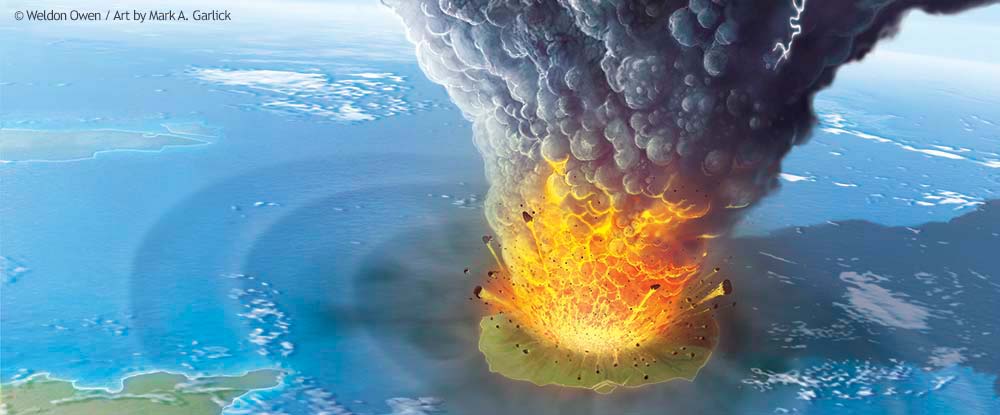
The lava, already incredibly hot, would flow slowly, like molasses in winter, spreading across the landscape under the immense weight of the sky. There would be no towering ash cloud. The eruption would be a quiet, deadly process, repaving the planet’s surface under a blanket of new rock. The heat from these flows would be so intense it would glow, even in the dim, filtered light that reaches the Venusian surface. These are the glows that Venus Express likely saw.

The Coronae: Wounds on a Living World

The evidence doesn’t stop with Magellan’s old photos. Other modern studies, looking at the planet’s bizarre and unique surface features, have pointed to the same conclusion. Venus is covered in strange, circular structures called “coronae.” They look like collapsed domes or impact craters, but they’re not. They’re believed to be formed by plumes of hot material rising from deep inside the planet, pushing the surface up and then letting it sag back down.

In 2020, a study showed that many of these coronae appear to be geologically young and located on what seem to be active hotspots. The trenches and cracks around them are signs of recent tectonic strain. It’s as if the planet’s skin is being stretched and broken by forces from within. These aren’t ancient scars; they’re fresh wounds.

What If… Venus Was Once Earth’s Paradise Twin?

This is where the story takes a dark, speculative turn. Why is this active volcanism so important? Because it might be the very thing that murdered a world.

There’s a growing and terrifying theory that Venus wasn’t always a hellscape. Billions of years ago, when the sun was younger and dimmer, Venus might have been… nice. It likely had liquid water oceans, perhaps for a very, very long time. It could have had blue skies, white clouds, and pleasant temperatures.

It could have had life.

So what happened? What turned this potential paradise into the most inhospitable place in the solar system?

The volcanoes. They are the prime suspect.

The theory goes like this: a series of massive, planet-wide volcanic eruptions began. Perhaps over millions of years, vast floods of lava covered everything. These eruptions pumped catastrophic amounts of carbon dioxide into the atmosphere. This wasn’t just a few volcanoes; it was a planetary geological event. The CO2 trapped heat from the sun, and the planet started to warm up. A little at first, then more and more.

The oceans began to boil.

As water vapor—itself a powerful greenhouse gas—filled the atmosphere, the heating process accelerated. It fed on itself. A runaway feedback loop from which there was no escape. The oceans evaporated completely, the water molecules were blasted apart by solar radiation, and the hydrogen was lost to space forever. What was left was a thick, choking, bone-dry atmosphere of CO2, a planetary pressure cooker.

The volcanoes didn’t just kill Venus. They cooked it alive. And what we’re seeing now—the flickers in the dark, the shifting vents—might be the very same process, still happening today.

Conspiracy Corner: Why Was Venus Ignored for So Long?

This raises an uncomfortable question. If our nearest planetary neighbor is this dynamic, this potentially world-altering, why have we been so obsessed with Mars?

Since the Magellan mission ended in 1994, NASA has not sent a dedicated orbiter back to Venus. Not one. Europe’s Venus Express (which ended in 2014) and Japan’s Akatsuki have been lonely sentinels. For nearly 30 years, the United States, the world’s leader in space exploration, effectively ignored the planet next door.

Why? The official line is that Venus is hard. It’s difficult to build probes that can survive the heat and pressure. Mars is easier, and the search for past life there is compelling.

But could there be another reason? Think about what the Venus story tells us. It’s a story of a planet that looks almost exactly like Earth in size and mass, but was destroyed by a runaway greenhouse effect triggered by volcanism. It’s a stark, terrifying warning about climate change.

Is it possible that for decades, the political will to explore Venus just wasn’t there because the story it tells is too close to home? Is it easier to sell missions looking for tiny microbes on a cold, red planet than it is to fund a mission to a hot, dead world that serves as a billboard for how our own planet could end?

It’s just a thought. But the 30-year gap in American exploration is a fact. A very strange fact.

The New Race to Hell is On

Thankfully, the silence is about to be broken. The recent discoveries have shocked the scientific community back into action. A new fleet of missions is now being prepared to storm the gates of hell itself.

  • NASA’s VERITAS: Scheduled for the early 2030s, this orbiter is the spiritual successor to Magellan. It will map the surface in stunning high-resolution, looking for the tell-tale signs of active eruptions and tectonic shifts.
  • NASA’s DAVINCI+: This is the wild one. It’s a probe that will actually plunge through the Venusian atmosphere. It will taste the air, analyze the chemistry, and take pictures of the surface on its way down to its doom. It will give us our first real “ground-level” view in over 40 years.
  • Europe’s EnVision: Working in concert with the NASA missions, this ESA orbiter will also use advanced radar to track surface changes, trying to catch a volcano in the act.

These missions aren’t just going to confirm if Venus has active volcanoes. They’re going to find out *how* active it is. Is this a planet with a few sputtering hotspots, or are we on the cusp of another planet-altering flood of lava? They will seek to answer the ultimate question: did Venus ever have life? And what, exactly, killed it?

The evidence is piling up. The flickers in the dark from 2014. The warped volcanic vent in the 30-year-old photos. The cracked and stressed coronae. These aren’t isolated incidents. They are puzzle pieces, and when you put them together, the picture is both terrifying and exhilarating.

Venus is not a dead planet. It is a living, breathing, violent world, hiding its secrets under a poison veil. We thought we were looking at a ghost. But we were looking at a monster in its lair. And now, we’re finally getting ready to poke it.

The question is, what will we find when it finally wakes up?

Amit Ghosh
Amit Ghoshhttps://coolinterestingnews.com
Aloha, I'm Amit Ghosh, a web entrepreneur and avid blogger. Bitten by entrepreneurial bug, I got kicked out from college and ended up being millionaire and running a digital media company named Aeron7 headquartered at Lithuania.
RELATED ARTICLES
- Advertisment -

Most Popular

Recent Comments

Warren Pan Abbott on The legend of the Devil Monkey !
chris davies on The McPherson Tape Mystery
Reed Reedly on ET has Internet!
Bea Houseoffashion on Proof Of Time Travellers – Gallery
Marcus2012 on ET has Internet!
Reed Reedly on ET has Internet!
LaughsAtConspiracyNuts on The 9/11 Conspiracy – Myths and Facts
Alex Sliverman on Did the ancients fly?
Doctor Wholigan on Time Traveler in 1938 film
chris davies on The McPherson Tape Mystery
Archie1954 on 10 secret UFO hideouts
chris davies on Ghosts of flight 401
Marcus2012 on ET has Internet!
jason Macdonald on Proof of Time Travel? – China
chris davies on Long-Lost Pyramids Found?
Reed Reedly on ET has Internet!
Milkman on Connected Universe
Tenmiles on Baigong Pipes Mystery
Simon Foster on Sirius – The Documentary
From the 1st April on 2013 – Alien Contact date ?
SkyWatcher on Is ET ignoring us?
I Come From The Future on Obama to make UFO Alien disclouser soon ?
Just another person on 2013 – Alien Contact date ?
Malcolm Windowcleaner on The strange case of Rudolph Fentz
Mason Servio on Strange Things on Mars
Marke Wisdom Seeker on What will we find as arctic melts?
Andrea A Elisabeth Levyne on Aliens Captured in Varginha, Brazil
Mitch Grouyeki on Amazing Space Shuttle pictures