The Silent Queen: Japan’s Abandoned Castle of Sin and the Secrets Within Its Walls
There are places on this earth that time forgot. Places that whisper stories to the wind. They stand silent, decaying, monuments to dreams that have crumbled to dust. And on a hill overlooking the vibrant, neon-soaked streets of Mito’s red-light district, one such monument looms larger than most.
They call it the Queen Chateau.
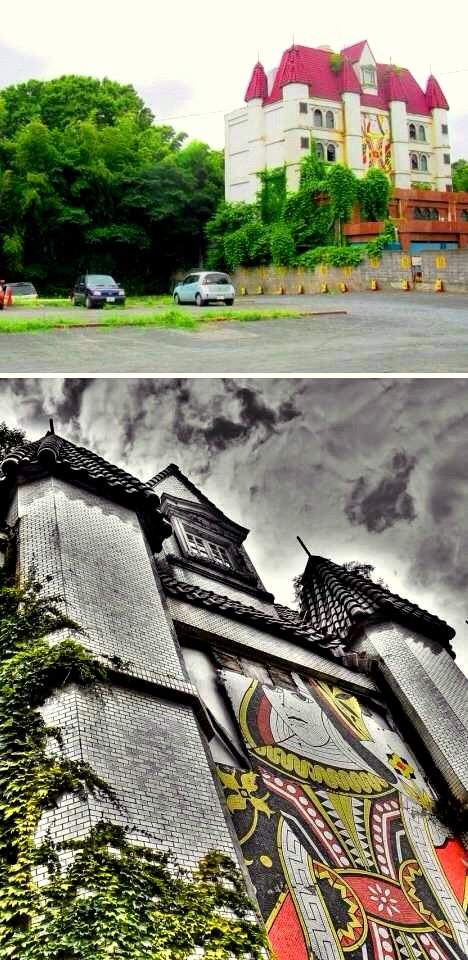
It’s a castle. A bizarre, gaudy, magnificent European-style castle, two hours northeast of the sprawling metropolis of Tokyo. It’s a phantom from another era, a place of forgotten pleasures and, perhaps, buried secrets. Today, it’s a ruin. An empty shell. But what was it? And more importantly, why was it left to die?
The story isn’t just about one building. Oh no. It’s about a nation’s wild, unchecked ambition. It’s about fortunes made and lost overnight. It’s about the hidden, shadowy world of Japan’s nightlife. To understand the Queen Chateau, you have to understand the world that created it. And the world that destroyed it.
Buckle up. We’re going deep.

A Ghost on the Hill: The Queen Chateau of Mito
First, you have to picture the scene. Mito’s entertainment district is a hive of activity. Music bleeds from doorways. Lights flash. People move with purpose. It’s alive. But lift your gaze, look up at the hill that borders the district, and the energy just… stops. There, against the sky, sits the Queen Chateau. Silent. Dark. A gaping hole in the city’s vibrant fabric.
Its location was a power move. Deliberate. Perched on high, it looked down upon its lesser competitors, a literal king (or queen) of the castle. Its multi-story, fantasy-inspired design wasn’t just architecture; it was a statement. A promise. A promise of an experience that was a cut above the rest. A fantasy made real.
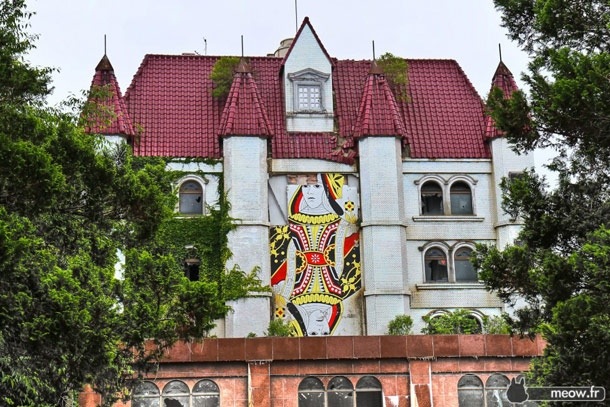
If Dracula had a penchant for neon and bubble baths, this would have been his weekend retreat. It’s pure, unapologetic excess. But the real showstopper, the feature that sears itself into your memory, is the facade.
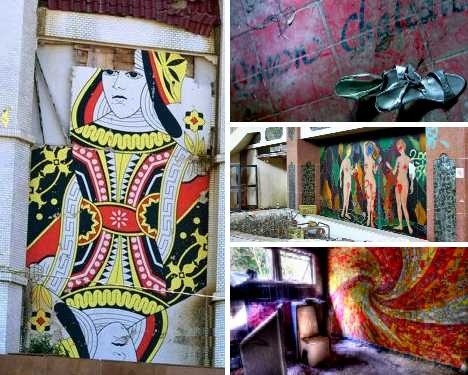
A colossal mosaic of a playing card Queen dominates the building’s face. It stretches stories high, a defiant symbol of the establishment’s name. Is she the Queen of Hearts? The Queen of Spades? The artist left it ambiguous, her suit a mystery. She is simply… The Queen. But get closer. Step past the overgrown weeds and cracked pavement, and you see the truth. The Queen is broken. Hundreds, maybe thousands, of her shimmering tiles have fallen away, leaving pockmarks and scars across her face. It’s a slow-motion vanishing act. A perfect, tragic metaphor for the building itself.
Deep Dive: What Exactly Was a Japanese “Soapland”?
Before we go any further, we need to address the elephant in the room. The Queen Chateau wasn’t a hotel. It wasn’t a theme park. It was what’s known in Japan as a “soapland.”
For those outside of Japan, the term sounds innocent. Quaint, even. The reality is a fascinating look into legal loopholes and cultural norms. After World War II, Japan enacted strict anti-prostitution laws. But human nature, and business, always finds a way. An ingenious loophole was discovered: the law prohibited payment for intercourse, but it said nothing about bathing.
And so, the soapland was born.
On paper, a soapland is a place where a customer pays to be bathed by a female attendant. The entire experience is couched in the theater of washing. The customer lies on a waterproof mattress while the attendant uses her body, covered in soap, to wash them. It’s all technically legal. What happens next, behind the closed door of a private, themed room, is a private matter. An unspoken agreement. A legal fiction that allowed a multi-billion yen industry to flourish in plain sight.
These weren’t sordid back-alley operations. The most successful soaplands, like the Queen Chateau aspired to be, were palaces of fantasy. They had elaborate themes, from Roman baths and tropical jungles to futuristic sci-fi pods. They were destinations. Escapes from the rigid, high-pressure world of the Japanese salaryman.

A Monument to a Lost Era: The Bubble Economy’s Wildest Dreams
You cannot look at the Queen Chateau without seeing the ghost of the 1980s. This was Japan’s “Bubble Economy” period. A time of absolute, mind-bending economic euphoria. The stock market and real estate prices soared to unimaginable heights. Money was cheap, and it flowed like water. It felt like the party would never end.
This economic explosion fueled a culture of outrageous excess. Companies bought priceless Van Gogh paintings. Solid gold sushi was a thing. And tycoons, flush with cash, poured fortunes into the *mizu shōbai*—the “water trade,” Japan’s nightlife and entertainment industry.
The Queen Chateau is a perfect artifact of this insane era. It was born from the belief that there were no limits. Why build a simple building when you could build a castle? Why have a simple sign when you could have a three-story mosaic? It was designed to attract men who had money to burn and a desire for the ultimate status symbol. Visiting the Queen Chateau wasn’t just about the service; it was about proving you could afford the best.
Then, the bubble burst.
In the early 1990s, the fantasy evaporated. The stock market crashed. Real estate values plummeted. The endless river of cash dried up. The lavish spending stopped. Companies went bankrupt. Fortunes vanished. For businesses like the Queen Chateau, which relied entirely on disposable income and a culture of excess, it was a death sentence.
The Great Unsolved Mystery: Why Was the Queen Dethroned?
So, it was the economy, right? Case closed? That’s the simple answer. The logical one. But for a place this grand, this legendary, the simple answer just doesn’t feel… complete. The world of urban explorers, local gossips, and internet sleuths suggests there’s more to the story. The sudden, complete abandonment of the Queen Chateau has spawned countless theories over the years.
Theory #1: The Bubble Bursts (The Official Story)
This is the most straightforward explanation. The economic crash was brutal and swift. The Queen Chateau’s clientele—stockbrokers, real estate developers, high-flying executives—were wiped out. The castle’s operating costs must have been astronomical. The custom lighting, the water for the baths, the sheer number of staff required to maintain the fantasy… it would have been unsustainable. The owner, facing a mountain of debt and an empty lobby, simply locked the doors and walked away. A clean, simple business failure. But is anything ever really that clean and simple?
Theory #2: A Yakuza Power Play? (The Conspiracy Angle)
Let’s be real. It’s impossible to talk about Japan’s red-light districts without mentioning the Yakuza, Japan’s infamous organized crime syndicates. For decades, they have had deep ties to the *mizu shōbai*. They act as lenders, “security,” and silent partners. The Queen Chateau, with its prime location and massive potential profits, would have been a prize jewel.
So what if its downfall wasn’t economic? What if it was a casualty of a hidden war? Perhaps the owner was backed by a specific Yakuza clan that fell out of favor. A rival group takes over the territory, and as a show of force, they shut down the crown jewel of their enemy. Or maybe the owner fell too deep into debt with the wrong people. One day, they came to collect, and the only thing he had left to give them were the keys to the castle. The building was then abandoned, left as a chilling reminder to others in the district: don’t cross us.

Theory #3: A Scandal Buried in Concrete (The Dark Secret)
This is the theory that internet forums whisper about late at night. A business like this, operating on the edge of the law, is always vulnerable to scandal. What if something terrible happened inside those opulent walls? A high-profile client dying under mysterious circumstances? A worker who disappeared? A crime so shocking that it tainted the building forever, making it impossible to continue operating without attracting massive, unwanted police attention?
In this scenario, the owners wouldn’t just close down; they would flee. They would seal the records, lock the doors, and let the building stand as a silent tomb, holding its secrets within. It would explain the suddenness of the abandonment—not a slow decline, but a full stop. One day open for business, the next day, a ghost town.
The Ghosts of the Internet Age: Modern Legends of the Queen Chateau
Today, the Queen Chateau has a second life. It’s a legend. A pilgrimage site for Japan’s urban explorers, known as *haikyo* enthusiasts. These adventurers risk trespass and danger to slip inside these forgotten places, documenting them before they disappear forever.
Accounts from those who have supposedly made it inside paint a haunting picture. They speak of rooms frozen in time. Gaudy, heart-shaped tubs covered in a thick layer of dust. Faded velvet wallpaper peeling from the walls. A single, forgotten slipper lying in the middle of a hallway. They describe an atmosphere that is heavy with the memories of what happened there.
The internet has amplified its legend. Reddit threads and anonymous forums are filled with supposed “new findings.” In 2019, a user claimed to have found ledgers in a back office detailing payments to local officials. Another story, likely fabricated but thrilling nonetheless, tells of a livestreaming explorer whose feed cut out abruptly after he opened the door to a “VIP suite” in the basement, never to be heard from again.
These are the modern ghost stories. The new folklore. The Queen Chateau is no longer just an abandoned building; it’s a living mystery, an interactive legend being written and rewritten by a new generation online.
Will The Queen’s Secrets Ever Be Revealed?
So what happens now? The Queen Chateau continues its slow decay. Each passing year, the rains wash more tiles from the Queen’s face. The weeds grow higher. The windows grow darker. The city of Mito seems content to let it stand, a strange and silent tourist attraction of its own.
Why not tear it down? The cost of demolition for a structure that size would be immense. And the legal ownership is likely a tangled nightmare, a web of bankrupt corporations and long-dead proprietors. So it sits. And it waits.
It’s a time capsule from an era of glorious, unapologetic madness. It’s a crime scene. A tomb. A monument to ambition and failure. It’s a puzzle with a thousand missing pieces. Every crack in its foundation, every shattered window, every fallen tile is a question that may never be answered.
The Queen on the hill keeps her secrets well. And maybe, just maybe, that’s the way it’s supposed to be.
Originally posted 2014-02-14 21:16:15. Republished by Blog Post Promoter