Friday, May 8, 2026
HomeWeird WorldStrange PlacesAbandoned Haunting Train Stations

Abandoned Haunting Train Stations

Have you ever walked past a chained-up fence and felt a cold shiver crawl up your spine? That feeling that something is watching you from the other side?

We live in a world obsessed with the “new.” New phones. New cars. New skylines. But underneath the shiny surface of modern Europe, there is a graveyard. A graveyard of iron and steam. Massive titans of industry that once roared with life are now silent, rotting away in the dark corners of the map. They were the airports of their day. The hubs of empires. Millions of people passed through these halls. Lovers said goodbye. Soldiers marched to war. Spies exchanged briefcases in the shadows.

And now?

Dust. Rust. Silence.

Why were they abandoned? Was it just economics? Or is there something darker buried beneath the tracks? Today, we are going off the rails. We are ignoring the “Keep Out” signs. We are going to dig deep into the history, the mystery, and the absolute madness of Europe’s most haunting abandoned railway stations. Put on your headlamp. It’s going to get dark.

20140213-234100.webp

The Titanic of the Mountains: Canfranc Station, Spain

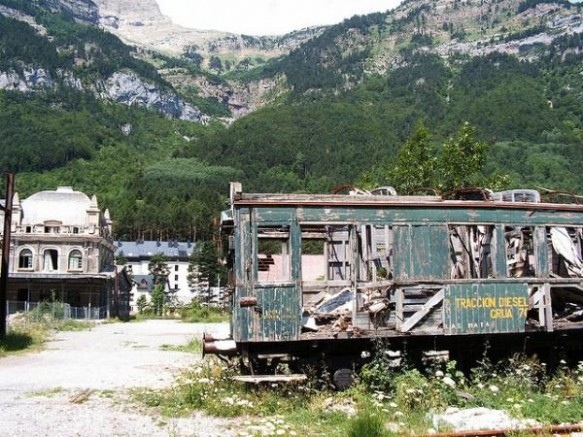
Look at that picture above. Just look at it. It looks like a palace, doesn’t it? That isn’t a castle. It’s a train station. And not just any train station. This is the Canfranc International Railway Station.

Situated in the Spanish Pyrenees, right on the border with France, this place is a monster. When they opened it in 1928, it was the second-largest station in all of Europe. They called it the “Titanic of the Mountains.” Talk about a cursed nickname. Just like the ship, this station was built with unmatched arrogance. It was grand. It was luxurious. It was supposed to change the world.

It didn’t.

The Nazi Gold Connection

Here is where the history books get fuzzy and the conspiracy theories start to make a lot of sense. During World War II, Canfranc became a hive of shadows. It was a chaotic mix of hope and evil. On one hand, you had desperate refugees and Jews fleeing the Nazi regime in France, slipping through the station into Spain to save their lives. It was a beacon of freedom.

But there was a dark trade happening on the other tracks.

Historians and locals have whispered for decades about the “Gold Trains.” Rumor has it that tons of Nazi gold—stolen from the central banks of occupied Europe and from the victims of the Holocaust—passed through this very station. The gold was allegedly shipped down into Spain and Portugal in exchange for tungsten and other raw materials the German war machine needed to keep killing.

Imagine standing on that platform in 1943. The cold mountain air biting your face. The steam hissing. And crates of blood money being loaded in the dead of night. Some local legends even say not all the gold left the station. Did some of it get buried? Is there a stash hidden in the sealed-up tunnels beneath the main hall? Treasure hunters have been asking that question for fifty years.

The Convenient “Accident”

So, why did it close? This is the suspicious part. The station was already losing money. It was too big. Too expensive. But you can’t just close a national monument without a reason.

Then, in 1970, a freak accident happened.

A train derailment destroyed a key bridge on the French side of the border. It was a mess. But was it unfixable? Hardly. Engineers could have repaired that bridge in weeks. Instead, the French and Spanish governments just… shrugged. They used the crash as the perfect excuse. They cut the phone lines. They locked the doors. They walked away.

For decades, the “Titanic of the Mountains” sat rotting. It became a playground for physicists studying dark matter (yes, really—there is an underground lab nearby) and urban explorers risking arrest to photograph the decay. Recently, there has been talk of turning it into a luxury hotel. But you have to wonder: can you really scrub away the ghosts of the past with a fresh coat of paint?

20140213-234337.webp

The Phantom Station: St. Martin, Paris

Let’s move from the mountains to the city. The City of Lights. But we aren’t looking at the lights. We are looking at the dark underbelly.

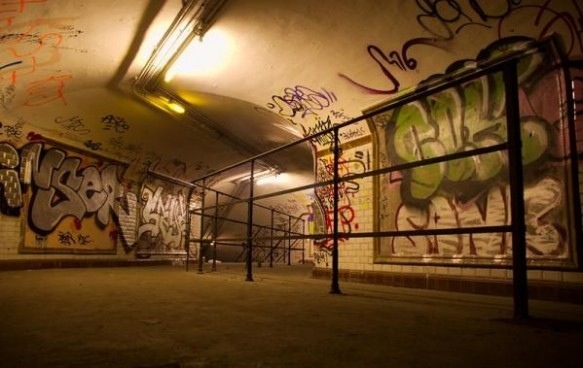
Paris has one of the best metro systems in the world. It’s dense. It’s fast. But did you know that as your train screams through the dark tunnels, you are passing right through “Ghost Stations”? You might see a flash of tiled walls or a dusty platform for a split second before the darkness swallows it again. You aren’t crazy. They are real.

The most famous of these is St. Martin.

Frozen in 1939

The story of St. Martin is bizarre. It closed in 1939. Why? Because World War II broke out and the city didn’t have enough workers to man every single station. It was supposed to be temporary. Just until the war ended. But when the dust settled and the Nazis were kicked out, the city planners looked at the map and realized something stupid.

St. Martin was only 100 meters away from the next station, Strasbourg-Saint-Denis. Literally a stone’s throw.

They decided it was pointless to reopen it. So, it stayed shut. It became a time capsule. While the world above changed—from the 1940s to the disco era, to the internet age—the air inside St. Martin stayed stale and still. The ceramic tiles on the walls are still there. The vintage ads from the 1930s plastered the walls for decades, peeling away like dead skin.

The Underground City of Shadows

But here is where it gets creepy. St. Martin isn’t just an empty hole. It has a life of its own. In the image above, you can see it doesn’t look totally abandoned. That’s because the Salvation Army sometimes uses the eastern section of the platform. They turned it into a day shelter for the homeless.

Think about the irony. A place built for speed and movement is now a place for people with nowhere to go.

And then there are the stories. Urban legends in Paris talk about the “Mole People” or secret societies that host parties in these phantom stations. While most of that is internet fiction, the reality is that urban explorers (cataphiles) have been breaking into these places for years. They report strange noises. Cold spots. The feeling of being followed.

Some claim the spirits of the French Resistance fighters who used the metro tunnels to hide from the Gestapo still linger here. Is it just the wind rushing through the tunnels? Or is it the echo of a war that never really ended underground?

20140213-234623.webp

The Orphan of the Empire: Szabadka Station, Serbia

Now, we travel east. To the lands where empires collided. This is Szabadka (known as Subotica in Serbian). This isn’t just a station. It is a tombstone for a country that no longer exists.

Look at the architecture in the photo. It’s haunting. It doesn’t look like a Serbian design. That’s because it isn’t. This station was built in the 1800s when this city was part of the mighty Austro-Hungarian Empire. This was Hungarian land. It was a proud node in a massive network connecting Vienna to the East.

A Border That Moved

History here is violent. After World War I, the borders were redrawn with a pen on a map by men in suits who had never visited the region. Suddenly, this Hungarian station was in Serbia (then Yugoslavia). The trains stopped coming as often. The glory faded. The empire collapsed, but the brick and mortar remained.

Today, this specific older station is a ghost. It is largely forgotten. While Subotica still has rail service, this specific relic has been left to the elements. The photographer who took these shots said you have to walk for an hour through fields just to find it. It’s off the grid.

The “Watcher” in the Fields

There is something deeply unsettling about this place. It sits in the middle of nowhere, surrounded by overgrown grass and silence. Locals don’t go there. Why would they? It’s just ruins.

But the few who do visit describe a heavy atmosphere. “The sense that one can feel the history behind the sighting,” as the photographer noted. It’s that feeling of displacement. The building doesn’t belong to the modern world. It’s an architectural zombie.

What really makes you think is the craftsmanship. Look at the windows. The arches. They built this thing to last a thousand years. They thought their Empire would last forever. They were wrong. It’s a harsh lesson for us today. We build our skyscrapers and our data centers and think we are invincible. But nature always wins. Time always wins. One day, our modern airports will look just like Szabadka. Empty. Quiet. Beautifully dead.

20140213-234722.webp

Why Are We Obsessed with Ruins?

Why do these pictures fascinate us? Why did you click on this article?

It’s not just about trains. It’s about the secrets. When we look at Canfranc, we don’t just see a building; we see the Nazi gold. We see the spies. When we look at St. Martin, we see the ghost of Paris past. When we look at Szabadka, we see the fall of kings.

The Modern “Dark Tourism” Boom

In recent years, a new trend has exploded online: Urbex (Urban Exploration). People are tired of sanitized tourist traps. They don’t want to see the Eiffel Tower; they want to see the sewers beneath it. They don’t want the museum; they want the abandoned asylum.

These railway stations are the holy grail for explorers. They represent the arteries of our civilization. When the blood stops flowing, the body dies. These stations are the dead limbs of Europe.

There are theories—wild ones—that governments keep some of these places closed not because of safety, but because of what is hidden there. Cold War bunkers? Emergency stockpiles? Secret transit lines for the elite? Probably not. But standing in the dark, listening to the drip-drip-drip of water on rusty tracks, you can believe anything.

The Future of the Past

What will happen to these giants? Canfranc is slowly being renovated, stripped of its ghostly charm to become a hotel for the wealthy. St. Martin will likely remain a tomb, sealed off from the commuters rushing overhead. Szabadka will probably crumble until the earth swallows it completely.

If you ever get the chance to visit these places—safely, and legally, of course—do it. Touch the walls. Listen to the silence. Close your eyes and try to hear the whistle of the steam engine.

Because these aren’t just piles of brick. They are the leftovers of a world that moved too fast and left its baggage behind.

What do you think? Are these places haunted by ghosts, or just by history? Let us know in the comments below!


Amit Ghosh
Amit Ghoshhttps://coolinterestingnews.com
Aloha, I'm Amit Ghosh, a web entrepreneur and avid blogger. Bitten by entrepreneurial bug, I got kicked out from college and ended up being millionaire and running a digital media company named Aeron7 headquartered at Lithuania.
RELATED ARTICLES
- Advertisment -

Most Popular

Recent Comments

Warren Pan Abbott on The legend of the Devil Monkey !
chris davies on The McPherson Tape Mystery
Reed Reedly on ET has Internet!
Bea Houseoffashion on Proof Of Time Travellers – Gallery
Marcus2012 on ET has Internet!
Reed Reedly on ET has Internet!
LaughsAtConspiracyNuts on The 9/11 Conspiracy – Myths and Facts
Alex Sliverman on Did the ancients fly?
Doctor Wholigan on Time Traveler in 1938 film
chris davies on The McPherson Tape Mystery
Archie1954 on 10 secret UFO hideouts
chris davies on Ghosts of flight 401
Marcus2012 on ET has Internet!
jason Macdonald on Proof of Time Travel? – China
chris davies on Long-Lost Pyramids Found?
Reed Reedly on ET has Internet!
Milkman on Connected Universe
Tenmiles on Baigong Pipes Mystery
Simon Foster on Sirius – The Documentary
From the 1st April on 2013 – Alien Contact date ?
SkyWatcher on Is ET ignoring us?
I Come From The Future on Obama to make UFO Alien disclouser soon ?
ÛñK?øWn on 2013 – Alien Contact date ?
Just another person on 2013 – Alien Contact date ?
Malcolm Windowcleaner on The strange case of Rudolph Fentz
Mason Servio on Strange Things on Mars
Marke Wisdom Seeker on What will we find as arctic melts?
Andrea A Elisabeth Levyne on Aliens Captured in Varginha, Brazil
Mitch Grouyeki on Amazing Space Shuttle pictures