Echoes in the Emptiness: The Unsettling Stories of the World’s Forgotten Places
There’s a pull, isn’t there? A strange, magnetic force that draws our eyes—and our minds—to places that time has left behind. Nothing screams “story” quite like an abandoned place. The silence is louder than any noise. The emptiness is full of ghosts. Not necessarily spirits, but the ghosts of what was. Laughter. Work. Life. Now, only dust and questions remain.
Why did everyone leave? What happened on the final day? We look at these crumbling structures and sunken wrecks, and we don’t just see decay. We see a puzzle. A mystery begging to be solved. We’re about to journey into five of these enigmas. Five locations disconnected from our world, each holding a secret whispered only to the wind and the weeds. Prepare yourself. The silence is about to speak.
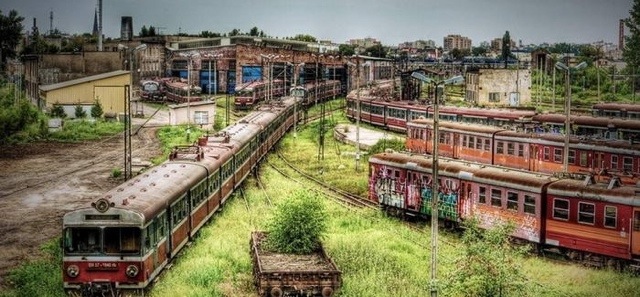
The Iron Ghosts of Czestochowa
In southern Poland, the city of Czestochowa is famous. Millions make the pilgrimage here. They come for the Jasna Góra Monastery, a holy site that houses the revered icon of the Black Madonna. It’s a place of faith, of prayer, of ancient history. But just beyond the holy grounds, past the sight of the faithful, lies a different kind of sanctuary. A graveyard.
A graveyard for giants.
This is the abandoned train depot of Czestochowa, a haunting expanse of rusting locomotives and decaying carriages. They sit on tracks being slowly swallowed by the earth, their iron bodies bleeding rust into the soil. These aren’t just a few forgotten cars. It’s a fleet of steel behemoths, frozen in time, waiting for a final departure that will never come.
What happened here? The simple answer is economics. The fall of the Soviet Union sent shockwaves through Poland’s state-run industries. The Polish State Railways, once a symbol of industrial might, underwent massive restructuring. Lines were cut. Depots were consolidated. These magnificent machines, once the lifeblood of a nation, were suddenly obsolete. Too expensive to run. Too costly to scrap. So they were simply… left.
Deep Dive: The Soviet Machine Grinds to a Halt
It’s hard for us to imagine the scale of it. Under the Soviet-influenced Polish People’s Republic, industry was everything. The railways were arteries, pumping coal, steel, and people across the country with brutal efficiency. These trains were workhorses, built for power, not comfort. They thundered through the countryside day and night. They were a constant. A certainty.
And then, one day, they weren’t.
The transition to a market economy in the 1990s was a brutal shock. Entire industries vanished almost overnight. A train depot like this would have employed hundreds. Engineers, mechanics, conductors, signal operators. Their lives were tied to the rhythm of the rails. When the trains stopped, their world stopped too. The silence that fell over this yard wasn’t just the absence of engine noise; it was the sound of a future being erased. Each rusting engine is a monument to a lost way of life.
What the Locals Whisper
But is that the whole story? Of course not. Urban explorers and local storytellers have woven new legends around the decaying depot. Some say that on certain moonless nights, you can see faint lights flickering inside the carriages, as if spectral passengers are still waiting. Others speak of a “Silver Arrow,” a phantom express train that was rumored to be a secret transport for high-ranking party officials, packed with state secrets and gold, that vanished from the network in the chaos of 1989. Could it be hidden somewhere in this maze of rotting steel, waiting to be found? It’s a fanciful tale, but in a place so heavy with history, you start to wonder. You start to feel the weight of every journey that ended right here, in this final, silent station.
The Frozen Ghost Ship at the Bottom of the World
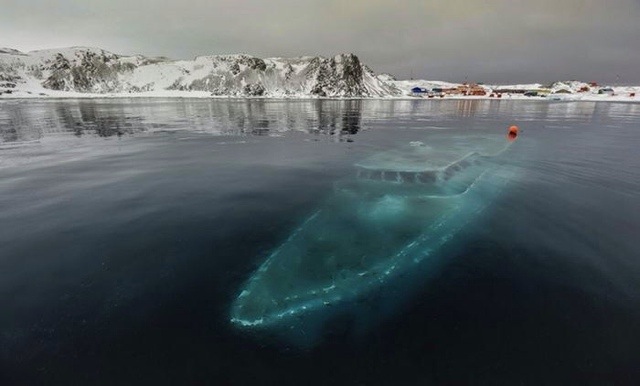
Look at this image. It’s unreal. A phantom vessel perfectly preserved in an underwater coffin of ice. This is not a movie set. This is the sunken yacht *Mar Sem Fim* (“Endless Sea”), a Brazilian research vessel resting in the shallow, freezing waters of Ardley Cove, Antarctica.
The official story is straightforward, a classic tale of man versus nature. In April 2012, the crew was filming a documentary when a fierce polar storm descended. Winds over 100 kilometers per hour trapped the yacht. The sea, churning violently, began to compress the ice around the hull. The pressure was immense. The boat was squeezed, its hull breached. The four researchers on board made a distress call and were rescued, but the *Mar Sem Fim* was lost. It sank to a depth of about 30 feet, where it remains, a ghostly monument in the crystal-clear water.
But this is Antarctica. Nothing is ever straightforward here.
Why was it left there for so long? Why did a mission get caught so unprepared by a storm? This continent is the most mysterious landmass on Earth, a place of extreme secrets and even more extreme theories. Could the *Mar Sem Fim* have been more than just a documentary boat?
Deep Dive: Antarctica’s Hidden History
For decades, conspiracy forums and alternative historians have pointed to Antarctica as a hotbed of hidden activity. The stories are wild. They talk about Operation Highjump, the massive post-WWII US naval expedition that some claim was a secret military operation to root out a hidden Nazi base, Neuschwabenland. They talk about strange magnetic anomalies detected beneath the ice, suggesting massive, unnatural structures. Some even whisper of ancient civilizations, flash-frozen and buried miles deep.
Think about it. A continent almost entirely unexplored beneath its icy shell. If you wanted to hide something—a base, a piece of technology, a discovery that would change the world—where better to do it?
Was the “Endless Sea” Looking for Something?
This is where the questions begin to swirl around the sunken yacht. Was a documentary the *real* reason for the voyage? Or was it a cover? Was the crew searching for evidence of these anomalies? Perhaps they got too close to something they weren’t supposed to see. A sudden, hyper-localized storm that appeared out of nowhere? It sounds like something from a spy thriller, but in a place as extreme as Antarctica, the line between reality and fiction gets very, very thin. The ship’s name, “Endless Sea,” has taken on a new, ironic meaning. It is now part of an endless sea of ice, forever guarding whatever secrets it might have found in the depths.
Where the Laughter Died: The Lawndale Theater
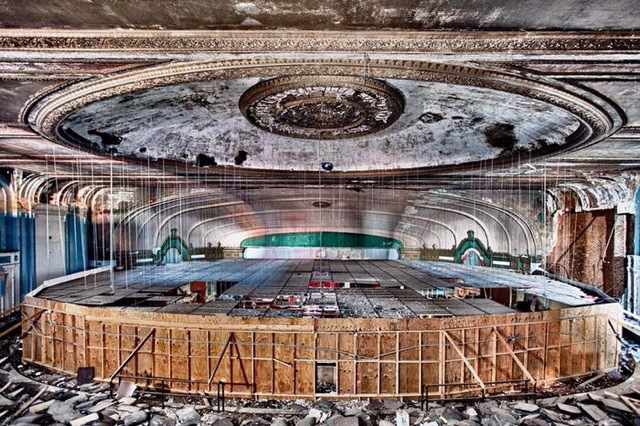
Every city has them. Grand old movie palaces, built in an era of glamour and spectacle, now sitting dark and silent. This is the Lawndale Theater in Chicago, a hollow shell of its former self. You can almost feel the energy here. The collective gasps, the laughter, the tears of thousands of audiences over decades, all soaked into the plaster and velvet.
Opened in the golden age of cinema, the Lawndale was a place of magic. A refuge. For a few hours, people could escape their lives and be transported to other worlds. But as television sets appeared in every living room and neighborhoods changed, the magic began to fade. The crowds thinned. The grand theater, once a gleaming palace, became a second-run movie house, and eventually, it became nothing. The doors were locked for the last time in the 1960s, and the silence began.
For over half a century, it has been decaying. Peeling paint hangs from the ornate ceiling like dead skin. The stage, which once hosted vaudeville acts and cinematic heroes, is now a platform for dust and debris. The seats, ripped and vandalized, look like rows of broken teeth in a gaping mouth.
A Stage for Specters
A place with this much emotional history doesn’t stay quiet for long. Urban explorers who have dared to venture inside have reported… things. The feeling of being watched from the empty projection booth. The faint sound of music from a long-dead organ. A sudden, inexplicable cold spot in the center of the grand balcony, right where a young woman supposedly took her own life after being jilted by a lover.
Is it just the wind whistling through broken windows? The groans of a dying building? Or is it something more? Energy, like matter, cannot be created or destroyed. All that emotion, all that focused human attention—does it just disappear? Or does it leave an imprint? An echo? The Lawndale Theater might be empty of the living, but many believe it is far from abandoned. It has simply traded one kind of audience for another, its final, endless show playing only for the shadows.
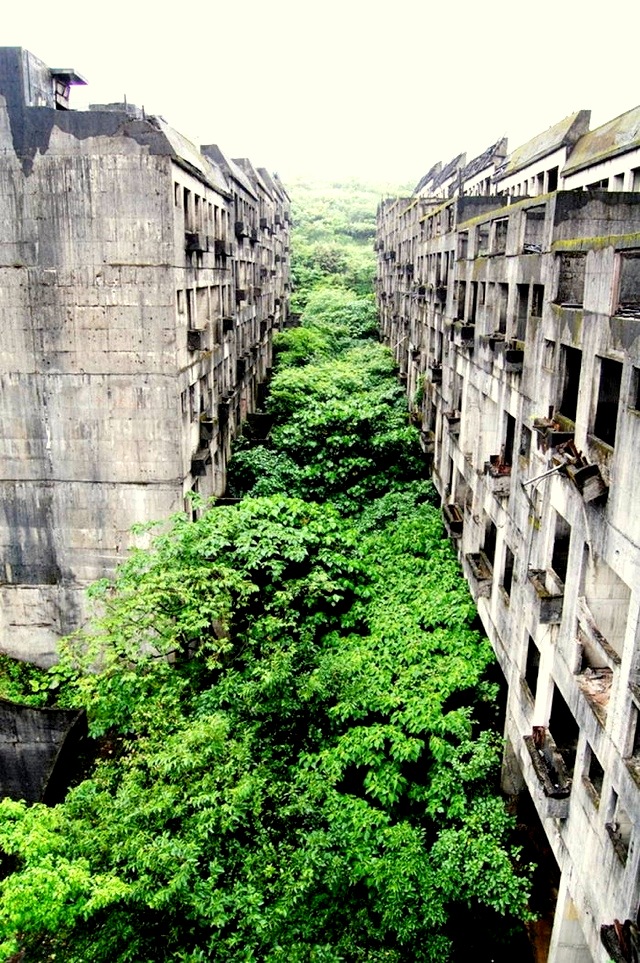
The Failed Utopia of Keelung
This isn’t just an abandoned building. It’s an abandoned dream. On a hillside overlooking the port city of Keelung, Taiwan, this massive apartment complex stands like a concrete skeleton. It’s a city within a city, designed for hundreds of families, now home only to pigeons and ghosts of “what could have been.”
What went wrong? The story is a familiar one in the world of rapid development. A hugely ambitious project, fueled by an economic boom in the 1990s, was supposed to create modern, desirable homes with stunning ocean views. But the developer allegedly cut corners. The construction was rumored to be shoddy, using sea sand in the concrete—a disastrous mistake that leads to rapid corrosion. Then, the company went bankrupt. And everything just… stopped.
The finished and half-finished buildings were left to the mercy of the elements. It’s a chilling sight. Hallways that should have echoed with the sounds of children playing are silent. Balconies designed for enjoying the sunset are crumbling. It’s a vision of the future that rotted before it ever had a chance to live.
Deep Dive: The Phenomenon of Ghost Cities
Keelung’s dead city isn’t an isolated case. It’s a small-scale example of a global phenomenon, particularly in Asia. We’ve all seen the stunning drone footage of China’s “ghost cities”—vast, sprawling metropolises built for millions, with gleaming towers, pristine parks, and six-lane highways… but no people. These projects are often driven by economic speculation rather than actual demand. They are bets on a future that hasn’t arrived, and sometimes, never does. They stand as eerie monuments to the hubris of unchecked ambition, modern-day Ozymandias statues made of steel and glass.
Modern Myths and Internet Sleuths
The Keelung complex has become a legend among Taiwanese locals and internet adventurers. It’s a popular (and dangerous) spot for urban exploration, and the stories that have come out of it are unsettling. People talk of it being built on a former graveyard. Drone pilots claim to have captured fleeting shapes moving behind the empty window frames. Online forums buzz with theories that the project was cursed from the start, a financial disaster that was simply the physical manifestation of a deeper spiritual problem. Whether you believe in curses or not, one thing is certain: walking through this silent, concrete jungle feels like stepping into an alternate reality where humanity has vanished.
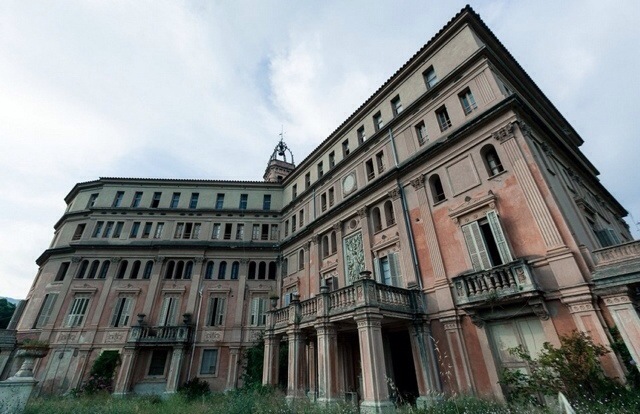
The Madman’s Tower Over Barcelona
Looming over the landscape near Barcelona, Spain, this structure looks like something from a fantasy novel. They call it the Governor’s Tower (Torre del Governador), but its history is far more personal and peculiar than its name suggests. This wasn’t a seat of government. It was the heart of a lavish, private estate, a bizarre and beautiful example of Catalan Modernist architecture.
This was once the summer residence of the Manresà family. At the turn of the 20th century, they hired a student of the legendary architect Gaudí to create a spectacular retreat. And he did. The estate was a wonderland of strange angles, vibrant mosaics, and organic forms. The tower itself was the crown jewel, a watchtower not for defense, but for pleasure—a place to survey the family’s domain and the sparkling sea beyond.
So why is it a ruin? The Spanish Civil War. The conflict tore the country apart, and the family was forced to flee. The house was occupied, ransacked, and eventually left to rot. The dream died. The laughter, the parties, the quiet moments watching the sunset from the top of the tower—all vanished, replaced by a slow, relentless decay.
Exploring the grounds today is a surreal experience. You can see the ghost of its former glory. A broken stained-glass window hints at the colors that once danced on the floor. A crumbling archway speaks to an elegance now consumed by ivy. The tower still stands, defiant. But it no longer watches over a pristine estate. It watches over its own slow death.
What secrets are held within these crumbling walls? What stories of love, loss, and war could they tell? We’ll never know. The Governor’s Tower, like all these places, keeps its secrets well. It reminds us that everything we build, no matter how grand or beautiful, is temporary. It’s all just borrowing time from the weeds and the rain. And in the end, nature always wins.
Originally posted 2014-02-14 21:29:26. Republished by Blog Post Promoter

Aloha, I’m Amit Ghosh, a web entrepreneur and avid blogger. Bitten by entrepreneurial bug, I got kicked out from college and ended up being millionaire and running a digital media company named Aeron7 headquartered at Lithuania.