The Silent Messenger from the Edge of Time
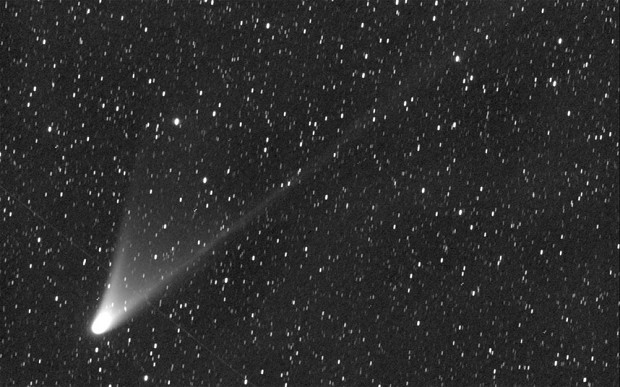
Stop what you are doing. Look at that image above. Really look at it. It looks like a smear of light, doesn’t it? Just another blurry photo in a sea of internet content. But that is where you’re wrong. Dead wrong.
What you are seeing is a traveler from the absolute void. A cosmic ghost.
We call it Comet C/2011 L4 Pan-STARRS. A boring, scientific name for something that is terrifyingly beautiful. It emerged from the darkness in June 2011, spotted by the Pan-STARRS telescope in Hawaii—a surveillance grid designed to scan the heavens for “killer rocks.” When they found it, this thing was a ghost, hovering over a billion kilometers away. Silent. Cold. Watching.
And now? It’s here.
This isn’t just a rock melting in the sunlight. This is a time capsule. This weekend marks the first time since the dawn of recorded history that human eyes on Earth can look up and see this object with the naked eye. It has already swept past the Southern Hemisphere, leaving astronomers stunned. They reported it burning as bright in the night sky as the stars of The Plough constellation. Think about the energy required to do that.
A Once-in-a-Civilization Event
Here is the kicker. This isn’t a regular visitor. Halley’s Comet? That comes back every 76 years. You might see it twice if you eat your vegetables and have good genetics. But Pan-STARRS?
It is a non-periodic comet.
That means it doesn’t care about our schedules. It doesn’t loop around in a tidy little circle. Its orbit is so massive, so incomprehensibly wide, that the last time it might have been in our neighborhood was roughly 100,000 years ago. Or maybe never. It might be a one-time visitor, swinging by to check on us before flinging itself back into the abyss, never to be seen again.
Let that sink in. 100,000 years.
If it was here before, who saw it? Not the ancient Egyptians. Not the Sumerians. We are talking about Neanderthals. We are talking about early Homo Sapiens migrating out of Africa, looking up at the night sky, huddled around a fire, wondering if that streak of light meant the gods were angry. Did they paint it on cave walls? Did they sacrifice to it?
Now, it returns to find a world of satellites, nuclear weapons, and digital noise. What a change.
The Electric Sky: Dirty Snowball or Plasma Discharge?
Mainstream science—the guys in the white coats who love to tell you everything is fine—will tell you a comet is just a “dirty snowball.” They say it’s a lump of ice and rock left over from the formation of the Solar System. When it gets close to the Sun, the heat melts the ice, creating gas. Boom. You get a tail.
Simple, right? Maybe too simple.
There is a growing community of alternative researchers who look at comets like Pan-STARRS and see something else entirely. Have you ever heard of the Electric Universe theory? If not, strap in.
The theory suggests that comets aren’t just melting ice balls. They are solid bodies moving through the Sun’s massive electrical field. As they scream toward the inner solar system, they pick up an electrical charge. That “glow” you see? That massive, million-kilometer tail? It might not just be gas. It could be plasma discharge. Like a neon sign buzzing in the vacuum of space.
When Pan-STARRS reaches its closest point to the Sun—about 45 million kilometers—it is interacting with solar forces we barely understand. It is waking up.
The core of this beast is estimated to be about 25 kilometers wide. That’s a rock the size of a major city. But the cloud of gas, dust, and potential plasma surrounding it? That stretches over one million kilometers. It is a monster. A giant, glowing anomaly moving through our backyard.
The Surveillance Grid: What is Pan-STARRS Really?
We need to talk about how this thing was found. The telescope that spotted it isn’t your grandpa’s backyard spyglass. It’s part of the Panoramic Survey Telescope and Rapid Response System (Pan-STARRS).
Notice the “Rapid Response” part? Rapid response to what?
Governments have spent billions scanning the sky. They tell us it’s for science. They tell us it’s to map the universe. But let’s be real. They are looking for threats. They are looking for the rock that has our name on it. The dinosaur killer.
In 2013, the same year this comet became visible, the Chelyabinsk meteor exploded over Russia with the force of 30 Hiroshima bombs. It injured 1,500 people. It blew out windows across six cities. And guess what? We didn’t see that one coming.
So we have Pan-STARRS, this massive eye in Hawaii, tracking a beautiful comet a billion kilometers away, while a smaller rock sneaks in and detonates over Russia. Was the comet a distraction? Or just a cosmic coincidence? In the world of alternative history, there are no coincidences.
The Viewing Window: A Race Against the Clouds
Okay, back to reality. You want to see this thing. You want to witness the traveler before it vanishes for another 100 millennia. Here is the situation on the ground.
Starting Friday night in the Northern Hemisphere, you can catch it. Grab a pair of binoculars. You don’t need a massive telescope; you just need patience and a little luck.
The comet will become gradually brighter until early next week. By then, if the gods of weather permit, it could be visible to the naked eye. A smear of light in the twilight.
The Weather Conspiracy (Just Kidding… Maybe)
Of course, just when the sky offers up a spectacle, the Earth decides to hide it. Typical.
Cloud cover is threatening to block the view for almost everyone except the lucky folks in the south west of England on Friday. If you are in Scotland, Saturday might be your only shot, specifically in the north west. The rest of us? We are at the mercy of the atmospheric chaos.
A spokesman for the Met Office—the people who control the weather narrative—gave a typical statement:
“There will be some cloud running in from the North Sea but there is a great chance of clear skies, particularly on Tuesday.”
Tuesday. Mark it on your calendar. That is the sweet spot. Fortunately, the cloudy fronts are expected to disperse in time for the best viewing opportunities early next week. This is exactly when the comet will appear brightest in the sky.
Why Tuesday? Because after its arrival in our field of view on Friday, the comet continues its suicide run toward the Sun. It reaches its closest point—perihelion—on Sunday. As it draws nearer, the heat intensifies. The “ice” (or electrical discharge) ramps up. The outer layer turns to gas. The brightness spikes.
The Cosmic Connection: Why This Matters
Why should you care about a ball of dust? Why write 2,000 words about a rock?
Because humans are pattern-seeking animals. For thousands of years, comets were seen as Harbingers. They foretold the death of kings. The fall of empires. The coming of plagues. When the Great Comet of 44 BC appeared, the Romans believed it was the soul of Julius Caesar ascending to divinity. When Halley’s Comet passed in 1066, the Anglo-Saxons saw it as an omen of their destruction at the hands of the Normans. They were right.
In 2013, as Pan-STARRS lit up the sky, Pope Benedict XVI became the first Pope to resign in 600 years. A meteor exploded over Russia. Political unrest swept the globe.
Is there a connection? A magnetic influence on the human brain? Or is it just the universe’s way of keeping time?
When you look up at C/2011 L4 Pan-STARRS this week, you aren’t just looking at astronomy. You are looking at history. You are seeing an object that is older than the pyramids. Older than language. It has been drifting in the freezing dark of the Oort Cloud—a theoretical shell of icy debris surrounding our solar system—waiting for its moment to shine.
How to Spot the Ghost
Don’t rely on apps. Use your eyes. Look West, just after sunset. Look for the twilight glow. It will be low on the horizon. If you see a fuzzy star with a tail pointing away from the Sun, you’ve found it.
Don’t miss it. Because once it’s gone, it is gone. It will slingshot around the Sun and head back out into the deep freeze. Maybe it will return in 100,000 years to see what’s left of us. Maybe the cockroaches will be running things by then. Maybe we will be star-travelers ourselves, chasing it down.
Or maybe, just maybe, this is the last time it ever visits a majestic, blue, living planet.
Keep your eyes on the skies.
Deeper Into the Rabbit Hole?
If you love this kind of deep-dive mystery, keep checking back. We don’t just report the news; we take it apart. The universe is stranger than they tell you. Much stranger.
Read More: Telegraph
Originally posted 2016-05-02 20:28:33. Republished by Blog Post Promoter

Aloha, I’m Amit Ghosh, a web entrepreneur and avid blogger. Bitten by entrepreneurial bug, I got kicked out from college and ended up being millionaire and running a digital media company named Aeron7 headquartered at Lithuania.