The Ghost City of the Pacific: Why Science Cannot Explain Nan Madol
Forget the Pyramids of Giza. Forget Stonehenge. There is a place in the middle of the Pacific Ocean that makes those ancient wonders look like child’s play. It’s called Nan Madol. And it shouldn’t exist.
Seriously. It physically shouldn’t be there.
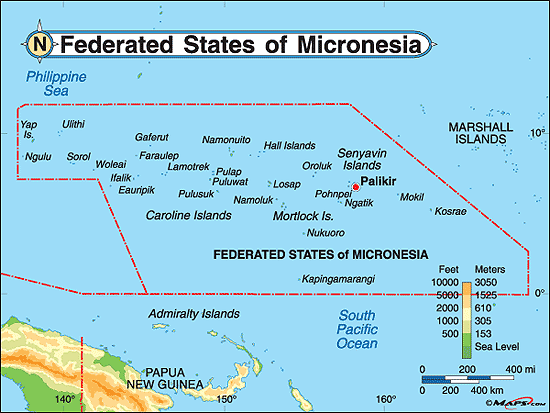
Located off the tiny island of Pohnpei in Micronesia, this massive abandoned city sits right on top of a coral reef. It’s a logistical nightmare. A construction impossibility. And it is hands down one of the most terrifying, confusing, and silenced mysteries on the face of the Earth.
Locals won’t go there at night. They say it’s the “City of Ghosts.” They say if you stay after dark, you die. Is it just superstition? Or is there a frequency, an energy, or a history here that we have forgotten?
Let’s rip this mystery wide open.
A City Built on Water?
Imagine trying to build a skyscraper on a swamp. Now, imagine doing it 1,500 years ago without cranes, without metal tools, and without wheels. Oh, and you’re building it in the middle of the ocean.
That is Nan Madol.
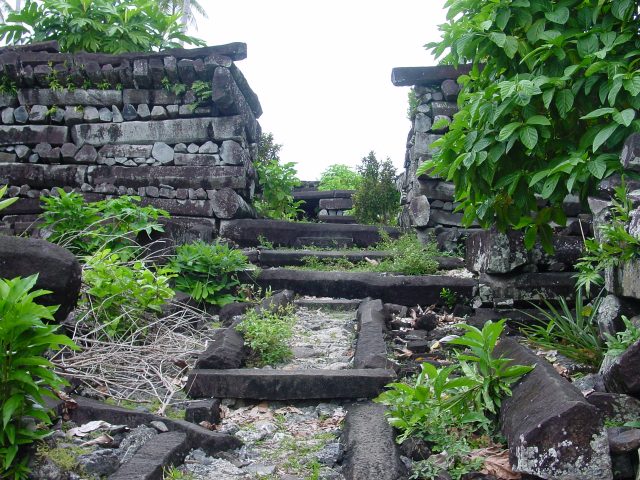
It consists of nearly 100 artificial islets. These aren’t just piles of dirt. They are geometric, heavy stone platforms separated by a network of tidal canals. It’s often called the “Venice of the Pacific,” but that nickname is too cute. Too safe. Venice is sinking wood and brick. Nan Madol is millions of tons of volcanic rock that refuses to budge.
The city covers an area of roughly 18 square kilometers. It’s massive. But the location is the first red flag. Why build here? Pohnpei is isolated. It is a speck in the vast Caroline Islands group, part of the Federated States of Micronesia (FSM). To find it on a map, look north of New Guinea and squint. It is thousands of miles from the nearest major civilization.
Yet, somehow, someone decided this remote reef was the center of the world.
The Impossible Math of the Black Rocks
Here is where the story gets heavy. Literally.
The city is constructed from columnar basalt. These are long, hexagonal logs of black volcanic rock. They look like petrified tree trunks, but they are solid stone. Some of the walls in Nan Madol stand 25 feet high and 17 feet thick.
The weight? It’s mind-numbing.
Experts estimate the total weight of the basalt used to build this city is around 750,000 metric tons. Let’s do the math on that. If the construction took four centuries, as mainstream archaeologists guess, the workers would have had to move 1,850 tons of rock every single year.
That is roughly 2,000 tons a year. Without pulleys. Without levers. Without steel.
But wait. It gets worse. Some of the individual stones weigh up to 50 tons. Fifty. Tons.
How do you move a 50-ton rock across a jungle? How do you float it over a coral reef without sinking your raft? Bamboo rafts can’t hold that weight. They would snap like toothpicks. And yet, these stones were quarried from the other side of the island, miles away, and transported over steep, impossible terrain, then floated out to the reef and stacked like Lincoln Logs.
Mainstream archaeology says: “It’s an unexplainable mystery.”
That’s code for: “We have no idea, and it scares us.”
The Legend of the Sorcerer Twins
If science can’t explain it, maybe the legends can. The oral history of the Pohnpeian people is very specific about how Nan Madol was built. They don’t talk about thousands of slaves dragging rocks.
They talk about magic.
According to the locals, two mysterious brothers arrived on the island ages ago. Their names were Olosopa and Olosipa. They weren’t normal men. They were “sorcerers” who came from a mythical land to the West. They were looking for a place to build an altar to the farm god.
The legend states that these brothers didn’t lift the rocks. They used a dragon to help them, and they performed a ceremony that caused the massive basalt logs to levitate.
You heard that right. Levitation.
They “flew” the heavy stones through the air and placed them gently into position. Sound crazy? Maybe. But look at the internet theories circulating today regarding acoustic levitation. We know that sound waves can lift small objects. Did ancient civilizations figure out how to scale this up? Did they use frequency and vibration to render stone weightless?
When you look at the Great Pyramid, similar legends exist. When you look at Baalbek in Lebanon, similar legends exist. Why does every ancient impossible structure have a story about flying rocks? Coincidence? Or technology we forgot?
The Saudeleurs: Tyrants of the Reef
The city became the seat of the Saudeleur Dynasty. These were the rulers of Pohnpei, and they were not nice guys. Nan Madol wasn’t just a city; it was a cage.
Historians believe the city was designed to house the nobility. But it was a trap. By forcing the local chiefs to live in Nan Madol, the Saudeleur emperors could keep an eye on them. It was a control mechanism. If you are living on a rock in the middle of the water, you rely on the Emperor for food, for fresh water, for everything.
There is no fresh water on Nan Madol. Let that sink in. They built a massive stone city for 1,000 people, and they had to canoe in every drop of water and every scrap of food.
Why? Why go to that much trouble?
Unless the location was more important than survival. Unless the spot on the reef had some power, some magnetic alignment, or some strategic value we don’t understand today.
The Magnetic Anomaly Theory
Here is a piece of the puzzle that often gets scrubbed from the textbooks. Some researchers have found that the basalt rocks at Nan Madol are magnetized. When you hold a compass up to certain stones, the needle spins wild.
Did the builders choose these specific rocks for their magnetic properties? Was Nan Madol a machine? An energy generator? Some alternative historians suggest that the city interacts with the Earth’s telluric currents. If the “flying rock” legend is true, maybe magnetism played a role in how they moved the stones.
The Lost Continent Connection: Is This Lemuria?
You can’t talk about Nan Madol without bringing up the “Motherland.”
In the late 19th and early 20th centuries, writers like James Churchward popularized the idea of Mu, or Lemuria. This was a supposed lost continent in the Pacific, similar to Atlantis in the Atlantic. The theory goes that a massive cataclysm sank the continent, leaving only the highest peaks above water.
Is Pohnpei one of those peaks?
Is Nan Madol the remnant of a much older, much more advanced civilization that was mostly wiped out by a flood? The construction style doesn’t match the primitive tools found in the area. It looks like the work of a society that had advanced engineering capabilities, then suddenly vanished.
If you look at the ocean floor maps around Micronesia, there are strange formations. Plateaus that look like they used to be islands. Could the ruins of Nan Madol be just the tip of the iceberg? What lies beneath the waves?
The Horror Under the Water
Speaking of what lies beneath… this is where the story turns into a horror movie.
There are rumors of an extensive network of tunnels beneath the city. An escape route. The legend says a tunnel began at the center of Nan Madol and bored straight down through the reef, exiting into the open ocean.
Divers have been looking for it for decades. They found openings. They found caves. But they haven’t found the end.
In 2012, a tragedy occurred that few people talk about. A group of divers went exploring the larger submerged caves near the city. They vanished. Gone. No bodies recovered. Just… emptiness.
Locals claim there are spirits guarding the underwater entrances. They speak of “Platinum Coffins.”
The Platinum Coffin Conspiracy
During the Japanese occupation of Micronesia before World War II, the Japanese military was very interested in Nan Madol. But they weren’t there for sightseeing.
Reports from that era claim the Japanese divers found sarcophagi at the bottom of the reef. These coffins were allegedly made of solid platinum. Not gold. Platinum. Platinum is rare, harder to work with, and incredibly valuable.
The story goes that the Japanese stripped the city of these platinum artifacts and shipped them out. But did they get them all? And who was buried in solid platinum coffins underwater? Humans? Or the “Sorcerer Twins”? Or something else entirely?
After the war, the records of these findings disappeared. But the locals remember the Japanese dredging the canals. They remember the activity.
The Cthulhu Connection
The vibe of Nan Madol is so unsettling that it inspired the master of horror himself, H.P. Lovecraft. While Lovecraft never visited the island, many scholars believe his fictional city of R’lyeh—the sunken nightmare city where the monster Cthulhu sleeps—was based on descriptions of Nan Madol.
Non-Euclidean geometry? Check. Weird angles? Check. Massive, cyclopean masonry dripping with seaweed? Check.
It is a place that feels “wrong” to the human mind. The angles of the walls don’t make sense. The silence of the place is heavy. Birds rarely sing there.
Why Haven’t We Solved It?
So, why isn’t this on the nightly news? Why aren’t universities swarming over Pohnpei?
Because it’s hard. The jungle is eating the city alive. The mangroves are tearing the walls apart. It is hot, humid, and full of mosquitoes. It is not an easy place to work.
But recently, technology has started to peel back the layers. New LIDAR scans (laser radar used to see through trees) have revealed that Nan Madol is much bigger than we thought. It connects to other ruins on the main island. It wasn’t just a city; it was a metropolis.
And yet, the core question remains: How?
How did they move the stones? Why did they build on a reef? Where did they go?
The Saudeleur Dynasty ended abruptly. Legend says a hero named Isokelekel invaded and overthrew them. But the city was eventually abandoned. The people left the stone platforms and went back to the hills. They left the ghosts alone.
The Final Verdict
Today, Nan Madol sits quietly in the water. The tides wash over the black rocks. The crabs scuttle across the altars where priests once stood.
It is an archaeological district now, covering 18 square kilometers. Tourists can visit, but few do. It’s too far. Too expensive. And frankly, too spooky.
We want to believe that we know everything about human history. We want to believe that our ancestors were simple people with stone hammers. But Nan Madol screams at us that we are wrong. It stands as a silent monument to a time when humans (or something else) could do the impossible.
Was it acoustic levitation? Was it lost ancient technology? Was it giants? Or was it just sheer, brutal human willpower that we can no longer comprehend?
Next time you look at a map of the Pacific, find that little dot named Pohnpei. Zoom in. And ask yourself: What are they hiding down there?
Because whatever built Nan Madol didn’t just stack rocks. They sent a message. And 1,500 years later, we still haven’t figured out how to read it.
Originally posted 2016-12-16 12:32:03. Republished by Blog Post Promoter

Aloha, I’m Amit Ghosh, a web entrepreneur and avid blogger. Bitten by entrepreneurial bug, I got kicked out from college and ended up being millionaire and running a digital media company named Aeron7 headquartered at Lithuania.