They tell us space is silent. They tell us it’s a cold, dead vacuum where nothing happens for millions of years. But every once in a while, the universe checks its watch. Gears click into place. Massive, world-ending spheres align with a precision that makes the best Swiss watchmakers look like amateurs.
We just witnessed one of those moments.
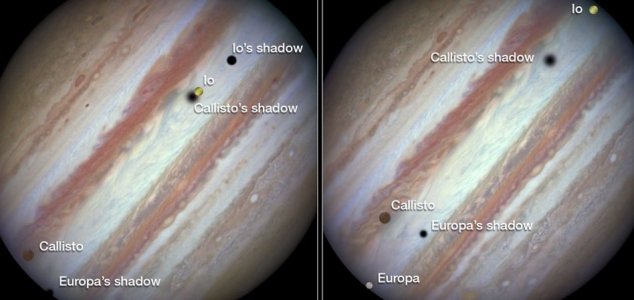
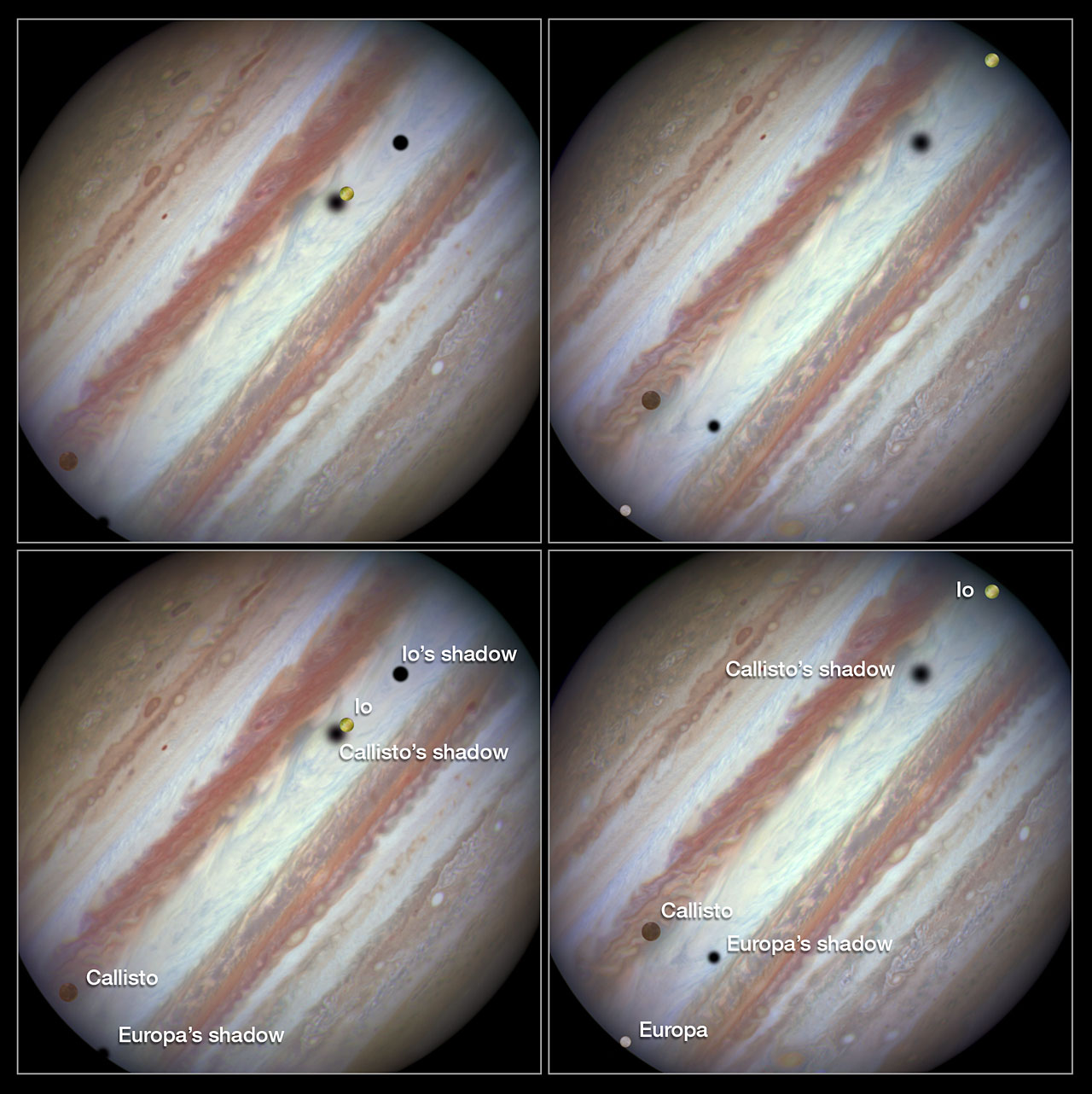
Look at that image. Really look at it. It’s not a computer generation. It’s not an artist’s rendering from a sci-fi movie about aliens invading the solar system. That is a raw, terrifying, beautiful capture from the Hubble Space Telescope. It shows three of the most mysterious objects in our neighborhood crossing the face of the King of Planets simultaneously.
Europa. Callisto. Io.
Three moons. One giant gas monster. A rare transit event that screams at us from the void. While you were grabbing coffee or sitting in traffic, a cosmic ballet was happening 400 million miles away. And thanks to some high-tech glass floating in orbit, we got a front-row seat.
The King of the Solar System: A Terrifying Monster
Before we dig into the mystery of this triple alignment, let’s talk about the stage this play is acted upon. Jupiter.
We learn about it in grade school. “The big red one.” But do you grasp the sheer scale of this beast? It is a nightmare of physics. You could fit 1,300 Earths inside Jupiter. If Earth were a grape, Jupiter would be a basketball. But it’s not solid ground. You can’t land on Jupiter. There is no “there” there.
It is a swirling, screaming ball of hydrogen and helium. The winds clock in at hundreds of miles per hour. The storms? They last for centuries. The Great Red Spot—that famous eye looking back at us—is a hurricane twice the size of Earth that has been raging since before the United States existed. Probably longer.
And the radiation? Lethal. If you flew a standard spaceship too close, the electronics would fry, and your DNA would unzip before you even hit the upper atmosphere. It is the boss level of the solar system.
A Failed Star?
There is a theory floating around the darker corners of the internet, and even in some serious astronomical circles, that Jupiter is a “failed star.” It has the same ingredients as our Sun. Hydrogen, helium. If it had been just a little bit bigger—okay, about 80 times more massive—it would have ignited. We would have had a binary star system. Two suns in the sky. Night would be a memory.
Instead, it sits there. Dark. Brooding. A massive gravitational bully that yanks asteroids out of orbit and flings them around. Some say it protects Earth, acting like a giant vacuum cleaner for space rocks. Others think it’s a ticking time bomb waiting for a spark.
The Triple Threat: What Actually Happened?
The Hubble Space Telescope picked up the moment three of Jupiter’s moons crossed its face at the same time. This isn’t a daily occurrence. It’s not even a yearly one.
In the chaotic dance of the Jovian system, singular transits happen all the time. Jupiter has a verifiable miniature solar system of its own. We are talking about at least 63 small moons and 4 massive ones—the Galilean moons. They buzz around the giant like flies around a streetlamp.
But getting three of the “Big Four” to line up in the camera frame? That is rare. It happens maybe once or twice a decade. It’s a moment where the chaotic math of the cosmos syncs up perfectly.
The images released captured a period of just over 40 minutes. Forty minutes where Europa, Callisto, and Io were silhouetted against the swirling cloud tops of their parent world. To an observer standing on Jupiter (if you could stand without being crushed instantly), you would have seen three solar eclipses happening at once. The sky would have gone dark in waves.
The Players: A Deep Dive into the Moons
Why does this matter? Because these aren’t just rocks. These are worlds. Each one has a personality, a history, and potentially… inhabitants? Let’s break down the trio that photo-bombed the giant.
1. Europa: The Water World
If you are looking for aliens, forget Mars. Mars is a dusty, dead sandbox. Look at Europa.
Europa is the star of the show. It’s covered in a shell of ice that is miles thick. But underneath that ice? Scientists are almost certain there is a global ocean of liquid water. Not just a puddle. An ocean with more water than all of Earth’s oceans combined.
Heat from Jupiter’s gravity stretches and squeezes the moon, keeping the core warm. This means the ocean stays liquid. Warm water + organic chemicals + time? That is the recipe for life. We see massive geysers shooting water vapor into space from cracks in the ice. NASA is planning missions right now to fly through those plumes and taste the water.
Arthur C. Clarke, the sci-fi legend, wrote “2001: A Space Odyssey.” In the sequel, the mysterious alien monoliths turn Jupiter into a star to warm up Europa and jump-start evolution. The warning sent to Earth was chilling: “ALL THESE WORLDS ARE YOURS EXCEPT EUROPA. ATTEMPT NO LANDING THERE.”
Did Clarke know something? Why is this moon so special? Seeing it transit Jupiter reminds us that it is hiding secrets beneath that cracked, icy shell.
2. Io: The Hellscape
On the other side of the spectrum, we have Io. If Europa is heaven, Io is hell. Literally.
It is the most volcanically active body in the solar system. It looks like a moldy cheese pizza, covered in yellows, oranges, and reds. That’s sulfur. Hundreds of volcanoes erupt constantly, spewing lava miles into the sky. It smells like rotten eggs and fire.
Why is it so angry? Gravity. Jupiter pulls it one way; the other moons pull it the other way. The entire moon physically bulges up and down by 300 feet every single orbit. The friction turns the rock into liquid magma. It is a world constantly turning itself inside out.
In the Hubble image, Io is the fast mover. It whips around Jupiter in less than two days. It’s a speed demon on a track of fire.
3. Callisto: The Battered Witness
Then there is Callisto. The old one. The scarred one.
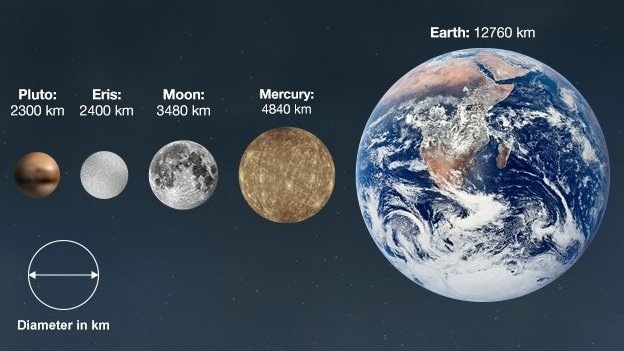
Callisto is the third-largest moon in the solar system and is roughly the size of Mercury. It is the most heavily cratered object we know of. Every inch of it has been smashed by asteroids and comets for four billion years.
It doesn’t have the volcanic reshaping of Io or the shifting ice plates of Europa. It just sits there and takes the hits. It is a fossil. A dead record of the violence of the early solar system. If you want to know what happened 4 billion years ago, you ask Callisto.
Seeing these three disparate worlds—the Ice Queen, the Volcanic Demon, and the Ancient Witness—all crossing the band of Jupiter at once is a reminder of how diverse our own backyard is.
The Hubble Legacy: Why We Keep Watching
These images were snapped by Hubble. That telescope is a legend. It’s been floating up there since 1990. It has rewritten the textbooks. It showed us the age of the universe. It showed us black holes.
But there is something haunting about it turning its eye back to our own family of planets. We spend so much time looking for exoplanets light-years away, dreaming of “Super Earths,” that we forget the monsters living next door.
Capturing this transit wasn’t easy. Jupiter spins fast. A day on Jupiter is only about 10 hours long. The moons are whizzing by at thousands of miles per hour. Hubble is orbiting Earth at 17,000 miles per hour. Snapping a clear photo of this alignment is like trying to shoot a bullet out of the air with another bullet while riding a roller coaster.
But they did it.
The Galileo Connection: A History of Heresy
We can’t talk about these moons without tipping our hats to the man who discovered them: Galileo Galilei.
Back in 1610, he pointed a homemade spyglass at Jupiter. He saw four little dots. Night after night, he watched them dance. He realized they weren’t stars. They were orbiting Jupiter.
This changed everything. It broke the world. Literally.
At the time, the powers that be (the Church and the established scientists) insisted that everything revolved around the Earth. We were the center of the universe. It was an ego thing. But if these moons were orbiting Jupiter, then not everything orbited Earth. The system was broken.
Galileo was dragged before the Inquisition. He was forced to recant. He spent the rest of his life under house arrest. All because he saw what Hubble just photographed: moons moving around a planet.
When we look at this triple transit, we are looking at the evidence that almost got a man burned at the stake. It is the visual proof that we are not the center of existence. We are just a small rock in a very crowded, very busy neighborhood.
The Electric Connection: A Different Perspective?
Here is where things get strange. Standard science tells us this is all gravity. Mass attracting mass.
But there is a growing community of researchers looking into the “Electric Universe.” They argue that the interactions between Jupiter and its moons aren’t just gravitational—they are electrical. Huge currents of electricity flow between Io and Jupiter. We know this for a fact; we can hear it on radio telescopes. It sounds like popcorn popping or ocean waves.
Some theorists believe that the “craters” on Callisto aren’t from impacts, but from massive interplanetary lightning strikes in the ancient past. They think the “volcanoes” on Io might be plasma discharge machining the surface. It’s a wild theory, shunned by the mainstream, but when you look at the violence of the Jovian system, you have to wonder.
Is Jupiter actually a giant electrical transformer? Are the moons acting as capacitors? When they align like this, does it create a surge? A circuit completion?
We don’t feel it here on Earth… or do we? Astrologers have talked about planetary alignments affecting human behavior for millennia. Science laughs at it. But if these are massive electrical bodies interacting, who knows what subtle waves ripple out through the solar system?
The Future: We Are Going Back
This photo is just a teaser. We aren’t satisfied with grainy images anymore. We are going back.
ESA (the European Space Agency) has launched the JUICE mission (Jupiter Icy Moons Explorer). NASA is launching the Europa Clipper. These aren’t just flybys. These are dedicated hunters.
The Europa Clipper is going to swoop down just 16 miles above the surface of Europa. It’s going to use ground-penetrating radar to see through the ice. It’s going to sniff the atmosphere. It is hunting for life.
Imagine the headlines ten years from now. “NASA Confirms Microbes in Europa’s Ocean.” It would be the biggest news in human history. We would no longer be alone. The universe would suddenly feel very crowded.
The Shadow of the Monolith
Why does this specific image resonate so much? Because it creates a sense of scale that human brains struggle to comprehend. The shadow of Europa on Jupiter’s clouds is bigger than the continent of North America.
Think about that.
A shadow the size of a continent, racing across a storm the size of a planet, cast by a moon that might hide alien squids in a dark, warm ocean.
Space isn’t just math. It’s drama. It’s horror. It’s mystery. This “rare transit event” is a reminder that the clockwork of the solar system keeps ticking whether we are watching or not. Hubble just happened to look up at the right second.
So next time you look up at the night sky and see that bright unblinking star that is Jupiter, remember what is happening up there. The storms are raging. The volcanoes on Io are exploding. The ice on Europa is cracking. And the great cosmic dance continues, silent and terrifying.
Keep your eyes on the skies.
Originally posted 2015-11-11 15:29:19. Republished by Blog Post Promoter

Arindam loves aliens, mysteries and pursing his interest in the area of hacking as a technical writer at ‘Planet wank’. You can catch him at his social profiles anytime.