The Woman Who Says She’s A Cat: A Medical Anomaly or Something More?
Forget what you think you know about identity. Forget psychology textbooks and neat little boxes. We’re about to go somewhere else entirely.
What if you woke up one morning and the reflection in the mirror felt… wrong? Not just a bad hair day. Wrong on a fundamental, biological level. The hands, the voice, the way you walked on two legs—it all felt like a costume you couldn’t take off. This is the world of a Norwegian woman named Nano. And her story will challenge everything you believe about what it means to be human.
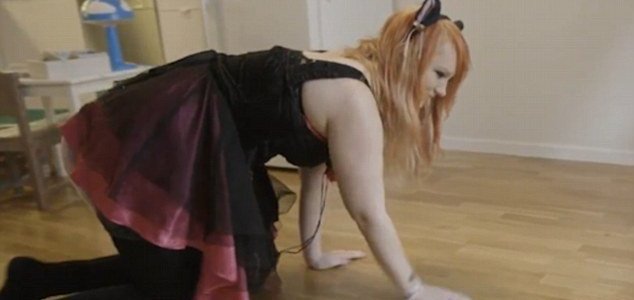
At first glance, she looks like any other young woman. But look closer. The ears aren’t just a fashion statement. The tail isn’t a joke. For Nano, these are corrections. Fixes for a cosmic mistake.
Because she says she’s a cat.
A cat born into the wrong body.
The Awakening: When The Human Mask Slipped
For Nano, life wasn’t always this clear. Childhood was a blur of feeling out of place. A strange sense of disconnection she couldn’t name. Then, at 16, everything clicked into place. It was a terrifying, yet liberating moment of truth.
“I realized I was a cat when I was 16 when doctors and psychologists found out what was ‘the thing’ with me,” she explained in an interview that quickly went viral. This wasn’t a phase. It wasn’t a metaphor. It was, in her own words, a diagnosis.
What did they find? According to Nano, it was a “genetic defect” present at birth. A biological misprint. A glitch in the code of life that put a feline consciousness into a human form. Think about that for a second. The implications are staggering. Could our DNA hold secrets far beyond eye color and height? Could it dictate the very species of our soul?
Deep Dive: The “Genetic Defect” Theory
This is where the story explodes from a personal account into a full-blown biological mystery. The phrase “genetic defect” is tantalizingly vague. It’s the kind of breadcrumb that sends internet detectives into a frenzy. What could it possibly mean?
Skeptics immediately dismiss it. There is no known, medically recognized genetic condition that makes a human identify as a different species. It’s not in any diagnostic manual. But does that mean it’s impossible? History is filled with medical conditions that were once dismissed as hysteria or spiritual possession before science caught up.
Let’s entertain the idea. What if there are dormant genes in our DNA, ancient echoes from a shared evolutionary past? Could a random mutation reactivate a piece of code that influences instinct and perception on a profound level? Some online theorists point to the concept of “junk DNA”—the 98% of our genetic code whose function we don’t fully understand. For decades, it was considered useless filler. Now, scientists are finding it’s full of switches that control other genes. Could a faulty switch be the source of Nano’s feline identity? A switch that, instead of ‘human,’ is flipped to ‘cat’?
It sounds like science fiction. But is it any stranger than a caterpillar liquefying in a chrysalis and emerging as a butterfly? Nature is filled with transformations that defy belief.
Living the Feline Life: Instincts Take Over
For Nano, this isn’t just a belief she holds. It’s a reality she lives every single day. Her human life is a constant battle against a flood of feline instincts. Instincts that are raw, powerful, and completely out of place in human society.
Take her senses. She claims they are supercharged. She can see in the dark, navigating dimly lit rooms with an ease that baffles her friends. She picks up on sounds no one else hears—the quiet skittering of a mouse behind a wall, the distant hum of an appliance. Is this a physical superpower, or has her mind simply learned to pay attention to stimuli the rest of us filter out?
Her behavior is even more telling. Water isn’t just something she dislikes; it’s something she fears on a primal level. A simple shower can be an ordeal. And her interactions with other animals? Pure instinct.
“Sometime I hiss when meeting dogs in the street,” she admits. “It’s because of their behavior and my instinct automatically reacts by hissing.”
It’s not a choice. It’s a reaction. A hard-wired response she can’t control. She also purrs when she’s happy and meows to communicate. She’s been known to get on all fours, feeling more comfortable and natural moving that way than walking upright.
Species Dysphoria: When The Body is a Cage
Nano’s story might seem isolated, but she is far from alone. She is part of a vast, mostly hidden community of people known as “Otherkin” and “Therians.”
A Therian is someone who identifies, on an integral and personal level, as a non-human animal. An Otherkin is a broader term for those who identify as something other than human, which can include mythological creatures like dragons or elves. For decades, these communities existed in the quiet corners of the early internet, on forums and message boards, sharing experiences they couldn’t talk about in the real world.
The core concept they often discuss is “species dysphoria.” It’s the profound and distressing feeling that your physical body does not match your true species identity. You feel trapped. A wolf in sheep’s clothing, or in this case, a cat in a human’s. You might feel “phantom limbs”—the sensation of having wings, a tail, or ears that aren’t physically there.
Is this a psychological condition? A spiritual belief? A neurological quirk? The community itself has no single answer. Some believe in reincarnation, that they were animals in a past life. Others, like Nano, look for a scientific explanation, hoping that one day medicine will understand their unique wiring. And many simply accept it as their truth, without needing an external label or validation.
The Online Reaction: From Meme to Movement
When Nano’s story first broke, the internet did what it always does. It exploded. She became an instant meme, a punchline on late-night talk shows. The comments sections were a brutal mix of mockery and disbelief.
But then, something else happened. Beneath the noise, thousands of people reached out in support. People from the Therian and Otherkin communities saw her as a hero—someone brave enough to tell her story on a global stage. They saw their own struggles reflected in her words, their own sense of alienation validated.
In the years since, the conversation has shifted. On platforms like TikTok and Reddit, you’ll find entire communities dedicated to exploring non-human identity. Young people share videos of themselves “shifting”—a term used to describe the experience of their animal side becoming more prominent. They share art, stories, and support, creating a space where they don’t have to pretend.
This modernization of the phenomenon raises new questions. Is the internet simply giving a voice to a pre-existing group, or is it contributing to the spread of the identity itself? Is being a cat-person the ultimate form of self-expression in a world where traditional labels are breaking down?
What If It’s Not Just in Her Head? Exploring the Fringe
Let’s put psychology aside for a moment. Let’s push past genetics. What if the explanation is even weirder? This is where the story gets really interesting for a true conspiracy researcher.
What if Nano is a new type of human? A harbinger of an evolutionary leap? Throughout history, there have been stories of people with animal-like abilities. Shamans in indigenous cultures who could allegedly communicate with or shapeshift into animals. The Berserkers of Norse legend, warriors who fought with the ferocity of bears. Were these just myths, or were they accounts of people like Nano, whose connection to the animal world was more than just metaphorical?
Some theories propose a psychic or spiritual connection. The idea that a powerful animal spirit could attach itself to a human soul at birth, blending its consciousness with the host. In this view, Nano isn’t delusional; she’s co-habiting her body with a feline spirit. Her instincts, her senses, her purrs and hisses—they aren’t hers. They belong to the cat within.
This is a reality that exists far outside the sterile walls of a doctor’s office. It suggests that consciousness might be more fluid than we ever imagined, capable of crossing the sacred line between species. It’s a mind-bending possibility, and one that is impossible to prove or disprove.
A Life Lived on Her Own Terms
Whatever the explanation—genetic, psychological, or paranormal—one thing is certain: Nano is committed to living her truth. She wears her ears and tail not as a costume, but as a part of her body. She navigates the world with a unique perspective, seeing and hearing things the rest of us miss.
Her psychologist once told her it was something she might “grow out of.” Nano disagrees. And why should she?
“I think I will be cat all my life,” she states, with a quiet confidence that is hard to dismiss.
In a world obsessed with conformity, her story is a radical act of self-acceptance. It forces us to confront our own rigid definitions of “normal.” Is Nano a medical puzzle to be solved? Is she a psychological case study? Or is she simply a person who has found a way to be happy in a body that wasn’t quite made for her?
Perhaps the real mystery isn’t why one woman identifies as a cat. The real mystery is why the rest of us are so determined to keep everyone in the same box. The truth is out there, and sometimes, it meows.