20 Natural Phenomena or Glitches in the Matrix? You Decide.
Forget what you think you know. Our world is a museum of anomalies, a gallery of glitches in the code of reality. Science has its explanations, of course. Neat little boxes for everything that feels strange and otherworldly. But what if those explanations are just the cover story? What if these spectacular, rare, and sometimes terrifying phenomena are not just random acts of nature, but messages? Warnings? Or evidence of forces we were never meant to understand?
We’re peeling back the curtain. We’re looking at the raw data the mainstream narrative wants you to ignore. Prepare to question everything. The rabbit hole is deep, and the world is far, far weirder than they tell you.
20. The Etruscan Vase Moon: A Glitch in Our Sky?
![]()
The Official Story
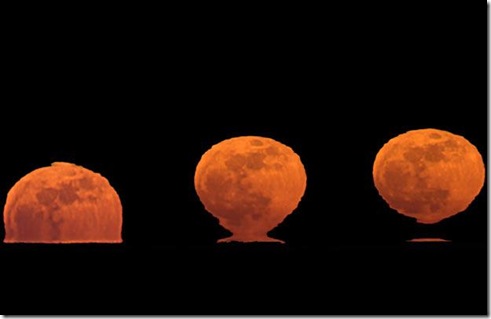
They’ll tell you it’s a simple trick of the light. A “superior mirage.” As the full moon rises, its light passes through different layers of air at different temperatures—a hot layer sitting on top of a cold one. This atmospheric inversion, they say, bends the light, creating a distorted, vase-like shape. They even have a name for the colored rims you sometimes see: atmospheric refraction. It’s all very neat. All very tidy.
But What Are We Really Seeing?
Is it a distortion? Or are we, for a fleeting moment, seeing the moon’s *true* shape? Or the shape of something else hiding behind it? Think about it. UFO sightings often describe craft that shimmer, distort, and appear to change shape. Could a massive, cloaked object use the moon for cover, its form only betrayed when our atmosphere acts like a faulty lens? Ancient cultures didn’t have “atmospheric inversion” to explain away what they saw. They had stories of multiple moons, of celestial boats, of cosmic battles. The green and red flashes reported by the photographer are classic elements of high-energy phenomena. This isn’t just a pretty picture. It’s a crack in the facade of our sky.
19. Green Lake, Austria: The Sunken Kingdom of Styria
![]()
A Park That Drowns
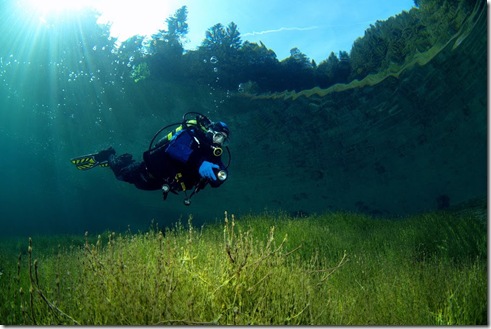
Every year, it happens like clockwork. The winter snows on the Hochschwab mountains melt, and the pure, clear water rushes down to flood a beautiful park. Benches, bridges, and walking paths all vanish beneath an emerald blanket of water. For a few short months, a hiker’s paradise becomes a diver’s dream. A temporary Atlantis. The water is so clear you can see the flowers still blooming on the submerged meadow floor. Then, just as mysteriously, the water recedes, and the park returns, ready for winter hikers once more.
Secrets Beneath the Surface
But is it just a park? What if this annual drowning is a ritual? A baptism by nature. For half the year, it exists in our world. For the other half, it belongs to another. Divers and online explorers whisper about it. They talk of a strange silence down there, an eerie feeling of being watched from the submerged trees. They say the light plays tricks on you. That you see things moving in the periphery. Could this be a seasonal portal? A place where the veil between two worlds becomes thin, one dry and one wet? What secrets are submerged with those park benches, waiting for the ice to melt so they can live again?
18. Underwater Crop Circles: A Pufferfish’s Passion or Something More?
![]()
The Artist Pufferfish Theory
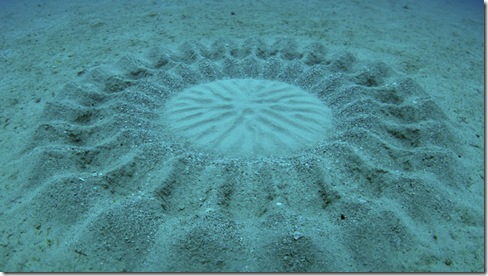
For years, these stunningly geometric patterns on the seafloor off the coast of Japan were a total mystery. Then, in 2011, scientists claimed they found the artist: a tiny male pufferfish, no bigger than your hand. They say he works 24/7, flapping his fins to sculpt these massive sand mandalas, all to attract a female. He even decorates them with shells. It’s a cute story. A romantic story. And maybe, just maybe, it’s exactly what they want you to believe.
Are We Ignoring the Obvious?
Let’s be real. We see complex geometric patterns and our first thought is “aliens.” Crop circles on land have been a cornerstone of UFO lore for decades. So why, when we find their identical cousins under the sea, do we accept the “horny fish” explanation without question? The patterns are mathematically perfect. They show a knowledge of fractal geometry that seems a bit advanced for a fish, don’t you think? USOs—Unidentified Submerged Objects—are reported just as frequently as UFOs. What if these aren’t nests? What if they are energy conduits? Landing markers? Or a form of communication from a deep-sea intelligence we have yet to discover? An intelligence that has been watching us from the abyss all along.
17. Where the Baltic and North Seas Meet But Never Mix
![]()
A Battle of Densities
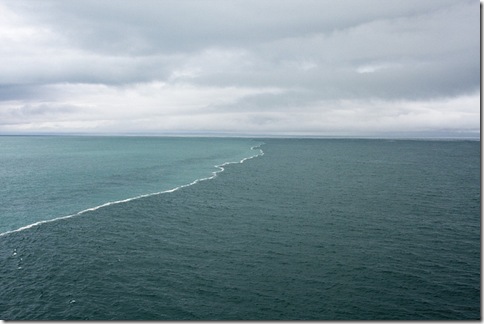
At Skagen, the northernmost tip of Denmark, you can stand on the beach and witness a war. It’s a silent, slow-motion conflict where two mighty seas, the Baltic and the North, collide. But they do not merge. A clear line separates them, as if an invisible wall runs down the middle of the ocean. The scientific reason given is a difference in density and salinity. The two bodies of water are simply incompatible, so they meet in a perpetual standoff.
An Invisible Barrier
But ancient myths and modern mystics talk about such places. They call them ley lines. Places of power. Energetic boundaries that are invisible to most, but physically manifest in unique ways. Is it just about density? Or is this a physical manifestation of a powerful telluric current? A place where two different kinds of planetary energy meet? Old sea charts are filled with warnings about such places, tales of ships getting lost, of compasses spinning wildly. Perhaps the “different densities” are not just of salt and water, but of something far more fundamental. A border not just between two seas, but between two different energetic zones of our own planet.
16. The Ghost Trees of Pakistan
![]()
A Plague of Spiders
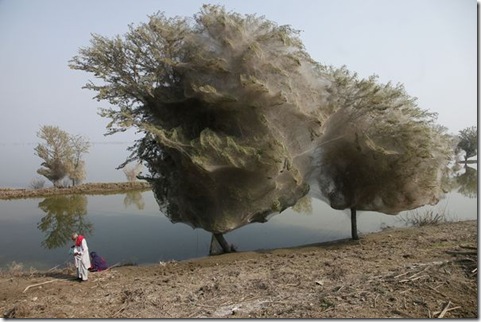
In 2010, Pakistan was devastated by historic floods. The waters rose so high and stayed for so long that a bizarre and unsettling thing happened. Millions, perhaps billions, of spiders fled the rising waters by climbing into the trees. There, they waited. And they spun. The result was nightmarish and ghostly. Entire trees were shrouded in thick, silky cocoons, their branches and leaves completely encased in web. It was a sight nobody had ever seen.
A Warning From Nature?
The official line is a simple survival story. But the sheer scale of it feels like something else. Something biblical. A plague. It’s a powerful image of nature turned upside down. Locals reported a strange side-effect: a massive drop in the mosquito population, reducing the spread of malaria. A horror that brought an unexpected benefit. But what if this wasn’t just a reaction? What if it was a coordinated response? A show of force from the insect kingdom? In a world facing climate change and ecological collapse, this haunting spectacle looks less like a fluke and more like a grim forecast of the strange new world we are creating. A world where nature adapts in ways that are both terrifying and deeply unsettling.
15. Underwater Lakes: Oceans Within Oceans
![]()
The Science of Brine Pools
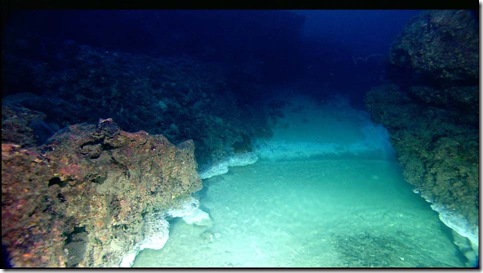
Deep on the ocean floor, explorers have found something that shouldn’t exist: lakes. With shorelines. And waves. These “brine pools” are formed by water that is many times saltier, and therefore much denser, than the surrounding seawater. This super-salty water sinks, creating a distinct body of “water” that sits under the ocean. You can land a submersible on its surface like a boat. But anything that swims into it dies instantly from the toxic salinity.
Gateways to the Abyss?
They call them “lakes,” but they feel more like traps. Or boundaries. What kind of life could possibly exist on the shores of these toxic, underwater seas? Scientists say they are home only to extreme bacteria. But what if they’re wrong? In a place where our normal rules of biology and physics break down, anything is possible. Could these pools be gateways? The high salinity and unique chemical composition could be a perfect shield for something that doesn’t want to be found. A perfect hiding place. When we look at a brine pool, are we just seeing a geological curiosity, or are we staring at the front door to an entirely different world, hidden right under our noses?
14. Ball Lightning: A Ghost in the Storm
![]()
A Puzzle for Physics
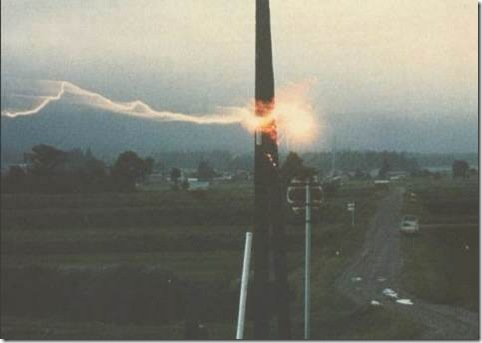
For centuries, people have reported seeing it. Glowing, floating spheres of light that appear during thunderstorms. They drift through walls, hover in mid-air, and then vanish with a pop. Or an explosion. Science has been trying to explain ball lightning for generations, and they still don’t have a solid answer. Theories range from vaporized silicon from soil to microwave radiation trapped in a plasma bubble. None of them fully explain the thousands of credible witness accounts.
Is It Even Lightning?
This is where the story gets really interesting. The descriptions of ball lightning sound an awful lot like something else. Paranormal investigators call them “orbs.” UFO researchers call them “probes.” People have reported these spheres acting with intelligence—seemingly inspecting a room before disappearing. They appear, they observe, they leave. Is it possible that what we call “ball lightning” isn’t a meteorological event at all? Perhaps thunderstorms, with their immense electrical energy, temporarily weaken the barrier between our dimension and another, allowing these strange, luminous visitors to slip through for a moment.
13. The Brinicle: Icy Finger of Death
![]()
How It Forms
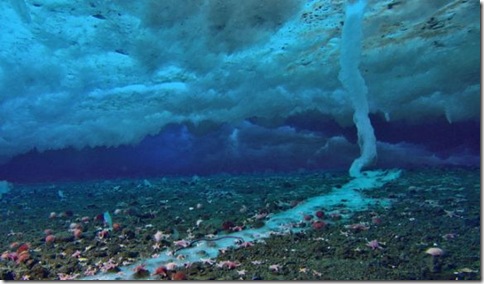
Underneath the polar ice sheets, a truly alien process unfolds. When sea ice forms, it pushes out salt, creating an ultra-cold, ultra-salty brine. This brine is denser and colder than the water below it. It sinks in a plume. As it falls, this incredibly cold stream freezes the fresher water it touches, forming a hollow tube of ice around itself. This “brinicle” grows downwards until it touches the seafloor, where it spreads out, freezing and killing everything in its path, like starfish and sea urchins.
A Predatory Phenomenon
Watch a time-lapse of a brinicle forming. It doesn’t look like a natural process. It looks alive. It looks like it’s hunting. It reaches down like a finger, touches the bottom, and spreads like a web, consuming everything. Is this just physics? Or is it something more? A semi-sentient force? Life, but not as we know it. A crystalline entity whose metabolism is so slow we mistake it for a simple chemical reaction. The poles are some of the least explored places on Earth. We have no idea what secrets are frozen in the ice or crawling on the deep floor. The “finger of death” might be far more than just a deadly icicle.
12. Ice Circles: Nature’s Perfect UFOs
![]()
The Eddy Current Explanation
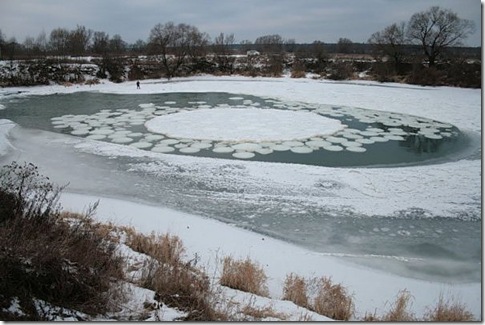
The official explanation for these perfectly circular, slowly rotating discs of ice is pretty simple. They say an “eddy”—a slow-moving whirlpool—in the river catches a chunk of ice and begins to spin it. As it spins, it bumps against the surrounding ice, grinding its edges down until it becomes a perfect circle. It’s plausible. It’s logical. It’s also incredibly boring.
A Message on the Water?
Let’s look at this with open eyes. We have a perfectly geometric shape, rotating slowly and silently. If it were in a field, we’d call it a crop circle. If it were in the sky, we’d call it a flying saucer. But because it’s in a river, we call it an “eddy.” Some of these circles are huge, over 50 feet across. Could a simple eddy really sculpt such a massive, perfect object? Or are we seeing the effect of a focused energy source? Perhaps a microwave beam from an overhead satellite, or a strange magnetic vortex generated from deep within the Earth? What if they aren’t random? What if they are signs? Markers appearing in the coldest parts of the world, telling us something is changing.
11. Snow Rollers: The Tumbleweeds of Winter
![]()
A Recipe for Rarity
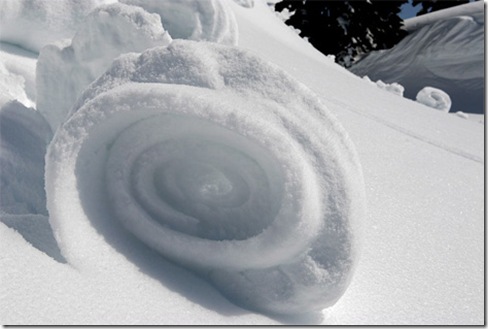
For a snow roller to form, the conditions have to be perfect. You need a layer of light, fluffy snow on top of a crust of ice or older snow that it won’t stick to. Then you need just the right wind speed—strong enough to push a chunk of snow, but not so strong that it blows it apart. The result is what looks like a giant, naturally-formed snowball or hay bale, often with a hollow core. They look like someone has been rolling them across a field. But no one has.
Nature’s Strange Sculptures
They appear as if from nowhere, dozens of them scattered across a landscape. They feel symbolic. Like nature is tidying up, or building something. Is it really just random wind? Or is some other force at play? Static electricity, maybe? A weak magnetic pulse that causes the snow to gather and roll in a specific way? They are so rare that seeing them feels like stumbling upon a secret. They leave tracks behind them, showing their path. But where are they going? What is their purpose? They are nature’s strange, self-assembling sculptures, a mystery written in snow.
10. Bioluminescent Mushrooms: The Forest’s Secret Lanterns
![]()
Glow-in-the-Dark Fungus
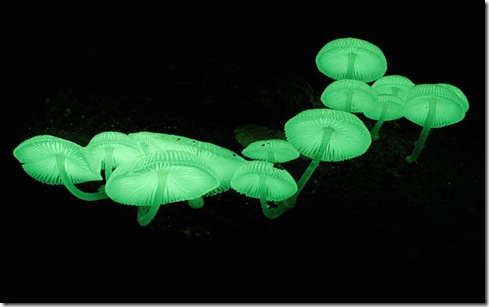
Deep in the darkest forests, something glows. Not fireflies, not electronics, but the fungus itself. Dozens of species of mushrooms have the ability to produce their own light through a chemical reaction. They call this “foxfire.” The accepted theory is that they glow to attract nocturnal insects, who then help spread the mushroom’s spores. It’s an ingenious evolutionary trick.
The Light of the Little People
For centuries, stories of glowing forests were dismissed as folklore. Tales of will-o’-the-wisps, of faeries and forest spirits lighting their way with magical lamps. Now we know the light is real. Did we just explain the magic away, or did we find the source of it? What if these mushrooms aren’t just attracting bugs? What if this cold, ethereal light serves another purpose? Perhaps it’s a power source, or a communication network for a hidden ecosystem we can’t see. The “little people” of legend needed light to see by. Maybe they didn’t carry lanterns. Maybe they just followed the glow of the forest’s own secret power grid.
9. Sea Foam: When the Ocean Breathes
![]()
The Ocean’s Cappuccino
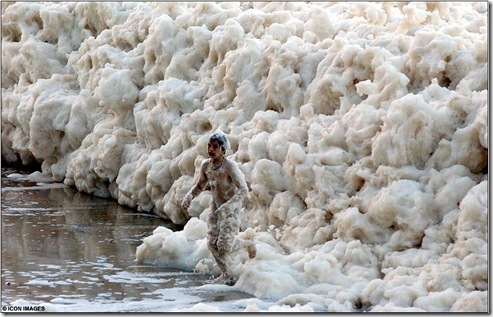
Sometimes, the ocean looks like it’s turning into a giant bubble bath. This happens when the water has a high concentration of dissolved organic matter—mostly from decaying algae blooms. When the wind and waves churn this protein-rich water, it creates a thick, persistent foam that can cover entire beaches and coastal towns. It’s usually harmless, just a sign of a very active ocean ecosystem.
A Planetary Immune Response?
But sometimes, it’s not harmless. When the algae blooms are toxic, the foam becomes a carrier for those toxins, causing problems for wildlife and humans. The incidence of these massive, sometimes dangerous, foaming events is on the rise. Is this just a side effect of pollution? Or should we look at it differently? What if the ocean is a single, massive living organism, as some theories propose? Then these foam events could be seen as an immune response. A reaction to a sickness. The planet is trying to expel something, to cleanse itself. The foam isn’t the problem. It’s a symptom of a much deeper illness.
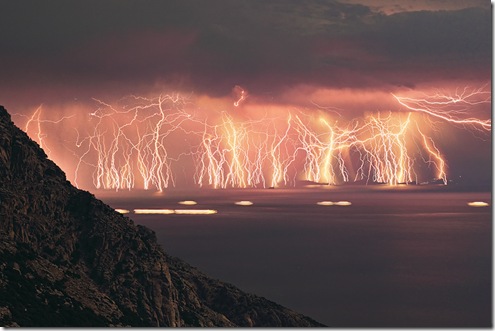
8. Catatumbo Lightning: The Never-Ending Storm
![]()
The Beacon of Maracaibo
In one specific spot in Venezuela, where the Catatumbo River flows into Lake Maracaibo, a storm rages for up to 200 nights a year, 10 hours a night. The lightning is nearly constant. They call it the “Relámpago del Catatumbo.” The leading theory points to a unique combination of wind patterns from the mountains and methane gas rising from the marshes, creating a perfect, self-perpetuating lightning factory.
A Natural Power Plant… Or Something Else?
A storm that never ends. Let that sink in. This single location produces more tropospheric ozone than any other spot on the planet. Local legends of the indigenous Yup’a people say the lightning is the work of fireflies meeting with ancestral spirits. But what if the modern explanation is also just a story? What if this isn’t a storm, but a machine? A power source. The constant, predictable discharge of immense energy is exactly what you’d need to power a hidden base or an advanced technology. Could this “storm” be the exhaust port for a massive underground facility? Or a permanent portal, with the lightning as a byproduct of its operation? In 2010, the lightning stopped for several months, and scientists had no idea why. Then, just as mysteriously, it started again. Machines get shut down for maintenance.
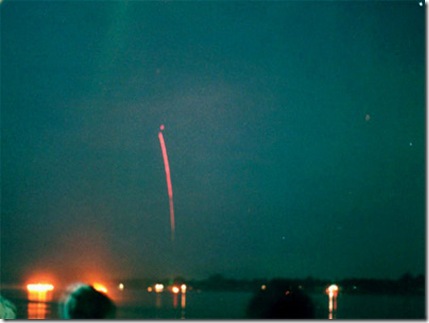
7. Naga Fireballs: The River Dragon’s Breath
![]()
A Festival of Lights
Every year, on the last night of the Buddhist Lent, thousands of people gather on the banks of the Mekong River in Thailand and Laos. They come to watch the Naga fireballs. Without a sound, glowing reddish orbs, from the size of a spark to the size of a basketball, rise from the river’s surface, hang in the air for a few seconds, and then shoot skyward before disappearing. Hundreds, sometimes thousands, can be seen in a single night.
Swamp Gas or Serpent’s Pearls?
Skeptics have an explanation, of course. They always do. They claim it’s “fermented methane” bubbling up from the riverbed and igniting on contact with the air. A kind of swamp gas. But this doesn’t explain why it happens so predictably on one specific night of the year. Or why the orbs ascend so perfectly. The local legend is far more compelling. They believe the fireballs are the breath of the Naga, a mythical serpent or dragon that lives in the river, released to celebrate the end of the rainy season. Is it a myth? Or is it a folk explanation for a recurring USO event, tied to the lunar or cosmic calendar, that has been happening for centuries?
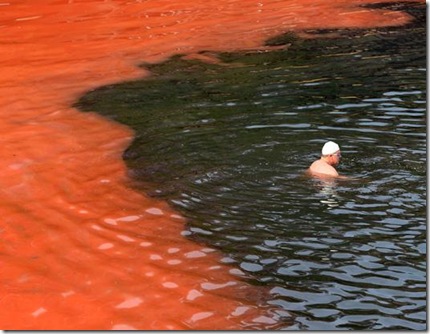
6. Red Tide: The Bleeding Ocean
![]()
An Algae Apocalypse
Suddenly, the sea turns the color of blood. A “red tide” is a massive bloom of a specific type of algae or dinoflagellate. When conditions are just right, their population explodes, and their sheer numbers discolor the water. These blooms can be deadly, depleting the oxygen in the water and releasing toxins that kill fish, birds, and marine mammals, and can even harm humans who breathe in the aerosolized toxins near the shore.
A Biblical Plague Made Real
The image is undeniably powerful. The sea turning to blood. It’s the first plague of Egypt. A sign of the apocalypse. Ancient texts from around the world describe similar events as divine omens, as warnings of great upheaval. Scientists point to nutrient runoff and warming sea temperatures. But the frequency and intensity of these red tides are increasing dramatically worldwide. Are we just looking at an ecological problem? Or are we witnessing the fulfillment of ancient prophecies? The planet is showing clear signs of sickness. The red tide feels like its fever breaking, a warning written in the water itself.
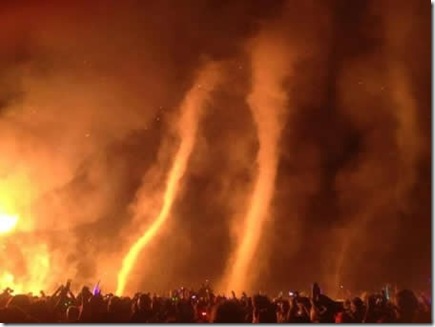
5. Fire Whirl: The Devil’s Tornado
![]()
When Fire Learns to Spin
It’s one of the most terrifying sights in nature. A “fire whirl,” or firenado, is born when intense heat from a wildfire combines with turbulent winds. The rising column of hot air begins to rotate, sucking in flames, embers, and combustible gases, creating a spinning vortex of fire. They can be small, just a few feet high, or they can become monstrous tornadoes over a thousand feet tall, with winds over 100 mph.
A Living Elemental
To witness one is to see something that feels alive. It moves. It roars. It consumes. It’s no wonder ancient cultures saw such phenomena not as weather, but as beings. Fire elementals. Djinn. Demons. They seem to have a will of their own, breaking away from the main fire and carving their own path of destruction. Is it possible that under such extreme conditions of heat and energy, something is actually born? A temporary, chaotic consciousness of pure energy and flame. A true force of nature given a terrifying, temporary body.
4. Glowing Waves: The Electric Ocean
![]()
Plankton That Shine
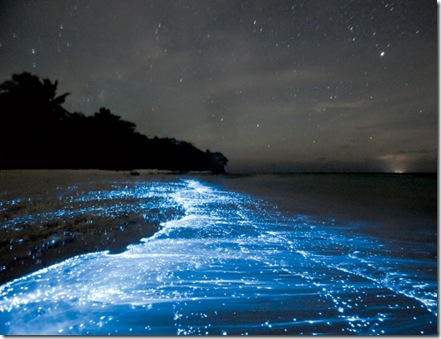
On certain beaches around the world, the waves glow with an eerie, electric blue light. Every crash on the shore, every footstep in the wet sand, every splash of a paddle leaves a trail of light. The effect is caused by billions of microscopic organisms called bioluminescent phytoplankton. When they are disturbed, they emit a flash of light as a defense mechanism, hoping to startle a predator.
The Ocean’s Neural Network
It’s a beautiful defense mechanism. But let’s think bigger. What if it’s more than that? The ocean covers 70% of our planet. What if these phytoplankton are more than just individual organisms? What if they form a planetary network? A liquid nervous system. Every wave, every current, every swimming fish creates a pattern of light. A flow of information. We are seeing the ocean’s brain fire. The patterns of light could be a form of communication on a scale we can’t possibly comprehend. A language written in living light.
3. Horsetail Fall: The Yosemite Firefall
![]()
A Trick of the Setting Sun
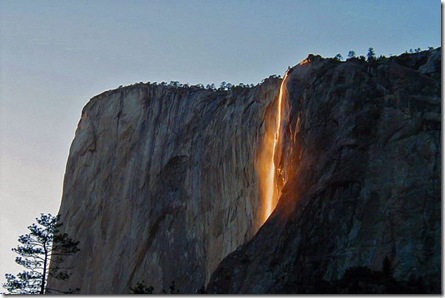
For just a few days in late February, a miracle happens in Yosemite National Park. Horsetail Fall, a seasonal waterfall on the eastern face of El Capitan, is transformed. If the conditions are perfect—enough snowmelt to feed the fall, and a clear sky at sunset—the last rays of sunlight hit the water at the exact right angle, making it glow a fiery orange and red. It looks for all the world like a river of lava pouring off the cliff.
A Portal of Light?
For centuries, this was a sacred site for the native Ahwahnechee people who lived in the valley. They had their own stories, their own reasons for why the mountain would bleed fire once a year. Modern science gives us the geometry of light. But the feeling of watching it is something else. It feels ancient. Magical. It only happens for about ten minutes, on a handful of days. A very specific time. A very specific place. It’s the kind of precision that makes you wonder. Is this a natural calendar, marking a moment of cosmic alignment? Or is it a doorway? A portal that only becomes visible when the sun’s key fits the lock of the mountain perfectly.
2. Volcanic Lightning: The Primal Scream of the Planet
![]()
A Dirty Thunderstorm
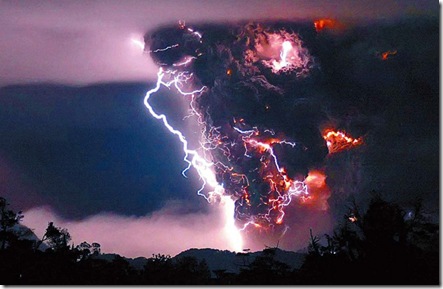
As if a volcanic eruption wasn’t dramatic enough, sometimes they produce their own lightning. This is one of the most powerful and primordial sights on Earth. A “dirty thunderstorm” is created when the particles of rock, ash, and ice in the volcanic plume collide, generating immense amounts of static electricity. The result is a violent, chaotic lightning storm raging within the cloud of ash. It’s a vision straight out of a prehistoric nightmare.
Energy From the Earth’s Core
The static friction theory makes sense. But the sheer power involved is staggering. It’s more intense than the lightning in a normal supercell thunderstorm. We are witnessing the release of energy from deep within the planet. This isn’t sky-weather. This is earth-weather. Is it possible that we are seeing more than just friction? Could the fracturing of magma and the immense pressure be releasing a type of energy we don’t yet have a name for? This is the planet’s raw, creative, and destructive power made visible. It’s not just a storm. It’s the Earth screaming.
1. The Milky Way: The Ghost in Our Sky
![]()
The Lost Spectacle
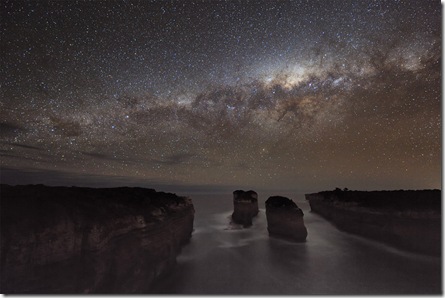
This is perhaps the rarest natural phenomenon of all. Not because it’s hard to find, but because we have hidden it from ourselves. For almost all of human history, every single person on Earth could look up on a clear night and see it: a vast, shimmering river of stars arching across the sky. The Milky Way. Our home galaxy. It was the backdrop to every myth, every religion, every campfire story. Now, for the majority of humanity living in or near cities, it’s gone. Wiped out by the glare of our own electric lights.
A Deliberate Disconnection?
We are told light pollution is an unfortunate byproduct of progress. But what if it’s more than that? What if it’s by design? By cutting us off from the stars, we are cut off from a sense of scale, a sense of wonder, a sense of our true place in the universe. It keeps our eyes down, focused on our small lives, not up at the infinite possibilities. Are “they” trying to keep us from seeing what’s really up there? From asking the big questions? By erasing the galaxy, they have put a ceiling on our world, trapping us under a dome of orange light. The greatest conspiracy might not be what they are showing us, but what they are preventing us from seeing.