Live, Die, Deceive: The Secret History of Edge of Tomorrow You Were Never Meant to Know
They told you it was just another summer blockbuster. Another Tom Cruise action flick. A slick, high-concept sci-fi romp about an alien invasion and a soldier stuck in a time loop. But what if that’s just the cover story? What if the real story—the one that happened behind the cameras, in frantic studio meetings, and under the crushing weight of 85-pound metal suits—is far more bizarre and fascinating than the movie itself?
Forget what you think you know. We’re going deep. We’re peeling back the layers of Hollywood spin to expose a tangled web of alternate realities, last-minute saves, and a title so cursed it took three tries to get it right. This isn’t just a list of fun facts. This is the case file on one of the most chaotic, brilliant, and misunderstood sci-fi masterpieces of our time.
The story of Edge of Tomorrow is its own time loop. A cycle of near-disasters, creative genius, and a struggle for identity that almost doomed it to obscurity. Ready to break the cycle?
Good. Let’s begin.
The Title Curse: A Film with Three Faces
What’s in a name? For Warner Bros., it was a multi-million-dollar headache. Before it was Edge of Tomorrow, the project had a name that was pure pulp poetry. A name that was aggressive, unforgettable, and perfectly captured the movie’s brutal, video-game-like loop.
It was called All You Need Is Kill.
Let that sink in. All You Need Is Kill. It’s perfect, right? It’s punchy. It’s dark. It’s based directly on the Japanese light novel by Hiroshi Sakurazaka that started it all. For months, even years, during pre-production and filming, everyone involved was making a movie called All You Need Is Kill. It was on the scripts. It was on the call sheets. It was the soul of the project.

Then the marketing department got cold feet. Panic set in. Was the word “Kill” too aggressive for a summer tentpole film? Would it scare away families? The suits in the boardroom, terrified of losing a single dollar, decided it was too risky. So, in a move that still baffles fans, they ripped the heart out of the title and replaced it with one of the most generic, forgettable phrases imaginable: Edge of Tomorrow.
It sounds like a soap opera. Or a banking slogan. The title was so bland that the movie, despite rave reviews, underperformed at the U.S. box office. People didn’t know what it was.
But the story doesn’t end there. In a stunning admission of failure, when the movie hit home video, the studio effectively changed the title a THIRD time. The Blu-ray and DVD covers were dominated by the film’s tagline, screaming in giant letters: LIVE. DIE. REPEAT. The actual title, “Edge of Tomorrow,” was relegated to a tiny font at the bottom. The deception was complete. The movie became a cult classic under its adopted name, the one the fans gave it. A name that, ironically, was born from a marketing failure.
The Alternate Timeline: What If Brad Pitt Had Lived, Died, and Repeated?
Every great conspiracy has a “what if?” A sliding doors moment where history could have split into a completely different timeline. For Edge of Tomorrow, that moment was the casting of Major William Cage.
Before Tom Cruise was ever attached, the role of the cowardly public affairs officer thrown into the meat grinder of an alien war was written for and offered to one man: Brad Pitt.
Just imagine it. Pitt, who had just come off his own massive blockbuster apocalypse in World War Z, was all set to take the lead. The deal was close. The papers were nearly signed. But the chaos of Hollywood scheduling, a force more powerful than any alien Mimic, intervened. Pitt had a scheduling conflict with another project he was committed to. He had to drop out.
Enter Tom Cruise. And with him, the entire dynamic of the film shifted. Cruise, known for his relentless, hyper-competent action heroes, was now playing against type. He was playing a coward. A smarmy media guy who literally tries to blackmail his way out of combat. It was a genius move. Cruise’s real-life persona as an unstoppable force made Cage’s transformation from zero to hero all the more compelling.

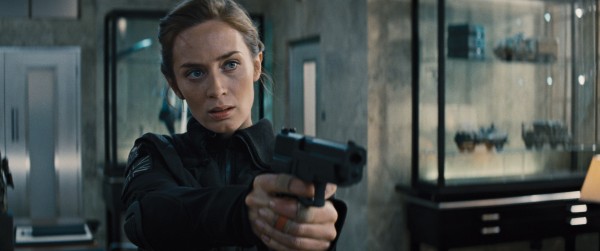
But in some alternate universe, there’s a version of this film starring Brad Pitt. Is it grittier? Funnier? Does his world-weary charm change the tone? It’s one of Hollywood’s great lost what-ifs. And it wasn’t the only casting shuffle. The iconic role of Rita Vrataski, the “Angel of Verdun,” was nearly played by Bérénice Bejo (from The Artist). When she passed, the door opened for Emily Blunt to create a character that would redefine the female action hero for a generation.
Deep Dive: The Brutal Reality of the Exo-Suits
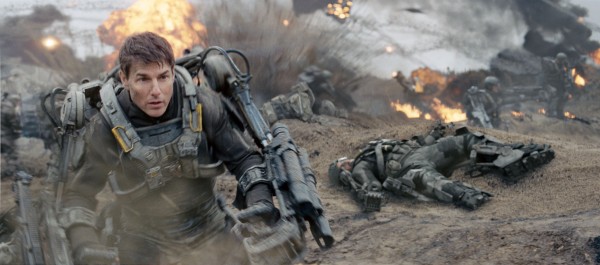
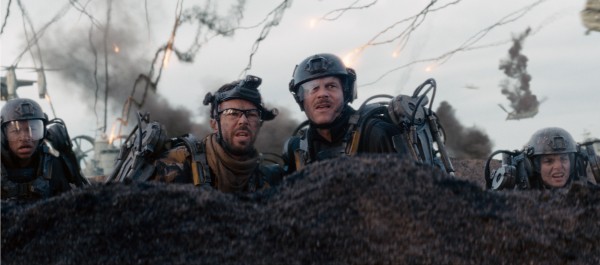
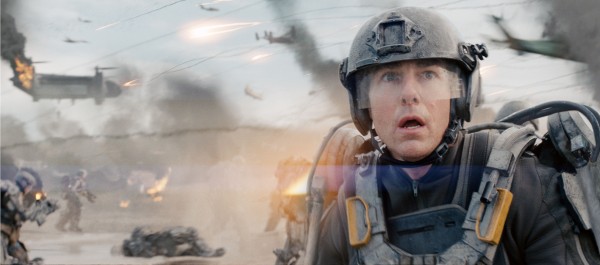
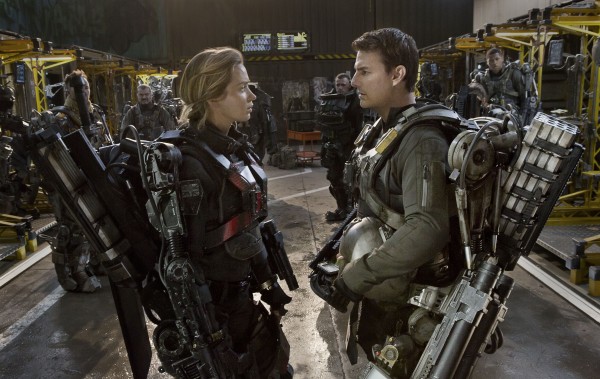
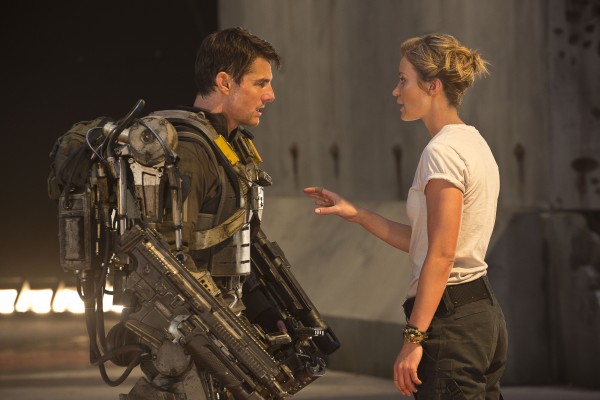
They look cool on screen. Hulking metal frames of pure destructive power. But for the actors inside, the “Jacket” exo-suits were a living nightmare. This wasn’t CGI, folks. These were real, practical, and unbelievably heavy pieces of machinery.
Each suit was a custom-built torture device. Designed by Pierre Bohanna, the same prop master who worked on the Batman films, they were made from aluminum and packed with hinges and pistons. The average suit weighed a staggering 85 pounds (around 38 kilograms). Now, imagine wearing that for 12 hours a day, five days a week, while running, jumping, and pretending to fight aliens.
Some versions, outfitted with sniper rifles or missile launchers, tipped the scales at over 130 pounds.
It was brutal. The physical toll was immense. Emily Blunt, upon putting on the suit for the first time, famously burst into tears. She recounted the story, saying she looked at Tom Cruise and said, “Tom, I’m not sure I’m going to be able to do this.” She was panicked by the sheer, suffocating weight. His response? He just stared at her, and after a beat, said, “Come on, stop being such a wuss.”

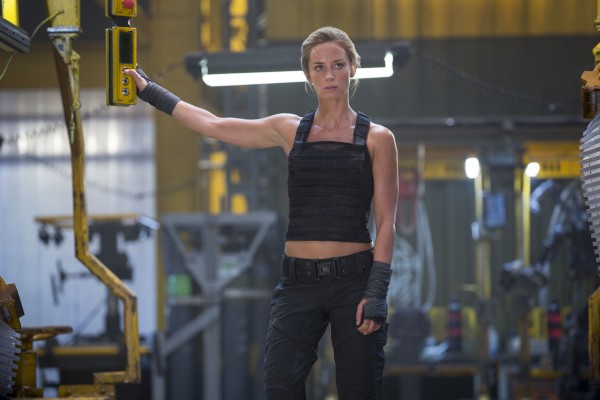
It was the tough love she needed. The actors underwent months of grueling training just to be able to function in the suits. It took a team of four people just to get one actor into their rig. Between takes, they were suspended from the ceiling by chains, like marionettes, to give their shoulders a rest. The challenge was so intense that Emily Blunt considers her role as Rita to be the most physically demanding of her entire career. A true trial by fire.
From Hogwarts to Hellscape: The Surprising Filming Location
Where do you go to create a dystopian future of alien warfare and beach-front carnage? A place of magic, of course.
Believe it or not, Edge of Tomorrow was filmed almost entirely at Warner Bros. Studios, Leavesden, in the UK. If that name sounds familiar, it should. It’s the very same studio where all eight Harry Potter films were made. The production literally moved into the soundstages vacated by wizards and house-elves.
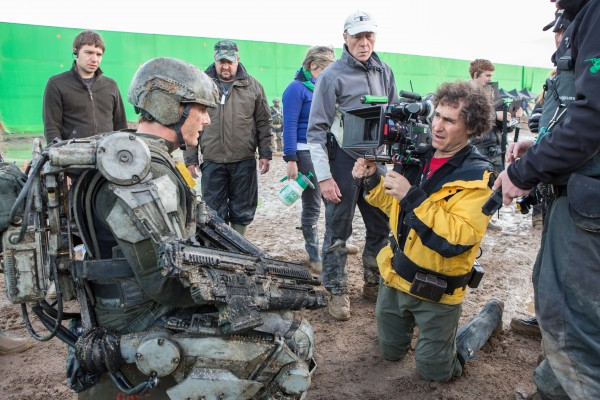
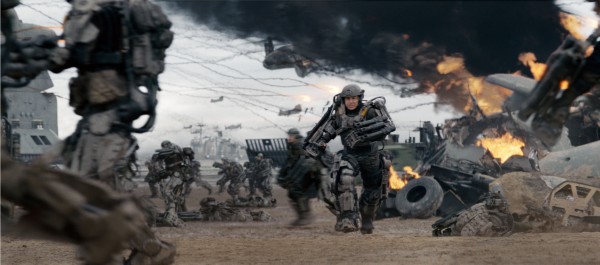
The sprawling backlot that once held Diagon Alley and the Hogwarts courtyards was transformed into military bases and alien-infested European cities. The French beach where the massive D-Day-style invasion was filmed? That was a massive, custom-built sandpit in the middle of a British backlot, surrounded by a giant green screen. They brought in hundreds of tons of sand to recreate the shores of Normandy. It was a logistical marvel.

The irony is thick. A place known for enchanting tales of good versus evil became the home for a gritty, violent story of endless death and rebirth. It’s a strange piece of trivia, but it shows the bizarre alchemy of filmmaking—how the same sterile soundstage can be home to both a flying Ford Anglia and a futuristic dropship.
The Million-Dollar Script That Vanished
Every movie starts with a script. But Edge of Tomorrow started with a bidding war. The original spec script, penned by Dante Harper, was so hot that it sparked a frenzy in Hollywood. Warner Bros. snatched it up for a reported sum of over $1 million. A huge payday for a writer’s first big sale.
But this is where the story gets murky.

As is common in Hollywood, other writers were brought in. And then more writers. The legendary Christopher McQuarrie, a frequent collaborator with Tom Cruise, was hired to do a massive rewrite. The script was constantly in flux, being changed and tweaked even *during* filming. Director Doug Liman thrives on this kind of creative chaos, discovering the story as he shoots.
But when the dust settled and the final credits rolled, Dante Harper’s name was nowhere to be seen. Due to the complex rules of the Writers Guild of America, he was denied a final screen credit. He walked away with the money, but his name was scrubbed from the project he initiated. A ghost in the machine.
Emily Blunt’s On-Set Secret
The production was already one of the most physically demanding jobs of her life. But partway through the grueling shoot, Emily Blunt discovered she was pregnant.
She was terrified. Not just for her own well-being, but for the film. She feared the studio would replace her or that she’d be forced to stop. So, she kept it a secret from almost everyone. She continued doing stunt work, wearing the heavy suit, and throwing herself into the action.
Only a tiny circle of people knew the truth: her husband John Krasinski, a close friend, and… Tom Cruise. She confided in her co-star, who became her on-set protector. When she finally had to tell the director and producers she could no longer do the intense wire-work stunts, she still didn’t give them the reason why. Her secret was safe, and the production adapted around her without ever knowing the full story until later. It’s a testament to her toughness and the trust she built with her co-star.

Imagine the pressure. Carrying a child while simulating your own death dozens of times a day, all while wearing an 85-pound metal cage. It makes the “Angel of Verdun” seem even more powerful.

The Phantom Party and the Workaholic Star
Tom Cruise’s dedication is the stuff of legend. He’s famous for his intensity and his commitment to the cast and crew. So, naturally, as filming was drawing to a close, he arranged for a massive, lavish wrap party to thank everyone for their hard work.
The price tag? A reported $100,000. It was an epic bash, meant to celebrate the end of a long, difficult shoot.
There was just one problem. The guest of honor didn’t show up.
Tom Cruise, the man who paid for the entire party, wasn’t there. Why? Because he was still working. While the cast and crew celebrated, he was back on a soundstage, filming pickup shots and unfinished scenes. The work wasn’t done, so in his mind, the celebration could wait. It’s the ultimate Tom Cruise anecdote: a gesture of incredible generosity immediately overshadowed by an even more incredible work ethic.

Deep Dive: The French Car from the Future-Past
In a movie filled with futuristic tech, one of the most memorable props is a beat-up, dusty, and decidedly old-school car. The vehicle Cage and Rita use to escape the farmhouse is a Citroën CX.
This isn’t just a random car. The Citroën CX was a French executive car produced from 1974 to 1991. It was famous for its futuristic (for the time) hydropneumatic self-leveling suspension and its quirky, ahead-of-its-time design. Choosing this specific car was a deliberate and brilliant move.

The film is set in Europe, and using a classic French car grounds the story in its location. More importantly, the CX represents a kind of “retro-futurism.” It’s a vision of the future from the past, which perfectly mirrors the film’s theme of repeating the past to create a new future. It’s a dusty, analog piece of hope in a world of overwhelming alien technology. A small but clever piece of world-building.

The Sequel That Remains Trapped in a Loop
For years, a sequel has been rumored. It even has a title that’s just as bonkers as the original: Live Die Repeat and Repeat. Director Doug Liman, Tom Cruise, and Emily Blunt have all expressed their intense desire to make it happen. A script apparently exists, and it’s said to be even more inventive than the first film.
So where is it? Why hasn’t it happened?
The project is a victim of its own ambition and the maddening schedules of its stars. The official story is that it’s simply impossible to get Cruise, Blunt, and Liman—three of the busiest people in Hollywood—in the same place at the same time for long enough to shoot it. Blunt has joked that they’ll all be too old to get into the exo-suits by the time it happens.
But maybe there’s more to it. The first film was a miracle of controlled chaos. Could the studio be afraid to roll the dice again on such an expensive, unpredictable production style? Is the “scheduling” issue just a convenient cover story? The sequel to Edge of Tomorrow remains tantalizingly out of reach, trapped in its own development loop, waiting for the perfect moment to break free. A moment that may never come.
So the next time you watch this sci-fi classic, remember the hidden history. Remember the film it almost was, the star it nearly had, and the title it was forced to abandon. The battle on screen was nothing compared to the war that was fought to get it there.
Originally posted 2014-06-08 18:43:21. Republished by Blog Post Promoter