
Are We Being Watched? The Cosmic Secrets They Don’t Want You to Know
Let’s get one thing straight. Space is big. No, bigger than that. It’s an ocean of blackness so vast, so mind-shatteringly empty, that our entire existence is less than a single grain of sand on an infinite beach. And for all of human history, we’ve screamed into that void, asking one simple, terrifying question: “Is anybody out there?”
For a long time, the answer was silence. A cold, static-filled nothing.
But then, things started to shift. A new energy crackled through the communities of people who watch the skies. Around the mid-2010s, a feeling grew that we were on the edge of something monumental. A change was coming. The whispers were getting louder, the signals were getting stronger, and humanity was building bigger ears to finally hear what the cosmos was trying to tell us.
We thought we were on the verge of the biggest discovery in history. The truth is, we might have been. And maybe someone, somewhere, slammed the door shut before we could see what was behind it.
The Dragon Awakens: Building God’s Ear
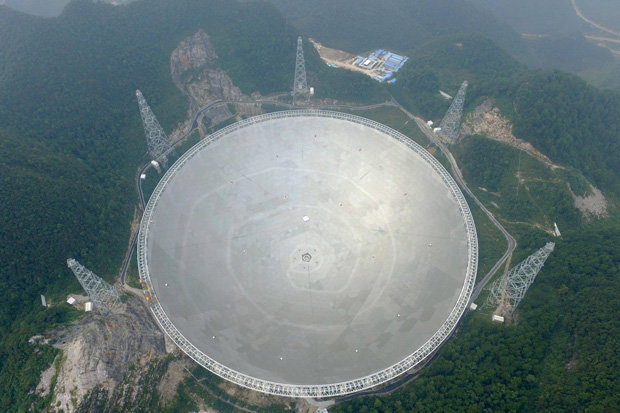
It all started with a promise. A promise of unprecedented power. In the remote, mountainous region of Guizhou, China, a monster was taking shape. This wasn’t a creature of myth, but a titan of science: the Five-hundred-meter Aperture Spherical Telescope, or FAST. They called it Tianyan. The Eye of Heaven.

Forget everything you think you know about telescopes. This thing was different. Completed in 2016, FAST became the largest single-dish radio telescope on the planet. By a lot. Its colossal collecting area, the size of 30 football fields, could hear the faintest whispers from the darkest corners of the universe. It was designed to detect pulsars, map the galaxy, and, of course, listen for a message. Listen for them.
Suddenly, the Search for Extraterrestrial Intelligence (SETI) wasn’t just a handful of scientists huddled around old equipment. It was a global arms race. A quiet one. Billionaire Yuri Milner, backed by a brain trust that included the late, great Stephen Hawking, had already launched Breakthrough Listen. A $100 million project to scan a million nearby stars and the 100 closest galaxies. They were aiming the world’s best telescopes at the heavens, hoping to catch a stray signal, a cosmic carrier pigeon meant for someone else that we just happened to overhear.
The stage was set. The money was flowing. The world’s most powerful listening devices were pointed at the sky. All we had to do was wait for the phone to ring.
But What If The Line Is Dead?
Here’s the chilling problem. It’s called the Fermi Paradox. In a universe with hundreds of billions of galaxies, each containing hundreds of billions of stars, many with planets… where is everybody? The math says the sky should be buzzing with signals, with star-faring civilizations. A cosmic freeway.
Instead, we get silence. An eerie, profound quiet.
This has led some to a very dark conclusion: The Great Filter. The theory goes that somewhere between primordial soup and a galaxy-spanning super-civilization, there is a wall. A filter. An evolutionary or technological challenge that is almost impossible to overcome. And every single civilization in the galaxy hits it. And they die.
The terrifying question isn’t whether the filter exists. The question is, are we past it, or is it still ahead of us? Are we one of the first, or are we just another ticking clock, heading for an inevitable, silent end? Top SETI scientists have suggested that super-intelligent aliens might be communicating in ways we can’t even comprehend. We’re listening for radio waves, the cosmic equivalent of smoke signals, while they could be using quantum entanglement or manipulating spacetime itself. We’re listening for a knock on the door, but maybe they’ve been in the house the whole time.
A Warning From a Titan: “Do Not Answer The Phone”
While some were desperately trying to make contact, one of the greatest minds of our time was screaming for us to stop. Stephen Hawking wasn’t just a brilliant physicist; he was a profound thinker about humanity’s place in the cosmos. And he was scared.
He warned us. Over and over again.
In 2010, he laid it out in stark, brutal terms. Intelligent aliens, he argued, might not be the peaceful explorers of our science fiction dreams. They could be nomadic. Marauders. “Rapacious plunderers, roaming the cosmos in search of resources to plunder and planets to conquer and colonize.”

He pointed to our own history as the terrifying blueprint. Think about it. When a more advanced culture meets a less advanced one on Earth, it never, ever goes well for the less advanced. Never.
“One day, we might receive a signal from a planet like this,” Hawking said, talking about a potentially habitable world called Gliese 832c. “But we should be wary of answering back. Meeting an advanced civilization could be like Native Americans encountering Columbus. That didn’t turn out so well.”
Let that sink in. The “Columbus” analogy is almost too perfect. He didn’t arrive with malice, at first. He arrived with curiosity, with a mission. But his very presence, the technological gap, the difference in worldview, brought disease, destruction, and doom. An advanced alien race might not even hate us. They might not even notice us. We could be like bacteria on a rock they want to mine for fuel. An inconvenience to be wiped away.
What If They Aren’t Monsters?
Of course, there’s another side to this cosmic coin. The idea that any civilization advanced enough for interstellar travel would have outgrown petty concepts like conquest and violence. The Kardashev scale gives us a framework. A Type I civilization has mastered its planet’s energy. A Type II has harnessed its star. A Type III? It commands the energy of its entire galaxy.
To a Type III civilization, we wouldn’t even register as a threat. We’d be a nature preserve. A cosmic curiosity. They might watch us from afar, hidden behind some Prime Directive, studying our primitive development. They would have solved energy, scarcity, and conflict millennia ago. What could they possibly want from us? Our water? Our gold? To a species that can harness a galaxy, that’s like us driving across the country to steal a single ant’s breadcrumb.
So which is it? Are the heavens filled with silent gods or ravenous monsters? As we ramped up our search, we were about to get a hint. And it came from the last place anyone expected.
The HD 164595 Signal: A Message or a Mistake?
It was a ghost story whispered among astronomers before it ever hit the news. A signal. A strange, powerful, and undeniably intelligent-looking signal. But it didn’t come from the new, fancy telescopes. It came from an old, Cold War-era instrument in Russia. The RATAN-600.
And then the story broke. An Italian researcher leaked the discovery. All hell broke loose.
Scientists had detected a “strong signal” from the direction of a star called HD 164595. It’s about 95 light-years away. A stone’s throw in cosmic terms. The star itself is almost a twin to our own sun, and we know it has at least one planet, a “warm Neptune” orbiting it. There could easily be more. Smaller, rocky worlds. Like ours.

But here’s where it gets weird. The signal was detected in May 2015. The world didn’t hear about it until late August 2016. More than a year of silence. Why?
Deep Dive: The Anatomy of a “Hoax”
Let’s break down the official story. The signal was a single, powerful burst. It wasn’t a repeating pattern. The strength was enormous. If it was broadcast in all directions (an isotropic beacon), it would require more energy than all of humanity produces. An impossible amount. To make it work, the aliens would have had to aim it directly at us. A focused beam. A cosmic sniper shot.
The SETI community scrambled. They pointed their telescopes at HD 164595. Nothing. Absolute silence. They listened for weeks.
Then came the explanation. The debunking. The Russian Academy of Sciences eventually released a statement. Oh, that? It was probably terrestrial interference. A secret Soviet-era military satellite passing overhead at just the right moment. Nothing to see here. Move along.
Case closed, right?
Wrong. Think about it. A year-long delay in reporting the most potentially significant discovery in human history? A signal so powerful it defied conventional explanation? A vague, convenient cover story about a forgotten satellite that just happened to perfectly mimic an extraterrestrial beacon? It feels too neat. Too tidy.
Was it a test? Did someone in power see the signal, panic, and orchestrate a year-long campaign to discredit it before it caused a global meltdown? Did they realize Hawking was right, and that answering the phone would be a death sentence? We’re told it was a mistake. But in the world of shadows and secrets, there are no mistakes. Only messages.
The Floodgates Open: The Post-2017 Revelation
That Russian signal, whether real or not, was a tremor before the earthquake. The world moved on, but the search didn’t stop. It just went underground, and then, exploded into the mainstream in a way no one could have predicted.
Forget faint radio signals from distant stars. The conversation shifted. It was no longer about “out there.” It was about “right here.”
The Pentagon. Yes, that Pentagon. In 2017, the New York Times published a bombshell report that confirmed the US government had been running a secret program to investigate UFOs. AATIP. The Advanced Aerospace Threat Identification Program. Suddenly, the “tinfoil hat” crowd wasn’t so crazy after all.
And then came the videos. Declassified. Official. Released by the US Navy. The “Tic Tac.” The “Gimbal.” The “GoFast.” Grainy, infrared footage from the cockpits of F-18 fighter jets, showing… something. Objects performing maneuvers that defy our known laws of physics. No wings, no visible propulsion, accelerating at impossible speeds and stopping on a dime.
Naval pilots, credible witnesses with everything to lose, went on record. Commander David Fravor, a Top Gun graduate, described the “Tic Tac” object he encountered in 2004. “I think it was not from this world,” he said. Flat out.
The conversation is no longer about listening for a message. It’s about dealing with the messengers who are already in our airspace. The congressional hearings, the official UAP (Unidentified Aerial Phenomena) reports… they all say the same thing. There are objects in our skies that we cannot identify, and they display technology far beyond our own. The stigma is gone. The secret is out.
The question we started with—”Are we alone?”—feels so childish now. So naive. A better question, a much more important question, has taken its place.
What do they want?
Originally posted 2016-11-07 19:08:45. Republished by Blog Post Promoter