Pangaea: The Apocalyptic Supercontinent That Forged a World of Monsters
Forget what you know about Earth. Forget the seven continents, the familiar oceans, the world map tacked to your classroom wall. That world is a recent invention. An afterthought. Before all of it, there was another planet hiding in our own past. A truly alien world.
A world with one continent.
One ocean.
And a climate so brutal it nearly sterilized the entire globe. Twice.
This was Pangaea. It wasn’t just a different map; it was a different reality. A planetary-scale pressure cooker where the rules of life and death were rewritten by fire, ice, and suffocating air. The story of this lost world isn’t just a geology lesson. It’s a mystery. A survival epic. It’s the story of the apocalypses that paved the way for the dinosaurs and, ultimately, for us. And the evidence is buried right under our feet, in the silent, colored layers of rock that whisper tales of a planet you were never meant to see.
The Great Unravelling: What Was Pangaea, Really?
So, what was this monster continent? You have to picture it. For hundreds of millions of years, the great tectonic plates that make up Earth’s crust were on a slow-motion collision course. Imagine North America slamming into Africa. See South America crashing into the landmass below it, while India, Australia, and Antarctica all crunch together. A planetary traffic jam of epic proportions.
The result? A single, colossal landmass that stretched from the South Pole all the way to the North Pole. They call it Pangaea, which means “all Earth.” And surrounding it was a single, globe-spanning ocean called Panthalassa, the “all sea.”
This wasn’t a stable place. The collision zones were violent, throwing up mountain ranges that would have dwarfed the Himalayas. The very shape of this supercontinent began to warp the planet’s climate in terrifying ways.
A Planet Turned to Dust: The Great Pangaean Desert
Think about weather patterns today. Rain comes from the ocean. Moist air drifts inland, hits mountains, and releases its water. Simple enough. But what happens when “inland” is thousands of miles from any ocean? What happens when the continent is so vast that no rain cloud could ever hope to reach its heart?
You get a desert. A desert the size of a planet.

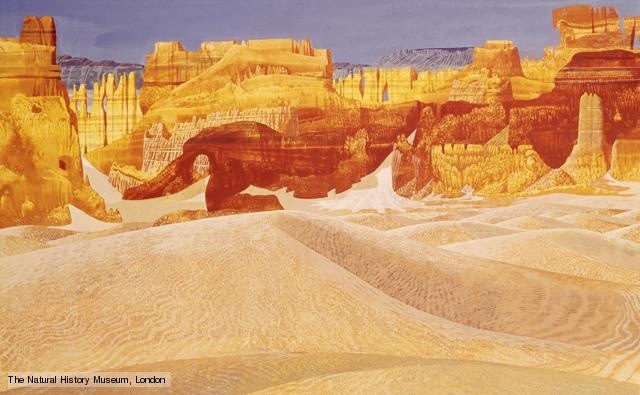
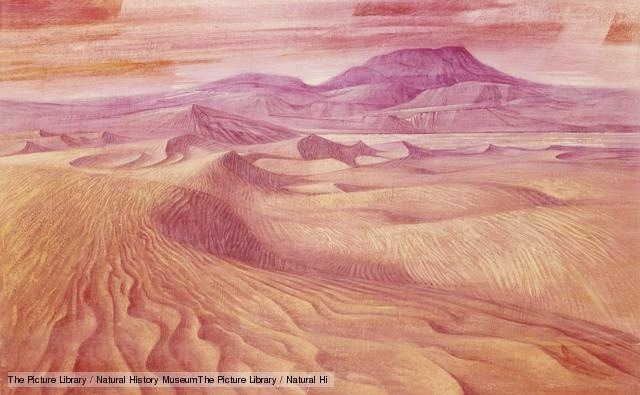
The interior of Pangaea became the largest, most hostile desert Earth has ever known. This wasn’t the Sahara with its rolling golden dunes. This was an alien wasteland. The intense heat and unique atmospheric conditions caused iron in the soil to rust on a massive scale, staining the entire landscape a deep, blood-red. When you see the stunning red rocks of the American Southwest or the Australian Outback, you are looking at the fossilized remains of this ancient desert.
Life was brutal. For years, maybe decades, no rain would fall. The sun would beat down relentlessly. Then, the pattern would break. The global climate system, thrown into chaos by the supercontinent, would unleash monsoon seasons of unimaginable violence. Rains that could last for months, turning the dusty red plains into raging torrents of mud and flash floods. These deluges carved canyons and filled temporary, shallow lakes. When the sun returned, the lakes would evaporate, leaving behind thick, crusty layers of salt and gypsum—scars still visible in the rock record today.
Life on the Brink: A Glimpse into the Permian
Before the worst of it, before the world truly caught fire, came the Permian Period. This was the final act for the old world, the era just before the dinosaurs. It began in the grips of an ice age, with massive glaciers grinding across the southern parts of Pangaea. But the planet was warming up. Fast.
The world of the Permian was populated by creatures straight out of a fantasy novel. This was not a dinosaur’s world. Not yet. It was ruled by our own distant, bizarre relatives, the synapsids.
- Dimetrodon: The famous sail-backed reptile often mistaken for a dinosaur. That massive fin on its back wasn’t for show; it was a complex radiator, a biological solar panel to warm it up in the morning and cool it down in the midday heat.
- Gorgonopsids: These were the apex predators. Imagine a wolf crossed with a lizard, but the size of a bear, with enormous saber-teeth erupting from its jaws. They were fast, vicious, and ruled the land.
- Scutosaurus: Huge, tank-like herbivores covered in bony plates, like giant, walking fortresses. They roamed in herds, grazing on the tough vegetation that could survive the harsh climate.
But as these strange beasts fought and flourished, the planet itself was getting sick. The chessboard was being set for an extinction event so complete, it makes the one that killed the dinosaurs look like a bad day at the office.

The Air Grew Thin: A Planetary Suffocation
One of the most terrifying changes was happening in the very air the animals breathed. During earlier periods, the atmosphere was packed with oxygen, perhaps as high as 35%. This led to gigantism—think dragonflies with the wingspan of a hawk. But during the Permian, the oxygen levels began to plummet. They crashed from that high of 35% all the way down to a suffocating 15%.
For context, our air today is 21% oxygen. At 15%, breathing becomes difficult. Physical activity is exhausting. It would feel like living permanently on a high-altitude mountain peak. This wasn’t just a local problem; the whole world was gasping for breath. The warming oceans couldn’t hold as much dissolved oxygen, creating vast dead zones in the sea. The planet was slowly, inexorably, suffocating.
The Great Dying: What Caused Earth’s Ultimate Apocalypse?
And then it happened. The Permian Period didn’t just end. It was murdered.
Scientists call it the Permian-Triassic extinction event. Most people just call it “The Great Dying.” The name fits. It remains the single greatest catastrophe in the history of complex life. Over a shockingly short period of geological time, 96% of all marine species vanished. Gone. Over 70% of all terrestrial vertebrate species were wiped out. Forests were annihilated. Insects suffered their only mass extinction in history. The planet was pushed to the very edge of becoming a dead rock.
For decades, the cause was a profound mystery. What could do this? What single killer could be so efficient, so total? The investigation has pointed to a conspiracy of culprits—a perfect storm of planetary destruction.
Suspect #1: The Siberian Traps
The prime suspect is a volcanic event of a scale that is simply impossible to comprehend today. In what is now Siberia, the Earth’s crust cracked open. For close to a million years, eruption after eruption poured unfathomable amounts of lava across the land. This wasn’t a single volcano like Vesuvius. This was an entire region, an area larger than Western Europe, being buried under miles of molten rock.
This event, known as the Siberian Traps, belched catastrophic amounts of carbon dioxide and sulfur dioxide into the atmosphere. The CO2 triggered runaway global warming, heating the planet to unbearable temperatures. The sulfur dioxide mixed with atmospheric water to create powerful acid rain, which fell for centuries, poisoning the soil and turning the oceans acidic. Life was being simultaneously cooked, suffocated, and dissolved.
Suspect #2: Methane Bombs from the Deep
As the Siberian Traps heated the globe, a terrifying feedback loop may have kicked in. Trapped in the cold depths of the ocean floor are massive, frozen deposits of methane gas. As the oceans warmed, these icy cages could have melted, releasing colossal bubbles of methane—a greenhouse gas over 25 times more potent than CO2—into the atmosphere.
Imagine the ocean itself exploding with flammable, heat-trapping gas. This “methane burp” theory suggests that the initial warming from the volcanoes was amplified exponentially, pushing the global thermostat into a red zone from which there was no return. The Great Dying might not have been a slow decline, but a sudden, violent spike in temperature that flash-fried the biosphere.
Alternative Theory: A Message from Space?
While most evidence points to the volcanoes, some researchers still hunt for the signature of an impact. Could a massive asteroid or comet have delivered the knockout blow? Unlike the dinosaur extinction, there’s no smoking-gun crater for the Permian event. But some scientists point to strange, shocked quartz found in rocks of the period and unusual concentrations of metals typically found in meteorites. Perhaps the Siberian Traps were just the accomplice, and the real killer was a silent assassin from the cosmos whose impact crater is now hidden, subducted back into the Earth, or lying undiscovered beneath the Antarctic ice.
The truth is likely a horrifying combination of all three. A planet under assault from within and, just maybe, from without.
A Ghost World Reborn: The Triassic Dawn
The world after The Great Dying was a barren, haunted place. The rich ecosystems of the Permian were gone. In their place was a ghost world, populated by a few hardy, “disaster” species that managed to cling to life. For millions of years, the planet was dominated by a single, pig-like herbivore called Lystrosaurus. Its fossils are found everywhere from Africa to Antarctica, a sign of a world with so little diversity that one creature could conquer it all.

But life is resilient. The empty planet was a blank slate, an open invitation for evolution to get creative. And in the furnace of the Triassic, new kinds of monsters were forged.
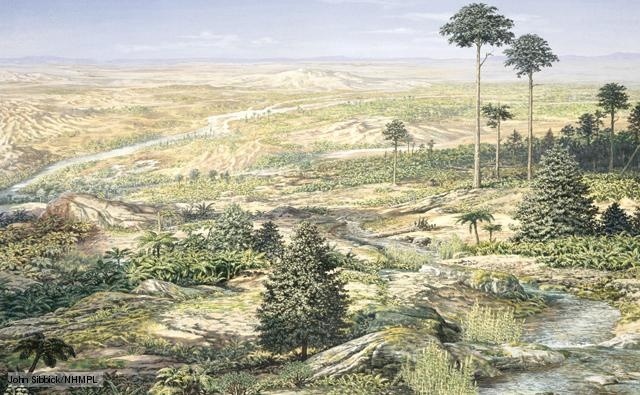
The Triassic was defined by heat. The supercontinent of Pangaea continued its reign, creating a hot, dry climate across most of the globe. The polar regions, free of ice, were warm and lush with forests. This strange, empty world provided a unique opportunity. With most of the old competition wiped out, new groups of animals could rise to prominence.
The First Kings: Dinosaurs and Mammals Emerge
This is when it happened. In the shadow of giant, crocodile-like reptiles and other strange Triassic beasts, two new groups of animals made their first appearance. One would go on to rule the world for 150 million years. The other would bide its time, waiting for its turn.
The first dinosaurs were not the giants we see in movies. They were small, scrappy, two-legged animals, like Eoraptor, no bigger than a large dog. They were fast and adaptable, but they were far from dominant. They were just one of evolution’s many new experiments.
At the same time, hiding in the undergrowth and coming out only at night, the very first mammals evolved. They were tiny, shrew-like creatures, living in constant fear of the giant reptiles that now ruled the day. Our own distant ancestors began their story as survivors in a world of monsters.
The Cracks Appear: The End of a Supercontinent
Pangaea was not meant to last. The same immense heat and mantle forces that had pushed the continents together now began to tear them apart. Deep within the Earth, pressure was building. Rifts began to split the supercontinent. The Atlantic Ocean was born, not as a sea, but as a series of long, narrow valleys and volcanoes.
This breakup was not a gentle separation. It was another period of immense volcanic activity. A new event, the Central Atlantic Magmatic Province (CAMP), unleashed another wave of lava and gas, triggering yet another mass extinction at the end of the Triassic. This second, less severe apocalypse was a crucial turning point. It wiped out many of the large reptiles that were competing with the dinosaurs.
The path was now clear. With their main rivals gone, the dinosaurs exploded in size, diversity, and dominance. The destruction of one world created the perfect conditions for the next. The Triassic-Jurassic extinction was the starting gun for the true Age of Dinosaurs.
The fragments of Pangaea drifted apart, slowly becoming the continents we know today. Its story was over. But its legacy is written in every rock, every mountain range, and in the very DNA of the creatures that survived its fiery reign. We live on the shattered pieces of a lost world, a world of impossible scale and apocalyptic violence. It’s a chilling reminder that our planet has remade itself before, and the forces that tore a supercontinent apart are still churning, silently, deep beneath our feet.
Originally posted 2013-05-06 20:12:02. Republished by Blog Post Promoter