The Ghost Town That Scared the World
Imagine walking into a town where dinner is on the table, tools are scattered in the dirt, and the fire is still warm. But there isn’t a single soul in sight. No bodies. No blood. Just… silence.
That is the nightmare scenario of Roanoke. It is the original American horror story.
For over 400 years, the disappearance of 120 men, women, and children from England’s first attempt at a colony has driven historians, archaeologists, and conspiracy theorists absolutely insane. We are talking about an entire population wiped off the face of the earth without a trace. Queen Elizabeth I and the legendary daredevil Sir Walter Raleigh banked everything on this 1580s expedition. They wanted a capital in the New World. They wanted gold. They wanted to stick it to the Spanish.
Instead, they got a ghost story.
Something went terribly, horribly wrong. The settlers didn’t just die. They didn’t just leave. They vanished. Did the local Native American tribes slaughter them? Did the Spanish navy hunt them down? Or did they fall victim to something darker, something the history books are afraid to touch?
The Setup: A Recipe for Disaster
Let’s back up. England in the late 16th century was desperate. Spain was the big bully on the block, hauling literal boatloads of gold out of South America. England wanted a piece of the action. Sir Walter Raleigh, the Queen’s favorite bad boy, organized an expedition to the Outer Banks of what is now North Carolina.
It was a suicide mission from the start.
The supply ships were notoriously unreliable. The location—Roanoke Island—is surrounded by treacherous shallow waters known as the “Graveyard of the Atlantic.” You couldn’t get a big ship close to shore if you tried. If you got into trouble, you were on your own. And boy, did they get into trouble.

The Vanishing: 1587 vs. 1590
The group that vanished was actually the second attempt. The first group, a bunch of soldiers, had already ticked off the local indigenous tribes and bailed out a year earlier. The second group was different. These weren’t just soldiers. These were families. Carpenters. Bricklayers. Pregnant women.
John White, the governor of the colony, made a heartbreaking choice. He left his daughter and his newborn granddaughter, Virginia Dare (the first English child born in America), on the island to go back to England for supplies. He promised to be back in three months.
He didn’t make it back for three years.
War with Spain broke out. The Spanish Armada attacked England. Every ship was seized for the war effort. White was stuck in London, helpless, knowing his family was starving or dying across the ocean. When he finally returned in 1590, the silence was deafening. The houses? Dismantled. The defensive palisade? Standing, but empty. The only clue was the word “CROATOAN” carved into a fence post and “CRO” carved into a tree.
No distress signal. No cross (the agreed-upon sign for “we are in danger”). Just gone.
The “Cover-Up” Theory
Here is where it gets spicy. For centuries, the “lost colony” became rooted in American folklore. We told ourselves stories about massacre or starvation. But recently, the internet has been buzzing with a different take. What if the location of the survivors wasn’t a mystery at all? What if the government—or specifically, Sir Walter Raleigh—knew exactly where they went but kept it a secret?
Raleigh had enemies. If the Spanish spies at the English court knew where the survivors were, they would have sent a warship to execute every single one of them. Secrecy wasn’t just paranoia; it was survival.
The Map That Changes Everything
Fast forward to the modern era. We thought we had found all the clues. We were wrong.
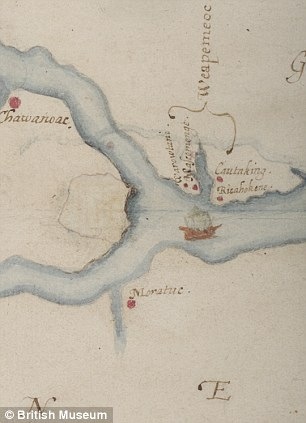
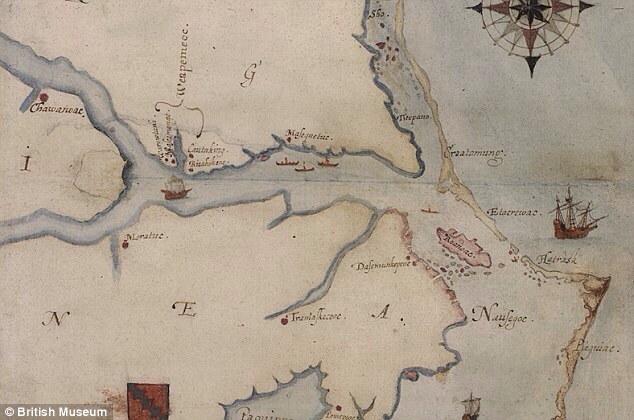
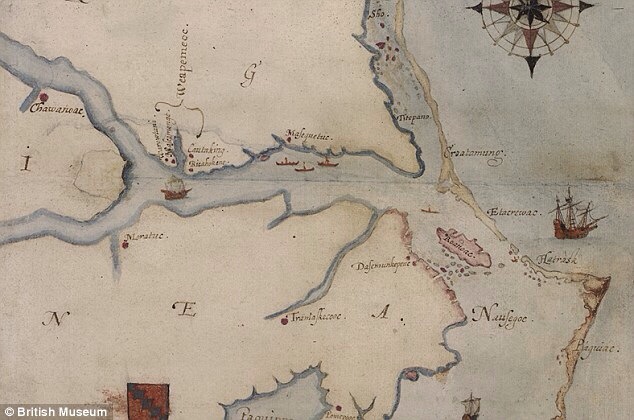
A few years ago, the British Museum dropped a bombshell that shook the archaeological world to its core. A centuries-old map, drawn by John White himself during that fateful voyage, was re-examined. For hundreds of years, people looked at this map and saw nothing but a jagged coastline and some watercolor ships.
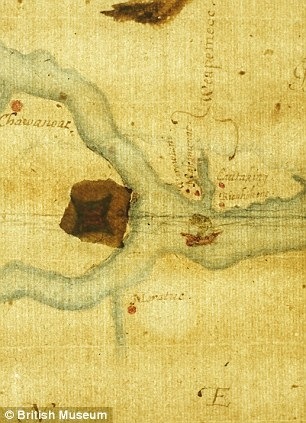
But researchers noticed something odd. There was a weird “patch” on the map. A piece of paper glued over a specific spot on the coastline.

Invisible Ink and Secret Forts
Why would a mapmaker glue a scrap of paper over his own map? Was it a mistake? A coffee stain?
Researchers at the British Museum put the map on a light table. It was like a scene from National Treasure. Hidden underneath that patch, drawn in what appears to be invisible ink or a reactive substance (likely milk, citrus juice, or urine, which turn brown when heated), was a symbol.
It wasn’t just any doodle. It was a massive lozenge shape.
In 16th-century cartography, a lozenge meant one thing: A Fort.
This wasn’t on Roanoke Island. This symbol was located 50 miles inland, near where the Chowan and Roanoke rivers meet. This changes the entire narrative. The experts identified this tantalizing clue as the possible location of the colony’s intended capital—the “Cittie of Raleigh.”
John White didn’t just lose the colonists. He might have known exactly where they were planning to go. He marked the spot on the map, then covered it up with a patch to hide it from prying eyes. Was this the “X-marks-the-spot” we have been waiting 400 years for?
Site X: The Excavation
The discovery of the patch kicked off a frenzy. They called the location “Site X.”
This wasn’t just a theory anymore. This was a target. The First Colony Foundation grabbed their gear—magnetometers, Ground Penetrating Radar (GPR), and shovels—and headed to a spot in Bertie County, North Carolina.
What they found was mind-blowing.

They didn’t find a giant golden city, but they found something arguably better: trash. Specifically, English Border Ware pottery. This is a specific type of ceramic used in London in the late 1500s. It wasn’t made in America. The Native Americans didn’t have it. And by the time later settlers arrived in the 1600s, this style of pottery was out of fashion.
This means English people were living at “Site X” exactly around the time the Roanoke colonists vanished. They found metal hooks used for stretching animal hides—typical settler tools. They found aglets (the little metal tips on shoelaces) that dated perfectly to the Elizabethan era.
The evidence paints a shocking picture. The colony didn’t vanish into thin air. They likely split up. One group may have gone north to the Chesapeake. Another group, the main body, likely headed inland to Site X, seeking the protection of friendly tribes.
The “Two Groups” Theory
Modern historians are now piecing together a scenario that feels real. The colonists realized no help was coming. They were starving. They couldn’t stay on the exposed island.
So, they executed a Plan B. A small group stayed behind at the coast to wait for John White (the ones who carved “Croatoan”). The rest moved inland to the fortified capital White had drawn on his map. They integrated. They married into the tribes. They survived.
But then, tragedy struck again. Theories suggest that just before the Jamestown settlers arrived in 1607, the Powhatan tribe, under the leadership of Chief Powhatan (Pocahontas’s father), may have slaughtered the survivors to eliminate a rival power base. Tales told to the Jamestown settlers mentioned “men clothed like you” living nearby who were wiped out.
Wait, What About The Supernatural?
We can’t ignore the weird stuff. The internet loves a good paranormal angle, and Roanoke is full of them. There are legends of the “White Doe”—that Virginia Dare was transformed into a white deer by shamanic magic and still roams the woods. There are theories about a viral outbreak that caused mass hallucinations.
Some even point to the lack of bodies as evidence of abduction. While the archaeological evidence points to assimilation and migration, the absence of a mass grave keeps the door open for the wildest imaginations.
Deep Dive Timeline: The Path to Mystery
To understand how a hundred people can just disappear, you have to look at the timeline. It is a slow-motion car crash of bad luck, bad timing, and bad decisions.
- 1584 — The Scout Mission: Sir Walter Raleigh’s men first land on Roanoke Island. It’s summer. The fish are jumping. The locals are friendly. They go back to London and tell the Queen it’s “Paradise.” (Spoiler: It wasn’t).
- 1585 — The Military Failure: 108 soldiers arrive to build a fort. They run out of food immediately. They treat the Native Americans poorly, spreading disease and violence. They abandon the fort and catch a ride home with Sir Francis Drake a year later.
- 1587 — The Families Arrive: A new group of 117 colonists arrives. Men, women, children. This is the “Lost Colony.” They find the ruins of the old fort and the skeleton of one man left behind. Bad omen? You bet.
- August 1587 — The Departure: Governor John White realizes they don’t have enough supplies for winter. He leaves his family and sails back to England. He plans to be back by Christmas.
- 1588-1589 — The War: The Spanish Armada attacks. England is on lockdown. White’s ships are seized. He is stranded in England, looking at the ocean, knowing his family is waiting.
- 1590 — The Return: Captain White finally returns. It is his granddaughter’s third birthday. He finds… nothing. The word “CROATOAN” is the only clue. A hurricane is coming, so he is forced to leave without searching the mainland.
- 1602 — The Last Try: Raleigh makes another attempt to locate the colony. He fails. The trail is cold.
- 1940s — Science Steps In: Professional archaeology begins at Roanoke. They find the earthworks, but no houses.
- 1998 — The Tree Ring Data: Scientists analyze ancient cypress trees. They discover that 1587-1590 was the worst drought in 800 years. The colonists didn’t just vanish; they were likely dying of thirst.
- 2012 — The Invisible Ink: The British Museum discovers the hidden fort symbol on John White’s map.
- 2013-Present — Site X Excavation: Researchers study the inland site with magnetometers and GPR, finding Elizabethan pottery. The mystery begins to unravel.
The Final Verdict?
Did we solve it? Maybe. The discovery of the patch on the map and the pottery at Site X is the closest we have ever come to a smoking gun.
It suggests the “Lost Colony” wasn’t lost at all. They knew exactly where they were going. They moved inland, mixed with the Native American populations, and their bloodlines likely continue today. The “mystery” might simply be that history forgot to write down their new address.
But until we find a journal, a grave, or a letter written by a survivor, Roanoke remains the ultimate cold case. The woods of North Carolina are deep, and they are good at keeping secrets.
Originally posted 2013-12-11 12:28:12. Republished by Blog Post Promoter
![20131211-132548[1]](https://coolinterestingnews.com/wp-content/uploads/2013/12/20131211-1325481.webp)