The Desert’s Greatest Magic Trick: Walking Rocks in the Valley of Death
Imagine a place so flat, so dry, and so aggressively hostile to life that it looks like the surface of Mars. The ground is a tessellation of cracked mud, baked hard as concrete by a relentless sun. There is no sound here. No birds. No rustling leaves. Just the blood rushing in your ears and the oppressive weight of silence.
This is the Racetrack Playa. It sits hidden in the remote northern reaches of Death Valley National Park, California. It is a place that shouldn’t exist. And sitting on this dry lakebed are objects that shouldn’t move.
But they do.
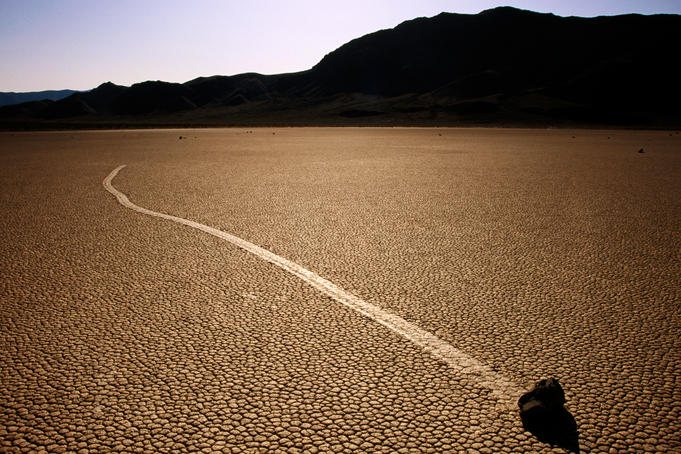
For nearly a century, visitors, scientists, and conspiracy theorists have stood over these heavy dolomite boulders, scratching their heads in absolute bewilderment. They call them the “Sailing Stones.” Some weigh a few pounds. Others weigh as much as a fully grown linebackers—up to 700 pounds (318 kg). And yet, despite their crushing weight, they slide across the flat earth, leaving behind long, deeply gouged trails that twist, turn, and sometimes even double back on themselves.
Here is the kicker: Until very recently, nobody had ever seen them move.
Not once. Not a park ranger. Not a camper. Not a lost hiker. The rocks would just be in one spot on Tuesday, and by Friday, they would be three hundred yards away, with a fresh track proving their journey. It was nature’s ultimate locked-room mystery. How do you move a giant boulder without footprints? Without machinery? Without leaving a single trace of evidence other than the groove in the mud?
The “Impossible” Physics of the Racetrack
Let’s look at the sheer absurdity of the situation. We aren’t talking about pebbles rolling down a hill. Racetrack Playa is aggressively flat. It varies in elevation by only an inch or two over several miles. Gravity isn’t doing the work here.
The tracks themselves are bizarre. Some are straight as an arrow, shooting across the playa for hundreds of feet. Others are curved, graceful arcs that look like the brushstrokes of a giant painter. And then there are the weird ones. Sharp, ninety-degree turns. Zig-zags. Tracks that show two rocks moving perfectly parallel to each other, only for one to suddenly veer off to the left while the other continues straight.
If you stand there, looking at a 40-pound rock at the end of a 500-foot trail, your brain breaks a little. It defies logic. It defies friction.
The Paranormal Panic: Aliens, Ghosts, and Magnetic Fields
When science stays quiet, imagination gets loud. And for decades, science was very, very quiet about the Racetrack Playa. Because experts couldn’t offer a solid explanation, the internet and the fringe communities filled the void with wild theories. And honestly? Some of them were a lot more fun than the truth.
The Area 51 Connection
You can’t talk about unexplainable phenomena in the American Southwest without someone bringing up UFOs. Death Valley isn’t exactly next door to Roswell, but it’s part of that same vast, empty corridor of Nevada and California where weird things happen in the sky.
The theory went like this: The rocks were being moved by extraterrestrial visitors. Maybe it was a form of communication? A cosmic game of chess? Or perhaps the rocks were being used as calibration tools for tractor beams. If you can lift a cow, you can slide a rock. It sounds ridiculous, but when you are standing alone in the dark on the playa, looking up at the Milky Way, the idea of little green men pushing rocks around doesn’t feel impossible.
The Magnetic Anomaly Theory
This was a favorite among the “energy vortex” crowd. The idea was that the Racetrack Playa sat on top of massive, fluctuating magnetic grid lines. These magnetic anomalies, they argued, could momentarily reduce the gravity around the stones, allowing them to float or hover just millimeters off the ground. Once hovering, even a gentle breeze could push them along.
It’s a cool idea. It’s also completely wrong. Geologists have surveyed the area extensively. There are no magnetic anomalies. The rocks are dolomite and syenite—they aren’t magnetic. But that didn’t stop people from bringing compasses out there, hoping to see the needle spin wild.
The Prankster Theory
Skeptics love this one. “It’s just college kids,” they say. “It’s a hoax.”
Here is why that falls apart. The Racetrack is remote. To get there, you have to drive nearly thirty miles down a washboard dirt road that destroys tires and rattles fillings loose. It takes hours. And the tracks? They have been there since the 1900s.
Furthermore, the mud on the playa is incredibly sensitive when it’s wet. If a human walked out there to push a rock, they would sink in. They would leave footprints. Deep, muddy, undeniable footprints. The “ghost rocks” leave no footprints. Just the trail of the stone itself. Unless the pranksters had hoverboards or lowered themselves from helicopters for eighty years straight, the hoax theory is dead in the water.
Decades of Frustration: Science vs. The Stone
Scientists hate not knowing things. It itches. Since the late 1940s, geologists have been trying to crack the code of the sailing stones.
In 1948, two geologists, McAllister and Agnew, proposed that dust devils—those mini-tornadoes you see spinning in the desert—might be responsible. It made sense on paper. The playa gets windy. Very windy. But the math didn’t add up. To move some of the heavier stones, you would need wind speeds of over 150 miles per hour. That’s a Category 4 hurricane.
While Death Valley is breezy, it isn’t experiencing almost-supersonic wind blasts on a regular Tuesday.
The “Karen” Incident
In the 1970s, a team led by Robert Sharp and Dwight Carey decided to get serious. They tagged the rocks. They gave them names. There was “Nancy.” There was “Mary Ann.” And there was “Karen.”
They monitored these rocks for seven years. They drove stakes into the ground to see if the rocks moved past them.
Do you know what happened? Nothing. For years, the rocks sat there, mocking the scientists.
Then, one winter, a storm hit. When the researchers came back, “Karen”—a 700-pound beast of a rock—had vanished. They found her far away from her starting point. She had moved. But again, nobody saw it happen. It was as if the rocks knew they were being watched and waited for the scientists to turn their backs.
The Breakthrough: The “Ice Raft” Phenomenon
Fast forward to the modern era. We have GPS. We have time-lapse cameras with batteries that last for months. We have weather stations. The mystery was living on borrowed time.
In 2011, paleobiologist Richard Norris and his cousin, engineer James Norris, decided to go all in. They set up a “Sliding Rock Weather Station.” They bored holes into limestone rocks (brought in from outside so they didn’t tamper with the park’s natural rocks) and installed GPS tracking units inside them.
They set up cameras. They waited.
Two years passed. The batteries died. The hard drives filled up with photos of nothing. It seemed like the Racetrack was going to keep its secrets.
Then, in December 2013, the cousins visited the site to do maintenance. They arrived at night. The playa was wet. A thin layer of water covered the lake bed. It was freezing cold.
The next morning, the sun rose over the mountains. And the magic show began.
The Perfect Storm
It wasn’t aliens. It wasn’t hurricane winds. It was something much more delicate and strange.
Here is the recipe for a Sailing Stone:
- Step 1: The playa must fill with water deep enough to form floating ice, but shallow enough that the rocks still poke out the top. We are talking about 3 inches of water.
- Step 2: It has to get cold. Freezing cold. A layer of ice forms on the surface. But—and this is vital—it can’t be a solid block of ice. It has to be thin. “Windowpane ice.” Less than a quarter-inch thick.
- Step 3: The sun comes out. The ice begins to crack and break up into massive floating panels. Some of these panels are hundreds of feet wide.
- Step 4: A light breeze kicks up. Just a gentle puff of air.
Because the ice is floating on the water, it has almost zero friction. The wind pushes the giant sheets of ice. These sheets drift across the water and bump into the rocks.
The ice grabs the rock. Because the ice sheet is so huge and heavy, it has massive momentum. It pushes the rock. The rock slides across the muddy bottom of the lake, driven by the floating ice raft.
It happens in slow motion. The rocks move at inches per second. It’s so slow that if you were standing there staring at it, you might not even realize they were moving until you looked away and looked back.
The Norris cousins watched it happen. They heard the ice cracking—a sound like breaking glass echoing across the desert. They saw the GPS trackers moving. They saw the trails forming in real-time.
Why the Mystery Still Matters
So, is the magic gone? Now that we know it’s just ice, wind, and water, is the Racetrack Playa just another dusty location?
Absolutely not.
Think about the odds. The conditions required for this to happen are insanely specific. You need rain in one of the driest places on Earth. You need a freeze in a place famous for heat. You need the wind to blow at the exact moment the ice is melting but not yet gone.
It might only happen once every decade. It’s a cosmic alignment of weather and geology.
And even knowing the science, standing on the Playa changes you. The sheer scale of the emptiness makes you feel small. You look at those tracks—some stretching for hundreds of feet—and you can feel the ghost of the event. You can imagine the creaking ice, the cold wind, and the silent, slow march of the stones.
The “Unsolved” Feel
There is still plenty about Death Valley that feels off. The silence is heavy. The heat waves distort your vision. You see things that aren’t there.
And while we know how the rocks move, seeing a 700-pound boulder at the end of a zig-zag track still triggers that primal part of your brain that says: “This isn’t right.”
Nature is weird. It doesn’t care if we understand it or not. For a hundred years, the rocks walked when nobody was looking. They kept their secret through wars, through the moon landing, through the invention of the internet. They just kept sliding, silently, in the dark.
If you ever get the chance, go there. Drive the washboard road. Walk out onto the cracked earth. Find a rock. Sit with it.
And maybe, just maybe, if you stay very still… it might just move for you.
Planning Your Trip to the Paranormal Playa
If you are brave enough to visit, here is what you need to know. This isn’t Disneyland. This is the wild.
- The Vehicle: Do not bring your sedan. You need a 4×4 with high clearance. The road to the Racetrack eats tires for breakfast. Flat tires are the norm, not the exception.
- The Season: Do not go in the summer. Temperatures can hit 120°F (49°C). People die here. Seriously. Go in late fall or winter.
- The Rules: Never, ever drive on the playa. The tire marks scar the landscape for decades. Walk. It’s good for your soul.
- The Rocks: Don’t move them. Don’t stand on them. Don’t take them. Let the mystery remain for the next traveler.
The Sailing Stones of Death Valley are a reminder that the world is still full of surprises. In an age where we think we have everything mapped, tracked, and explained, it’s nice to know that sometimes, rocks just want to go for a walk.
Originally posted 2016-04-11 04:28:23. Republished by Blog Post Promoter