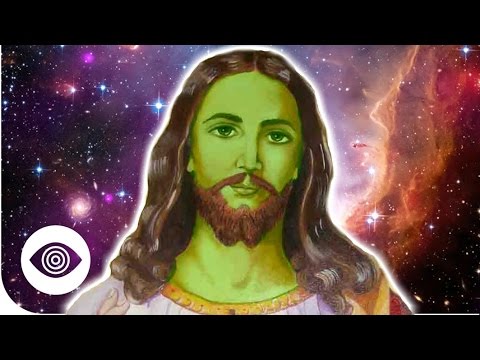
Was Jesus an Alien? The Forbidden History You Were Never Meant to See
Forget everything you think you know. Seriously. Take the history books, the Sunday school lessons, the neatly packaged stories you’ve been told your whole life, and set them aside. Just for a moment.
Because we’re going to ask a question so massive, so shattering, it could rewrite human history from the ground up.
What if the greatest story ever told wasn’t the whole story?
What if it was a story of advanced technology, misinterpreted by a primitive people? A story of cosmic visitors, not divine beings. A story of a man who came from the stars, not from heaven.
What if Jesus Christ was an extraterrestrial?
It sounds like science fiction. It sounds blasphemous. It sounds completely insane. But stick with me. The theory, often called the “Ancient Astronaut” hypothesis, suggests that what our ancestors recorded as divine intervention was actually contact with a technologically superior alien race. They saw flying machines and called them chariots of fire. They saw beings in protective suits and called them angels. They saw advanced medical devices and called them miracles.
And at the center of it all stands one figure: a carpenter from Nazareth who changed the world. But was he really just a carpenter? Or was he something… more?
Before we journey down this rabbit hole, see for yourself what has so many people questioning the official story.
The Immaculate Deception: A High-Tech Birth?
The story begins, as it should, at the beginning. A birth shrouded in mystery and proclaimed a miracle. The Virgin Mary, a young woman in Nazareth, is visited by an angel named Gabriel who announces she will conceive a child by the power of the “Holy Spirit.”
Let’s pause. Stop. Reread that from a modern perspective.
An unknown being appears, seemingly out of nowhere, and informs a woman she will become pregnant without a human partner. In the year 2024, what would we call that? We have a term for it. Artificial insemination. Advanced genetic engineering. In-vitro fertilization.
Could “Gabriel” have been not a winged celestial being, but a biological emissary from another world? Was the “Holy Spirit” not a mystical force, but the name given to a hyper-advanced procreation technology that a first-century mind could never hope to comprehend? They used the words they had. They described the light, the overwhelming presence, the impossible news. They called it a miracle. What else could they call it?
This “visitor” tells Mary her child will be the “Son of the Most High.” Is this a spiritual designation, or a literal one? The son of a being from *higher up*… in the sky?
That’s No Star… It’s a Spaceship
Then comes the birth. And with it, one of the most glaring pieces of evidence in the entire story: the Star of Bethlehem.
The Bible is very specific about this “star.” It wasn’t just a bright point of light. It moved. It guided the Magi from the East directly to the location of the infant Jesus. And then, most telling of all, Matthew 2:9 states that the star “went before them, till it came and stood over where the young child was.”
Stars don’t do that.
Planets don’t do that. Comets, supernovas, astronomical phenomena of any known kind do not stop, hover, and pinpoint a single building on the surface of the Earth. It is physically impossible according to our understanding of astrophysics.
But you know what can do that?
A vehicle. A craft. A drone or a scout ship. Something under intelligent control. Imagine a small, illuminated craft sent from a larger mothership in orbit, leading a caravan of important figures across the desert with precision GPS. To the people on the ground, witnessing this glowing object maneuver with purpose, what would they call it? They would call it a star. A special star. A star sent by God.
The story of Jesus’s birth isn’t just a story of a miracle. It’s a story that, when you strip away the ancient terminology, sounds suspiciously like a carefully monitored, technologically assisted, extraterrestrial-guided event.
Miracles or Misunderstood Machines?
As Jesus grew, his mission began. And with it came a series of “miracles” that defy all known laws of physics and biology. Or do they? The Ancient Astronaut theory proposes a stunning alternative: Jesus wasn’t breaking the laws of physics. He was using a technology so advanced that it simply looked like magic.
Think about it. If you traveled back in time with a smartphone, a solar charger, and a drone, you would be a god. You could show them images from across the world. You could play music from an invisible orchestra. You could send a flying eye into the sky. They wouldn’t call it technology. They would call it divine power.
Now, let’s re-examine his famous acts through that same lens.
Walking on Water & Calming Storms: Gravity Control?
One of the most iconic images: Jesus walking on the stormy Sea of Galilee. His disciples are terrified, their boat tossed by the waves, and he simply walks toward them on the water’s surface. A miracle?
Or a personal anti-gravity device? A small, localized field generator that nullifies the effect of gravity beneath his feet? We see this in science fiction all the time. Perhaps it wasn’t fiction. Perhaps it was a standard-issue piece of equipment for his kind. When Peter tries and fails, is it because his “faith” wavered, or because he didn’t know how to operate the device correctly and panicked?
Later in the same event, he is said to have “rebuked the winds and the sea, and there was a great calm.” Weather manipulation. Cloud seeding. Atmospheric pressure adjustment. Technology we are only just beginning to experiment with today. For a civilization thousands of years ahead of us, would calming a local storm be a major feat?
Water to Wine, Bread for Thousands: Matter Replication?
The wedding at Cana. They run out of wine. Jesus tells them to fill six large stone jars with water. They do. He then turns that water into the finest wine. Magic?
Or a molecular synthesizer? A portable device, maybe no bigger than a canteen, that can rearrange the atoms of H2O into the complex molecules of fermented grape juice. It’s the stuff of Star Trek’s replicators. Drop in base matter, get out anything you want.
The same logic applies to feeding the 5,000. He starts with just five loaves of bread and two fish. He ends up with enough to feed a massive crowd, with 12 baskets of leftovers. It’s mathematically impossible. Unless… he wasn’t just “blessing” the food. He was using a matter replication device to multiply it exponentially. To the hungry crowd, seeing food appear from almost nothing, it was a gift from God. To an engineer, it’s just a highly efficient process.
Healing the Blind: The Ultimate Medical Toolkit?
The gospels are filled with accounts of Jesus healing the sick. He cures leprosy, restores sight to the blind, makes the lame walk, and even raises the dead.
Let’s look at the “healing” of the blind man. He makes a poultice of mud and his own saliva and applies it to the man’s eyes, restoring his sight. Is this a holy ritual, or a sanitized description of applying a bio-restorative agent? Perhaps his alien biology, or a technology contained within his saliva, contained nanites—microscopic robots—programmed to repair damaged retinal tissue.
Raising Lazarus from the dead? The man had been in a tomb for four days. Medically, he was gone. But what if he was only in a deep coma, or a state of suspended animation? What if Jesus possessed a medical device—a defibrillator, a shot of advanced stimulants, a cellular regenerator—that could restart his biological functions? To the grieving family, their beloved Lazarus had returned from the afterlife. To a paramedic with a futuristic kit, it was just another successful resuscitation.
A Kingdom “Not of This World”
Beyond the “miracles,” consider the message itself. Jesus’s teachings were radical. Revolutionary. In an era of tribalism, conquest, and an “eye for an eye” mentality, he preached universal love, forgiveness for one’s enemies, and humility. He spoke constantly of a “kingdom.” But he was very clear: “My kingdom is not of this world.”
Everyone took it as a metaphor. The kingdom of heaven. A spiritual place after death.
But what if he meant it literally?
What if his kingdom—his home, his people—was literally not of this world, Earth? What if his teachings were a kind of cosmic philosophy, an attempt to socially engineer and uplift a primitive, violent species (us) to a higher level of consciousness? It was a gentle guidance. A program to get humanity to stop killing each other so we might one day be ready to join a galactic community.
His parables, his focus on unity and compassion, his dismissal of earthly power and wealth… it all paints a picture of an outsider, a visitor with a much grander perspective, trying to teach the children of Earth a better way to live before they destroyed themselves.
The Resurrection Ruse: Cheating Death and Ascending to the Stars
This is the grand finale. The cornerstone of the entire story. The crucifixion, the death, and the impossible return. It is here that the Ancient Astronaut theory presents its most compelling, and most shocking, claims.
Was Jesus executed? Absolutely. But did he die?
Or was it a brilliantly staged exit plan?
Surviving the Cross
Accounts say he “died” remarkably quickly for a crucifixion victim. He was offered a sponge soaked in sour wine (a mild anesthetic, perhaps?) right before he passed. His legs, which were normally broken to speed up death by asphyxiation, were left intact. A soldier pierced his side with a spear, and “blood and water” came out—a detail some medical experts say could be a sign of a living person with pleural effusion, not a corpse.
What if he didn’t die? What if he was simply put into a death-like state, a medically induced coma, using technology or biological abilities unknown to us? His followers, believing him dead, take his body and place it in a tomb.
Then, the plan kicks in.
A “great earthquake” occurs, and an “angel of the Lord, whose appearance was like lightning,” rolls away the stone. A geological event and a being of light. Or, perhaps, the sound and vibration of a landing craft, and an ally in a bright, self-illuminated environmental suit emerging to retrieve their operative?
The body is gone. Not because it was resurrected, but because it was recovered.
“He Was Taken Up Before Their Very Eyes”
After a few strategic post-“resurrection” appearances to his most loyal followers to prove his “victory” over death, Jesus prepares for his final exit. This is the moment that should send a shiver down your spine.
The Book of Acts, Chapter 1, Verse 9, describes it plainly: “And when he had spoken these things, while they beheld, he was taken up; and a cloud received him out of their sight.”
He was taken up. A cloud received him. He didn’t sprout wings. He didn’t fade away. He physically rose into the sky until a “cloud” obscured him. Is there any better way for a first-century fisherman to describe a man being lifted by a tractor beam into a waiting, cloaked ship hovering overhead?
The two “men in white” who suddenly appear beside the disciples drive the point home. They ask, “Why do you stand here looking into the sky? This same Jesus, who has been taken from you into heaven, will come back in the same way you have seen him go into heaven.”
In the *same way*. A physical return from the sky. Not a vague spiritual second coming, but a literal arrival. A landing.
The ascension wasn’t a miracle. It was an extraction.
The Final Question: Believe or Re-Examine?
So, where does this leave us? Is it a wild, entertaining fantasy? A desperate attempt to strip spirituality from the world’s most influential story? Or is it a plausible, even logical, explanation for a series of events that otherwise defy all reason?
The theory doesn’t necessarily take away the power of Jesus’s message. Love, forgiveness, and compassion are profound ideas, no matter their origin. But it does re-frame the messenger. It suggests we weren’t visited by a god, but by a guide. A teacher from a more advanced civilization, sent on a mission to help humanity take its first baby steps toward cosmic citizenship.
The evidence, proponents argue, is there. Hidden in plain sight within the very texts people hold sacred. A moving star. Miracles that mirror future technology. A message of cosmic brotherhood. A resurrection that looks like a medical revival. And a final ascension that reads like a Starfleet beaming someone up.
Was Jesus an alien? Was the Bible a garbled, first-hand account of an extraterrestrial intervention? Were the miracles simply technology? The questions are bigger than any one answer.
Perhaps the point isn’t to believe one story over the other. Perhaps the point is to finally start asking the right questions, to look at the ancient tales with modern eyes, and to accept that the history we’ve been taught might be far smaller, and far less strange, than the truth.
The truth, as they say, is out there. Maybe it’s been right here, in front of us, all along.