Thursday, May 14, 2026
HomeWeird WorldStrange StoriesMolinere Underwater Sculpture Park

Molinere Underwater Sculpture Park

Imagine this.

You are floating in the warm, turquoise waters of the Caribbean. The sun is blazing above you. The world is loud, bright, and full of life. But then, you take a breath. You dip your head beneath the surface. The noise stops. The light shifts. And there, staring back at you from the silent gray floor of the ocean, is a face.

Not a fish. Not a rock. A human face. Eyes closed. Frozen in time.

Welcome to one of the most haunting, beautiful, and downright bizarre places on Earth: the Molinere Underwater Sculpture Park. Located just off the west coast of Grenada in the West Indies, this isn’t your average art gallery. There are no velvet ropes here. No security guards telling you to step back. Just the endless blue, the crushing weight of the sea, and an army of stone people that look like they simply walked into the water one day and never walked out.

The Atlantis of the Caribbean?

When you first see the photos, your brain tries to trick you. Is this an archaeological find? Did we just stumble upon a lost civilization? Is this the real Atlantis, finally giving up its secrets? It looks ancient. It looks like a graveyard of a forgotten city.

But the truth is stranger. And more modern.

This entire underwater “city” was created by one man: British sculptor Jason deCaires Taylor. Back in May 2006, he did something that sounded absolutely crazy at the time. He decided to open the world’s first public sculpture park. But instead of putting it in a park in London or a square in New York, he tossed it into the ocean.

Taylor didn’t just want to make cool statues. He wanted to shake things up. He wanted to force a collision between humanity and nature. His goal? To grab the local community by the shoulders and make them look—really look—at the underwater world surrounding them. But he didn’t carve random faces. No. That would be too easy.

He took life casts of the actual local people. The faces you see down there? They are the faces of Grenadians. Real people. Frozen in cement. Sitting on the ocean floor, forever.

underwater mystery

Why Bury Art in the Ocean?

Let’s talk about the vibe for a second. It is spooky. There is no getting around it.

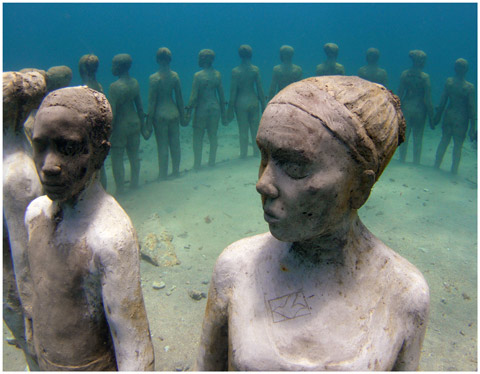
When you dive down to Molinere Bay, you are entering a different world. The sculptures are mostly human forms. Some are alone. Solitary figures sitting at desks, or watching TV (yes, really), or just standing there, waiting. Others are in groups. The most famous piece—and the one that gives everyone goosebumps—is a ring of children holding hands, facing outward into the current.

Why do this? Why spend months sculpting detailed figures just to drown them?

The location wasn’t random. Molinere Bay was barren. It was a sandy, empty scar on the ocean floor, damaged by storms. It was a wasteland. By dropping these concrete heavyweights—we are talking about 15 tonnes of dry cement—Taylor wasn’t just littering. He was terraforming.

The park is an artificial reef. A decoy.

Tourism is a double-edged sword. Everyone wants to see the reefs at Flamingo Bay nearby. It is the number one snorkeling spot. But thousands of flippers kicking and hands touching can kill a reef fast. Taylor’s idea was genius: give the tourists something else to look at. Something weird. Something mind-bending. Draw the crowds away from the fragile natural reefs and let nature heal.

And it worked. But something else happened. Something darker.

The “Vicissitudes” and the Ghost of the Middle Passage

Look at that image above again. A circle of children. Holding hands. Facing the darkness of the deep ocean. As the currents rip past them, they stand strong.

This piece is called Vicissitudes. And it has sparked one of the fiercest debates in the art world.

When you look at African bodies chained or linked together at the bottom of the Atlantic Ocean, what is the first thing that hits you? For many, it is a punch to the gut. It screams of the Middle Passage. It looks like a memorial to the millions of enslaved Africans thrown overboard during the horrific journey from West Africa to the Americas. The ocean floor of the Caribbean is, in a very literal sense, a graveyard. It holds a memory of pain.

Internet theories exploded. Bloggers, historians, and tourists became convinced this was a secret tribute. A silent, underwater monument to the lost.

But here is the twist.

Jason deCaires Taylor says no. He claims that wasn’t the plan. In a statement that shocked many, the artist said: “It was never my intention to have any connection to the Middle passage. Although it was not my intention from the outset I am very encouraged how it has resonated differently within various communities and feel it is working as an art piece by questioning our identity, history and stimulating debate.”

He says it represents unity. The continuity of life. The children are adaptable, facing the currents of change.

But does the artist’s intent matter once the art is in the wild? Or in this case, in the water? If you swim down there and feel the weight of history, that feeling is real. The ocean context changes everything. You can’t put bodies on the floor of the Caribbean sea without evoking ghosts.

The Science of Turning Stone into Life

Let’s get technical for a minute, but keep it simple. How do these things not crumble?

You can’t just throw a garden gnome in the sea and hope for the best. Saltwater is brutal. It eats everything. Taylor had to use a special mix of marine-grade cement, sand, and micro-silica to create a pH-neutral concrete. This is vital.

Most cement is toxic to coral. It burns it. But Taylor’s mix is like catnip for marine life.

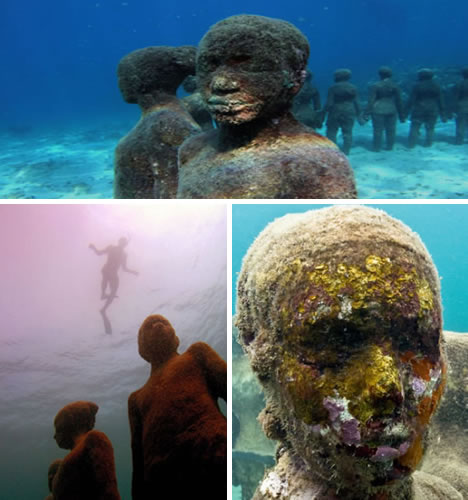
This is where the magic happens. When the statues first go down, they are gray. Boring. Human. But within weeks, the ocean claims them. Algae starts to grow. Then come the coral polyps. Sponges. Hydroids. The gray turns into an explosion of pink, orange, and green.

The statues are mutating.

A man’s face becomes a mask of fire coral. A woman’s dress becomes a living sponge. The “Lost Correspondent”—a man sitting at a desk with a typewriter—is now covered in so much life that you can barely see the typewriter keys. It is a slow-motion transformation. The art is not finished. The ocean is the second artist. It is painting over Taylor’s work, year after year.

The Uncanny Valley: Why is it Scary?

We need to talk about the fear factor. There is a name for the fear of submerged man-made objects: submechanophobia. But this is different.

This is the Uncanny Valley effect. The statues look too human. They are life-size. They have the faces of real people. But they don’t move. They don’t breathe. When you are snorkeling above them, looking down through 12 meters of water, the distortion of the light makes them look like they are shifting. Like they are watching you.

There are over sixty-five of these figures now, spread out over 800 square meters. It is a silent army.

Some divers report a feeling of intense sadness down there. Others feel peace. But almost everyone feels small. You are floating over a civilization that has been swallowed whole. It mimics the look of a post-apocalyptic world where the sea levels have risen and humanity has been wiped out, leaving only our stone echoes behind.

Maybe that is the real warning.

underwater2

A Modern Mystery: The TikTok Generation Discovers Molinere

Recently, the internet has rediscovered this place. Footage of the park often goes viral on TikTok and YouTube, usually accompanied by creepy music and captions like “What did they find in the Caribbean?” or “Proof of ancient giants?”

It feeds into our obsession with the unknown. We want magic to be real. We want to believe there are secrets hidden in the deep. Even when we know the logical explanation—”It’s an art project from 2006″—our brains prefer the mystery.

And the park is evolving. It is not static.

Recently, a local artist on the island added new works to the mix. The collection is growing. It is becoming a collaborative graveyard of ideas. The older statues are now almost unrecognizable, completely encased in coral. They look less like humans and more like reef monsters. In another 50 years, will we even be able to tell they were statues? Or will they just be oddly shaped lumps of vibrant coral?

How to Experience the Eeriness Yourself

So, you want to see it? You want to face the ghosts?

Getting there is surprisingly easy. You don’t need a submarine. You don’t need to be a Navy SEAL. The Molinere Underwater Sculpture Park is accessible to pretty much anyone who can swim (and even those who can’t, if you stay on the boat).

  • Location: About 2 miles (3 km) North of St Georges (the capital) or Grand Anse Bay.
  • Depth: The sculptures sit at depths ranging from very shallow up to about 12 meters (almost 40 feet).
  • How to View:
    • Scuba Diving: This is the immersive way. You get down on the floor with them. You can look into their coral-covered eyes.
    • Snorkeling: This gives you the “God view.” You float above, watching the silent drama unfold below.
    • Glass Bottom Boats: For those who want to stay dry but still peek into the abyss.

Boats leave daily from the main port. It is a tourist hotspot, but don’t let that fool you. Once you put your face in the water, the tourists disappear. The noise of the engine fades. It is just you and them.

The Final Verdict: Art or Warning?

What are we supposed to take away from the Molinere Underwater Sculpture Park?

Is it just a clever way to save a reef? Sure. Scientifically, it is a massive success. The marine life in the bay has exploded. The biomass has increased. Nature is winning.

But artistically? Philosophically? It is a mirror.

It shows us our future. We come from the ocean, and eventually, the ocean takes everything back. Our concrete, our bodies, our history—it all gets swallowed by the blue. These statues are standing against the current, holding hands, refusing to let go, even as the coral consumes them.

It is beautiful. It is terrifying. And it is one of the few places on Earth where you can see the exact moment where humanity ends and nature begins.

If you are ever in Grenada, go. Put on a mask. Jump in. But be warned: when you stare into the abyss, the abyss stares back. And sometimes, it has a stone face.


Originally posted 2016-02-15 00:03:50. Republished by Blog Post Promoter

Amit Ghosh
Amit Ghoshhttps://coolinterestingnews.com
Aloha, I'm Amit Ghosh, a web entrepreneur and avid blogger. Bitten by entrepreneurial bug, I got kicked out from college and ended up being millionaire and running a digital media company named Aeron7 headquartered at Lithuania.
RELATED ARTICLES
- Advertisment -

Most Popular

Recent Comments

Warren Pan Abbott on The legend of the Devil Monkey !
chris davies on The McPherson Tape Mystery
Reed Reedly on ET has Internet!
Bea Houseoffashion on Proof Of Time Travellers – Gallery
Marcus2012 on ET has Internet!
Reed Reedly on ET has Internet!
LaughsAtConspiracyNuts on The 9/11 Conspiracy – Myths and Facts
Alex Sliverman on Did the ancients fly?
Doctor Wholigan on Time Traveler in 1938 film
chris davies on The McPherson Tape Mystery
Archie1954 on 10 secret UFO hideouts
chris davies on Ghosts of flight 401
Marcus2012 on ET has Internet!
jason Macdonald on Proof of Time Travel? – China
chris davies on Long-Lost Pyramids Found?
Reed Reedly on ET has Internet!
Milkman on Connected Universe
Tenmiles on Baigong Pipes Mystery
Simon Foster on Sirius – The Documentary
From the 1st April on 2013 – Alien Contact date ?
SkyWatcher on Is ET ignoring us?
I Come From The Future on Obama to make UFO Alien disclouser soon ?
Just another person on 2013 – Alien Contact date ?
Malcolm Windowcleaner on The strange case of Rudolph Fentz
Mason Servio on Strange Things on Mars
Marke Wisdom Seeker on What will we find as arctic melts?
Andrea A Elisabeth Levyne on Aliens Captured in Varginha, Brazil
Mitch Grouyeki on Amazing Space Shuttle pictures