The Night the Universe Finally Said Hello?
Imagine the setting. It’s August 1977. Elvis Presley is just days away from leaving the building forever. Star Wars is exploding in theaters, changing pop culture permanently. But while the world was distracted by rock and roll kings and space operas, something genuinely terrified and electrified a small team of scientists in a quiet corner of Delaware, Ohio.
There were no special effects here. No John Williams score. Just a massive, strange-looking contraption sitting in a field, listening to the static hiss of the cosmos. This was the Big Ear.
For years, humanity had been screaming into the void. We sent radio waves, television broadcasts, and pulsed radar signals out into the black, wondering if anyone was listening. We heard nothing back. Just the cold, indifferent hum of background radiation. Until one muggy night, when the silence broke.
For seventy-two heart-stopping seconds, a radio signal blasted through the receiver so loud, so clear, and so impossibly precise that it defied every natural explanation we had. It wasn’t a star. It wasn’t a pulsar. It looked, for all the world, like a hello.
This is the story of the “Wow!” signal. The single most compelling piece of evidence that we are not alone. And the maddening, decades-long silence that has haunted us ever since.

The Red Pen That Changed History
Let’s rewind. The “Big Ear” wasn’t your typical satellite dish. It was a radio telescope the size of three football fields, operated by Ohio State University. It didn’t swivel or rotate. It relied on the rotation of the Earth to scan the sky, a massive passive bucket catching radio rain from the universe.
It was part of SETI: The Search for Extraterrestrial Intelligence. The job was tedious. In the 1970s, computers didn’t have fancy graphical interfaces. They spit out reams of continuous paper filled with numbers. Rows and rows of numbers.
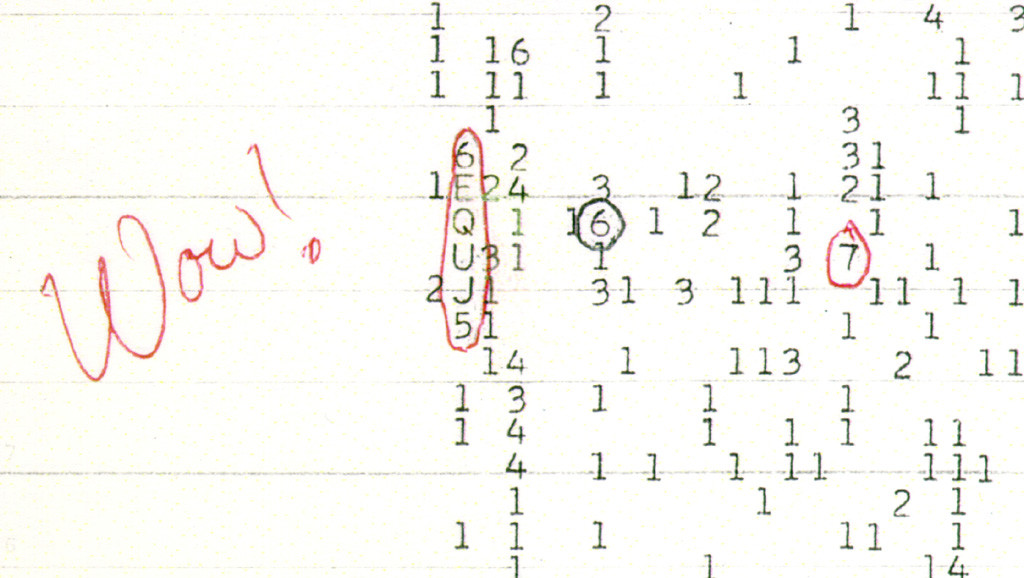
Enter Jerry Ehman. He was a volunteer project scientist, the guy tasked with looking through the haystack for the needle. A few days after the actual event—yes, the signal sat unnoticed in a stack of paper for days—Ehman sat down to review the data logs from the night of August 15th.
Most of the paper was covered in 1s and 2s. These low numbers represented the background noise. The quiet hum of empty space. Occasionally a 4 or a 5 might pop up, indicating a bit of interstellar static. Nothing to write home about.
Then, his eyes locked on a sequence that shouldn’t have been there.
6EQUJ5
It looks like a random password, right? It’s not. It’s a measurement of intensity. The computer used numbers 1 through 9 to denote signal strength. But if the signal went higher than 9? The computer switched to the alphabet. ‘A’ was stronger than 9. ‘B’ was stronger than ‘A’.
The signal started climbing. 6… E… Q… U… J… 5.
See that ‘U’? That ‘U’ is the smoking gun. In the language of the Big Ear, ‘U’ represented a signal intensity thirty times louder than the background noise. It was a scream. A focused, high-energy blast of radio waves hitting the detector with impossible clarity.
Ehman was so stunned by the anomaly that he grabbed a red pen, circled the vertical column of alphanumeric characters, and wrote a single word in the margin. A reaction that would name the phenomenon forever:
Wow!
The 72-Second Window: Why It Had to Be Space
Skeptics love to jump in here. “It was a microwave oven!” “It was a secret spy plane!” “It was a reflection off space junk!”
Hold on. There is a specific reason why astronomers get sweaty palms over this signal, and it comes down to the number 72. Remember how I said the Big Ear couldn’t move? It was fixed to the ground. It scanned the sky only because the Earth turns.
Given the width of the Big Ear’s observation window and the speed of the Earth’s rotation, any fixed point in the stars would be “visible” to the telescope for exactly 72 seconds. It would start quiet, ramp up to a peak as it hit the center of the telescope’s focus, and then fade away as the Earth turned past it.
That is exactly what the Wow! signal did. It didn’t turn on and off abruptly like a man-made transmitter would. It followed a perfect “antenna pattern” curve. It swelled, peaked, and vanished in exactly 72 seconds.
This effectively rules out a terrestrial broadcast. If it were a signal from Earth, or a plane whizzing by, it wouldn’t match the Earth’s rotation speed perfectly. It wouldn’t fit the curve. The geometry doesn’t lie. This thing originated from deep space, specifically from the direction of the constellation Sagittarius.

The Magic Frequency: The Water Hole
It gets weirder. If you were an alien civilization trying to call your neighbors, what channel would you use? You wouldn’t pick a random frequency. The universe is too noisy. You’d pick a channel that everyone, everywhere, would be listening to.
Scientists have long theorized that this universal channel is 1420 MHz.
Why? Because that is the frequency of hydrogen. Hydrogen is the most common element in the universe. If you are a scientist on Earth, or on a planet orbiting a star in the Andromeda galaxy, you know about hydrogen. You study it. You listen to it. It is the universal standard. Astronomers call this frequency range the “Water Hole,” a poetic spot where galactic civilizations might meet to have a drink and chat.
The Wow! signal? It was tuned almost exactly to 1420 MHz. It was narrow-band, meaning it didn’t splash across the dial like a natural explosion would. It was sharp, precise, and right on the money. It was like tuning a radio and hitting a crystal-clear station in a sea of static.
The Great Silence: Why Didn’t They Call Back?
Here is where the story turns from exciting to frustrating. We looked back. Oh, how we looked back. Within minutes of finding the data, Ehman and his colleagues were scrambling. But the telescope had already swept past that patch of sky.
They waited for the Earth to rotate around again. Nothing. They checked the next day. Silence. They checked a month later. Just the hiss of the cosmos. For decades, astronomers amateur and professional have pointed their dishes at Sagittarius, begging the darkness to speak again.
It never has.
In his gripping book, The Elusive Wow, amateur astronomer Robert Gray documents the hunt. Gray isn’t just a hobbyist; he is perhaps the most dedicated hunter of this signal on the planet. He has traveled the globe, using the massive Very Large Array (VLA) in New Mexico and dishes in Tasmania to try and catch a repeat performance.
I caught up with Gray to ask him why this specific signal keeps him up at night. His answer cuts through the noise of skepticism.
A Fingerprint in the Sky
“From a technical standpoint, what makes the ‘Wow!’ signal so extraordinary?” I asked.
Gray: “The main thing is the profile of the signal, the way it rises and falls over about seventy-two seconds. When we point these big dish antennas up at the sky, and a radio source moves across them, they have a special signature, a kind of fingerprint.”
Gray explains that this fingerprint is non-negotiable. It’s the physics of a stationary dish on a spinning planet. “That fingerprint results from the ‘loudness’ of the radio source slowly increasing, getting to a peak as the dish points straight at it, and then slowly decreasing as the object moves across the dish and past its beam of observation.”
“In the case of the ‘Wow!’ signal,” Gray continued, “the signal followed that curve perfectly. It looked exactly like a radio signal in the sky would look, and it’s pretty unlikely that anything else—like an airplane or satellite or what have you—would leave a special signature like that.”
Natural Phenomenon or Alien Technology?
We have to ask the hard questions. Could it be a quasar? A pulsar? A black hole burping out X-rays? The universe is a violent, noisy place.
Gray shuts that down quickly. “There’s not much doubt that the ‘Wow!’ signal was a radio signal, rather than something from a natural source like a quasar,” he told me.
Here is the proof: The Big Ear used a receiver with fifty channels. Imagine fifty AM radios lined up, each tuned to a slightly different station. If a natural event happens—like a star exploding—it creates “broadband” noise. It splashes across all the channels at once. Static everywhere.
“With the ‘Wow!’ there wasn’t any noise on any of the channels except for one,” Gray emphasized. “And that’s just not the way natural radio sources work. Natural radio sources diffuse static across all frequencies, rather than hitting at a single frequency.”
Think about that. It’s the difference between a lightning crash (static on every channel) and a radio station broadcasting Mozart (clear sound on 101.5 FM, silence on 101.3 and 101.7). The Wow! signal was Mozart.
“It was very narrow band, very concentrated, exactly like a radio station, or a broadcast, from another world would look,” Gray concluded.
The Comet Hypothesis: A Modern Twist?
In 2016 and 2017, the internet exploded with a new theory. Professor Antonio Paris from St. Petersburg College proposed that the signal wasn’t aliens, but comets. specifically, comets 266P/Christensen and P/2008 Y2 (Gibbs).
The theory went like this: Comets are surrounded by massive clouds of hydrogen gas. As they passed through the Big Ear’s field of view in 1977, the hydrogen cloud emitted the signal at 1420 MHz. Mystery solved, right? Pack it up, go home.
Not so fast. The astronomy community fought back hard. While the media loved the “Mystery Solved!” headline, the actual scientists at the Big Ear (and researchers like Gray) pointed out huge holes in the comet theory.
First, comets don’t emit radio waves loud enough to cause a “U” intensity signal. If they did, we’d be hearing “Wow!” signals all the time. Second, the comet would have been in the telescope’s view for much longer than 72 seconds. Third, the frequency was slightly off. The comet theory, while clever, doesn’t fit the data.
So, we are back to square one. An artificial signal from nowhere.
The “Lighthouse” Theory
If it was aliens, why didn’t they call back? This is the question that drives skeptics crazy. If you are going to say hello, you don’t just say “H—” and hang up.
But consider the lighthouse theory. Imagine an alien civilization sweeping a powerful beacon across the galaxy, like a lighthouse beam warning ships. Or perhaps it’s a radar system tracking asteroids in their own system. They aren’t broadcasting to us. We just happened to be in the line of fire when the beam swept past Earth.
If that beam is rotating, it might take seconds, years, or centuries to sweep past us again. Maybe the beacon broke. Maybe the civilization collapsed. Or maybe, just maybe, they realized we were listening and went silent.
A Sun-Like Star Found in the Zone
The mystery deepened recently thanks to the Gaia mission, a massive project to map the stars in 3D. In 2020, an amateur astronomer named Alberto Caballero searched the Gaia database for stars in the exact region where the Wow! signal originated.
He found something chilling. There is a star there, known as 2MASS 19281982-2640123. It is almost a twin of our own Sun. Same temperature, same radius, same luminosity. It sits about 1,800 light-years away.
If there is a mirrored Earth orbiting that mirrored Sun, and they looked at us in 1977, they would have seen a planet leaking radio waves (TV, radar) into space. Maybe they sent a ping back.
What If It Happens Again?
The Big Ear is gone now. The land was sold, and the telescope was dismantled. Today, ironically and somewhat tragically, the site of humanity’s greatest contact with the unknown is a golf course. The signals from the stars now rain down on fairways and sand traps.
But the search hasn’t stopped. New initiatives like Breakthrough Listen are scanning the skies with technology thousands of times more sensitive than the primitive computer Jerry Ehman used.
The “Wow!” signal remains the ultimate cold case. It sits there in the history books, a 72-second anomaly that refuses to be debunked. It taunts us. It begs us to keep listening.
Was it a glitch? A secret military test? Or was it a lonely hand waving across the cosmic ocean, a brief spark of connection in the infinite dark? Until we hear it again, all we have is a red circle on a piece of paper, and the haunting possibility that for one minute in 1977, we weren’t alone.