The Modern-Day Atlantis: A Deep Dive into the Drowning of Villa Epecuén
Imagine this. You pack your bags for a summer vacation. You head to a bustling, wealthy resort town. The hotels are packed. The trains are running on time. The saltwater spas are bubbling. It is the jewel of Argentina. Fast forward. The same town is gone. Erased.
Not destroyed by a bomb. Not leveled by an earthquake. Drowned. Slowly, painfully strangled by the very water that made it famous.
This isn’t a movie script. This is the terrifying, true reality of Villa EpecuĂ©n. For twenty-five years, this place slept beneath the waves. It sat in silence. A time capsule sealing the lives of 5,000 people under thirty feet of murky, high-salinity water. But now? The water has pulled back. And what it left behind is the stuff of nightmares.
We are looking at a post-apocalyptic skeleton. A bleached, salty corpse of a city that refuses to rot. Why did this happen? Was it just a freak weather event, or was it a catastrophic failure of human engineering? Let’s rip this story open.
The Glory Days: When Salt Was Gold
To understand the horror of the ruins, you have to understand the beauty of the living city. Back in the 1920s, this wasn’t a ghost town. It was the place to be.
Located about 600 kilometers southwest of Buenos Aires, Villa EpecuĂ©n was built on the banks of Lago EpecuĂ©n. This wasn’t just a lake. It was a thermal miracle. The salinity levels here are off the charts. We are talking ten times saltier than the ocean. It is second only to the Dead Sea. You literally cannot sink. You float.

The Healing Myth
Rich tourists flocked here by the thousands from the capital. They believed the water was magic. Rheumatism? Cured. Skin diseases? Vanished. Depression? Washed away.
Business boomed. They built grand hotels with Italian marble floors. They constructed theaters, cinemas, and sprawling avenues. At its peak, the town had 5,000 permanent residents, but during the summer? That number swelled to 25,000. Trains arrived daily, dumping wealthy vacationers onto the platforms. It was a bubble of luxury in the middle of the pampas. But bubbles pop.
For decades, the town lived in a delicate dance with the lake. Sometimes the water was low. Sometimes it was high. But nobody thought the lake was an enemy. It was the cash cow. It was the lifeblood. Until the weather turned.
The Warning Signs: A Climate Conspiracy?
Here is where things get sketchy. History books will tell you it was just “rain.” But dig a little deeper. The weather patterns in South America began to shift drastically in the late 1970s and early 1980s.
It was a wet cycle. An impossibly wet cycle. The region was getting pounded by rain, year after year. The lake had no natural outlet. It was a bowl. You keep pouring water into a bowl, eventually, it spills. The government knew this. The local authorities knew this. Did they act? Barely.
They built a retaining wall. An embankment. It was supposed to protect the town. It stood between the luxury hotels and the rising monster. For a while, it worked. Residents watched the water lap against the top of the wall, nervous but confident. “The government will save us,” they thought. “They won’t let a tourist goldmine drown.”
They were wrong.
November 10, 1985: The Day the World Ended
It didn’t happen with a bang. There was no explosion. It was the sound of water trickling through stone. Then a crack. Then a rush.
On November 10, 1985, a massive seiche (a standing wave in an enclosed body of water) caused by fierce winds smashed against the man-made barrier. The embankment snapped. It gave way.
The water didn’t rush in like a tsunami in a Hollywood blockbuster. It was more sinister. It was a slow, unstoppable creep. It moved inches an hour. But it didn’t stop. It just kept coming. Imagine standing in your living room and watching a puddle turn into a pool, then a lake. You can’t bail it out. You can’t fight it.

The Exodus
Panic set in, but it was a slow-motion panic. Families grabbed photos, jewelry, and pets. They fled to higher ground. Some stayed, climbing onto their roofs, waiting for the water to recede. They thought it would go down in a few days. Just a bad flood, right?
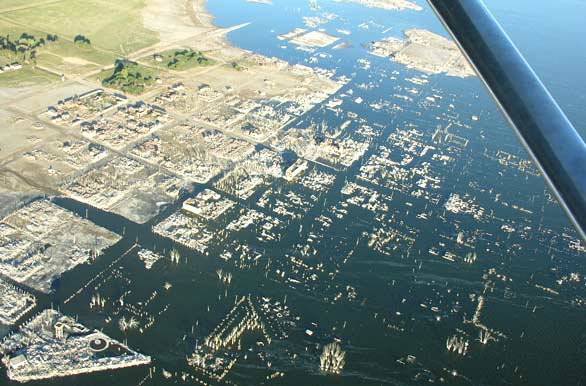
Two days passed. The water rose. A week passed. The water rose higher. By 1986, the town was under four feet of water. By 1993? The town was gone. Totally submerged under 33 feet (10 meters) of saltwater.
Think about that. The cinema where couples had their first dates? Underwater. The playgrounds? Underwater. The cemetery? We’ll get to that. It’s the creepiest part.
The Deep Freeze: 25 Years of Silence
For a quarter of a century, Villa EpecuĂ©n was a modern Atlantis. Fish swam through hotel lobbies. The salty water began its work. It didn’t rot the wood like fresh water would. It pickled it. It petrified the trees. It stripped the paint and rusted the iron, but it preserved the concrete structures in a ghostly stasis.
The town became a legend. A myth. Locals would point to the middle of the lake and say, “There is a city down there.” It sounds like folklore. But the spire of the church acted as a marker, sometimes visible just beneath the surface, a cross reaching up for air.
2009: The Resurrection
Then, the climate shifted again. The rains stopped. The sun baked the pampas. Evaporation took over. Slowly, painfully, the lake began to give the town back.
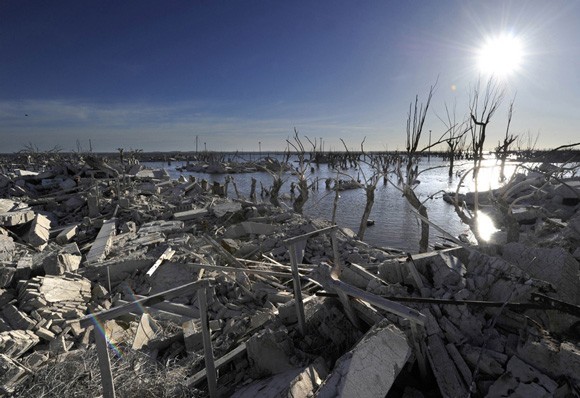
In 2009, the waters receded enough to reveal the horror. What emerged was not the town that went under. It was something else entirely. It resembles a war zone. Or a scene from a nuclear winter.
The White City of Death
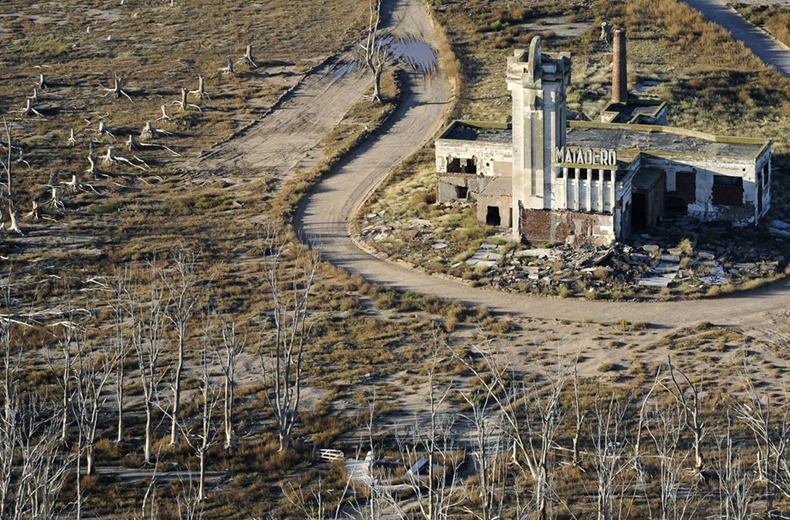
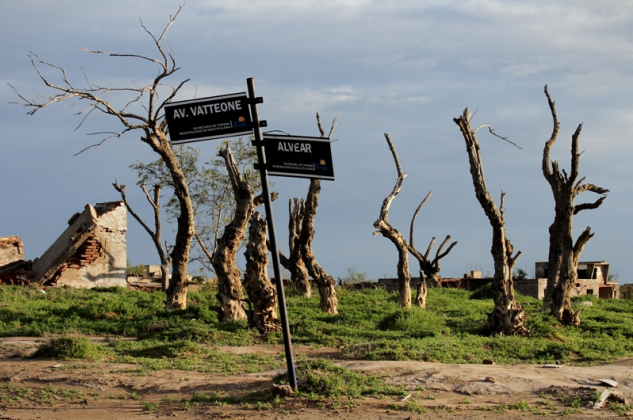
Everything is white. The high salt content has bleached the rubble. The trees are dead skeletons, standing in rows along the old avenues, their branches white as bone. The iron rebar twists out of broken concrete like gnarled fingers.

It looks alien. Photographers travel from all over the world just to capture the light hitting these ruins. It’s beautiful, in a sick, twisted way. You walk down the street and see a rusty bedframe. A toilet half-buried in the mud. A staircase leading to nowhere.
The Cemetery Horror
Here is the part most travel brochures leave out. When the water rose, it didn’t respect the dead. The town cemetery was flooded. Water seeps into the soil. It loosens the earth.
Coffins floated up. Tombs cracked open. For years, the bones of the ancestors floated in the murky depths alongside the ruins of their descendants’ homes. When the water receded, the scene was grisly. Workers had to come in and collect the scattered remains. Many tombs are still broken open today, a stark reminder that nature conquers everything. Even death.
The Last Man on Earth: Pablo Novak
You might think a place like this is totally abandoned. You’d be wrong. There is one survivor. One guardian.
His name is Pablo Novak. Born in the 1930s, he refused to leave the area. When the water went down, he moved back to the edge of the ruins. He lives in a small stone house with no electricity and a pack of dogs. He is the town’s only citizen.
Why does he stay? He says he belongs there. He walks the ruined streets every day, reading old newspapers, talking to the ghosts. He has become a celebrity in his own right, the “World’s Loneliest Man.” He is the living memory of a drowned world. If you visit, you might see him, riding his rusty bicycle through the rubble, a smile on his weathered face.
The Theories: Was It Preventable?
This brings us to the big question. The one the internet loves to debate. Was Villa Epecuén a sacrifice?
Some theorists argue that the government favored other agricultural lands. They claim the canals were diverted in a way that sacrificed the tourist town to save the valuable crop fields of wealthy landowners nearby. Was it a calculated decision? “Let the resort drown, save the soy”?
Others point to pure incompetence. The “canal system” in the province was a mess of unfinished projects and corrupt contracts. The money meant to reinforce the embankment? Maybe it went into someone’s pocket. It wouldn’t be the first time.
The Curse of the Lake
And then, there are the legends. The indigenous people of the region, the Mapuche, considered the lake sacred. Legend says EpecuĂ©n was formed by the tears of a great Chief grieving for his forbidden love. Some say the town was never meant to be there. That selling the “healing waters” for profit was a violation. The lake took back what was hers.
Why This Matters Today
Why should we care about a broken town in Argentina? Because it’s a warning. Look at the world today. Rising sea levels. Crazy weather patterns. Cities like Miami, Venice, and Jakarta are facing water issues right now.
Villa Epecuén is a microcosm. It shows us how fragile our civilization is. We build our concrete castles. We think we are safe. But nature is always batting last. It took only twenty days to wipe out sixty years of history. And it took twenty-five years to spit it back out as a warning.
Visiting the Ruins
Today, Villa Epecuén is a dark tourism hotspot. It’s not easy to get to, but it’s worth the trek. The silence there is heavy. It presses on your chest.
You can walk into the slaughterhouse (a masterpiece of Art Deco architecture by Francisco Salamone) which still stands, ominous and towering. You can see the rusted slide of the public pool. You can kick through the debris of the Hotel del Parque.
But watch your step. The ground is unstable. The metal is sharp. And the salt? It covers everything. It tastes of tears and history.
The water is still there, lurking a few hundred meters away. Watching. Waiting. Will it come back? Pablo Novak thinks so. And looking at the history of this place, I wouldn’t bet against him.
Originally posted 2013-04-26 20:22:34. Republished by Blog Post Promoter