
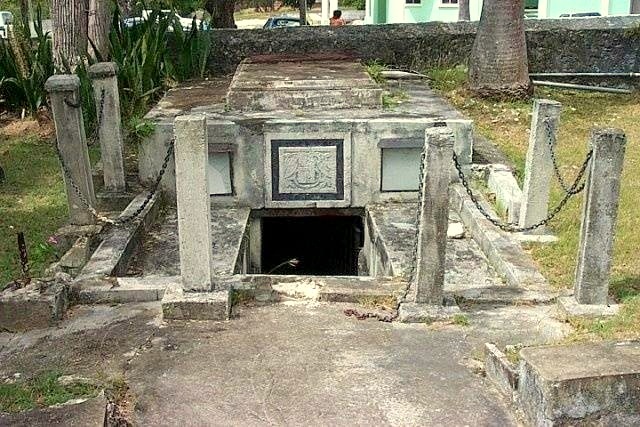
The Chase Vault: Barbados’s Chilling Mystery of the Dancing Coffins
Some doors are better left unopened. Some secrets are meant to remain buried deep within the earth. But what happens when the earth itself refuses to keep them? What happens when the dead refuse to rest?
This isn’t a Hollywood script. This is the story of a real place. A sun-drenched island paradise with a dark, festering secret at its heart. A single, rock-hewn tomb in Barbados that became the stage for a terrifying, unexplainable drama that defies all logic. A vault where the dead would not lie still.
Welcome to the confounding case of the Chase Vault.
A Tropical Paradise with a Poisonous Past
Picture Barbados in the early 1800s. It’s the jewel of the British Caribbean, an island built on a mountain of sugar and an ocean of human suffering. Enormous wealth. Opulent plantation houses. And beneath it all, the brutal, grinding machinery of slavery.
In the graveyard of Christ Church Parish, a wealthy family of planters, the Walronds, constructed a tomb for their family. It wasn’t just a grave; it was a fortress for the afterlife. Carved out of solid coral rock, its only entrance was a single, monstrously heavy slab of blue Devonshire marble that took multiple strong men to move. Once sealed with cement, it was meant to be impenetrable. A final, quiet resting place.
In 1807, the tomb received its first occupant, a woman named Mrs. Thomasina Goddard. She was laid to rest in a simple, wooden coffin. There she lay, undisturbed. Peaceful. The story should have ended there.
But it didn’t.
Enter the Notorious Chase Family
A year later, the vault was purchased by another family. The Chase family. Headed by Colonel Thomas Chase, they were another wealthy planter family, but history paints them with a darker brush. Thomas Chase was known to be a man of cruel temperament, notoriously harsh even by the brutal standards of the time. Whispers followed him everywhere—stories of his cruelty to his slaves, his family, and anyone who crossed him. He was, by many accounts, a truly hated man.
The Chase family’s connection to the tomb began with tragedy. In 1808, they interred their infant daughter, Ann Maria. Four years later, in 1812, her older sister Dorcas Chase joined her. The story behind Dorcas’s death is chilling. It’s said she starved herself to death, driven to despair by her father’s relentless cruelty. The family sealed her away in her heavy lead casket, next to her sister, and once again, the massive marble slab was cemented into place.
Just one month later, the vault had to be opened again. This time, for the patriarch himself. Colonel Thomas Chase had taken his own life. Eight men strained to carry his immense lead-lined coffin to the family tomb. As they finally managed to slide the marble door aside and peer into the darkness, a collective gasp rippled through the funeral party.
Something was horribly, terrifyingly wrong.
The Dance of the Dead: A Timeline of Terror
What the mourners saw that day in 1812 was the beginning of a nightmare that would grip the island for years. It was a scene that defied all explanation, a violation of the natural order.
1812: The First Chilling Discovery
The heavy lead coffins of the two Chase sisters were not resting peacefully where they had been placed. They had been moved. Violently. Dorcas’s coffin was standing upright, its top end pressed firmly against the far wall of the tomb. Ann Maria’s was propped up against the side. It was a scene of chaos. Utter chaos.
An immediate investigation was launched. Was it grave robbers? Vandals? There was no sign of a break-in. The massive marble door and its cement seal had been perfectly intact. Nothing was stolen. The pallbearers, confused and unnerved, righted the coffins, placed Colonel Chase’s massive casket alongside his daughters, and resealed the tomb. They hoped it was some bizarre, one-time event.
They were wrong.
1816: An Impossible Feat of Strength
Four years passed. The tomb was opened once more for the burial of an 11-year-old boy, Samuel Brewster Ames. By now, the strange tales of the Chase Vault had become local legend. A small, curious crowd gathered to watch.
When the seal was broken and the door heaved aside, the horror was magnified. Every single one of the Chase coffins—the two girls and their father—had been violently thrown about. They were a jumbled, chaotic mess. But one thing stood out that turned cold fear into sheer disbelief. The coffin of Colonel Thomas Chase, the colossal lead-lined casket that had taken eight strong men to lift, was now standing bolt upright, leaning against the interior wall of the vault.
How? How was this possible? The tomb was sealed. No human could have entered. And even if they had, how could they have single-handedly lifted a quarter-ton coffin and stood it on its end in the cramped, pitch-black space? Panic began to set in. The workers rearranged the caskets, placed the new one among them, and sealed the door, their hands trembling.
1819: The Governor Intervenes
The story reached the ears of the Governor of Barbados himself, Lord Combermere. A man of science and reason, a military man, he was not one for ghost stories. He was determined to put an end to this island superstition.
In 1819, after another funeral and another report of disarray, Lord Combermere personally supervised the opening of the vault. He saw the chaos with his own eyes. The heavy caskets were scattered as if by a giant, angry hand. Yet, something else caught his attention. In the corner, the simple, decaying wooden coffin of Mrs. Thomasina Goddard remained exactly where it had been placed in 1807. Untouched. Unmoved. It was only the leaden caskets of the hated Chase family that were being tormented.
Combermere decided to set the ultimate trap. He had the coffins neatly rearranged. Then, he ordered a fine layer of white sand to be spread across the floor of the tomb, a perfect, undisturbed surface that would capture the faintest footprint of any intruder. He then personally supervised the sealing of the door with fresh cement, and as a final measure, he pressed his own official seal into the wet cement. Now, no one could enter without his knowledge.
1820: The Unbroken Seal and the Final Horror
Less than a year later, in April of 1820, reports of strange noises, muffled scrapings, and eerie sounds coming from the direction of the cemetery compelled the Governor to act. He gathered a party of witnesses and marched to the Christ Church graveyard.
They found the tomb just as he had left it. His personal seal in the cement was perfect. Unbroken. There were no cracks, no signs of tampering. With a sense of grim anticipation, he ordered the workers to break the seal and pry open the massive door.
The air that escaped from the vault was cold and stale. Torches were lifted, and the men peered inside. The Governor’s blood ran cold. The fine sand on the floor was perfectly smooth. Not a single footprint. Not a scuff mark. Not a disturbance of any kind.
But the coffins… the coffins were in their worst state of disarray yet. They had been thrown about with what seemed like incredible fury. Thomas Chase’s coffin was wedged against the door. Others were upside down. One of the small children’s caskets had been hurled with such force that a piece of it had chipped.
And still, in the corner, Mrs. Goddard’s fragile wooden coffin lay in perfect peace. The trap had worked. It had proven that nothing human had entered the vault. But it had solved nothing. It only deepened the mystery into a terrifying, impossible truth.
Cracking the Code: The Hunt for an Explanation
This was the final straw. It was decided that the Chase Vault was no longer a suitable resting place. The coffins were removed and buried elsewhere in the churchyard in separate graves. The vault itself was officially abandoned. It remains empty to this day, a silent monument to an event that has no logical answer. But that hasn’t stopped people from trying to find one.
Theory 1: Human Intruders?
The most obvious explanation is vengeful humans. Perhaps slaves, brutalized by Colonel Chase, seeking revenge on his family even in death? It’s a compelling motive. But the method is impossible. How did they bypass a sealed marble door and the Governor’s personal seal without leaving a mark? How did one or two people move multiple 400-pound lead coffins in a tiny, dark space? And why do it repeatedly? It makes no sense.
Theory 2: The Power of Nature?
Could natural forces be at play? Some have suggested that rainwater could have flooded the semi-underground vault, causing the sealed, airtight lead coffins to become buoyant and float around. When the water receded, they would settle in random positions. This is one of the more popular scientific theories. But it has major problems. For one, the much more buoyant wooden coffin of Mrs. Goddard never moved an inch. Furthermore, when Lord Combermere opened the tomb, there was no sign of water damage, no waterline on the walls, and the sandy floor was bone dry. A flood would have washed the sand into a mess, not left it perfectly smooth.
Theory 3: A Secret Masonic Hoax?
Here’s where we enter the rabbit hole. Some modern researchers have pointed out that Governor Combermere was a very high-ranking Freemason. The story goes that perhaps the Chases had wronged the Masons, or this was all an elaborate, technically sophisticated prank designed by the fraternity to scare someone or prove a point. Could secret mechanisms or gases have been used? It’s a fascinating thought, but there is zero evidence to support it, and it seems like an awful lot of trouble to go to for a prank.
Theory 4: A True Paranormal Event?
This leaves us with the explanation that so many on the island believed. That this was not an act of man or nature, but something else entirely. A poltergeist. The restless, tormented spirits of the Chase family, particularly the cruel Colonel and his tragic daughter Dorcas, locked together in an eternal, violent struggle. Was the energy so negative, so powerful, that it manifested physically, throwing their earthly remains around the tomb? For many, this is the only answer that fits the impossible facts.
The Skeptic’s View: Was It All Just a Story?
It’s important to be rational. We have to ask: did any of this really happen? When you dig into the historical records, the story gets murky. The earliest detailed accounts of the Chase Vault mystery were published decades after the events supposedly took place. There are no mentions of it in Governor Combermere’s official records or personal letters. Is it possible that this was all just a fantastic piece of folklore? A ghost story that grew and became more elaborate with each telling, eventually being printed as fact?
Perhaps it started with a simple case of shoddy tomb construction and a minor disturbance, and over the years, the legend of the “dancing coffins” was born. It’s a plausible, if less exciting, possibility.
The Silent Vault: A Legacy of Fear
Yet the story endures. It endures because it pushes the boundaries of our understanding. The details are too specific, too vivid to be dismissed entirely. The unbroken seal. The smooth sand. The untouched wooden coffin. These are the elements that elevate the Chase Vault from a simple ghost story into a profound and lasting mystery.
Today, you can still visit the Christ Church Parish graveyard in Barbados. You can stand before the empty, open doorway of the abandoned vault. The air is warm, the birds are singing, but looking into that dark, silent space, you can’t help but feel a chill. You can’t help but wonder what really happened in that small, stone room two centuries ago.
Was it a hoax? A freak of nature? Or was it proof that sometimes, the laws of our world can be broken, and that even in death, there is no guarantee of peace? The coffins are gone, but the questions remain, echoing in the silent, empty tomb.









