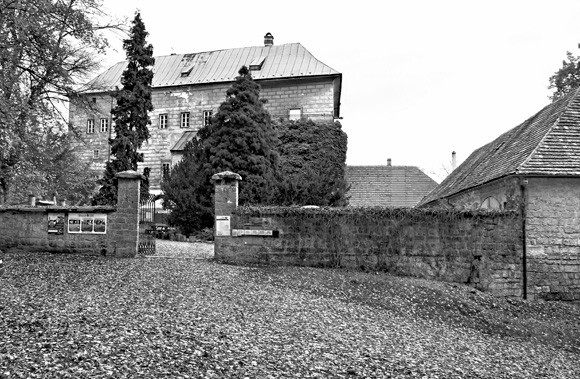
Home Weird World Strange Places The strange and haunted old Nazi secret camp, Houska Castle

The strange and haunted old Nazi secret camp, Houska Castle

0
61

The Castle Built to Cage a Demon: Inside Houska, the Gateway to Hell

Forget everything you think you know about castles. Forget moats and drawbridges. Forget noble kings and damsels in distress. Castles are walls. They are shields. They are stone fortresses built to keep enemies out.

But not this one.

Deep in the dense, silent forests north of Prague, there is a place that spits in the face of history and military strategy. A place built with no access to water. A fortress with no strategic borders to protect. A castle whose primary fortifications face… inward.

It’s called Houska Castle.

And it wasn’t built to keep people out. It was constructed with a singular, terrifying purpose: to keep something in.

This isn’t just a ghost story. This is the story of a stone plug hammered into a crack in the world. A permanent seal built over a fabled Gateway to Hell itself.

A Fortress Designed Backwards

Look at a map. You’ll see Houska Castle sits in the middle of nowhere. It wasn’t built along a trade route. It guards nothing of importance. In the 13th century, when King Ottokar II of Bohemia commissioned its construction, it made absolutely zero sense. A castle without a reliable water source is a death trap. A fortress far from any enemy is a waste of resources. So why build it?

The answer lies in the architecture. It’s a puzzle box of wrongness. The main defensive structures, the high walls and battlements, are arranged to protect the outside world from whatever is locked in the central courtyard. The layout is designed to trap and contain, to prevent a force from breaking *out*, not in.

And at the absolute center of this architectural anomaly, the heart of the fortress, is not a throne room or a barracks. It’s a chapel.

A chapel built directly, deliberately, over a hole in the ground.

A hole that the locals for centuries had called the Pit. A chasm they swore was bottomless.

A gateway.

Before the Stone: What Crawled from the Crack in the World?

Long before the first stone of Houska was ever laid, the area was a place of profound fear. Local legends, passed down in hushed whispers around nervous fires, didn’t speak of spirits or phantoms. They spoke of things with weight and claws. Physical abominations.

They claimed the chasm in the limestone rock was a wound in the earth. And from this wound, terrible things emerged under the cover of darkness. Half-human, half-beast hybrids were seen stalking the forests, their unnatural forms silhouetted against the moon. Dark, winged creatures with leathery skin would fly from the pit, their cries echoing through the trees. Villagers’ livestock would disappear, and sometimes, so would the villagers themselves.

The hole wasn’t just a physical place. It was an infection. The land around it was cursed, and the air thick with a palpable dread. It was a place you avoided. A place you didn’t talk about after sunset. It was Hell’s front door, left carelessly ajar.

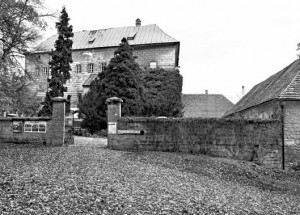
Houska Castle

This was the problem facing King Ottokar II. How do you fight an enemy that crawls up from the very ground you stand on? You don’t build a wall against it. You build a lid for it.

But before they sealed it forever, they made a terrible mistake. They got curious.

The Devil’s Pardon: One Man’s Descent into Sheer Madness

The story is as chilling today as it was 700 years ago. As the castle’s construction was being planned, the Duke and his men stood at the precipice of the dark fissure. They couldn’t see the bottom. They threw torches in; the light was simply swallowed. They shouted; no echo returned.

So they made an offer. A deal.

A pardon from the gallows was offered to any condemned prisoner willing to be lowered by rope into the chasm and report back on what he saw. In a dungeon full of men facing certain death, one brave—or foolish—soul agreed. It was a chance at life, after all.

Imagine the scene. The grim-faced guards. The creak of the thick rope as they began to lower the man into the suffocating black. For a few moments, there was silence. The rope continued to unspool, deeper and deeper into the earth.

And then the screaming started.

It wasn’t a scream of fear. It was a raw, primal shriek of utter, soul-shattering horror. It was a sound no human throat should be able to produce. The men above panicked, hauling on the rope with all their might, pulling the prisoner back to the surface.

What they pulled out of the hole was no longer the man they had lowered in just moments before. His hair had turned stark white. His face, once that of a young man, was now a web of deep, terrified wrinkles. His eyes were wide with a terror that went beyond madness. He had, by all accounts, aged more than 30 years in the darkness.

He was babbling, incoherent, unable to describe what he had seen. Whatever it was, it had broken his mind completely. He died just two days later, his body succumbing to a shock from which his soul could never recover.

That was enough. The experiment was over. The order was given: seal the pit. Now. They filled the chasm with stone and earth, and over it, they built the chapel, hoping holy ground could act as a final, desperate lock on the gateway. Then they built the rest of the castle around it. A prison for a hole in the ground.

For centuries, the castle stood as a silent, brooding watchman. The stories faded into folklore. But evil has a way of attracting evil. And in the 20th century, a new kind of monster came to Houska Castle.

Himmler’s Occultists: The Third Reich’s Quest for Hell’s Power

In the 1930s, as the shadow of the Third Reich fell over Europe, the castle was seized. Not for its strategic value—it had none—but for its reputation. It became the personal property of one of the most sinister organizations in history: the SS.

Heinrich Himmler, the architect of the Holocaust, was a man obsessed with the occult. He poured vast resources into his pet project, the Ahnenerbe, an SS division tasked with finding ancient relics and supernatural powers to secure the Third Reich’s thousand-year reign. They sought the Holy Grail, the Ark of the Covenant, and gateways to other worlds.

And Houska Castle, with its legend of being a literal portal to Hell, was a prize beyond measure.

The castle was sealed off from the public. What happened inside during those years is a dark mystery, pieced together from local rumors and grim post-war discoveries. The Nazis weren’t trying to keep the gate closed. They were trying to pry it open.

Locals reported seeing strange lights emanating from the castle at night. Unearthly sounds were said to echo from its walls. The Ahnenerbe’s top occultists were allegedly performing bizarre rituals, trying to harness the demonic energy of the portal. Were they trying to communicate with the entities inside? To control them? To unleash them upon their enemies as an ultimate weapon?

We may never know the full extent of their depraved experiments. But we have a clue as to how it ended.

Years later, during renovations, a horrifying discovery was made. The skeletons of several high-ranking Nazi officers were found. They hadn’t been killed in battle. The evidence suggested they had been executed, lined up and shot. Why? What could have happened that required such a brutal, summary execution and cover-up?

Did their experiment succeed, only to unleash something they couldn’t control? Did they witness a truth so terrible that their superiors decided they could not be allowed to live? Or did they simply try to flee, driven mad by what they had seen in the depths of Houska?

The Nazis were gone, but they had stirred the darkness. And the castle never went back to sleep.

The Ghosts That Never Left

The entities at Houska are not your typical spectral echoes of the past. They are aggressive, bizarre, and deeply unsettling. The castle seems to be a permanent residence for a host of paranormal beings, each more disturbing than the last.

The Lady in the Old Dress

One of the most frequently seen apparitions is a woman in an ancient dress. She is almost always spotted peering out from one of the top-floor windows. She doesn’t interact, she doesn’t make a sound. She just watches. Is she a former resident? A victim of whatever lies beneath? Or is she a guardian, a silent sentinel warning people away?

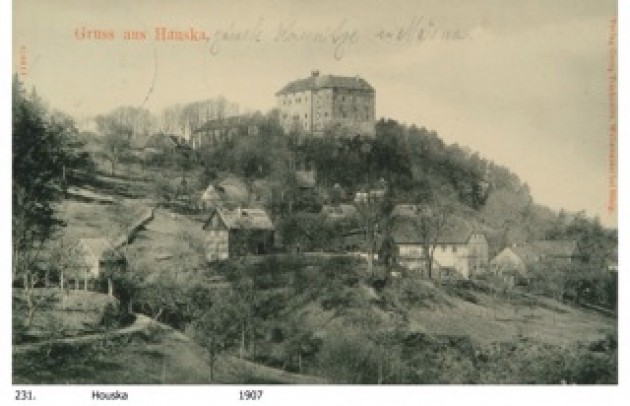
An early picture of the strange Houska Castle

The Unholy Procession

Many witnesses have reported a ghostly procession of figures marching towards the main gate. They are chained together, some carrying their own severed heads, their bodies mangled from some unspeakable torment. They are led by a terrifying headless black horse. Is this a vision of the damned, forever marching back to the pit they came from?

The Thing in the Cellar

Perhaps the most grotesque of Houska’s residents is the creature said to haunt the lower levels. It’s described as a monstrous hybrid: part giant bulldog, part frog, part human. This isn’t a ghost. Witnesses who have encountered it describe a solid, physical being of terrifying proportions. Could this be one of the original entities that escaped the pit before it was sealed? A permanent, physical manifestation of Hell on Earth?

This links to another disturbing legend: that beneath the castle cellars, in hidden chambers, lie the remains of the nonhuman beasts that were slain by villagers centuries ago. A demonic graveyard, right below your feet.

So, What Is Really Going On at Houska?

The sheer volume of weirdness surrounding this castle is staggering. For over 700 years, the story has remained remarkably consistent. This place is wrong.

Modern paranormal investigators who have been granted access to the castle return with terrifying evidence. They capture EVPs (Electronic Voice Phenomena) of guttural, inhuman voices whispering in empty rooms. They film shadow figures darting through the chapel. Batteries drain instantly. Equipment malfunctions. People are overcome with sudden, intense feelings of nausea, dread, and the overwhelming urge to flee.

Online forums and paranormal communities buzz with theories. Is it a dimensional weak spot? A prison for a single, ancient, and immensely powerful demon? Was it an alien outpost, and the “demons” were simply extraterrestrials the medieval mind couldn’t comprehend?

Is There a “Rational” Explanation?

Skeptics, of course, try to find mundane answers. Some historians suggest Houska was simply an administrative center built by King Ottokar II to manage his vast estates. The inward-facing fortifications? Perhaps a unique architectural flourish, or a way to protect the administrator from a rebellious local populace. The “bottomless pit”? Maybe just a deep cave system or an old mine shaft, with the demonic stories invented to scare away trespassers.

But these explanations feel hollow. They crumble under the weight of the evidence. They don’t explain the complete lack of a water source. They don’t explain why the mighty Nazi SS would choose *this* specific, useless castle for their top-secret occult research. And they certainly don’t explain the terrified, white-haired man who was pulled screaming from the darkness, his life force stolen in a matter of seconds.

The truth is, some places are just… bad. They are wounds. Houska Castle is more than just a haunted building. It’s a monument to fear. A stone cage built around a nightmare.

The chapel, they say, keeps the gateway sealed. The cross and the holy ground act as a metaphysical cork in a bottle filled with damnation. But stones crumble. Faith can waver. And 700 years is a very, very long time to keep a door closed.

It makes you wonder. What is still down there, on the other side of the stone? And what sound does it make, as it scratches, and waits?

Originally posted 2015-09-29 15:18:46. Republished by Blog Post Promoter