
Monday, May 11, 2026
HomeWeird WorldParanormalThe real haunting at the General Wayne Inn

The real haunting at the General Wayne Inn

The General Wayne Inn: An American Haunting Where History Bleeds Through the Walls

Some places are just… wrong. Not evil, not necessarily. Just… heavy. You feel it the moment you step onto the property. The air gets thick. The silence becomes a sound. It’s the weight of centuries pressing down. The General Wayne Inn in Merion Station, Pennsylvania, is one of those places. It’s a building that has seen everything. Revolution. Poetry. Passion. And murder.

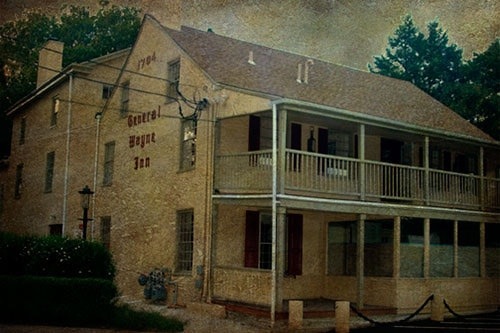
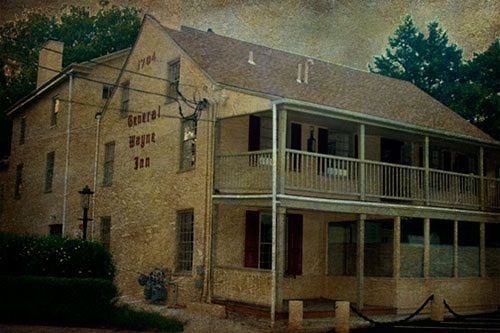
It’s a stone-and-mortar library of secrets, where every floorboard groans with a story and every shadow seems to hold a shape. It began its life in 1704, a simple public house on a dusty colonial road. But history refused to let it stay simple. It became a crossroads, a witness to the birth of a nation and the death of far too many of its people. And some of them, they say, never checked out.

Today, the sign still reads “General Wayne Inn,” a ghost of a name for a building full of them. But its purpose has shifted dramatically. What was once a den of spectral soldiers and whispered secrets is now a center for spiritual life. But does a new coat of paint and a new purpose silence the echoes of the past? Or does it just make them listen more intently?

20140105-190537.webp

A Crossroads of American History (And Its Ghosts)

To understand the haunting, you have to understand the history. They are one and the same. The inn wasn’t just built on land; it was built on a timeline, a focal point where pivotal moments in American history converged and left their indelible psychic stains.

From Wayside Inn to Revolutionary War Hotspot

Before it was the General Wayne, it was The Wayside Inn, established in 1704. Think about that. 1704. That’s more than seventy years before the Declaration of Independence was even a treasonous dream. In those days, an inn was the heart of a community. It was a post office, a town hall, a courtroom, and a news hub, all washed down with ale. Travelers brought stories, merchants made deals, and locals debated the politics of the Crown. The very wood and stone of the place absorbed the hopes and fears of a nascent America.

Then, the world caught fire. The Revolutionary War exploded, and the inn’s location—smack in the middle of the conflict near Philadelphia—turned it from a resting place into a strategic asset. It was renamed in 1797 for “Mad” Anthony Wayne, a brilliant, ferocious general who was a local hero. The name stuck, a permanent tribute to the inn’s role in the bloody birth of a nation.

Washington Slept Here… But Who Else Never Left?

The guest list reads like a who’s who of the 18th century. George Washington. The Marquis de LaFayette. These men weren’t there for a weekend getaway. They were there to plan a war. Imagine the scene: Maps spread across a heavy oak table, candlelight flickering on grim faces, the future of a continent being decided in hushed, urgent tones. The emotional energy of those moments—the tension, the desperation, the slivers of hope—doesn’t just dissipate. It soaks into the environment. It becomes part of the building’s DNA.

But for every celebrated hero who passed through its doors, countless unnamed soldiers marched by, many to their deaths. The inn was caught in the crossfire of major campaigns, including the brutal Battle of Germantown in 1777. Which brings us to the most infamous spectral residents.

The Hessian Connection: Soldiers Who Refused to Die

Who were the Hessians? They weren’t British. They were German soldiers, thousands of them, rented out by their rulers to King George III to crush the American rebellion. They were professional, disciplined, and often, utterly terrifying. To the colonists, they were the ultimate bogeymen—foreign invaders speaking a strange tongue, fighting for a paycheck.

Many Hessians died here, thousands of miles from their homes in Hesse-Kassel. They were buried in unmarked graves, forgotten by their king and despised by their enemy. Is it any wonder their spirits are said to be so restless? They are lost souls in a foreign land, forever searching for a way home that no longer exists.

This historical tragedy is the source code for the Inn’s most persistent haunting. These aren’t just generic “soldier ghosts.” They are the echoes of specific, lonely, and violent deaths. A psychic named Mike Benio, who investigated the inn, claimed to make direct contact with one of them. A Hessian soldier named Ludwig. Ludwig told him he was killed during the war, a casualty lost to the history books but not to the building where his life ended. He is, perhaps, the most famous of the spectral soldiers who still walks the halls.

The Raven’s Shadow: A Muse of Misery?

As if a Revolutionary War haunting wasn’t enough, the inn adds a layer of gothic literary horror to its resume. In the 19th century, another famous guest checked in: Edgar Allan Poe. The master of the macabre himself. Local legend insists that he not only stayed at the inn but penned part of his immortal, soul-crushing poem, “The Raven,” within its walls.

Coincidence? Or inspiration?

Think about Poe. A man obsessed with death, loss, and the maddening persistence of memory. Did he choose the inn at random? Or was a man so finely tuned to the darker frequencies of the human experience drawn to a place already saturated with sorrow? Imagine him sitting in a dim, firelit room, the wind howling outside, listening to the old building creak and groan. Was he just hearing the wind? Or was he hearing the faint whispers of Ludwig and his forgotten comrades? Did the oppressive atmosphere of the inn seep into his subconscious, helping him conjure the bleak, suffocating despair of his most famous work? It’s a chilling thought: that the ghosts of the General Wayne Inn helped give the world “The Raven.”

A Modern Murder Taints Ancient Walls

For centuries, the ghosts of the General Wayne were relics of a distant, violent past. But in 1996, a fresh, horrific layer of tragedy was brutally added to the inn’s history. The violence wasn’t from a battlefield. It came from within.

The Christmas Killing of 1996

It happened the day after Christmas. A time for peace and family, shattered by gunfire. The inn’s co-owner, James Webb, was found dead in a third-floor office. He had been shot. The crime was shocking, a modern brutality laid bare against the backdrop of colonial history. The prime suspect was his business partner and the inn’s chef, Guy Sileo.

The motive, at first, seemed simple. Money. The two were reportedly arguing over the inn’s finances. A classic, if tragic, story of a business deal gone sour. But as investigators dug deeper, the story grew darker and more complex.

A Tangled Web: Sileo, Webb, and a Fatal Affair

There was another person in the mix. A 20-year-old waitress named Felicia. She was Sileo’s mistress. The story goes that James Webb, the murdered partner, strongly disapproved of the affair and wanted it to end. Did this create the friction that finally snapped?

The narrative became a twisted knot of money, secrets, and illicit love. Guy Sileo was arrested, tried, and convicted of the murder. He maintains his innocence to this day. But the story has one more grim chapter. Not long after the murder, Felicia, the young mistress at the center of the storm, took her own life.

Now, a new, terrifying question hangs over the inn. Are the spirits of the 18th century now sharing their space with the tormented souls of the 20th? Did the building’s pre-existing negative energy act as a catalyst, fanning the flames of greed and jealousy into a murderous inferno? It’s a “chicken or the egg” question for the paranormal world: Do bad things happen in haunted places, or do bad things make places haunted? At the General Wayne, the answer seems to be a resounding “yes” to both.

The Roster of the Restless: Cataloging the Inn’s Phantoms

The paranormal activity reported at the General Wayne Inn over the years isn’t subtle. It’s a full-blown spectral circus, with a cast of characters spanning the entire history of the building. Witnesses aren’t just getting a “feeling.” They are seeing, hearing, and feeling things that defy explanation.

The Startled Soldier on the Stairs

Perhaps the most compelling sighting involves the ghost who seems as surprised as the living. A staff member was walking near the main staircase when she saw him. A man in the full, unmistakable uniform of a Hessian soldier. He was just standing there. For a heart-stopping second, they made eye contact. And in that moment, she saw the look on his face: pure shock. He seemed just as startled to see her as she was to see him. Then, as quickly as he appeared, he faded into nothing.

This isn’t a menacing phantom. This is the apparition of a man seemingly caught out of time, confused by the modern world he has stumbled into. Is this Ludwig, the ghost contacted by the psychic? A soldier still reporting for a duty that ended over 200 years ago?

The Desperate Spirit in the Cellar

The basement holds another, more tragic tale. Staff and investigators have reported seeing another Hessian soldier in the dark, damp cellar. But this one isn’t just standing guard. He appears to be frantically searching for something. The legend says he’s looking for his uniform.

In the 18th century, a soldier being buried stripped of his uniform was the ultimate dishonor. It meant being cast into the afterlife without an identity, without a country, without a shred of dignity. Is this spirit trapped in a loop, endlessly searching for the one thing that will restore his honor and allow him to rest? It’s a heartbreaking concept—a ghost whose torment is rooted in a loss of identity.

Whispers, Cries, and Unseen Faces

The list goes on. The inn is a cacophony of phantom sounds and fleeting figures.

  • The Bar Ghost: Women sitting at the bar have reported a bizarre, sequential phenomenon. One after another, down the line, each would feel an icy breath on the back of her neck, a phantom whisper with no source.
  • The Crying Boy: The disembodied sounds of a small child crying have been heard echoing from empty rooms. Who was he? A child of a colonial family? A victim of disease or accident whose story is lost to time?
  • The Forgotten Souls: Apparitions of a Native American man and an African American man have also been spotted. Their presence is a stark reminder that history is written by the victors, and countless stories, especially those of minorities from that era, were never recorded. Their spirits remain, silent witnesses whose identities we may never know.
  • The Woman in White: In 1986, an owner and his friend were sitting alone in the dining room late at night. They watched in disbelief as a woman in full period dress rushed past their table, her face a mask of panic, before vanishing through a solid wall.

The Poltergeist in the Kitchen

Not all the activity is passive. The kitchen has been the site of classic, and terrifying, poltergeist phenomena. Heavy pots and pans have been witnessed flying off shelves. Clean towels have been found inexplicably thrown all over the floor. And most disturbingly, doors that were double-checked and securely locked at night would be found standing wide open the next morning. Is this the work of an angry spirit? Or is it the chaotic, combined psychic energy of so many trapped souls bleeding through into our world?

From Haunted Inn to Holy Place: An Unlikely Transformation

Around 2004, the inn finally closed its doors as a public house. The centuries of serving food and drink, and hosting guests both living and dead, came to an end. The building was sold, and its new purpose is, on the surface, the polar opposite of its dark and storied past. It became the Chabad Center for Jewish Life.

This transformation is perhaps the most fascinating chapter in the inn’s long history. A place of war became a place of peace. A building filled with the echoes of violence and murder became a house of prayer and community.

Can Prayer Cleanse a Haunting?

It raises a profound question. Can goodness overwrite evil? Can the positive energy of prayer, study, and community finally quiet the restless dead? Since the Chabad Center took over, public reports of paranormal activity have gone silent. But does silence truly mean absence?

Or have the new occupants simply chosen not to speak of what they might see in the shadows? Perhaps the entities are still there, watching, listening, and wondering at the strange new rituals being performed in their timeless home. It’s possible that the new, peaceful purpose of the building has soothed the spirits. It’s also possible that it has made them retreat, waiting for the quiet to be broken once more.

The name, however, remains. A large sign on the building’s side still proudly proclaims it as the “General Wayne Inn.” The past refuses to be entirely erased. It’s a permanent reminder, carved in wood, that no matter what happens within those walls today, it will forever be a place defined by its ghosts.

So what is the truth? Is the General Wayne Inn just a very old, very storied building? A place where overwrought imaginations have run wild for generations? Or is it something more? Is it a genuine psychic battlefield, where the tragedies of American history are on a constant, repeating loop? A place where soldiers still fight a forgotten war, a poet still broods over his dark verse, and the victims of a modern murder still cry out for a justice they never found.

We may never know for sure. But the walls of the General Wayne Inn know. And they’re not telling.

Amit Ghosh
Amit Ghoshhttps://coolinterestingnews.com
Aloha, I'm Amit Ghosh, a web entrepreneur and avid blogger. Bitten by entrepreneurial bug, I got kicked out from college and ended up being millionaire and running a digital media company named Aeron7 headquartered at Lithuania.
RELATED ARTICLES
- Advertisment -

Most Popular

Recent Comments

Warren Pan Abbott on The legend of the Devil Monkey !
chris davies on The McPherson Tape Mystery
Reed Reedly on ET has Internet!
Bea Houseoffashion on Proof Of Time Travellers – Gallery
Marcus2012 on ET has Internet!
Reed Reedly on ET has Internet!
LaughsAtConspiracyNuts on The 9/11 Conspiracy – Myths and Facts
Alex Sliverman on Did the ancients fly?
Doctor Wholigan on Time Traveler in 1938 film
chris davies on The McPherson Tape Mystery
Archie1954 on 10 secret UFO hideouts
chris davies on Ghosts of flight 401
Marcus2012 on ET has Internet!
jason Macdonald on Proof of Time Travel? – China
chris davies on Long-Lost Pyramids Found?
Reed Reedly on ET has Internet!
Milkman on Connected Universe
Tenmiles on Baigong Pipes Mystery
Simon Foster on Sirius – The Documentary
From the 1st April on 2013 – Alien Contact date ?
SkyWatcher on Is ET ignoring us?
I Come From The Future on Obama to make UFO Alien disclouser soon ?
ÛñK?øWn on 2013 – Alien Contact date ?
Just another person on 2013 – Alien Contact date ?
Malcolm Windowcleaner on The strange case of Rudolph Fentz
Mason Servio on Strange Things on Mars
Marke Wisdom Seeker on What will we find as arctic melts?
Andrea A Elisabeth Levyne on Aliens Captured in Varginha, Brazil
Mitch Grouyeki on Amazing Space Shuttle pictures









