1. The Door to Hell – Turkmenistan

The Door to Hell was originally a gas field set alight by Soviet scientists that has been burning continuously for over 40 years. Inexplicably, spiders seem to love this place and swarm there by the thousands.
2. Aokigahara Forest – Mount Fuji, Japan (The Suicide Forest)

Also known as the Trees of the Sea is a 35 sq km forest that lies at the northwest base of Mount Fuji in Japan. The forest is the second most popular place for suicides in the world (right after the Golden Gate Bridge). Almost 100 people a year wander in the forest never to return again. For years the corpses just stayed there and rotted away, meaning the forest is scattered with human skulls and bones. Nowadays they do a yearly sweep through the forest. The suicide plague has gotten so bad that the officials even put out signs throughout the park displaying discouraging messages like: “Life is precious! Please think about it!” or “Is she really worth it?”
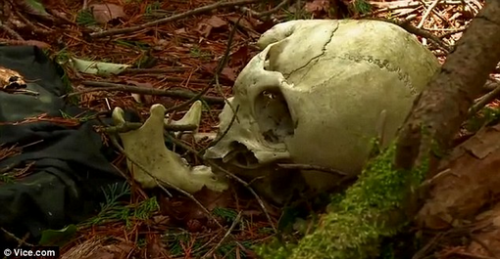
The crushed skulls lying around in the forest
3. La isla de la Muñecas or The Island of Dolls – Mexico

What doesn’t help this place becoming a popular travel destination is the fact that almost every single tree is decorated with deformed and mutilated dolls. The dolls almost seem evil and I seriously wonder where one would buy such creepy dolls. As you walk the island, it supposedly feels like you are being watched at all times. Well of course creepy toys aren’t enough to make this a candidate for scariest place in the world. You guessed it, the island is supposedly haunted! Even though the island is totally abandoned, over 50 years ago, a man named Don Julian Santana left his wife and kids and moved there to live the rest of his life alone. When he was living there, the body of a dead little girl came floating up in one of the canals. Don Julian thought he had become haunted by her spirit. He began to collect dolls and decorate the island with them. He would trade vegetables and fruits in exchange for any dolls. The dolls were believed to be used by Don Julian as a shrine for the spirit that haunted him. Over the 50 years that he lived there, he continuously collected dolls and decorated them all over the island, until he died.

The creepy dolls!

4. Union Cemetery – Connecticut, USA

Union Cemetery in Easton, Connecticut is not just the most haunted cemetery in Connecticut, it is considered by many to be the most haunted cemetery in the United States. The most famous ghost there is the White Lady. Numerous photographs have been taken of her and she has even been caught on film. She has long dark hair and wears a bonnet and nightgown. She frequently appears in the roadway where she is often “hit” by oncoming vehicles. On one occasion in 1993, a fireman was driving along the road when he hit the lady – he heard a thud and a dent was left in his vehicle. As the woman appeared in front of his car he also saw a farmer with a straw hat sitting beside him in the car. The cemetery is locked at night and regularly patrolled by the police.

The famous White Lady caught on camera.
5. The Whaley House – San Diego, USA

Since the mysterious deaths of the members of the Whaley family, this house has seen all kinds of mysteries. Visitors have reported seeing the ghost of a woman in the garden, while many people also claim to have seen Thomas Whaley’s spirit in the parlour. A young girl who matches the description of Marion Reynolds, the great grand-daughter of Thomas Whaley, who died from ingesting ant poison, is reported to grab the arms of visitors as they tour the house, while a spectral dog is occasionally seen by children.
6. Raynham Hall – Norfolk, England

Raynham Hall is a country house in Norfolk, England. For 300 years it has been the seat of the Townshend family. The hall gave its name to the area, known as East Raynham, and is reported to be haunted, providing the scene for possibly the most famous ghost photo of all time, the famous Brown Lady descending the staircase. However, the ghost has not been reported since the photo was taken.
7. The Tower of London – London, UK

Her Majesty’s Royal Palace and Fortress The Tower of London, more commonly known as the Tower of London (and historically simply as The Tower), is an historic monument in central London, England on the north bank of the River Thames. Perhaps the most well-known ghostly resident of the Tower is the spirit of Ann Boleyn, one of the wives of Henry VIII, who was also beheaded in the Tower in 1536. Her ghost has been spotted on many occasions, sometimes carrying her head, on Tower Green and in the Tower Chapel Royal.
8. Pickens County Courthouse – Alabama, USA

The Pickens County Courthouse in Carrollton, Alabama is a courthouse famous for a ghostly image that can be seen in one of its windows. The image is said to be the face of Henry Wells, who, as legend has it, was falsely accused of burning down the town’s previous courthouse, and lynched on a stormy night in 1878. The image on the window is easily seen, although it is more face-like from some angles than from others. It is said that the image is only visible from outside the courthouse; from inside the pane appears to be a normal pane of glass. Since the photo above was taken, the city of Carrollton has installed, on the exterior of the courthouse, a reflective highway sign with an arrow pointing to the pane where the image appears. There are permanent binoculars installed across the street from the window for people who wish to get a closer look.
9. Pripyat – Ukraine

Pripyat was established on Feb. 4th, 1970 in Ukraine near the border of Belarus as a Soviet nuclear city. It was home to many of the workers who worked in the nearby Chernobyl nuclear power plant, which melted down disastrously in the 1986 Chernobyl Disaster. After being evacuated, Pripyat remains a radioactive ghost town that can only be visited through guided tours.

The abandoned city

Gas masks in Pripyat primary school
10. Mirny Diamond Mine – Eastern Siberia, Russia

The world’s second largest man-made hole, Mirny was constructed by Stalin to satisfy the Soviet Union’s demand for industrial diamond. Further digging efforts were eventually abandoned when it became too difficult to continue digging this massive hole.
11. Farmhouse – Seneca Lake, New York

The entire site is engulfed in poison ivy and 4 foot high thorn bushes. This abandoned farmhouse in New York state also acts as a graveyard for many vintage cars which are now empty shells of their former selves which makes this place even more creepier than ever.

12. Willard Asylum – Willard, New York

Willard Asylum for the Chronic Insane was built in 1869 and closed in 1995. Housing 4000 patients at its peak, more than half of the 50,000 patients who called Willard Asylum their home died within its walls. This makes the asylums morgue (pictured above) one of the creepiest places we can imagine. By its closure, most patients were eventually integrated back into society, but in the early days “people didn’t leave unless it was in a box.”

13. Six Flags Jazzland – New Orleans, Louisiana

Severely damaged by Hurricane Katrina, Six Flags Jazzland has been abandoned since. Several of the rides still stand, a testimony to the resilience of New Orleans. Several companies have plans to develop the park, but until then it will remain as the perfect setting for a horror movie.

14. I.M. Cooling Tower – Belgium

These are parts of a cooling tower in an old power station in Monceau, Belgium. The trumpet-like structure in the middle introduced hot water to the structure, where it then cooled while dripping down hundreds of small concrete troughs and slats. The very structure of the tower gives an eerie feeling to whoever sees it.

15. Sunken Yacht – Antarctica

This eerie ghost ship is the Mar Sem Fim, a Brazilian yacht that was shipwrecked near Ardley Cove in Antarctica. A Brazilian crew had taken it to film a documentary, but strong winds and stormy seas forced the crew to abandon ship. The water that washed over the ship froze, cracked its hull and sunk the yacht, but it has since been salvaged.
16. Underwater City – Shicheng, China

his incredible underwater city, trapped in time, is 1341 years old. Shicheng, or Lion City, is located in the Zhejiang province in eastern China. It was submerged in 1959 during the construction of the Xin’an River Hydropower Station. The water protects the city from wind and rain erosion, so it has remained sealed underwater in relatively good condition.
17. Abandoned Military Hospital – Beelitz, Germany

This eerie picture is part of the Beelitz-Heilstätten hospital complex in Beelitz, Germany. The large complex was built at the end of the 1800s and helped Adolf Hitler recuperate from a leg wound incurred at the Battle of Somme in 1916. Parts of the complex remain in operation, but most were abandoned after the Soviets withdrew from the hospital in 1995.
18. UFO Houses – San Zhi Resort, Taiwan

These alien-looking houses in Sanzhi were initially intended to serve as a vacation destination, especially for U.S. military officers returning from their positions in Asia. Lost investments and unfortunate car accidents, however, forced the site to close down in 1980, not long after it had been built. Unfortunately, the buildings were torn down in 2010.
19. Salto Hotel – Colombia

The Hotel De Salto opened in 1928 near Tequendema Falls in Colombia to serve tourists who came to marvel at the 157 meter-tall waterfall. It closed down in the early 90s after interest in the waterfall declined. In 2012, however, the site was turned into a museum.
20. Christ of the Abyss – San Fruttuoso, Italy

Guido Galletti built this statue of Christ in 1954 and placed it into the water at a depth of 55 feet.
21. Eastern State Penitentiary – Philadelphia, Pennsylvania

Operated from 1829 until 1971, Eastern State was one of the first modern penitentiaries. Now a national landmark, the prison was designed in a revolutionary wagon wheel shape which became a globally adopted style. This strangely abandoned place gives the creeps out to anyone who dares to visit it. It tells the stories of the prison inmates and the torture and solitary confinement they went through. If only walls could talk…

22. Bhangarh Fort – Rajasthan, India

Bhangarh, a deserted town in Rajasthan, was established in 1613 by King Madho Singh, son of great Mughal general, Man Singh of Amber. Bhangarh was abandoned soon after being built and supposedly after it was cursed by a magician. In ignorance Ajab Singh, the grandson of Madho Singh, raised the palace to such a height that the shadow reached the forbidden place. Hence the devastation of entire town of Bhangarh happened. Local villagers say that whenever a house is built there its roof collapses. People say that nobody returned who stayed there after dark. And the Archaeological Survey of India (ASI) sign board put up there says, “Staying after sunset is strictly prohibited in this area.”

The houses without roofs!

The board set up by Archaeological Survey of India which warns people who visit the place
23. Hashima Island – Japan

In the past Hashima Island was rich in coal, with over 5000 miners once living on the island. When petrol replaced coal as Japan’s main source of fuel, the settlement was left abandoned. Now the once thriving town is creepily abandoned, with only shadows remaining.
24. Catacombs – Paris France

The Parisian Catacombs function as a gigantic ossuary and cemetery for approximately 6 million bodies. Beyond just bones, there is also the non-tourist section of the Catacombs, where a mostly illegal and unpoliced second city extends for miles beneath Paris. Seeing skeletons all around you engraved within walls, infact, walls made of skeletons is a totally scary and creepy feeling one can get while roaming these caves


So…..are you ready to sleep today? ‘Coz I think I just lost my ability to sleep…..forever.