Savannah’s Heart of Darkness: The House at 507 East Saint Julian Street
Savannah, Georgia. The name itself hangs in the air like the Spanish moss dripping from its ancient oaks. It’s a city of stunning beauty, of mint juleps on sun-drenched verandas and the gentle echo of history in its twenty-two public squares. But walk those cobblestone streets after midnight, when the tourist crowds have vanished and the gas lamps cast long, dancing shadows, and you feel it. Something else. A weight. A presence born from centuries of war, fire, plague, and secrets buried just beneath the surface.
This city isn’t just historic. It’s haunted. Deeply, profoundly haunted.
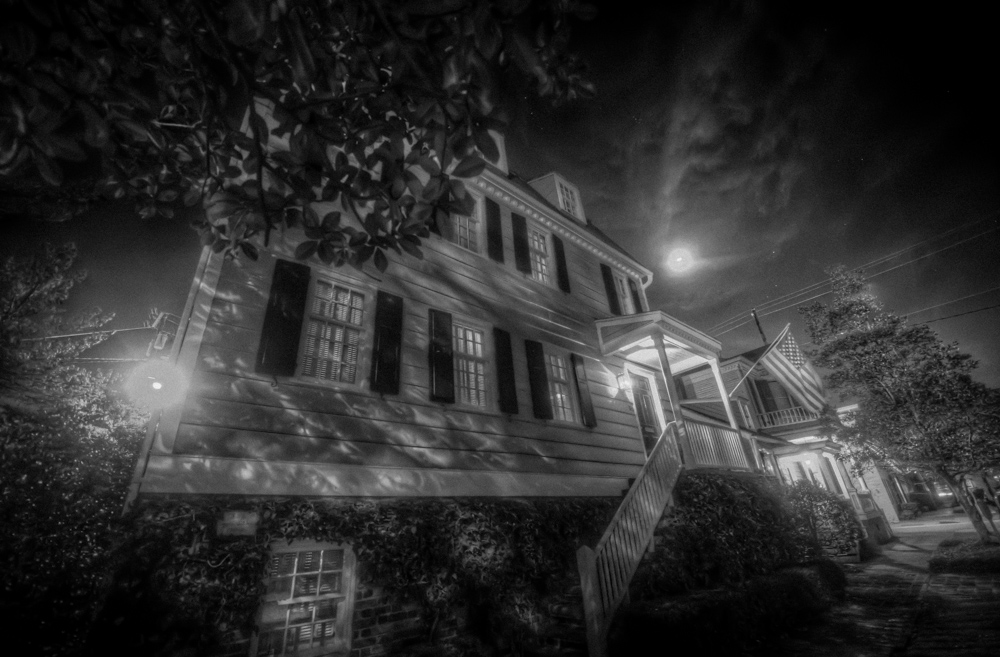
And in the heart of this spectral city, on a quiet, unassuming block, sits a house that many believe is its dark, beating heart. 507 East Saint Julian Street. To the casual observer, it’s a picture of colonial grace. A beautifully restored three-story home, painted a tasteful, demure gray, with a quaint widow’s walk on the roof offering a glimpse of the sky. It looks peaceful. Safe.
It’s a lie.
This is the Hampton-Lillibridge House. And behind that serene facade lies a history so violent, so charged with negative energy, that it has resisted every attempt to cleanse it. This isn’t just a house with a ghost story. This is a house that feels fundamentally *wrong*. A place where the veil between our world and… somewhere else… is worn terrifyingly thin.

The House That Moved
Here’s the first strange twist in a story full of them: the Hampton-Lillibridge House doesn’t belong here. Not originally.
It was built around 1796 by Hampton Lillibridge, a Rhode Islander who moved south to make his fortune. The house first stood several blocks away, on what was then the outskirts of the fledgling city. It was one of the oldest wooden frame houses in Savannah, a survivor. But by the 1960s, it had fallen into disrepair, a forgotten relic slated for the wrecking ball. Progress, they called it.
Enter Jim Williams. If that name rings a bell, it should. Williams was the charismatic, controversial, and brilliant antiques dealer and historic preservationist made infamous by the book and movie, *Midnight in the Garden of Good and Evil*. Williams saw the architectural treasure rotting away and couldn’t let it die. So he did something audacious. He decided to move it.
Imagine the sight. A two-story, 18th-century house, lifted from its foundation, creeping through the historic streets of Savannah on the back of a massive flatbed truck. A spectacle. A triumph of preservation. But what if, when they lifted the house, they disturbed something that had been sleeping beneath it for centuries? Or worse, what if they moved the house onto a piece of land that was already occupied… by something unseen?
A Foundation of Secrets
The chosen spot was 507 East Saint Julian Street. A vacant lot. Perfect. Or so it seemed. As workmen began digging a new foundation, their shovels hit something solid. Not rock. It was structured. Carefully, they cleared the dirt away, revealing the top of a stone structure. An old tomb. A hidden crypt, unmarked on any city map.
Panic. The work crew, composed of locals who grew up on Savannah’s ghost lore, wanted nothing to do with it. Who was buried there? Why was it forgotten? Was it a family plot? The resting place of yellow fever victims? Or something older? Some have speculated it was a pre-colonial Native American burial site, a sacred space that was about to be desecrated.
The decision was made with a chilling pragmatism. Don’t open it. Don’t investigate. Just pour the concrete. The crypt was filled with sand and the new foundation of the Hampton-Lillibridge house was poured directly on top of it, sealing the mystery forever. They put a house on top of a tomb. A terrible, monumental mistake.
The activity started almost immediately.
A Catalog of Nightmares
The stories associated with this house are not the gentle whispers and fleeting shadows of your typical haunting. They are aggressive. Malicious. Physical. The house doesn’t just want to scare you; some say it wants to hurt you.
The Man in the Window
One of the most persistent legends is that of a sailor who took his own life in a third-story bedroom. The details are lost to time, but the psychic impression he left behind is apparently as strong as ever. Tour guides speak of a figure seen staring out the window, a man in period clothing, sometimes described as looking forlorn, other times with an expression of pure rage. Passersby on the street have reported seeing the top-floor lights flicker on and off, even when the house is empty. But the real terror is for those inside. The room is said to be perpetually cold, and some visitors have reported feeling an overwhelming sense of despair, a crushing hopelessness that seems to bleed from the very walls. The phantom rope still creaks.
Deep Dive: The Poisoning
Another dark tale, woven into the fabric of Savannah’s brutal past, speaks of an entire family lost within the house’s original walls. The story goes that a family living there in the early 19th century was poisoned by their enslaved servants. It’s a horrific story, born from the unimaginable cruelty of that era. While historical records confirming this specific event are scarce—such tragedies were often swept under the rug—the emotional residue of such an act of desperation and violence is precisely the kind of thing that paranormal experts say can stain a location forever. Could the collective agony of that event have created a permanent scar, an echo of pain that replays itself over and over?
Modern Theories and Digital Ghosts
The internet has only amplified the house’s dark reputation. Paranormal investigation forums are filled with supposed Electronic Voice Phenomena (EVP) captured within the walls. Disembodied voices whispering “Get out.” A child’s laugh echoing from an empty hallway. One Reddit user, claiming to be a former contractor who worked on a later renovation, posted a chilling story about tools vanishing from a locked room only to reappear, bent and broken, in the center of the floor the next morning. He wrote, “It wasn’t a prank. The feeling in that house… it’s like being watched by something that hates you. We finished the job and never went back.”
Jim Williams and the Fight for His Friend’s Life
The most terrifying and well-documented incident involves Jim Williams himself. His connection to the paranormal is well-known; his other famous property, the Mercer-Williams House, is the site of the shooting that led to his multiple murder trials and is considered one of Savannah’s most active haunts. Williams, it seems, was a magnet for the supernatural.
He was at the Hampton-Lillibridge house with a group of friends during its restoration. The place was a chaotic construction site, with exposed beams and open shafts. They were downstairs when they heard it. A loud crash from the third floor. Then another. Banging. Scraping. It sounded like a crew was still at work, throwing debris around.
But the workers had all gone home.
One of Williams’s friends, a writer named Joe, bravely volunteered to go investigate. He climbed the dusty stairs to the third floor, to the very room where the sailor had supposedly hanged himself. The room was empty. The noise had stopped. But the air was electric, heavy. In the center of the room was an old, bricked-up chimney, with a portion of the shaft left open during the renovations—a straight, dark drop to the ground floor.
What happened next is the stuff of horror movies.
As Joe stood there, he felt a sudden, immense pressure on his back. Not a push. A grip. It was as if a set of massive, invisible hands had seized him and were physically dragging him across the floor. He dug his heels in, fighting against a force he couldn’t see. He was being pulled, inexorably, toward the open chimney shaft. He screamed. His feet slid across the dusty floorboards. He knew, with absolute certainty, that this thing was trying to throw him down the shaft to his death. In a last, desperate act of survival, he threw himself to the floor, going completely limp. The pressure vanished.
He lay there, gasping, as Jim Williams and the others rushed up the stairs. They found him pale and shaking, covered in dust, inches from the abyss. He told them what happened, his voice trembling. It wasn’t the wind. It wasn’t his imagination. Something in that house had tried to murder him.
An Evil So Old, Even God Said No
The incident with his friend was the final straw for Jim Williams. He was a man of the world, a pragmatist, but he could no longer deny what was happening. The house was not just haunted; it was malevolent. He did something few people in his position would even consider. He sought an exorcism.
Williams, an Episcopalian, contacted his local bishop. He explained the escalating events, the physical attack, the pervasive sense of dread that permeated the property. The bishop took him seriously. An Episcopal priest was dispatched to 507 East Saint Julian Street to perform the rite of exorcism, to cleanse the home with prayer and holy water.
It didn’t work.
According to the story, which Williams himself recounted many times, the priest performed the entire ritual. He blessed every room, sprinkled holy water in every corner, and commanded any unclean spirits to depart in the name of God. For a short time, there was peace. A strange calm settled over the house.
And then it came back. Angrier than before.
The activity exploded. Objects flew off shelves. Doors slammed with such force that the frames cracked. The oppressive atmosphere returned, tenfold. The priest, shaken, reported back to his bishop. His conclusion was terrifying: the entity in the house was too old, too powerful, and too deeply rooted to the land itself. It was something pre-Christian, something that did not recognize the authority of his faith. The exorcism hadn’t banished it; it had only provoked it.
The bishop, after hearing the report, gave Williams a piece of advice that sends a shiver down the spine. He couldn’t help. The church couldn’t help. His advice? “Don’t Tarry There.” In other words: run.
What If?: Unraveling the Enigma
So what is truly going on at the Hampton-Lillibridge House? Is it merely a collection of ghost stories, embellished over the years by tour guides and thrill-seekers? Or is something more profound at play?
- What if the primary force isn’t human? The failed exorcism suggests we’re not dealing with the ghost of a sailor or a poisoned family. What if the entity is a “genius loci,” a spirit of the land itself? A powerful elemental being that was peaceful until a house was literally dropped on top of its sacred tomb. Its rage isn’t about past trauma; it’s about a territorial violation.
- What if the house is a psychic battery? The house itself has a history of trauma. Jim Williams’s life was filled with drama, scandal, and ultimately, violence. Could the intense negative emotions of the living have been absorbed by the house, feeding the entity within and making it stronger? The house didn’t just contain a haunting; it amplified it.
- What if the crypt is a gateway? This is where we go deep down the rabbit hole. Some theories suggest that certain locations, often ancient burial sites, can act as portals or weak spots between dimensions. By disturbing the crypt and then sealing it, did the builders inadvertently trap something on our side? Or did they just put a lid on an open door, a door that things can still crawl through?
The truth remains elusive, buried under concrete and a century of fear. The Hampton-Lillibridge House is a private residence today, its inhabitants no doubt aware of the chilling tales that cling to their home like that ever-present Spanish moss. They don’t talk about it. They just live there.
But the questions linger. When you look at that calm, gray facade, you have to wonder. What secrets are still locked inside? What presence waits patiently in the shadows of that third-floor room? And what is sleeping, or perhaps stirring, in the forgotten tomb beneath the floor? Some mysteries are not meant to be solved. They are meant to serve as a warning. A warning that some doors are better left unopened, and some places are better left alone.
Originally posted 2016-02-27 04:57:04. Republished by Blog Post Promoter