Home Weird World Strange Stories The Coded Shugborough inscription

The Coded Shugborough inscription

0
68

It sits quietly in the English countryside, mocking us. For more than two and a half centuries, a stone monument in Staffordshire has held its tongue, refusing to give up a secret that has driven some of history’s smartest people absolutely crazy. It looks innocent enough. Just a garden ornament, right? Wrong.

This isn’t just a statue. It is quite possibly the most frustrating, tantalizing uncracked puzzle on the face of the Earth. We are talking about the Shugborough Inscription. A code so tough that the people who cracked the Nazi Enigma machine couldn’t break it. A code that might—just might—tell us where the Holy Grail is hidden.

Shugborough inscription

The 250-Year-Old Riddle

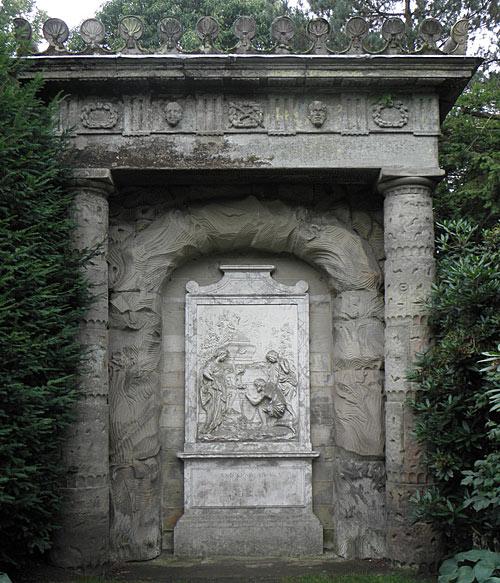
Let’s set the scene. You are in Staffordshire, England. You are walking through the grounds of Shugborough Hall, the ancestral home of the Anson family. It’s the mid-18th century type of place—grand, imposing, and dripping with old money. As you wander into the garden, you come across the Shepherd’s Monument.

At first glance, your eyes slide right over it. It looks like a standard piece of art commissioned by a wealthy guy trying to look sophisticated. It’s a sculpted relief based on a very famous painting by Nicolas Poussin called “The Arcadian Shepherds.” You see three shepherds and a woman gathered around a tomb. Typical classical stuff.

But then you look closer. You lean in. Below the image, carved deeply into the stone, is a sequence of ten letters that makes absolutely no sense.

O U O S V A V V

These eight letters are sandwiched between a D on the left and an M on the right, which sit slightly lower than the rest. The full sequence reads: D O U O S V A V V M.

What does it mean? Is it a sentence? An acronym? A map? For 250 years, linguists, mathematicians, historians, and conspiracy theorists have thrown everything they have at this stone. And the stone has won every single time.

The Admiral’s Treasure: Where Did the Money Come From?

To understand the mystery, you have to understand the man who paid for it. The monument was commissioned by Thomas Anson. But the money came from his brother, Admiral George Anson.

George Anson wasn’t just a sailor. He was a legend. In the 1740s, he circumnavigated the globe. He fought the Spanish. He battled scurvy, storms, and disaster. When he came back to England, he wasn’t just a hero; he was arguably the richest man in Britain.

He had captured a Spanish galleon, the Nuestra Señora de Covadonga, which was loaded to the gunwales with gold and silver. We are talking about a fortune that would make modern billionaires blush. George gave a huge chunk of this cash to his brother Thomas to fix up the family estate.

Here is where the whispers start. Did Anson find something else out there on the high seas? Something more valuable than gold? Some theories suggest that the “treasure” wasn’t just coins. It was knowledge. Secret documents. Ancient relics.

The Anson brothers were members of high-society secret clubs. They rubbed shoulders with the elite. If they had a secret to hide—a secret that could shake the foundations of the church or the monarchy—they needed a way to preserve it without letting just anyone read it. Hence, the code.

The Poussin Connection: A Mirror to the Past

The mystery gets weirder when you look at the artwork itself. The relief on the monument is a copy of Nicolas Poussin’s painting Et in Arcadia Ego. But it is not an exact copy.

It’s a mirror image. It’s reversed. And there are extra details added, like a sarcophagus placed on top of the main tomb. Why change a masterpiece? In the world of cryptography and secret societies, nothing is accidental. If you flip an image, you are telling the viewer to look at things differently. To look “through the looking glass.”

Poussin himself is a massive figure in conspiracy lore. Before he died, he claimed to carry a secret that “no riches could buy.” For centuries, people have analyzed his paintings for hidden geometry. The phrase on the tomb in the painting—Et in Arcadia Ego—translates roughly to “Even in Arcadia, there am I” (referring to Death). But it’s grammatical nonsense in Latin. It’s missing a verb.

If you rearrange the letters of Et in Arcadia Ego, you can form the sentence: I Tego Arcana Dei.

Translation? “Behold, I keep God’s secrets.”

Did Thomas Anson know this? Was he signaling to other initiates that he, too, knew the secret? The fact that the Shugborough monument uses this specific imagery is the biggest red flag in history.

Theory #1: The Holy Grail and the Knights Templar

This is the big one. The theory that keeps us up at night. The idea is that the code reveals the hiding place of the Holy Grail.

The logic goes like this: The Knights Templar were supposedly the guardians of the Grail (the cup of Christ, or perhaps the bloodline of Christ). When the order was crushed in the 14th century, the survivors went underground. They passed their secrets down through generations of noble families and secret societies, like the Priory of Sion.

Some researchers believe the Anson family was part of this chain. They think the letters D O U O S V A V V M stand for a Latin prayer or a set of directions.

One popular interpretation connects to the search for the Grail in Rennes-le-Château, France. But others think the Grail was moved. Brought to England. Buried in a quiet garden in Staffordshire.

Could the Cup of Christ be sitting in a hole a few feet beneath this stone? It sounds insane. But then you remember that the Anson family had the money and the connections to pull off a cover-up of that magnitude.

Theory #2: The Cursed Love Story

Not everyone thinks it’s about Jesus or magic cups. Some think the answer is much more human, and much sadder. A tragic romance.

There was a rumor—never proven, but persistent—that Thomas Anson had a very close relationship with a woman. Some say it was a secret mistress. Others, delving into the darker gossip of the 18th century, suggest it might have been an forbidden love within the family, perhaps involving his brother’s wife or even a sister.

Under this theory, the letters aren’t a map. They are an epitaph. A final goodbye to a lover he couldn’t publicly acknowledge.

One proposed translation is: Optima Uxoris Optima Sororis Viduus Amantissimus Vovit Virtutibus Maria.

That means: “Best of wives, best of sisters, a most devoted widower dedicates this to your virtues.”

It’s poetic. It fits the melancholic vibe of the shepherd pointing at a tomb. But does it fit the letters perfectly? Not quite. It requires a bit of stretching. And why wrap a love note in a code that withstands military-grade decryption? That seems like overkill for a broken heart.

Famous Minds Who Failed

You might be thinking, “It’s just ten letters. How hard can it be?”

Let’s look at the resume of the people who have tried and failed.

Charles Darwin

The father of evolution himself. A man who looked at the chaos of nature and saw a pattern. He was a genius of observation. He visited Shugborough. He stared at the stone. He walked away empty-handed.

Charles Dickens

The man who wrote some of the greatest convoluted plots in literature. He loved puzzles. He loved mysteries. He supposedly took a crack at the Shugborough code and got nowhere.

Josiah Wedgwood

The famous industrialist and grandfather to Darwin. He lived nearby. He was obsessed with it. Nothing.

These weren’t stupid men. They were the giants of their era. If they couldn’t solve it, we aren’t dealing with a simple word jumble.

The Bletchley Park Connection

This is where the story gets truly wild. During World War II, Bletchley Park was the top-secret home of the British codebreakers. These were the people—like Alan Turing—who broke the German Enigma cipher and helped win the war.

Decades later, a team from Bletchley (long after the war, during a reunion event) decided to turn their attention to Shugborough. They had cracked the most complex machine ciphers in history. They figured a 200-year-old garden carving would be a piece of cake.

They fed the letters into their computers. They applied frequency analysis. They used every trick in the spy handbook.

The result? nothing. Zero. Zilch.

They eventually concluded that the code might be a “one-time pad.” That means the letters only make sense if you have a specific book or key to decode them. Without that key, the letters are mathematically unbreakable. If the key was a specific book in Thomas Anson’s library, and that book is lost… the secret is gone forever.

Modern Internet Theories: The Hive Mind

In the age of the internet, the mystery has gone viral. Reddit sleuths and amateur historians have flooded forums with new ideas. We have moved past the old theories and are getting some fresh, weird takes.

The “Jesus H. Defy” Theory

A few years ago, an American linguistic researcher named Keith Massey used his background in Latin to propose a new solution. He noted that the letters O U O S V A V V could be an acronym for the Latin phrase: Oro Ut Omnes Sequantur Viam Ad Veram Vitam.

Translation: “I pray that all may follow the Way to True Life.”

It’s a standard Biblical sentiment. It fits the letters perfectly. The “D” and “M” on the side? Diis Manibus (“To the Manes/Spirits of the Dead”), which was a standard Roman tomb inscription. It’s plausible. It’s logical. But is it boring? Yes. And does it explain why a rich admiral would hire a master sculptor to hide a generic Bible verse? That is the question.

The Coordinate Theory

Others suggest the letters stand for numbers. Roman numerals? Coordinates? Some have tried to overlay the letters on a map of the Shugborough estate. Does V stand for 5? Does it point to a specific tree or a cave? People have gone out there with metal detectors (illegally, usually) hoping to find the spot marked X. So far, only rusty nails and bottle caps.

Why It Matters

Why do we care about a dead guy’s stone puzzle? Why does this page get thousands of hits?

Because we hate the unknown. We live in a world where we can Google anything. We can see satellite images of the entire planet. We think we know everything. The Shugborough Inscription is a slap in the face to our modern ego.

It reminds us that history is deep, dark, and full of secrets. It reminds us that people used to hide things—big things. And sometimes, they hid them so well that they stayed hidden.

Maybe it really is a map to the Holy Grail. Maybe it proves Jesus had kids. Maybe it’s the location of a pirate treasure worth billions.

Or maybe, just maybe, Thomas Anson is looking up from the afterlife, laughing his head off at us. Maybe it’s just nonsense letters carved by a man with a weird sense of humor, designed to waste the time of future generations.

If that was his plan, it worked.

So, take a look at the letters again. D O U O S V A V V M.

Do you see a pattern? Do you see a message? Or do you just see stone?

The answer is out there. But for now, the Shepherd’s Monument keeps its mouth shut.

Originally posted 2016-03-30 04:28:34. Republished by Blog Post Promoter

Originally posted 2016-03-30 04:28:34. Republished by Blog Post Promoter