The Bible Code: Is History’s Ultimate Prophecy Machine Hidden in Plain Sight?
What if the most influential book ever written is more than just a collection of stories and laws? What if it’s a program? A complex, layered data file containing the secrets of our past, present, and future, waiting for the right key to be turned?
Forget everything you think you know about prophecy.
This isn’t about vague verses or symbolic interpretations. This is about a hidden text. A secret message woven into the very fabric of the original Hebrew Bible, a code so complex that it remained invisible for millennia. A code that some of history’s greatest minds suspected was there, but could never prove.
Until now. Until the age of the supercomputer.
This is the story of the Bible Code, a theory so mind-bending it challenges our understanding of time, destiny, and the nature of reality itself. It claims that major world events—from political assassinations to global catastrophes—were documented thousands of years before they happened. The assassination of JFK. The rise of Hitler. The Great Depression. Even the horrific attacks of September 11th, 2001.
Is it the ultimate proof of a divine author? A warning from a higher intelligence? Or is it just the most staggering coincidence in human history? Buckle up. We’re going deep down the rabbit hole.
The Machine Beneath the Text: How Does It Even Work?
Let’s get one thing straight. The Bible Code isn’t about reading a sentence and saying, “Oh, this sounds like it could mean something in the future!” That’s child’s play. This is a mathematical phenomenon.
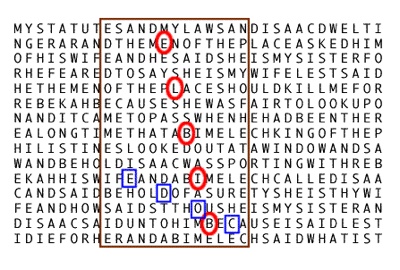
It’s based on a concept called an Equidistant Letter Sequence, or ELS. Imagine a giant block of text with all the spaces and punctuation removed. Now, pick a starting letter. Skip a set number of letters—say, 50—and write down the next letter. Skip another 50, write it down. Keep doing this. Most of the time, you’ll get gibberish. A random mess of characters.
But what if, against all odds, you don’t? What if you get a word? A name? A date?
That’s the core principle. Proponents of the code focus on the original Hebrew text of the Torah (the first five books of the Old Testament). They use this version for a very specific reason: ancient Hebrew was written as a continuous string of consonants. No vowels. No spaces. It was essentially one gigantic, unbroken line of code. Perfect for a computer to search.
Computers can perform this ELS search in a way no human ever could. They can check every possible starting letter and every possible “skip” sequence—forwards, backward, and diagonally—transforming the one-dimensional line of text into a two-dimensional crossword puzzle from another dimension.
And when related words—like “assassin,” “John Kennedy,” and “Dallas”—all appear clustered together in this cosmic puzzle, crossing each other’s paths… well, that’s when things get interesting. Very interesting.
The Unlikely Codebreakers: From Medieval Mystics to Isaac Newton
The idea of a hidden layer of meaning in the holy text is not new. For centuries, Jewish mystics, known as Kabbalists, believed the Torah contained infinite secrets. As early as the 13th century, a Spanish rabbi named Bachya ben Asher pointed out a simple ELS. He found that by skipping every 42 letters from the beginning of Genesis, the Hebrew letters spelled out a key date on the Hebrew calendar.
A curious finding. A neat party trick, perhaps. But it was just the tip of a colossal iceberg.
Centuries later, one of the most brilliant minds in human history became obsessed with this very idea. We remember him for the apple, for defining gravity, for revolutionizing our understanding of the physical universe. But Sir Isaac Newton had a secret life. He was a deeply religious man, an alchemist, and a mystic who spent more time trying to decode biblical prophecy than he ever spent on physics or mathematics.
Newton believed the Bible was a cryptogram, a divine blueprint of all human history, past and future, written by God himself. He learned Hebrew and spent years of his life hunched over ancient texts, trying to find the key. He hypothesized that a system of equidistant letters held the secrets, but he was a man working with a quill pen in an age of candlelight. The skips between letters were often enormous—hundreds, even thousands of characters apart. The sheer computational power required was beyond his wildest dreams.
He failed. The code remained locked away, a sleeping giant waiting for the right technology to wake it.
The Digital Revolution: Computers Finally Crack the Code
Fast forward to the late 20th century. The age of the supercomputer had arrived. The brute-force calculations that were impossible for Newton were now child’s play for modern machines.
In the 1980s and 90s, a team of Israeli mathematicians, led by Dr. Eliyahu Rips, decided to put the ancient theory to a rigorous, scientific test. Along with Doron Witztum and Yoav Rosenberg, Rips programmed a computer to search the Book of Genesis for ELS patterns.
Their first major experiment was stunning. They compiled a list of 34 famous rabbis and sages from history. Then, they had the computer search for their names in close proximity to their dates of birth or death. The odds of finding this by chance? Almost nonexistent. Yet the computer found them. The names and dates were intertwined in the text like threads in a tapestry.
They wrote up their findings in a scientific paper. They knew it would be controversial, so they submitted it to a respected, peer-reviewed journal, *Statistical Science*. The editors were baffled. They spent years having other mathematicians and statisticians check the work. They couldn’t find a flaw in the methodology. Finally, in 1994, they published the paper, stating that the results were significant and that the “phenomenon is real.”
The floodgates opened. The Bible Code exploded into the public consciousness.
The Chilling “Hits”: Prophecies That Defy All Logic
The “Great Sages” experiment was just the beginning. Once the method was out, researchers and journalists began searching the text for everything. And the things they claimed to find were earth-shattering.
The 9/11 Terror Attacks
This is perhaps the most haunting and detailed “prophecy” found in the code. Researchers looking at the text after the attacks found an absolutely terrifying cluster of words. The matrix wasn’t just vague; it was specific. Horrifyingly specific.

The terms “Twin Towers,” “airplane,” and “it will cause to fall” or “destroyed” were all found crossing each other. But it gets worse. The name “Bin Laden” was reportedly found nearby. So was “Pentagon.” Some researchers even claim to have found the location “Shanksville.” The date itself, “11 September,” was also allegedly encoded.
Think about that. Not just a reference to a tower falling. But the specific name of the target, the weapon used, the perpetrator, and the date. How do you explain that as a coincidence?
The Assassination of Yitzhak Rabin
This is the case that turned the Bible Code from a curiosity into a global phenomenon, largely thanks to journalist Michael Drosnin’s book *The Bible Code*. In 1994, over a year *before* the Israeli Prime Minister Yitzhak Rabin was assassinated, Drosnin claims he found a chilling message. The name “Yitzhak Rabin” was crossed by the phrase “assassin that will assassinate.”
He was so disturbed that he flew to Israel to deliver a warning to a friend of the Prime Minister. The warning was dismissed. On November 4th, 1995, Yitzhak Rabin was shot and killed by a right-wing Israeli extremist.
After the event, researchers looked at the same matrix again. They found the name of the killer, Yigal Amir, encoded right there. This single event, a prediction allegedly found *before* it happened, remains one of the most powerful arguments for the code’s authenticity.
A Frightening Pattern of History
The list goes on and on. Researchers claim to have found detailed encodings for:
- The Assassination of JFK: “Kennedy,” “Dallas,” “gunshot,” “from above,” and even the name “Oswald” are said to be clustered together.
- The Rise of Hitler: The terms “Hitler,” “Nazi,” and “slaughter” have been found in a matrix.
- World War II and the Holocaust: Encoded phrases like “World War” and “Auschwitz” have been reported.
- The Moon Landing: A matrix allegedly contains “spaceship” and “man on the moon,” crossing the date “1969.”
The sheer volume and specificity of these findings seem to prove that something extraordinary is going on. Something beyond our current understanding.
The Skeptics Strike Back: Cracks in the Sacred Code
But hold on. For every stunning claim, there’s a powerful counterargument. As the Bible Code became a sensation, an army of statisticians, mathematicians, and debunkers started picking it apart. And they found some major problems.
The Moby Dick Experiment
The single most damaging blow to the Bible Code theory came not from theology, but from literature. An Australian mathematician named Brendan McKay decided to apply the same ELS computer search… to the book *Moby Dick*. He wasn’t trying to find ancient wisdom; he was trying to prove a point about probability.
And he succeeded. Spectacularly.
Using the exact same methods as the Bible Code researchers, McKay and his team found “prophecies” in Herman Melville’s novel about a whale. They found ELS matrices that predicted:
- The assassination of Indira Gandhi.
- The assassination of Martin Luther King, Jr.
- The death of Princess Diana, complete with the names “Dodi” and “Henri Paul.”
The point was clear and devastating. If you have a large enough body of text and you give a computer enough flexibility to search forwards, backward, and at any skip interval, you are *guaranteed* to find patterns. It’s not prophecy; it’s a mathematical certainty. The human brain is wired to see patterns, and a computer can find apparent patterns in any sufficiently large data set. Even in a book about a whale.
The “Wiggle Room” Problem
Critics also point to the enormous flexibility the code-breakers give themselves. This isn’t like a simple crossword puzzle where the answers have to fit perfectly.
First, ancient Hebrew has no vowels. So, a word like “David” is just written as “DVD.” The researchers add the vowels back in to make sense of it. This gives them options.
Second, there’s no set rule for how names are spelled. Is it “Bill Clinton” or “President Clinton”? “Bin Laden” or “Osama Bin Laden”? You can search for different variations until you find one that fits.
Third, the “closeness” of words in a matrix is subjective. How close do “JFK” and “Dallas” have to be to count as a hit? There’s no objective standard. This combination of factors, critics argue, is like shooting a thousand arrows at a wall and then drawing a bullseye around where one of them landed.
The Failed Prophecies
What about all the predictions that didn’t come true? This is the elephant in the room. In his books, Michael Drosnin claimed the code predicted a “world war” and a “nuclear holocaust” for the year 2006. It didn’t happen. Other researchers have found “prophecies” for catastrophic earthquakes and political events that never materialized.
Believers argue that these futures were averted, or that our actions can change the outcome. But for skeptics, it’s the final nail in the coffin. A prophecy machine that’s wrong half the time isn’t a prophecy machine at all. It’s just a random noise generator.
The Great Debate: Divine Blueprint or Cosmic Coincidence?
So where does that leave us? Trapped between two impossible conclusions.
On one hand, you have the believers. They argue that the Bible Code’s “hits” are far more statistically significant and contextually rich than anything found in *Moby Dick*. They point to the Rabin assassination as proof that the code can, and did, predict a future event. For them, the sheer improbability of it all points to a singular, staggering truth: the Bible was authored by a non-human intelligence with the ability to see the entire span of human history.
It’s an intelligence we might call God.
If they are right, the implications are profound. Does it mean our lives are predetermined? Is free will just an illusion, a comforting story we tell ourselves as we act out a script written eons ago?
On the other hand, you have the skeptics. They see the Bible Code as the ultimate example of confirmation bias and data-mining. They argue that with a big enough book and enough computer power, you can “find” anything you want to find. It’s a statistical ghost in the machine, a trick of probability that preys on our deep-seated human need for meaning and order in a chaotic universe.
So, what is the answer? Is the Bible a simple book of faith… or is it a warning label for humanity, a message in a bottle floating across the sea of time that we are only now learning how to read?
The code remains silent. The computer keeps searching. And we are left to wonder.