Home Weird World Strange Stories The Bennington Triangle Mystery

The Bennington Triangle Mystery

0
68

The Bennington Triangle: The Mountain That Eats People

Some places are wrong. You feel it in your bones. A shift in the air, a silence in the woods that’s a little too deep. The forest floor seems to hold its breath, waiting. Glastenbury Mountain in southwestern Vermont is one of those places. It’s the dark heart of an area paranormal investigators and mystery buffs have come to call the Bennington Triangle—a name whispered with a mixture of fear and fascination.

Because between 1945 and 1950, this patch of wilderness seemed to develop an appetite.

Five people. Five ordinary individuals, from an elderly woodsman to a young child, walked into this pocket of New England and were swallowed by the landscape. No bodies. No clues. No answers. They simply… ceased to be. Vanished. Wiped clean from the face of the Earth in a series of events so baffling, so chillingly impossible, they defy every rational explanation we have.

Forget what you think you know about missing person cases. This isn’t about getting lost. This is about being taken. The question is, by what?

THE BENNINGTON TRIANGLE

The First to Go: The Vanished Guide

The story begins on a cold November day in 1945. November 12th, to be exact. Seventy-four-year-old Middie Rivers was not a man you’d expect to get lost in the woods. He was the woods. He’d spent his entire life hunting and fishing the tangled forests and crooked streams around Glastenbury Mountain. He knew its moods, its secrets, its every trail and game path. He was the guy you hired so you *wouldn’t* get lost.

That day, he was guiding four hunters up the mountain. The air was crisp, the hunt was successful, and they were on their way back down. As they walked along the Long Trail, a path that would soon become infamous, Middie’s long strides pulled him ahead of the group. He was a familiar silhouette against the grey sky, just for a moment. He rounded a bend, and the others, trudging along behind, expected to see him waiting for them at the next clearing.

He wasn’t.

They called his name. Only the wind answered. They searched the area, thinking he’d stepped off the trail for a moment. Nothing. He was simply gone. An extensive search was launched immediately. Local police, volunteers, everyone who knew Middie combed the area for days. They found not a single footprint, not a broken twig, not a sign of a struggle. The only thing they ever found was a single, solitary rifle cartridge from his belt, lying in the shallow water of a stream. The official theory? He must have bent over to drink, and it fell out of his pocket.

A rifle shell. That’s all that was left of a man who knew those woods better than his own backyard. A man who could read the forest like a book vanished from its pages without a trace.

The Girl Who Walked Into Thin Air

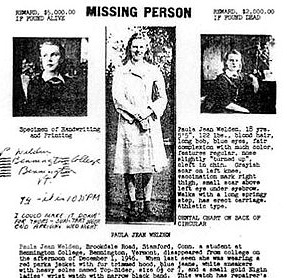
A year later, the mountain was hungry again. This time, its victim was Paula Jean Welden. And her case would blow the mystery of the Bennington Triangle wide open.

On December 1st, 1946, Paula, an 18-year-old sophomore at Bennington College, decided to go for a hike. She was bright, adventurous, and dressed for the chilly day in a distinctive red parka. She told her roommate she was heading for a walk on the Long Trail—the very same trail where Middie Rivers had disappeared. She hitched a ride to the trailhead, a cheerful, vibrant young woman heading for an afternoon stroll.

She was not alone on the trail. A middle-aged couple was hiking about 100 yards behind her. They saw her red coat clearly against the stark trees. They watched her walk up the path, following its twists and turns. At one point, the trail curved sharply around a rocky outcropping of land. Paula walked around the bend and out of their sight.

The couple continued their walk. When they rounded the same rocky outcropping moments later, the trail ahead was empty. Utterly empty.

There was nowhere to go. No side trails. Just steep, wooded slopes on either side. It was physically impossible for her to have disappeared from view so quickly without sprinting or flying. She was there. And then she was not.

When she didn’t return to her dorm, the alarm was raised. What followed was one of the largest manhunts in Vermont’s history. The college shut down as students and faculty joined the search. The FBI was called in. Her father offered a massive reward. They scoured every inch of that mountain. They found nothing. No scrap of her red parka. No footprint. No sign of a fall or a struggle.

The theories flew. Did she run away to start a new life? Unlikely, she left her money and belongings in her dorm room. Was it foul play? A local man was questioned intensely but there was zero evidence to connect him. It was as if the trail itself had opened up and swallowed her whole.

The Ghost on the Bus

If you think a person can’t just vanish from a mountainside, what about vanishing from a crowded, moving bus? Three years to the day after Paula Welden disappeared, the Bennington Triangle claimed its next victim in the most impossible way imaginable.

December 1st, 1949. James E. Tedford, an ex-soldier, was on a bus heading home to the Soldiers’ Home in Bennington. He had been visiting relatives in St. Albans, Vermont. He boarded the bus, found his seat, and settled in for the long ride. There were fourteen other passengers on that bus. They all saw him.

Witnesses later testified that they saw Mr. Tedford dozing in his seat. The bus made its scheduled stops, but it never emptied. It was a closed environment, a metal tube hurtling through the night. As the bus pulled into its final destination in Bennington, the other passengers began to gather their things and file out.

But James Tedford’s seat was empty.

Let that sink in. He wasn’t at the bus station. He wasn’t in the restroom. He was gone. His luggage was still in the overhead rack. A bus timetable lay open on his vacant seat. The driver was baffled. The fourteen other passengers were stunned. No one saw him get up. No one saw him leave. The bus had been in motion on the highway for its final long stretch into town. To vanish, he would have had to open a window and hurl himself out of a moving bus without anyone noticing.

He was there, surrounded by people, and then he was nowhere. James Tedford has never been seen or heard from again.

bennington-triangle

The Boy and the Bloodhounds

The fall of 1950 would be the Triangle’s most brutal season. In mid-October, the phenomenon turned its attention to the most innocent of victims: eight-year-old Paul Jepson.

Paul lived on a local farm with his mother. She was out tending to the animals, and she left Paul playing happily in his red jacket near the pigsty. He was in a familiar place, a safe place, just yards from his mom. She was gone for less than an hour. When she returned, the yard was silent. Paul was missing.

Another massive search party was formed. Hundreds of volunteers, local law enforcement. This time, they brought in bloodhounds. The dogs picked up Paul’s scent immediately, right where his mother last saw him. They followed it eagerly, their noses to the ground, leading the searchers away from the farm and toward a local crossroads.

And then, in the middle of the road, the scent just stopped.

It didn’t veer off into the woods. It didn’t double back. It just ended, as if Paul had been lifted straight up into the sky. The dogs grew confused, whining and circling the same spot, unable to find a single trace of which way he went. It was a dead end written in scent. A complete and total blank.

The boy in the red jacket was gone, plucked from his own yard. Like Paula Welden, who also wore red, he was absorbed by the strange energy of Bennington.

The Final Victim and the One Chilling Clue

Just sixteen days after Paul Jepson vanished, the Triangle would claim its last known victim. And this time, it would leave something behind.

On October 28, 1950, Frieda Langer, 53, was hiking with her cousin near the Somerset Reservoir. The day was getting late, and the terrain was tricky. Frieda slipped and fell into a stream, soaking her clothes. Chilled and uncomfortable, she made a simple, logical decision. She told her cousin to wait for her while she quickly hiked the half-mile back to their campsite to change into dry clothes. She promised she’d catch up.

She never came back.

Her cousin waited, then eventually returned to the camp, only to find she wasn’t there. No one had seen her. Once again, the alarm was raised. Over the next two weeks, five separate, massive searches were conducted. Helicopters and planes scanned from above while up to 300 people on the ground grid-searched the entire area between the stream and the campsite. It was a small, contained area. They found absolutely nothing.

The case went cold. Winter came and buried the mountain in snow. Then, seven months later, on May 12, 1951, Frieda Langer’s body was found.

But here’s where it gets truly bizarre. Her remains were discovered out in the open, near the Somerset Reservoir, in an area that had been one of the most heavily searched locations during the manhunt. There is no possible way hundreds of searchers and aircraft could have missed a body lying in that spot.

The only conclusion is that it wasn’t there in October. Someone—or something—put it there later. Due to the extreme decomposition, the medical examiner could determine no cause of death. Frieda Langer was the last to vanish and the only one ever found, her mysterious reappearance only deepening the horrifying questions surrounding the Bennington Triangle.

What is Happening on Glastenbury Mountain?

Five people, gone in five years. What ties these cases together? What dark force was at work in those woods?

Theory 1: The Human Predator

The simplest explanation is often a human one. Could a reclusive, cunning serial killer have been living in the forests of Glastenbury Mountain, preying on unsuspecting hikers and travelers? It would explain Middie Rivers, Paula Welden, and Paul Jepson. A killer could have abducted them, leaving no trace. He could have murdered Frieda Langer and returned her body months later to taunt authorities.

But this theory falls apart with James Tedford. How does a serial killer snatch a man from the middle of a moving bus filled with witnesses? It’s a logistical nightmare that defies belief.

Theory 2: The Bennington Monster & Ancient Curses

Local lore is filled with whispers of strange things in those woods. Before it was called the Bennington Triangle, Native American tribes considered the mountain cursed, a place to be avoided. Some legends speak of a “man-eating stone” that would swallow anyone who stepped on it. Over the years, there have been scattered reports of a tall, hairy, Bigfoot-like creature roaming the area—a “Bennington Monster.” Did these five people stumble upon something ancient and territorial that calls those woods home? Something that doesn’t like to be disturbed?

Theory 3: A Dimensional Doorway

This is where things get really weird. Some researchers, looking at the sheer impossibility of the disappearances, have proposed a more paranormal explanation. Is the Bennington Triangle a geographic anomaly, similar to the Bermuda Triangle? A place where the fabric of our reality is thin? A “vortex” or a “dimensional window” that occasionally opens and closes, pulling people through?

It sounds like science fiction. But think about it. It would explain how Paula Welden could vanish in the blink of an eye. It would explain how Paul Jepson’s scent could abruptly end in the middle of a road. It would even explain how James Tedford could disappear from a bus—if the window opened inside the vehicle itself, he wouldn’t have gone anywhere in our world. He would have just been… gone.

The disappearances stopped as abruptly as they began. After 1950, the mountain fell silent. The town of Glastenbury itself is now a ghost town, its buildings slowly being reclaimed by the forest, as if the land itself is erasing the human presence.

So what do you believe? Was it a monster? A killer? Or is Glastenbury Mountain a doorway to somewhere else? The only ones who know the truth are the five people who walked into the Bennington Triangle and never walked out.

Originally posted 2013-10-10 21:49:24. Republished by Blog Post Promoter