Home Conspiracies The Apollo 1 Conspiracy Theory

The Apollo 1 Conspiracy Theory

0
83

The Apollo 1 Conspiracy: Murder on the Launchpad?

January 27, 1967. Cape Kennedy. A gleaming white Saturn IB rocket stands silent against a gray Florida sky, the Apollo 1 command module perched at its peak. Inside, three of America’s finest are strapped into their couches: Commander Gus Grissom, a stoic veteran of the Mercury and Gemini programs; Senior Pilot Ed White, the first American to walk in space; and Pilot Roger Chaffee, a brilliant rookie on his first mission.

It was supposed to be a routine “plugs-out” test. A full dress rehearsal before their actual launch into Earth orbit. But it was anything but routine.

At 6:31 PM, a chilling voice crackled over the communications link. A single word, distorted by static and rising panic.

“Fire!”

Then another voice, strained, desperate. “We’ve got a fire in the cockpit!”

For seventeen agonizing seconds, the ground crew listened helplessly to the sounds of a struggle. A final, horrifying scream. And then… silence. An eternal, deafening silence. When the smoke cleared, three heroes were dead, and the American space program was scarred forever.

The official story is one of catastrophic failure. A tragic accident born from a fatal combination of hubris, haste, and flawed design. But what if that’s not the whole story? What if the fire that consumed Grissom, White, and Chaffee wasn’t an accident at all? What if it was the perfect murder, executed in plain sight and covered up at the highest levels of NASA?

Strap in. Because the accepted history of the Apollo 1 disaster might be the biggest lie ever told.

apollo 1 conspiracy

The Official Story: A Recipe for Disaster

To understand the dark theories, you first have to understand the “official” version of events—a narrative that, even without a conspiracy, is a horror story of negligence. The Apollo 1 Command Module, designated CM-012, was a death trap waiting for a spark.

NASA, locked in a desperate Cold War sprint to beat the Soviets to the moon, was cutting corners. President Kennedy wanted a man on the moon by the end of the decade, and the pressure was immense. Schedules were compressed. Problems were patched instead of solved. And the astronauts knew it.

The Ticking Time Bomb: A Pure Oxygen Nightmare

The single greatest flaw was the atmosphere inside the capsule. For the ground test, the cabin was filled with 100% pure oxygen, pressurized to 16.7 pounds per square inch (psi)—higher than normal atmospheric pressure. This pure oxygen environment is hypergolic. That means materials that are normally non-flammable can suddenly burn with explosive speed. Everything becomes fuel.

Miles of wiring were bundled together and insulated with Teflon, a material that could outgas toxic fumes when burned. Velcro, a new wonder material at the time, was everywhere—over 34 square feet of it used to hold equipment in place. It was catastrophically flammable in pure oxygen. Nylon netting, designed to catch dropped items, was like a spiderweb of kindling draped throughout the cockpit.

And then there was the hatch. The brand new, complex, three-part hatch opened inward. To open it, the crew had to first vent the cabin pressure. But as the fire erupted, the internal pressure skyrocketed in seconds, sealing the hatch shut with thousands of pounds of force. It effectively entombed the astronauts inside. They were trapped. There was never any chance of escape.

The official investigation concluded that a spark from a frayed wire beneath Gus Grissom’s seat ignited the volatile atmosphere. The fire spread with unimaginable speed, consuming the capsule in a flash of heat and toxic gas. It was a preventable tragedy. A failure of imagination. A case of what Congress would later call “criminal negligence.”

Case closed, right? Not even close.

Gus Grissom: The Hero NASA Wanted to Forget?

Virgil I. “Gus” Grissom was not a man who kept quiet. He was one of the original Mercury Seven, America’s first astronauts. A decorated Air Force pilot. A tough-as-nails engineer who understood the machines he was flying better than anyone. And he was deeply, openly critical of the Apollo Command Module.

He called it a “bucket of bolts.” He complained constantly about the shoddy workmanship and the endless technical problems. In a moment of gallows humor that would become hauntingly prophetic, he and his crew posed for a gag photo, praying over a miniature model of their capsule. In another famous incident, Grissom hung a lemon on the Apollo simulator, a clear and public message to management: this thing is a dud.

Was he just a demanding perfectionist? Or did he know something more? Did he represent a threat to the carefully curated public image of the Apollo program? To answer that, we have to look back at an incident that had haunted Grissom’s career for years—an incident NASA desperately wanted the public to forget.

Deep Dive: The Ghost of Liberty Bell 7

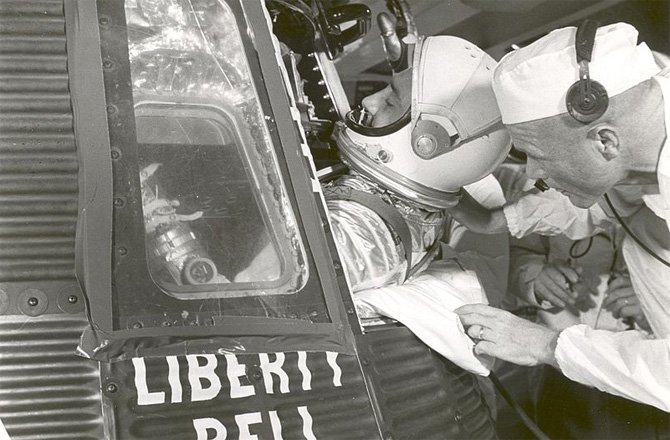
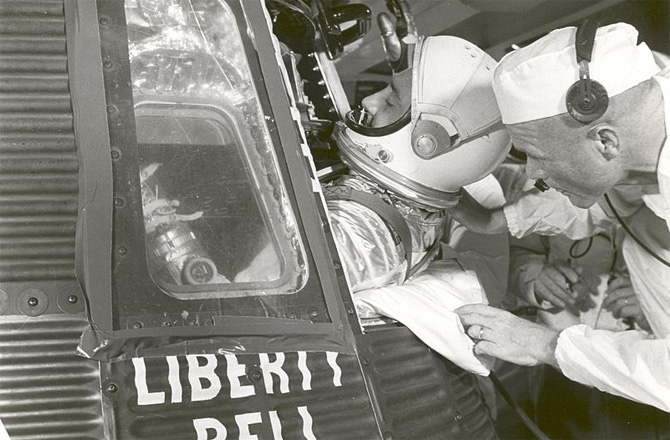
July 21, 1961. Grissom had just completed a perfect suborbital flight in his Mercury capsule, nicknamed Liberty Bell 7. He was the second American in space. After splashing down in the Atlantic, the recovery helicopter was hooking onto the capsule. Suddenly, the explosive bolts on the side hatch blew without warning. Water flooded in. The capsule began to sink.

Grissom scrambled out and was nearly dragged under as his suit filled with water. He was rescued, but the capsule—filled with priceless flight data—sank 16,000 feet to the ocean floor. It was a major embarrassment for NASA.

The official story was a technical malfunction. But whispers immediately started circulating within the agency. Did Grissom panic? Did he “screw the pooch” and blow the hatch himself? The charge was baseless—the plunger to activate the explosives was recessed and required significant force, something Grissom couldn’t have done accidentally while still strapped in. Yet, the stigma stuck to him like glue. Some in NASA’s upper echelons never forgave him for losing a spacecraft.

Now, fast forward to 1967. Gus Grissom, the man with the “blot” on his record, is commanding the very first Apollo mission. If things went according to plan, he was on the inside track to be the first man to walk on the moon. Could the powers that be at NASA stomach the idea of the man who “lost” a capsule being the face of their ultimate triumph? For some researchers, this is the cold, calculated motive for murder.

The Smoking Gun: A Son’s Chilling Discovery

The most explosive parts of the Apollo 1 conspiracy theory don’t come from anonymous sources or shadowy whistleblowers. They come from Gus Grissom’s own son, Scott Grissom. For decades, he refused to accept the official story, launching his own investigation into his father’s death.

In the 1990s, after years of fighting, he was finally granted access to the charred remains of the Apollo 1 command module, stored in a secure facility at Langley Research Center in Virginia. And what he found there sent a shockwave through the established narrative.

Rooting through the scorched instrument panels, he discovered something that was never mentioned in any official report. Something that shouldn’t have been there.

It was a “fabricated metal plate,” a small piece of metal deliberately placed behind the switch that controlled the capsule’s changeover from external to internal electrical power. According to Scott, its placement was no accident. It was positioned in such a way that when the switch was toggled—a standard part of the test procedure—it would short out, creating an arc. A guaranteed spark.

In a capsule filled with pure oxygen, a guaranteed spark is a guaranteed inferno. It was, in his view, an assassination device.

The Corroborating Witness

A lone son’s claim might be dismissed as grief-fueled fantasy. But he wasn’t alone. A North American Aviation engineer named Clark Mac Donald backed him up. Mac Donald had conducted his own independent investigation immediately after the fire. His report, he claimed, also identified an electrical short caused by the power changeover as the fire’s origin.

But what happened to his report? According to Mac Donald, NASA confiscated and destroyed it. They buried his findings, he said, to suppress any narrative that deviated from the “frayed wire” story—a story that put the blame on shoddy manufacturing rather than deliberate sabotage.

Motive for Murder: Why Kill America’s Heroes?

If the fire was sabotage, the question is monumental: Why? Killing three American heroes on the launchpad seems unthinkable. But in the high-stakes world of the Cold War, unthinkable acts were sometimes considered necessary. Several theories have emerged, each more disturbing than the last.

Theory 1: Silencing a Whistleblower

This is the most widely cited motive. Gus Grissom wasn’t just complaining about the capsule; he was threatening to go public. He knew the Block I Command Module was a death trap, and he was furious that NASA was willing to risk his crew’s lives in it. The theory suggests Grissom gave NASA an ultimatum: fix the spacecraft, or he would tell the world the truth. A press conference with a national hero blowing the whistle could have derailed the entire Apollo program, handing the moon to the Soviets. In this scenario, the fire wasn’t just about killing Grissom. It was about creating a “tragic accident” that would force NASA to build the safer Block II module he had been demanding, all without admitting their own deadly negligence. Grissom, White, and Chaffee were a sacrifice to save the moonshot.

Theory 2: The Liberty Bell 7 Grudge

This theory is more personal, more petty, and perhaps more chilling. It holds that certain powerful figures at NASA never forgave Grissom for the loss of Liberty Bell 7. They saw him as a screw-up who, through sheer luck and seniority, was about to claim the ultimate prize: the first moon landing. They simply couldn’t let that happen. Sabotaging his mission would remove him from the flight roster permanently, clearing the way for a more “suitable” hero like Neil Armstrong to take the historic first step. It paints a picture of an agency so obsessed with image and legacy that it would murder one of its own.

Theory 3: The Cold War Saboteur

Could it have been an outside job? In the 1960s, the space race was not a friendly competition; it was a front in the Cold War. Soviet spies were a real and present danger. Is it possible a saboteur infiltrated the clean rooms at Cape Kennedy and planted the device? Delaying the American moon program by killing its lead crew would have been a massive victory for the USSR. This theory, while less focused on an internal NASA plot, is a stark reminder of the global conflict that served as the backdrop for the race to the moon.

What Really Happened Inside Apollo 1?

The official report is tidy. A stray spark, a tragic accident, lessons learned. But the loose ends refuse to be tied down.

Why was there no fire extinguisher in the capsule? Why did the ground crew have such difficulty communicating with the astronauts in their final moments? Why was a safety test conducted under the most dangerous possible conditions—more dangerous, in fact, than an actual launch?

And what about the metal plate? Has NASA ever acknowledged its existence? No. They remain silent, dismissing such claims as baseless conspiracy theories. The evidence found by Scott Grissom and the testimony of Clark Mac Donald exist outside the official record, preserved only in the world of alternative research.

Ultimately, the fire served a purpose. The redesigned Block II Apollo Command Module that emerged from the ashes of Apollo 1 was a vastly superior and safer machine. It had a quick-opening outward hatch. Fire-retardant materials replaced the flammable ones. The on-pad atmosphere was changed to a safer nitrogen-oxygen mix. The very changes Gus Grissom had allegedly been fighting for were all implemented—but only after his death.

This is the terrible paradox of Apollo 1. Whether an accident or an assassination, the deaths of Grissom, White, and Chaffee directly enabled the success of the entire Apollo program. Without the fire, another crew, perhaps on the way to the moon, might have faced a similar disaster with no hope of rescue. Did three men have to be sacrificed to save the nine moon missions that followed?

The history books will tell you it was a tragic accident. A painful but necessary lesson. But for those who look closer, the silence from NASA is deafening, and the ghost of Gus Grissom still points an accusing finger from the ashes.

Was the Apollo 1 fire a story of technical failure and human error? Or was it the coldest, most calculated act of the Cold War, a murder hidden in a plume of fire on a lonely launchpad, the truth of which was sacrificed for a footprint on the moon?

Originally posted 2016-02-11 00:56:17. Republished by Blog Post Promoter