Terror, Mystery, Mayhem
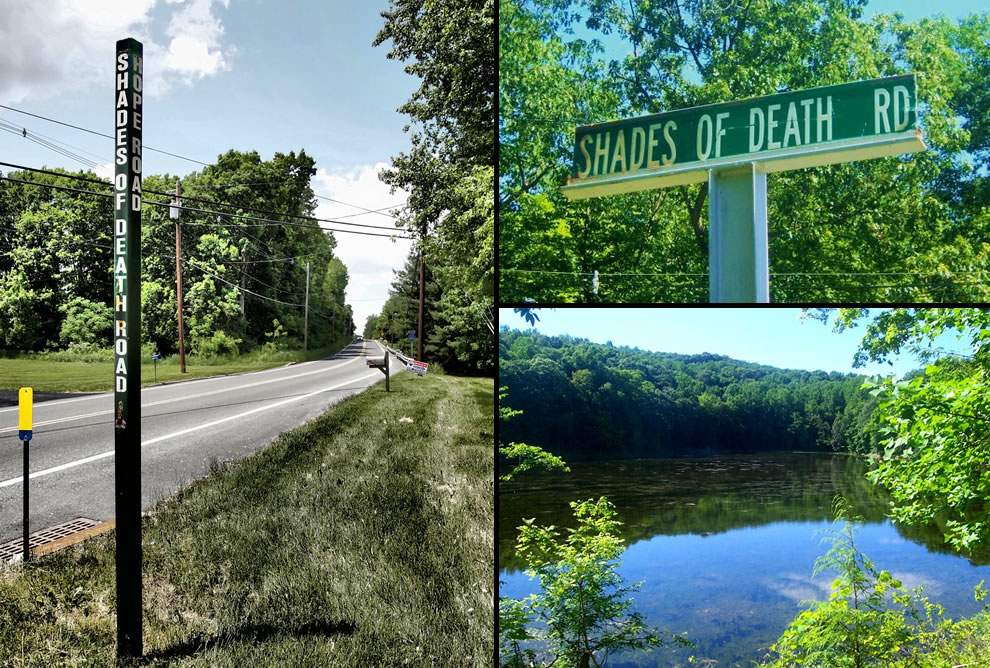
Shades of Death Road in Warren County, New Jersey is said to be haunted. It is is located near Jenny Jump State Forest and Ghost Lake. In the 1990s, two people wrote to Weird NJ magazine, claiming they had found strange and mysterious polaroids scattered along the road.
This New Jersey road winds through 7 miles of countryside, and along that stretch it gives us no definitive clues as to the origin of its eerie name (for those wondering, Shades of Death is not a nickname given by locals, but is in fact the road’s official moniker). While the explanation for this highly unusual name has been lost, many theories abound. Some say that murderous highwaymen would rob and kill those along the road. Others say the reason was because of violent retaliations by the locals against the very same highwaymen, resulting in their lynched corpses being hung up as a warning.
Some attribute it to three murders that occurred in the 20’s and 30’s. The first murder saw a robber beating his victim over the head with a tire iron, the second saw a woman decapitate her husband and bury the head and body on separate sides of the road, and the third consisted of poor Bill Cummins being shot and buried in a mud pile.
Some attribute it to massive amounts of fatal car crashes, while others consider it the fault of viscous wildcats from the nearby Bear Swamp.
The most likely explanation, however, is that malaria-bearing mosquitos terrorized the locals year after year, and the remoteness of the area prevented good medical attention from being prominent. This is supported by the fact that, in 1884, most of the swamps in the area were drained.
We have found several theories for the road’s macabre name:
Some focus on the road’s southern half, where the adjoining forest with its aged trees provides much actual shade from the sun on even the brightest days. Highwaymen or other bandits would supposedly lay in wait for victims in these shadows, then often cut their throats after taking what they had, or they would engage in fights to the death among themselves over women.
Or, it is said, the local populace would take revenge against these highwaymen by lynching them and leaving the bodies dangling from low-hanging tree branches as a warning to others criminally inclined.
In the 1920s and 1930s there were three brutal murders along the road, one a robbery in which a man was hit over the head with a tire jack over some gold coins, a second in which a woman beheaded her husband and buried the head and the body on different sides of the street, and lastly one in which a local resident, Bill Cummins, was shot and buried in a mudpile. It was never solved.
The twists and turns of the road have led to suggestions that it has led to an inordinate number of fatal car accidents, and supposedly the reflective guard rails along the road indicate where that has happened. However, the road had earned its name well before automobile use became common in the area.
Bear Swamp nearby was known as either Cat Hollow or Cat Swamp, because of packs of vicious wild cats that lived there who frequently and lethally attacked travelers along the road.
A final explanation points to the Pequest lowlands and nearby Bear Swamp, used today for sod farming.
In 1850, malaria-carrying insects were discovered nesting in a cliff face along the road. They flourished in the nearby wetlands of Bear Swamp, causing annual outbreaks of the disease. The high mortality rates due to the remoteness of the area from effective medical treatment cut a swath through so many families that a street once called merely Shade or Shades Road due to its tree cover took on the name Shades Of Death out of black humor. The problem was so widespread, that in 1884 a state-sponsored project drained the swamps, ending the threat.
The Terror
A murder that supposedly occurred here was the murder of a 15-year old girl. Apparently, she was dating a boy who had a lot of mental problems. One night, he invited the girl and her friend to go hiking in the woods. When they were deep in the forest, he attacked the girl. Her friend managed to get away and tried to bring help. By the time she came back with the police, it was too late. The boy had already assaulted the girl and stabbed her to death. He is still serving a life sentence.
Gruesome history and spooky name aside, you have much to fear along this byway. South of the I-80 overpass lies an officially unnamed lake, that most will tell you is called Ghost Lake. This lake is frequently the home of specter-like vapors, and the sky is supposed to be unusually bright, no matter what time of night you are there. As per the name, ghosts of the highwaymen’s victims roam the area, and they are most frequent in the abandoned cabin across the lake. The dead-end road known as Lenape Lane is home to thick fogs and apparitions, and you may be chased off the road by a white light. Wikipedia details the most disturbing aspect of the road:
“One day during the 1990s, some visitors found hundreds of Polaroid photographs scattered in woods just off the road. They took some and shared them with Weird NJ, which published a few as samples. Most of the disturbing images showed a television changing channels, others showed a woman or women, blurred and somewhat difficult to identify, lying on some sort of metal object, conscious but not smiling. Local police began an investigation after the magazine ran an item with the photos, but the remainder disappeared shortly afterwards.”
Shades of Death Road Polaroids
Weird NJ published correspondence from two anonymous readers who said they found hundreds of Polaroid photographs, some of them showing the blurred image of a woman, possibly in distress, scattered in woods just off the road during the 1990s. The magazine claims the local police began an investigation but the photos “disappeared” shortly afterward.
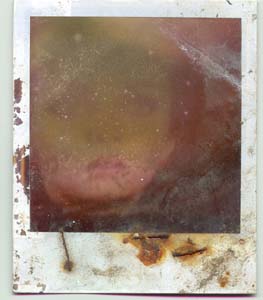
A number of strange Polaroids have appeared online since claiming to be those found on or near Shades of Death Road.
There were rumors that a serial killer in the area took pictures of women just before he murdered them.

Paranormal Activity
A well told legend is about a ghost who is a 9-year old girl walking up and down the side of the road at night. Rumor has it if you should stop your car and she sees you, she will come up to your car and ask you one question, which is where her parents are.
If you do not answer her or if you drive away, they say you will die in 40 days. You must give her an answer even if you do not know – just point off in some direction and she will be on her way. No one knows what happened to her, but it is suspected that she was kidnapped from her parents and killed right there on Shades of Death Road.
Witness
Here’s an un-edited first person account from a young woman who drove down this road. It was taken from the comment section of a paranormal website. “Me and my friend actually were just on this road. I live 10 minutes away from it, I’ve been there dozens of times. Once my friend’s car wouldn’t start under the bridge (which is one of the stories).
But the other night, me and my friend turned off my car and sat there for five minutes when the windows started fogging up (which is part of the story). Hand prints didn’t show up, but when I tried starting my car, it stalled. Then when we were leaving Shades, and some black truck started following us doing about 60 mph.
There was NO road he could have turned off of and we were going straight. I didn’t wanna pull over cause I was too scared. Then I sped up and did around 45-50. At night. In the woods. On a windy road. With deer and other animals. Then when we got to the end of the road, we turned and the truck turned the other way” – Kristen