
The Earth Is Swallowing Our World, and They’re Not Telling Us Why
It starts with a groan. A deep, guttural sound from somewhere beneath your feet. A vibration you feel in your bones before your ears can even process it. Then comes the crack. A spiderweb of fissures racing across the pavement, the lawn, the very foundation of your home. And then, silence. A horrifying, sudden silence as a piece of the world you thought was solid simply… vanishes.
Swallowed whole. Gone.
This isn’t the opening scene of a disaster movie. This is the reality. They call them sinkholes. A quaint, almost gentle name for such a terrifying phenomenon. A “sink.” As if the planet is just tidying up. But what if it’s not that simple? What if these gaping maws in the earth are more than just geological quirks? What if they are warnings? Or worse, what if they are doorways?
The Day the Road Disappeared in Oregon
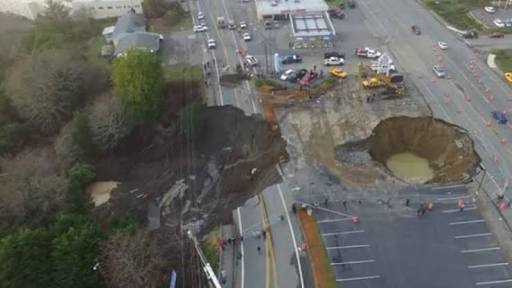
Let’s rewind to a small town. Harbor, Oregon. A quiet corner of the world where the biggest news is usually the weather. But in the winter of 2016, the weather fought back. Relentless rains, day after day, soaked the ground until it was heavy and weak. In December, the first sign appeared. A pit. A hole in a major road that seemed to come from nowhere. An inconvenience, they said. A problem to be managed.
They were wrong.
Just a few weeks later, the real event happened. The first hole was just an appetizer. The main course was a monster. The ground gave way with a sickening lurch, devouring an enormous section of the highway. This wasn’t a pothole. This was an 80-foot-wide chasm. A wound in the earth.
Theron Fox, a local restaurant manager, saw it happen. He described running out to see the road literally disappearing before his eyes. His business, his livelihood, cut off by an expanding abyss. Officials estimated it would take 65,000 cubic yards of material to “fix” it. Think about that. 65,000 cubic yards. That’s enough to fill nearly twenty Olympic-sized swimming pools. All of that solid ground, just gone.
Where did it go? That’s the question they never seem to answer properly.
The Official Story: A Bedtime Story of Water and Rock
Ask a geologist, and they’ll give you a calm, measured explanation. They’ll talk about “karst topography.” It’s a term for landscapes formed from the dissolution of soluble rocks. Rocks like limestone, dolomite, and gypsum. They’ll tell you that rainwater, slightly acidic, seeps into the ground. Over thousands, even millions of years, this water carves out underground rivers and vast caverns, creating a hidden, hollow world beneath the surface.
Think of the ground beneath your feet not as a solid block of rock, but as a slice of Swiss cheese. The surface is just a thin, fragile lid over a network of voids and tunnels.
Most of the time, this lid holds. But when it gets too heavy—saturated with rainwater from a storm like the one in Oregon—or when the underground support system erodes just a little too much… the lid breaks.
They have neat categories for it:
- Dissolution Sinkholes: The slow ones. Where there’s not much on top of the rock, and water just pools and slowly eats away at the surface, like sugar dissolving in coffee.
- Cover-Subsidence Sinkholes: The sneaky ones. Where sand and clay slowly trickle down into the caverns below, causing a gradual depression on the surface over time. You might not even notice it until your house starts to lean.
- Cover-Collapse Sinkholes: The terrifying ones. The ones that make the news. This is when the cavern below grows so large that the surface layer, the “cover,” can no longer support its own weight. It holds. It holds. And then, in an instant, it doesn’t. Catastrophic, total collapse. This is what happened in Oregon. This is the stuff of nightmares.
It’s a nice, clean explanation. It puts everything in a box. But does it really explain it all? Does it explain the terrifying perfection of some of these holes? The sheer violence of their appearance?

A Global Epidemic of Collapsing Ground
The Oregon incident was just a whisper. Around the world, the planet is screaming. These events aren’t isolated geological oddities; they’re happening everywhere, with increasing frequency and ferocity. Each one is a chilling postcard from the abyss.
Deep Dive: The Guatemala City Anomaly
Look at the pictures from Guatemala City in 2007, and again in 2010. These weren’t the messy, sloping collapses you see in a field. These were almost perfectly circular. Terrifyingly precise. They looked like a giant hole-punch had been driven through the city from below.
In 2010, a hole 65 feet across and 100 feet deep opened up in the middle of a city intersection, swallowing a three-story clothing factory. It didn’t just collapse; it was as if the building had been surgically removed from the universe. The official cause? A broken sewer pipe and tropical storm Agatha. A sewer pipe. Does that look like the work of a sewer pipe to you?
The sheer verticality of the walls is what gets you. It’s not a crater; it’s a shaft. A shaft leading… where? Internet forums exploded with theories. Was it a natural event exaggerated by failing infrastructure? Or was the infrastructure failure just the final trigger for something far more ancient and powerful lurking below?
Deep Dive: China’s “Heavenly Pit”
In China, they have the Xiaozhai Tiankeng, which translates to the “Heavenly Pit.” This is the world’s deepest sinkhole. It’s over 2,100 feet deep. You could drop the Eiffel Tower into it twice and still not see the top. It’s so vast that it has its own weather system inside. Clouds form halfway down. It contains a pristine forest with plant species found nowhere else on earth. A lost world, hidden from sight.
While this one is ancient, its existence proves the scale of the voids beneath our feet. If a cavern that massive can exist, what other “lost worlds” are we walking on top of every single day, completely unaware?
Beyond Geology: The Theories They Won’t Discuss
This is where we leave the sanitized world of textbooks and step into the shadows. When you look at the evidence—the increasing frequency, the strange symmetrical holes, the sheer terror of it all—you have to ask: is geology the full story? Or is it just the most convenient one?
Hollow Earth or Hidden Tunnels?
For centuries, people have spoken of Agartha, a legendary kingdom said to exist in the Earth’s core. A world of vast continents, strange suns, and advanced civilizations, accessible only through hidden portals at the poles or deep within the planet’s crust. It sounds like fantasy, right?
But then a perfectly circular shaft opens up in the middle of a city. A “Heavenly Pit” reveals a hidden world. Suddenly, the myths don’t seem so mythical. Could some of these sinkholes be failed portal openings? Or, more chillingly, collapses of tunnels leading to these inner-earth domains? Are we not just losing ground, but are the barriers between our world and another one getting thinner?
D.U.M.B.s and the Underground Network
Let’s get back to something a bit more terrestrial, but no less shocking. D.U.M.B.s. Deep Underground Military Bases. It’s an open secret in conspiracy circles that governments around the world have been building vast, city-sized complexes underground for decades. Bunkers, research labs, high-speed transit tunnels connecting them all. A secret world for the elite.
What happens when one of these secret construction projects goes wrong? What happens when a tunnel boring machine hits an unstable patch of geology? You get a collapse. A sudden, massive sinkhole on the surface. And what’s the perfect cover story? “Oh, it was just the heavy rain and some limestone.” It’s clean, simple, and requires no one to admit that a top-secret facility just caved in on itself miles below a town like Harbor, Oregon.
Is it a coincidence that so many sinkholes appear near areas of strategic importance or unusual seismic activity? The internet is filled with maps plotting sinkhole clusters against supposed D.U.M.B. locations. The overlaps are… interesting.
Are We Doing This to Ourselves?
Maybe the conspiracy isn’t about what’s below, but what we’re doing on top. Think about it. We are hammering our planet. Fracking injects high-pressure fluid deep into the earth, shattering rock formations that have been stable for eons. We’re over-extracting groundwater for agriculture and cities, literally draining the support structures from under our feet.
The official narrative blames a rainstorm. But maybe the rainstorm is just the straw that breaks the camel’s back. Maybe decades of corporate carelessness have weakened the ground to the point of collapse, and they’re happy to let Mother Nature take the blame. It’s the ultimate corporate cover-up: blame the planet for the damage you inflicted upon it.
Could You Be Living on the Edge of an Abyss?
This isn’t a problem for “somewhere else” anymore. Modern satellite mapping and ground-penetrating radar are revealing a terrifying truth: the voids are everywhere. Florida is a hotbed, basically a thin crust over a water-filled sponge. But huge karst regions exist all over the United States, Europe, and Asia.
What if a massive sinkhole opened under a skyscraper in New York? Or a nuclear power plant? The emergency planners have plans for earthquakes, hurricanes, and floods. Do they have a plan for the ground itself ceasing to exist?
It’s easy to dismiss this. To read it, feel a little chill, and then go about your day. But the ground beneath you feels a little different now, doesn’t it? A little less certain. A little less real.
The next time your house creaks in the night, or you see a new crack in the sidewalk, you’ll have to wonder. Is it just the house settling? Or is it something else? Is the abyss looking up at you?
The official story of rock and water is comforting. But the evidence suggests a far more complex and frightening picture. A world of hidden spaces, secret activities, and a planet groaning under the weight of our own actions. The question isn’t *if* the next great chunk of our world will be swallowed. The only question is *where*.
Originally posted 2016-03-14 21:04:23. Republished by Blog Post Promoter











