The Secret Under the Mountain: Is Cheyenne a Cold War Relic or Something More?
There are places on this planet that hum with a strange energy. Places shrouded in secrecy, whispered about in hushed tones, and buried deep within the Earth. And then there’s Cheyenne Mountain.
This isn’t just another military base. Forget what you think you know. This is a symbol. A legend. A hollowed-out granite god staring unflinchingly at the sky, waiting for the end of the world. It’s the stuff of nightmares and Hollywood blockbusters, a place where the line between defense and something far, far stranger gets blurry. For decades, it was the brain and central nervous system of a nation holding its breath, its finger hovering over the big red button.
But what is it now? A dusty relic? A tourist attraction for military buffs?
Or is that just what they want us to think?
The official story is impressive enough. But the official story is never the whole story. You and I know that. Let’s dig deeper. Let’s go past the blast doors and into the real mystery that lies in the granite heart of America.
The World on a Knife’s Edge: Why Build a Mountain Fortress?
To understand Cheyenne Mountain, you have to go back. Back to a time of primal fear. The 1950s. The Cold War wasn’t just cold; it was absolutely glacial. The United States and the Soviet Union stood toe-to-toe, two nuclear titans locked in a deadly staring contest. Schoolchildren practiced diving under their desks. Families built fallout shelters in their backyards. The air itself felt radioactive with tension.
The biggest fear? The “bolt from the blue.” A surprise attack. Soviet bombers appearing over the horizon, their bellies pregnant with atomic death. There was no warning, no defense, no hope.
Something had to be done.
In 1958, a joint U.S. and Canadian command was born: NORAD. The North American Aerospace Defense Command. Its job was simple, yet monumental: watch the skies. Be the continent’s unblinking eye, scanning for any threat, from a single bomber to a full-scale missile launch. Early NORAD was a collection of radar stations and command posts, but they all had a fatal flaw. They were exposed. Sitting ducks. A single well-placed nuke could decapitate the entire defense system, leaving the nation blind and helpless as the missiles rained down.
Finding the Granite Skull
The Pentagon needed a command center that could survive the unthinkable. A place that could take a direct nuclear hit and keep on ticking. A place where leaders could analyze an attack and coordinate a response, even as the world outside burned. They needed a fortress. An ark.
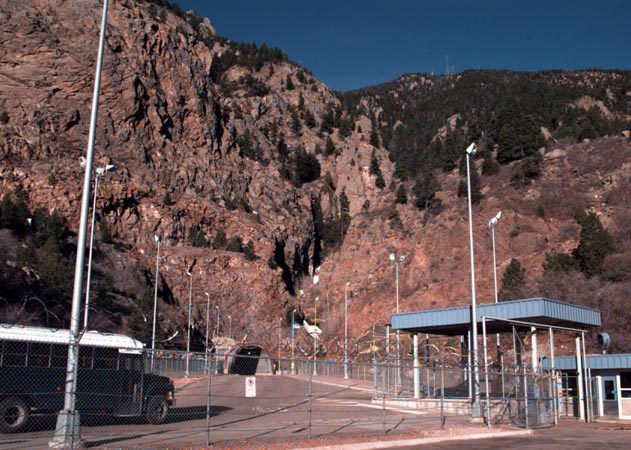
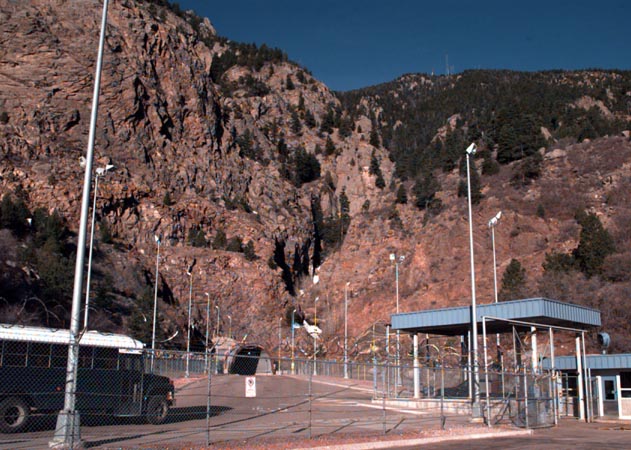
They searched the country for the perfect spot. They needed geology on their side. They needed granite—immense, ancient, unyielding granite. And they found it in Colorado, looming over Colorado Springs. Cheyenne Mountain. At over 9,500 feet, it was a solid slab of Pikes Peak granite, one of the hardest rocks on Earth. It was the perfect shield. A natural bomb shelter provided by Mother Nature herself.
The location was chosen. The plan was insane. They weren’t going to build *on* the mountain. They were going to build *inside* it.

Carving a Hole in Hell: An Engineering Marvel
Think about the challenge for a second. In the early 1960s, with the technology of the day, the U.S. Army Corps of Engineers was tasked with digging a city inside a solid mountain of granite.
It was a Herculean task.
They started by blasting a tunnel nearly a mile long, curving it specifically to deflect and dissipate the force of a nuclear blast wave. No straight shots for a fireball to travel down. Pure, brutal physics. Then, they hollowed out the core. Over 700,000 tons of granite were excavated and hauled away. Enough rock to build a skyscraper. They created a cavern so vast you could fit a multi-story building inside it.
And that’s exactly what they did.
A City on Springs
Here’s the part that bends your mind. The Cheyenne Mountain Complex isn’t part of the mountain. The fifteen buildings inside are completely separate structures. They are freestanding buildings made of steel, built inside the rock chambers, with a huge gap between their walls and the granite caverns.
Why? To survive an earthquake. Not a natural one. A man-made one, triggered by a multi-megaton bomb exploding overhead.
The entire complex—all fifteen buildings, weighing thousands of tons—sits on more than 1,300 massive, coiled steel springs. Each spring is about a yard tall. They are shock absorbers on a god-like scale. If a nuclear weapon struck the mountain, the granite would shake violently. The ground would heave. But inside, the entire city would gently sway and rock on its springs, its delicate electronics and human operators protected from the seismic fury. It’s a design of elegant, apocalyptic genius.
25 Tons of “Stay Out”
And then there are the doors. Oh, the doors.
The main entrance is guarded by a pair of blast doors that are the stuff of legend. Each one is over three feet thick and weighs 25 tons. They aren’t just slabs of steel; they are complex hydraulic machines. When the order is given, these behemoths swing shut and are sealed by massive steel locking pins, creating an airtight seal in less than 45 seconds. They don’t just close; they seal a tomb, protecting those inside from the blast, the heat, and the radioactive fallout. They are the final gatekeepers at the end of the world.
The Nerve Center of Armageddon
For decades, this underground city was the hottest piece of real estate in the entire military. This was NORAD’s command center. This was where teams of airmen and officers sat in the famous “war room,” staring at giant screens that showed a map of the world. They watched for missile launches, tracked unknown aircraft, and maintained a constant vigil.
It was designed to be completely self-sufficient. A sealed bottle against a poisoned world.
Think about what that means:
- Water: The complex has its own massive underground water reservoirs, literally man-made lakes carved from the rock, holding millions of gallons of fresh water.
- Power: Should outside power be cut (a certainty in an attack), a bank of six massive diesel generators, the size of locomotives, would roar to life, capable of powering the entire city for a month or longer. They have their own fuel reserves right there in the mountain.
- Air: A sophisticated filtration system could scrub the air of nuclear, biological, and chemical (NBC) agents. The air inside would be cleaner than anywhere on the planet.
- Food & Supplies: A cafeteria and stores could keep over a thousand personnel alive and functioning for at least 30 days, completely cut off from the outside world.
This wasn’t just a base. It was a lifeboat. A time capsule designed to outlive civilization itself.
The Stargate Connection: Hiding in Plain Sight?
For a generation of sci-fi fans, Cheyenne Mountain isn’t known for its blast doors or its Cold War history. It’s known for one thing: Stargate Command.
The hit TV show *Stargate SG-1* famously—and brilliantly—placed the headquarters of its top-secret alien-fighting program deep inside the real Cheyenne Mountain Complex. For ten seasons, audiences saw Colonel Jack O’Neill and his team walk through the same corridors, past the same blast doors, on their way to another galaxy.
The U.S. Air Force not only approved of this but actively participated. The show filmed on location at the base. Real Air Force generals made cameo appearances. It was an unprecedented level of cooperation. The official line was that it was great PR. A way to make the Air Force look cool and attract recruits.
But come on. We have to ask the question.
Was it *just* PR? Or was it the most brilliant piece of misdirection in human history? Hiding a fantastical truth in plain sight. Disguising a reality-shattering secret as a piece of popular fiction. Think about it. If you actually had a program for intergalactic travel, where would you hide it? You’d hide it in the most secure, most impenetrable, most famous bunker on Earth. And how would you keep it secret? You’d make a TV show about it, so if anyone ever leaked the truth, they’d be laughed out of the room. “Oh, you mean like that TV show? Right.”
It’s a tantalizing thought. A conspiracy theory so perfect it almost has to be true. Is the real Stargate on Level 28, just past the break room?
A Fortress in Twilight: Obsolete or Repurposed?
Here’s where the story takes a sharp turn, and the modern mystery begins. In 2006, the military announced that regular, day-to-day NORAD operations were being moved out of Cheyenne Mountain and relocated to the nearby Peterson Air Force Base.
The mountain, they said, would be placed on “warm standby.” A backup, in case it was ever needed.
The official reason made sense, on the surface. The Cold War was over. The primary threat was no longer a massive Soviet nuclear strike, but terrorism and cyberattacks. You don’t need a half-billion-dollar bunker to fight an enemy with a laptop or a box cutter. It was a cost-saving measure. A practical move for a modern world.
Or was it?
This is where the whispers start. The online forums light up. The alternative historians lean in. The “move” in 2006 could be the biggest smokescreen of all.
Theory 1: The Ultimate Black Site
What if they moved the *boring* stuff out to make room for the *really* secret stuff? With NORAD’s daily operations gone, the mountain became the perfect black site. A place where projects that technically don’t exist can operate in total secrecy. Reverse-engineered alien tech? Advanced energy weapon development? The Stargate program? Moving the public-facing NORAD out was the perfect cover to move something else in.
Theory 2: The EMP Shield
Perhaps the most compelling modern theory is that the mountain’s purpose has evolved. One of the biggest threats to the modern world is an EMP—an electromagnetic pulse. A single, high-altitude nuclear detonation could create an EMP blast that would fry every unprotected electronic circuit across the continent. No power grid. No cars. No computers. No phones. It would send us back to the Dark Ages in an instant.
But what’s the one thing that can shield electronics from an EMP? Thousands of feet of solid granite.
Cheyenne Mountain is, by its very nature, the ultimate EMP-proof vault. In 2015, the Pentagon quietly announced it was moving some of its most sensitive communications gear *back into* the mountain, specifically citing the EMP threat. They told us they were moving out, but now they’re moving back in? It suggests the mountain is not a relic at all. It’s our last line of defense against a silent, electronic apocalypse. The Peterson AFB “headquarters” might just be a decoy, while the real, hardened nerve center remains safe under the rock.
Theory 3: The Deep State Bunker
Let’s go darker. What if the mountain isn’t for the military anymore? What if it’s the ultimate continuity-of-government (COG) bunker? A panic room for the global elite. If a truly world-ending event were on the horizon—not war, but a supervolcano eruption, a catastrophic solar flare, a civilization-ending pandemic—where would the people *really* in charge go? Not to the well-known public bunkers. They’d go to the one place built to survive anything. The move of NORAD out of the mountain wasn’t a military decision; it was a handover. The facility has been quietly repurposed as an ark for a chosen few, waiting for the rest of us to be washed away.
What Lies Beneath?
So what is Cheyenne Mountain today? A Cold War museum on life support? A shield against a new kind of warfare? A secret gateway to the stars? Or an exclusive tomb for the powerful, waiting for the end?
The truth is, we don’t know. And that’s the point. The facility was designed from the ground up to be a black box, a mystery wrapped in an enigma and buried under a mountain. Its very existence is a testament to a level of paranoia and planning that is almost impossible to comprehend.
They built a city to survive the apocalypse. Maybe they’re still waiting for it. Or maybe, from deep inside that granite heart, they’re working on projects that will redefine what “apocalypse” even means. The one thing we know for sure is that the secrets of Cheyenne Mountain are buried deeper than any drill can reach.
Originally posted 2013-11-06 22:26:46. Republished by Blog Post Promoter
![Cheyenne-Mountain-Complex[1]](https://coolinterestingnews.com/wp-content/uploads/2013/11/cheyenne-mountain-complex1.webp)