October 4, 1957. A date etched in paranoia.
The world looked up, terrified. A 184-pound metal beach ball named Sputnik 1 was circling the planet, emitting a relentless, mocking beep-beep-beep. It wasn’t just a satellite. It was a signal flare. The Soviet Union had beaten the United States to the high ground. Panic ensued.
If they could put a radio transmitter over Washington D.C., what else could they drop? A nuclear warhead? A biological weapon?
That single aluminum sphere didn’t just start a scientific endeavor. It kicked off a war. A war for survival. The Space Race wasn’t about rocks or flags. It was about dominance. It was the ultimate contest of ideology, technology, and raw nerve.

We are told the sanitized version in schoolbooks. We see the smiling astronauts and the ticker-tape parades. But when you peel back the layers of history, the story gets darker. Weirder. More dangerous.
The Cold War’s Ultimate Battlefield
For decades, the United States and the Soviet Union stared each other down, fingers hovering over red buttons. But the real battles happened in the vacuum of space.
Missions like Venera 9 (which sent back the only photos we have from the hellish surface of Venus) and Cassini-Huygens changed everything we knew about our cosmic neighborhood. But before the international handshakes and the collaborative space stations of the 1990s, this was a bloodsport.
Think about the risks. These men were strapped to modified intercontinental ballistic missiles. They were riding explosions into the sky, guided by computers with less processing power than a modern musical greeting card. It was madness. Beautiful, calculated madness.
And then came the big one. The Moon.
Apollo 11: The One-Way Ticket That Came Back
1969. The year everything changed. Project Apollo wasn’t just a program; it was a desperate national mandate. President John F. Kennedy had thrown down the gauntlet in 1961, promising to land a man on the Moon and bring him back safely before the decade was out. It was an impossible deadline.
When Apollo 11 launched, the world held its breath. Literally.
We all know the quote. Neil Armstrong’s voice, crackling through the static of 240,000 miles of nothingness: “That’s one small step for man, one giant leap for mankind.”
It’s poetic. It’s perfect. But did you know President Nixon had a different speech ready?
In a secret contingency file, a speech titled “In Event of Moon Disaster” was prepared. It began: “Fate has ordained that the men who went to the moon to explore in peace will stay on the moon to rest in peace.”
That is how close to the razor’s edge they were. If the Lunar Module’s ascent engine had failed—even for a split second—Armstrong and Buzz Aldrin would have been stranded. They would have suffocated or starved while Michael Collins orbited above, helpless, forced to fly back to Earth alone. It’s a chilling “What If?” scenario that haunts historians.
The 600 Million Witnesses
An estimated 600 million people watched the grainy black-and-white feed. It was the largest television event in history. For a brief moment, humanity wasn’t divided by borders or iron curtains. We were just a species, looking at a reflection of ourselves on a desolate grey rock.
But the conspiracy theorists haven’t slept in 50 years. Why? Because the footage was too perfect? Or perhaps because it was too degraded?
Rumors still swirl today. Why are there no stars in the photos? Who filmed Armstrong coming down the ladder? (Answer: A deployable camera arm, but the skeptics aren’t convinced). What about the “missing tapes”? NASA admitted to erasing the original magnetic telemetry tapes during a budget shortage in the 80s. A clerical error? or a cover-up?
Regardless of the whispers, Armstrong, Aldrin, and Collins splashed down in the Pacific Ocean, heroes. They had done the impossible. They fulfilled Kennedy’s pledge. But the story didn’t end there. In fact, it got stranger.
Apollo 12: The Lightning Strike and the Mystery Bacteria
November 1969. America was still high on the success of Apollo 11. But Apollo 12 almost ended in catastrophe before it even left the atmosphere.
36 seconds after liftoff, lightning struck the Saturn V rocket. Then it happened again at 52 seconds. The entire electrical system in the Command Module went dead. Instruments scrambled. The crew was flying blind on top of a controlled explosion.
Mission Control was paralyzed. But a young engineer named John Aaron remembered an obscure telemetry pattern from a simulation a year prior. He made the call: “Try SCE to Aux.”
Nobody knew what that meant. Except astronaut Alan Bean. He flipped the switch. Power was restored. The mission was saved.

The Pinpoint Landing
Apollo 12 wasn’t just about getting there; it was about precision. Apollo 11 had drifted miles off course. Apollo 12 wanted to prove they could park a spaceship on a dime.
Commanded by Pete Conrad, with Alan Bean and Richard Gordon, the mission targeted the “Ocean of Storms.” Their goal? To find a robot.
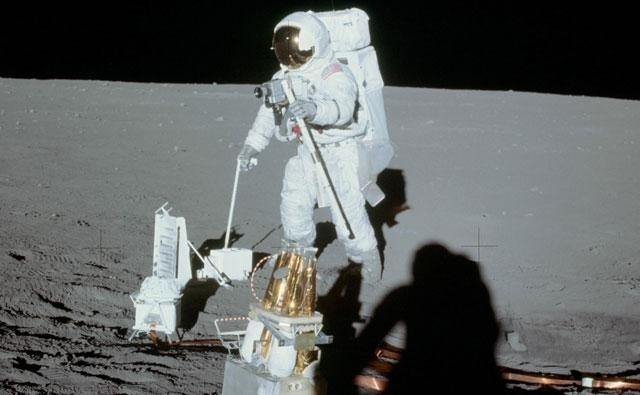
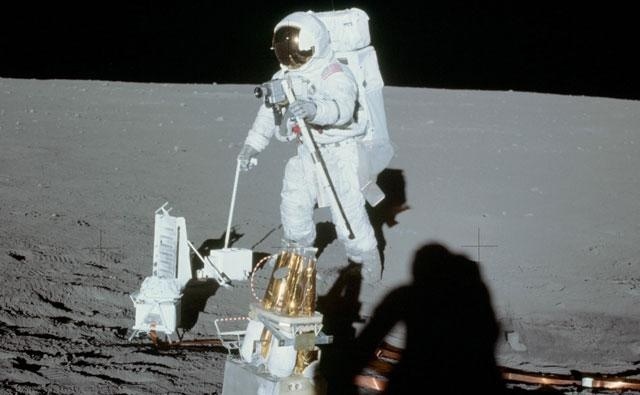
The Surveyor 3 probe had been sitting on the Moon since 1967. Conrad and Bean pulled off a miracle of navigation, landing their Lunar Module, the Intrepid, just 600 feet away from the dead probe. It was like throwing a dart from New York and hitting a bullseye in London.
The Alien Contamination Theory
Here is where it gets weird. The astronauts walked over to Surveyor 3. They cut off pieces of the probe, including the camera, to bring back to Earth. NASA scientists wanted to see how materials held up after two years of exposure to the brutal radiation and vacuum of space.
When they analyzed the camera back on Earth, they found something impossible.
Streptococcus mitis. Common bacteria. Alive.
Inside the camera insulation, bacteria from Earth had apparently survived two years on the Moon. Or so the story goes. This sparked a massive debate. Did life survive the vacuum? Or did the technicians back on Earth accidentally sneeze on the sample after it returned?
If the bacteria really survived the Moon, it changes everything we know about the resilience of life. It supports the theory of Panspermia—the idea that life can hitchhike on comets and debris between planets. Did we accidentally seed the Moon with life in 1967?
Apollo 13: The “Successful Failure”
By 1970, the public was getting bored. Walking on the Moon seemed routine. Easy, even. Apollo 13 changed that.
Commanded by Jim Lovell, with Jack Swigert and Fred Haise, the mission was intended to land on the Fra Mauro highlands. But 200,000 miles from Earth, a routine stir of the oxygen tanks turned into a nightmare.
BOOM.
“Houston, we’ve had a problem.”
An oxygen tank had exploded, blowing out the side of the Service Module. It crippled the main ship. They were losing oxygen. They were losing power. And they were venting their life support into the black void of space.
The Moon landing was off. Now, it was a rescue mission.
The Lifeboat Strategy
The crew had to abandon the Command Module (Odyssey) and retreat into the Lunar Module (Aquarius). The Aquarius was designed to hold two men for two days. Now it had to keep three men alive for four days.
It was freezing. The temperature dropped to near zero. They couldn’t run heaters because they needed to save every amp of battery power for re-entry. Condensation dripped from the walls. They were dehydrated, sleep-deprived, and floating in a tin can that was slowly filling with carbon dioxide.
The CO2 scrubbers in the Lunar Module didn’t fit the canisters from the Command Module. It was a square peg in a round hole problem—literally. Ground control had to invent a way to build an adapter using only what was on the ship: plastic bags, cardboard, and duct tape.
The Radio Blackout
The re-entry was the final terror. Because the explosion had damaged the heat shield (potentially), nobody knew if the ship would survive hitting the atmosphere at 25,000 miles per hour.
Usually, the radio blackout during re-entry lasts three minutes. For Apollo 13, it lasted nearly six. Six minutes of static. Six minutes where the world assumed they were dead, burned to ash in the upper atmosphere.
When the parachutes finally bloomed on the screens, Mission Control erupted. Grown men wept. It was a triumph of ingenuity over disaster.
The Great Mystery: Why Did We Stop?
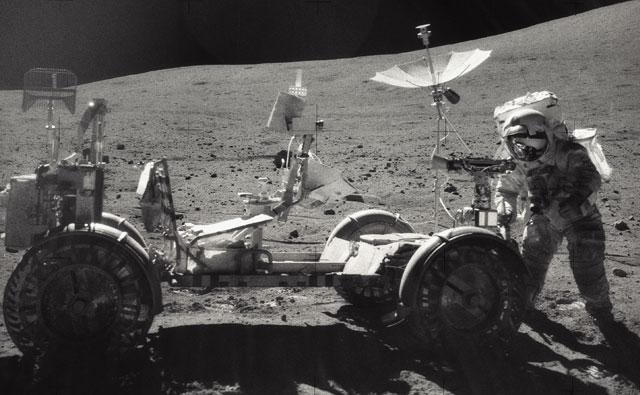
After Apollo 13, there were four more successful landings (Apollo 14, 15, 16, and 17). We drove cars (Rovers) on the Moon. We played golf. We collected hundreds of pounds of rocks.
And then, in December 1972, Gene Cernan climbed back into the Lunar Module, leaving the last bootprint in the dust. We haven’t been back since.
Why?
Technically, it was budget cuts. The Vietnam War was draining the US treasury. The public lost interest. But does that really make sense?
Computing power has exploded. Materials science has advanced light-years. We carry more technology in our pockets than the entire Apollo program possessed. Yet, for 50 years, Low Earth Orbit has been our ceiling.
The Conspiracy Theories Persist
Some internet sleuths argue we were “warned off.” They point to strange transcripts, sightings of unidentified lights near the craters, and the sudden cancellation of Apollo 18, 19, and 20. Did the astronauts see something they weren’t supposed to? Structures? Mining operations? Other ships?
Others argue the Van Allen Radiation Belts are actually impassable without lethal doses of radiation, and that we barely lucked out the first time (or faked it to avoid the risk).
Or perhaps the answer is more mundane but equally depressing: We lost our nerve. We became a risk-averse society, unwilling to trade blood for progress.
The New Space Race
Today, the silence is breaking. Private companies and new superpowers are eyeing the lunar surface again. China has landed rovers on the “Dark Side” (the far side) of the Moon. The Artemis program aims to put humans back on the surface soon.
But the legacy of those early days remains. It was a time of cowboys and slide rules. A time when three men would climb into a capsule, not knowing if they were explorers or martyrs.
Look up at the Moon tonight. Really look at it. It’s not just a rock. It’s a graveyard of ambitions, a museum of 1960s technology, and perhaps, the keeper of secrets we are only just beginning to understand again.
Originally posted 2013-05-26 19:07:02. Republished by Blog Post Promoter
![20130526-210535[1]](https://coolinterestingnews.com/wp-content/uploads/2013/05/20130526-2105351.webp)