The Global Cover-Up: Why Are These Places Blacked Out on Google Maps?
Ever feel like you’re being watched? Of course you have. In our hyper-connected world, it’s a given. Cameras on every corner, satellites in the sky, a GPS tracker in your pocket.
But what if the opposite is true?
What if someone, somewhere, is actively stopping you from watching them?
Open up Google Maps or Google Earth. It feels like magic, doesn’t it? A god-like view of our entire planet, from the highest mountain peaks to your own backyard. You can zoom in on the pyramids, trace the Amazon river, or check the traffic on your morning commute. The whole world is at your fingertips. Almost.
Because there are places you’re not allowed to see. Digital black holes. Scars on the satellite’s eye. Vast patches of the Earth that have been deliberately blurred, pixelated, or simply blacked out entirely. These aren’t glitches. They are intentional acts of digital censorship. And when you start asking why, you fall down a rabbit hole so deep you might never see daylight again.
Governments will tell you it’s for “national security.” A simple, boring explanation. But is it the truth? When you see what they’re hiding, you’ll find that simple, boring answers just don’t cut it. Not even close. Let’s take a trip to the dark spots on the map.
The Star-Gazer’s Secret: Europe’s Strangest Smudge
Our first stop is in Noordwijk, Netherlands. It’s the home of the European Space Research and Technology Centre (ESTEC). This is the technical heart of the European Space Agency (ESA). The brain trust. It’s where they design missions to Mars, build billion-dollar satellites, and test technology that will define our future in space. It’s a place of science and wonder.
It even has a visitor’s center. You can literally buy a ticket and walk right in. They want the public to come and see their work.
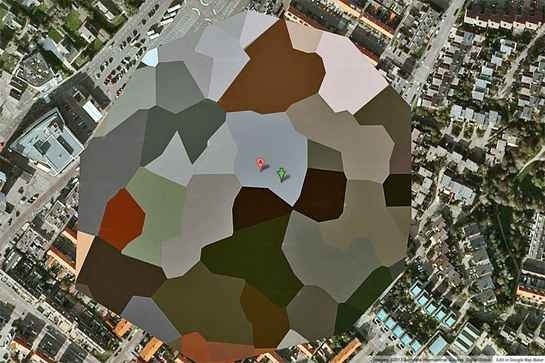
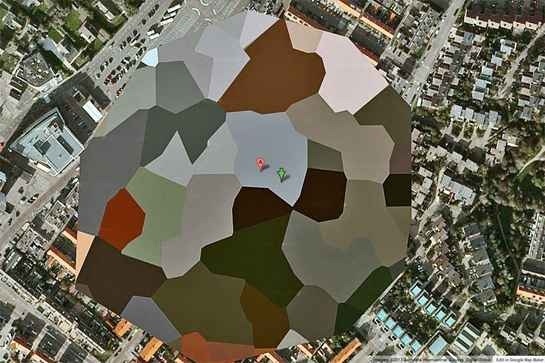
So why, then, does it look like this from above?

A bizarre, low-resolution, heavily pixelated mess. It’s a jarring digital wound on an otherwise pristine landscape. The surrounding farms and houses are crystal clear. You can count the trees in your neighbor’s yard. But the one place dedicated to looking out at the cosmos is a place we’re not allowed to look at from above.
Why? What could they possibly be hiding at a facility that has a public-facing PR department? The official line is often that satellite imagery gets updated at different times, and this is just an old, low-quality picture. A simple lag in the system.
Does that feel right to you? For one of the most advanced technology centers on the planet?
Deep Dive: What’s Really Under the Pixels at ESTEC?
Let’s think about this. ESTEC is where the ESA’s most sensitive projects are born. We’re talking next-generation propulsion systems. Cutting-edge satellite surveillance tech. Maybe even projects that aren’t on the public record. Is it possible they’re testing a new type of spacecraft in the open, and they’d rather not have rival agencies—or us—getting a sneak peek before it’s announced?
The theories get wilder from there. For years, insiders and whistleblowers have hinted that major world space agencies are in possession of technology not of this world. Reverse-engineered craft. Materials that defy our known physics. If you were tinkering with something that didn’t come from Earth, would you want a high-definition Google satellite snapping photos of it while you wheeled it from one hangar to another? Probably not.
The pixelation isn’t a wall; it’s a curtain. And it begs the question: what’s the show they don’t want us to see?
The Beacon in the Barrens: A Black Bar in the Arctic
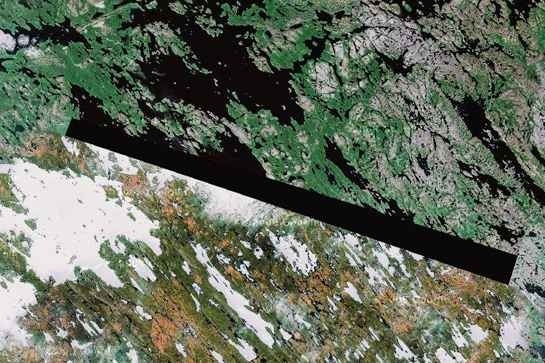
Fly north with me. Way north. To the remote, frozen tundra of the Canadian Arctic. We’re heading to Baker Lake, a hamlet in the Nunavut territory. It’s a vast, sparsely populated region, home to the Inuit people and more caribou than humans. It’s one of the last truly wild places on Earth.
And it’s home to this.

A massive, solid black rectangle. A void. Not a blur, not a smudge, but a complete and total redaction. It’s so jarring and unnatural it looks like someone took a giant marker to the map of the world. For years, this black bar fueled intense speculation across the internet.
What could it be hiding?
A man named Dr. Richard Boylan, a controversial figure in the UFO research community, put forth a mind-bending theory. He claimed that this black bar, and others like it found in remote locations around the globe, were placed to conceal extraterrestrial beacons. Beacons, he says, that are placed on Earth by alien visitors to help them navigate our planet. He believes these are powerful energy sources, and our governments know all about them, hiding them in plain sight with these crude digital cover-ups.
Deep Dive: Secret Base or Alien Lighthouse?
Is it an alien beacon? It’s a wild thought. But in a place this remote, anything feels possible. The area is rich in uranium deposits, a fact that has brought mining companies and government interest to this otherwise isolated land. Some researchers have suggested the black bar could be hiding a secret mining operation or even a storage facility for nuclear materials.
Others point to the region’s strategic importance. Northern Canada forms a line of defense for North America, dotted with Cold War-era radar installations and Distant Early Warning (DEW) Line sites. Could this black bar be concealing a new, top-secret military installation? A listening post? A drone base? Hiding a base in a location few people will ever visit makes perfect sense.
Interestingly, in recent years, some satellite views of this specific location have been “updated,” and the black bar is gone. Was the secret moved? Or was the censorship deemed no longer necessary? Or maybe, just maybe, it was a simple mapping glitch all along. But for a glitch, it looked awfully deliberate. The mystery of the Baker Lake black bar may be officially “solved,” but the questions it raised still linger in the cold arctic air.
The Siberian Void: Russia’s Phantom Zone
If you think a black bar in Canada is strange, travel across the globe to the endless, frozen expanse of the Siberian tundra in Russia. This is a land of secrets. A place where entire cities were once kept off maps, where exiles vanished, and where the full might of the Soviet military machine was hidden from Western eyes. It seems some things never change.
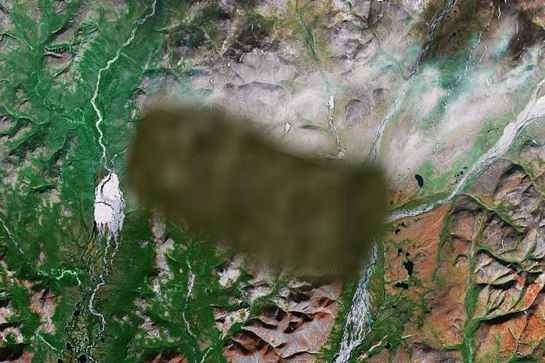
Behold, one of the most baffling images on Google Earth.

What… even is that? It’s not a blur. It’s not a black box. It looks like a huge chunk of the landscape has been crudely copied and pasted from another area, creating a nonsensical swirl of terrain that blends horribly with its surroundings. It’s digital camouflage at its most clumsy and most obvious.
The location is deep in the Chukotka Autonomous Okrug, right across the Bering Strait from Alaska. This is a place so remote and inhospitable that almost no one has a clear idea of what’s there. And that’s what makes the cover-up so terrifying.
Deep Dive: Russia’s Secret in the Slush
The speculation here is off the charts. Some online sleuths on forums like Siberian Light pointed out the obvious military angle. Given its proximity to the US, this would be a prime location for a radar station, a missile launch site, or an interceptor base for Russia’s strategic defense. That’s the logical guess.
But the way it’s hidden feels… different. The copy-paste job is bizarrely unsophisticated, as if it was done in a hurry. This has led to darker theories. Could it be the site of a massive environmental disaster? A secret nuclear waste dump? The location of a weapons test gone wrong that has poisoned the land? Covering up something you’re building is one thing; covering up something you’ve broken is another thing entirely.
And then there’s the ultimate Russian conspiracy: the secret cities. During the Soviet era, dozens of “closed cities” existed that were completely secret, housing weapons facilities or research centers. They had code names and didn’t appear on any official maps. Is it possible that in the vastness of Siberia, one such city still exists, hidden from the prying eyes of the 21st century by a crude Photoshop job?
One thing is for certain: whatever is under that digital smudge, the Russian Federation does not want you to see it.
HAARP: The Alaskan Sky-Heater and Its Digital Fog
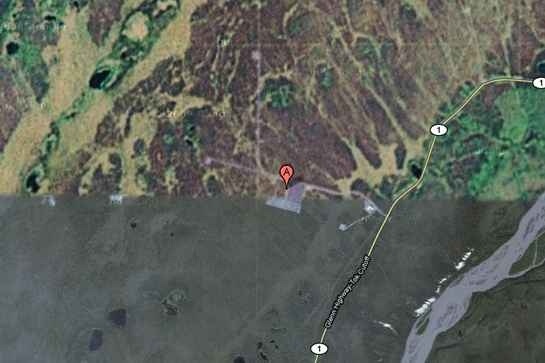
Finally, we return to American soil. To a remote patch of wilderness near Gakona, Alaska. Here, a strange forest of antennas rises from the ground, pointing at the sky. This is the High-Frequency Active Auroral Research Program. HAARP.
Even the name sounds like something from a science fiction movie. And for decades, this facility has been at the absolute center of some of the most persistent and popular conspiracy theories on the planet.
And, surprise surprise, the facility has often been heavily obscured on public satellite maps.

The official purpose of HAARP is to study the ionosphere, the upper, charged part of our atmosphere. Scientists use its powerful array of 180 antennas to excite a small section of the ionosphere and observe the results. They say it’s for improving communication and navigation technology.
But many people don’t buy that for a second.
Deep Dive: Weather Weapon or Benign Research?
The theories surrounding HAARP are legendary. The most famous is that it’s a weather control device. Theorists claim that by heating the ionosphere, the US military can steer jet streams, creating floods in one country and droughts in another. Some have blamed HAARP for everything from Hurricane Katrina to the 2011 earthquake and tsunami in Japan.
Is there any proof? Very little. But the facility’s secrecy and its powerful capabilities have always stoked the fires of suspicion. Other theories suggest it’s a massive mind-control device, capable of broadcasting frequencies that can influence human thought and emotion. Or perhaps it’s an over-the-horizon super-weapon, able to disable satellites or even trigger earthquakes by beaming energy into fault lines.
In 2014, the U.S. Air Force officially shut down the project and handed ownership over to the University of Alaska Fairbanks. They now host open houses, trying to dispel the myths. But for the conspiracy-minded, this is just a new layer of cover. Did the project really end? Or did it just go deeper underground, with the university providing the perfect public cover for a project that is now more secret than ever?
When you see the site digitally fogged over, it’s hard to believe it’s just a simple university research station.
You Are Not Cleared for Access
These four locations are just the tip of the iceberg. The more you look, the more you find. There’s Volkel Air Base in the Netherlands, where a Dutch prime minister accidentally admitted US nuclear weapons are stored—the base is a pixelated mess on Google Maps. There are huge swaths of the Faroe Islands, a remote Danish territory, that are inexplicably blurred out. Why?
There’s the Moruroa Atoll in French Polynesia, site of over 170 nuclear weapons tests. Entire islands are just… gone from the map. And countless military bases, power plants, and government buildings across the world are given the same treatment.
So what’s the real story here? Is it as simple as governments asking Google to please hide their sensitive military sites? Or is every blur and black box a breadcrumb? A clue to a secret world operating just behind the curtain of our own.
The map is not the territory, they say. But what if the map is a lie? What if the empty spaces are actually the most important places of all? The world is full of secrets. And sometimes, you can find them by looking for the holes.
Go ahead. Start exploring. And let us know what you find.