Home Weird World Space Satellite sent into space to monitor blind zone – for aliens?

Satellite sent into space to monitor blind zone – for aliens?

0
54

The Billion-Dollar Eye Pointed at Our Sun: Are They Hunting Asteroids or Hiding Something Else?

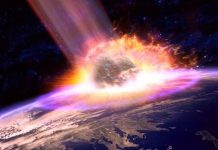
Look at that picture. Really look at it.

It’s the stuff of nightmares, isn’t it? A silent, world-ending rock hurtling out of the black. No sound. No warning. Just a fiery final act for all of us. The powers that be tell us this is exactly what they’re trying to prevent. They tell us that’s why they spent nearly a billion dollars to launch a super-advanced space telescope.

They call it Gaia.

The official story is clean, sensible, and just scary enough to make you nod along. But when you start pulling at the threads, when you ask the questions no one is supposed to ask, a very different picture begins to form. A picture far stranger, and perhaps far more terrifying, than a simple asteroid.

So, what is this billion-dollar project really for?

The Official Story: A Shield Against Silent Killers

Let’s start with the story they want you to believe. It’s a good one. It makes perfect sense.

Space is a shooting gallery, and Earth is the target. We’re constantly being pelted by rocks, big and small. Most burn up harmlessly in our atmosphere, beautiful shooting stars on a summer night. But some don’t.

Some get through.

Remember February 2013? The people of Chelyabinsk, Russia, certainly do. Without a single peep from any of our advanced warning systems, a 20-meter asteroid traveling at over 40,000 miles per hour slammed into the sky. It exploded with the force of 30 Hiroshima bombs. The shockwave blew out windows across the city, injuring over 1,500 people. The flash was so bright it temporarily blinded people and left behind skin burns. And the scariest part?

Nobody saw it coming. Not a soul.

Why? Because it came from the one direction we can’t easily look. It came from the sun.

Welcome to the Kill Zone

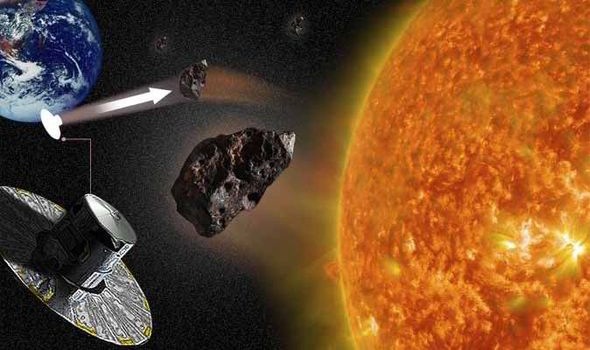
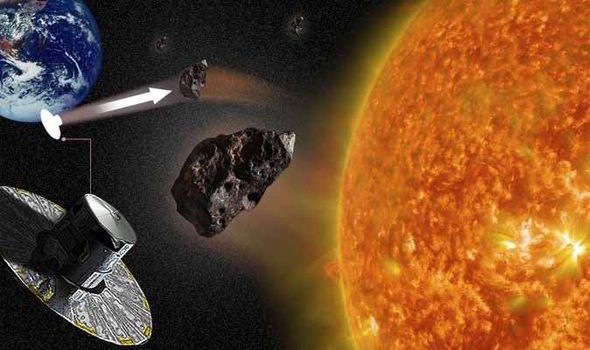
Imagine trying to spot a tiny, dark rock while someone is shining a billion-watt searchlight directly in your eyes. That’s the problem astronomers face. The immense glare and radiation from our own sun create a massive “blind zone” in our sky. We can scan the dark of deep space for threats, but if something is coming at us from the direction of the sun, it’s effectively invisible. A cosmic ghost.

The Chelyabinsk meteor rode this solar superhighway straight to our doorstep. It was a wake-up call. A shot across the bow.

Enter the European Space Agency (ESA) and their shiny, expensive solution: the Gaia Space Telescope. Launched in late 2013, this £800 million (over $1 billion in US dollars) marvel was presented as our planetary bodyguard. Its key task, they said, was to park itself in a special spot in space where it could stare into that blind zone. It would monitor the space between Earth and the sun, hunting for these hidden killers and giving us the precious warning we need to do… something.

As a bonus, a kind of side-hustle for this billion-dollar scope, Gaia would also spend its five-year mission mapping a billion stars. A billion of them. It would measure their positions and movements with unbelievable precision, creating the first truly accurate 3D map of our Milky Way galaxy. A lovely scientific goal. A noble pursuit of knowledge.

And the perfect cover story.

Does the Story *Really* Add Up?

A billion dollars is a staggering amount of money. Is protecting us from a Chelyabinsk-level event—which, while damaging, wasn’t an extinction-level crisis—worth that price tag? Governments don’t typically spend that kind of cash on “insurance policies” unless the threat is far more certain, and far more serious, than they’re letting on.

This is where the questions start. The whispers in the dark corners of the internet. The anomalies that just don’t fit.

When a government project has two goals, one is for the public and one is for them. The 3D star map? That’s for the press releases, the university textbooks, the feel-good science documentaries. It’s brilliant. It’s real. It produces verifiable data that keeps everyone happy and distracted.

But what if the *real* mission is also using that same advanced technology to look for something else? Something they don’t want to tell us about. Something hiding in the sun’s glare that isn’t just a random chunk of rock.

20131028-214656.webp

Deep Dive: The Sun’s Forbidden Secrets

Once you start looking, you realize the sun’s blind spot could be hiding just about anything. For decades, we’ve only been able to get fleeting, blurry glimpses into this region. Now, we have a billion-dollar, high-definition eye pointed right at it, 24/7. So what could it be looking for? The theories that bubble up from the research community and online forums are mind-bending.

Theory 1: The Sun Cruiser Phenomenon

Have you ever seen the images from SOHO? The Solar and Heliospheric Observatory is another satellite that watches the sun, and for years, anomaly hunters have been flagging utterly bizarre objects in its photos. These aren’t specks or camera glitches. They are massive, sometimes planet-sized objects that appear to be interacting with our star.

They’re often geometric. Some look like vast, winged craft. Others appear as perfect spheres siphoning plasma directly from the sun’s surface, as if they’re refueling. The internet calls them “Sun Cruisers.”

Official explanations are always the same. “Camera artifact.” “Cosmic ray.” “Pixel burnout.”

But what if they’re not? What if our sun is a galactic hub, a cosmic gas station for entities we can’t even comprehend? If these objects are real, they are operating on a scale of technology that is godlike to us. They treat the surface of the sun—a place that would vaporize our most advanced probes in an instant—like a swimming pool.

Is Gaia’s true purpose to get a crystal-clear, high-resolution look at these things? Is it designed to monitor their traffic, to figure out who they are, where they’re from, and—the most chilling question of all—what they want?

The asteroid defense system is the perfect public excuse to build a U.F.O. hunter and point it directly at their base of operations.

Theory 2: Planet X and the Nemesis Star

This is one of the oldest and most persistent “alternative history” theories out there. The idea is that our solar system isn’t alone. That we have a hidden neighbor. The theory comes in two main flavors.

  • Planet X/Nibiru: A large, undiscovered planet on a huge, elliptical orbit that stretches far beyond Pluto. Every few thousand years, its orbit brings it swinging back through the inner solar system, causing chaos, gravitational disruption, and untold destruction on Earth. Ancient myths of great floods and cosmic battles, the story goes, are actually historical records of its last pass.
  • Nemesis: The theory that our sun is part of a binary star system. Its partner is a small, dim “brown dwarf” star named Nemesis. This companion star is also on a massive orbit that, every 26 million years or so, passes through the Oort cloud—the vast shell of comets at the edge of our system—sending a shower of death-dealing comets and asteroids hurtling towards Earth. Scientists have even noted that mass extinctions on Earth seem to happen on a cyclical, 26-million-year schedule. Coincidence?

In both scenarios, this massive, system-disrupting object would spend most of its approach hidden. And the best place to hide would be… you guessed it. In the glare of the sun.

Is Gaia’s “star-mapping” mission a cover for its real objective: to pinpoint the exact location and trajectory of an incoming world? Finding an asteroid is one thing. Announcing that a planet-sized object is on its way would cause a global panic that would tear civilization apart. Better to look for it in secret. Better to have a plausible, public-facing mission to explain why you’re building the most precise stellar observation tool in human history.

Theory 3: The Breakaway Civilization’s Secret Outpost

This theory is perhaps the wildest, but it has a strange internal logic. What if the thing we’re looking for isn’t alien and isn’t natural? What if it’s… ours?

The “Breakaway Civilization” theory suggests that a secret, shadow version of humanity has existed alongside us for decades. Fueled by recovered crash technology and black-budget projects, this group is generations ahead of us in science and engineering. They have space travel we can only dream of. They have energy sources that would make fossil fuels obsolete.

They operate in secret, in space, and they view the rest of us on the surface as a kind of primitive nature preserve.

Where would such a civilization put its most important assets? Where would you build a massive command center, a weapon platform, or a shipyard, far from the prying eyes of the public and rival nations? You’d put it in the one place no one can easily look. You’d park it in a stable orbit, hidden by the sun.

From this vantage point, you could observe everything on Earth. You could monitor all space traffic. You would be the king of the solar system. In this scenario, Gaia has a very different job. It’s not a shield. It’s a spyglass. Was it built by the “mainstream” space programs like ESA to try and get a look at what the breakaway group is doing? Is it an attempt to re-establish contact? Or is it a military tool, a targeting system for a conflict we on the surface know nothing about?

Untangling the Threads of a Cosmic Mystery

So, we have the official story: a benevolent shield against rocks from the sky. And we have the alternatives: a U.F.O. watchtower, a doomsday detector, or a spy camera for a secret space war.

How do we sort it out?

The advocates for the official story have a very strong point. Since its launch, Gaia has released incredible amounts of data. Its star maps are revolutionizing astronomy. We now know the precise locations and movements of nearly 2 billion stars. That’s not a lie. It’s a demonstrable fact. They are doing exactly what they said they would do.

But that’s the genius of a perfect cover.

The sheer volume of information Gaia produces is an ocean of data so vast it’s almost incomprehensible. Hiding a second, classified mission inside that data flow would be trivial. The telescope points where it’s told. The data streams back. 99.9% of that data—the star maps—is released to the public. But a tiny, critical 0.1% is routed to a different server. To a different set of eyes. The eyes that are *really* looking.

Nobody would ever know. The public gets its pretty star maps, the astronomers are happy, and the secret keepers get their prize.

But What If the Simplest Answer Is the Truth?

Let’s take a step back from the shadows for a moment. Let’s imagine there is no conspiracy. No aliens, no Planet X, no secret space fleet.

There is just us. On a fragile blue marble, in the middle of a cosmic shooting gallery.

The 2013 Chelyabinsk event was a firecracker. The 1908 Tunguska event, another airburst over Siberia, was a bomb, flattening 800 square miles of forest with the force of a hydrogen weapon. The asteroid that wiped out the dinosaurs 66 million years ago was a mountain hitting the planet at 50 times the speed of a rifle bullet. It ended a world.

These things are not theories. They are history. They happened. And it will happen again. It’s not a question of *if*, but *when*.

Viewed through that lens, is a billion dollars really that much to spend? Is it an outrageous expense, or is it the most sensible insurance policy humanity has ever bought? Maybe, just maybe, they’re telling the truth. Maybe Gaia is nothing more and nothing less than a sentinel. A silent guardian watching over us from the dark, looking for the monsters that might emerge from the light.

It’s a comforting thought.

But the questions linger. The shadows in the SOHO photos persist. The strange math of ancient extinction cycles remains unsolved.

The Gaia telescope is up there, right now, executing its mission with unparalleled precision. It is watching. But what it is *really* looking for is a secret that may determine the future of us all.

Originally posted 2013-10-28 20:49:53. Republished by Blog Post Promoter