Pluto’s Dark Secret: The Four Unexplained “Holes” NASA Can’t Ignore
Forget everything you thought you knew about the cold, dead edge of our solar system. Forget the dusty textbooks that called Pluto a simple ball of ice. Something is out there. Something strange. And for years, a set of chilling images captured by a lone probe three billion miles from home has been fueling a quiet, persistent mystery that official science seems all too eager to forget.
We’re talking about four enormous, impossibly regular dark spots. A quartet of shadows, marching in a perfect line across the surface of a world we’ve only just begun to understand.
Are they natural formations?
A trick of the light?
Or are we staring at something else entirely? Something that hints at a history, or a presence, that could change our place in the universe forever.
The Billion-Mile Stare: What Did New Horizons Really See?
The year was 2015. After a journey of nearly a decade, NASA’s New Horizons spacecraft, a grand-piano-sized probe traveling faster than a speeding bullet, was finally making its historic flyby of Pluto. It was a moment of triumph for humanity. Our first-ever close-up look at the distant, frozen world. The pictures that came back were breathtaking. Towering mountains of water ice. Vast, nitrogen glaciers. A thin, hazy atmosphere.
Pluto was alive. Geologically, at least.
But then, another set of images came through. And the mood shifted from celebration to bewilderment.
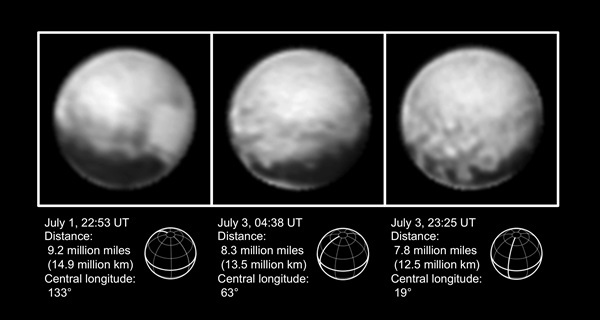
On the side of Pluto that perpetually faces its largest moon, Charon—a tidally locked dance in the dark—the probe’s cameras spotted them. Four colossal dark patches. All roughly the same size. All spaced with an unnerving, almost mathematical precision.
They weren’t random splotches like you see on our own Moon. They looked… intentional.
NASA’s own scientists were immediately stumped. In a press release from the time, the agency couldn’t hide its confusion. “Three billion miles from Earth and just two and a half million miles from Pluto, NASA’s New Horizons spacecraft has taken its best image of four dark spots that continue to captivate,” they wrote. The word “captivate” feels like an understatement. “Baffle” might be more accurate.
The regularity was the sticking point. Nature can be chaotic and beautiful, but it’s rarely so neat. “It’s weird that they’re spaced so regularly,” admitted New Horizons program scientist Curt Niebur, a man not prone to casual speculation. That single, candid admission spoke volumes. This wasn’t normal.
A Deep Dive: The One-Shot Flyby
To understand why this mystery remains frozen in time, you have to understand the New Horizons mission itself. It wasn’t an orbiter. It couldn’t slow down and hang around Pluto for a scenic tour. To get there in a reasonable timeframe (nine and a half years!), the probe had to be shot out of Earth’s gravity at an incredible velocity. It screamed past Pluto at over 36,000 miles per hour.
Think about that. Thirty-six thousand miles per hour.
This meant NASA had one chance—and one chance only—to get it right. The entire flyby, the period of closest approach where the best data could be gathered, lasted only a few hours. The spacecraft was a blur of pre-programmed activity, its cameras and sensors swiveling madly to capture as much as possible as it zipped past.
And here’s the kicker. The most detailed, high-resolution images were planned for the side of Pluto visible during that closest approach. The four mysterious spots? They were on the *other side*. The side that was turning away from the spacecraft as it arrived. The side that always faces its moon, Charon.
Alan Stern, the mission’s principal investigator, called the image we have “the last, best look that anyone will have of Pluto’s far side for decades to come.”
Decades. A perfect cosmic alibi. We found something strange, but by a cruel twist of orbital mechanics, we flew right by before we could get a better look. It’s almost too convenient, isn’t it?
Analyzing the Anomaly: What in the World ARE Those Spots?
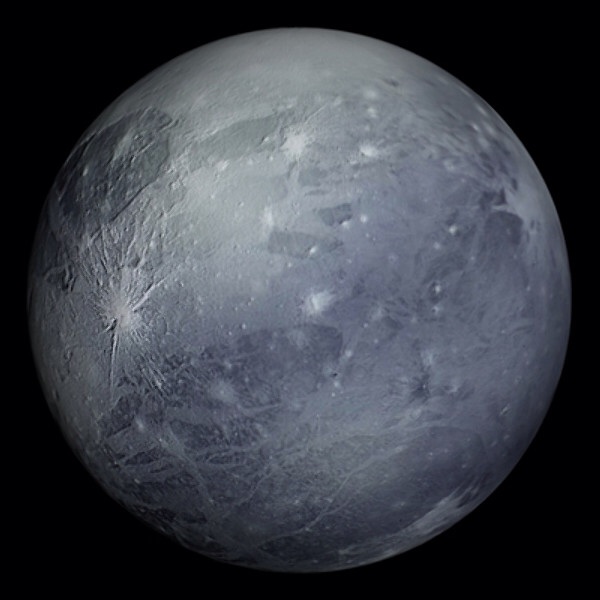
The spots themselves are massive. Each one is estimated to be about 300 miles across. For perspective, that’s roughly the size of the state of Missouri. Imagine four Missouris, painted black and placed in a perfect row. That’s what we’re dealing with. They are part of a larger, darker band that circles Pluto’s equator, but these four stand out because of their distinct, semi-circular shapes and, of course, their spacing.
Over the years, scientists have offered up a few potential—and frankly, unsatisfying—explanations. Let’s look at the official theories first, before we venture into more interesting territory.
Theory 1: A Chain of Impact Craters?
The most obvious guess is that they’re impact basins, the scars from ancient asteroid or comet collisions. It’s a violent neighborhood out in the Kuiper Belt, so Pluto has certainly taken its share of hits. But this theory falls apart fast. For four separate objects to hit a planet and create four craters of nearly identical size, in a nearly straight line, with such even spacing… the odds are astronomical. It would be like throwing four baseballs from a moving car and having them all land in a perfect, evenly-spaced row a mile away. It’s statistically close to impossible.

Theory 2: Cryovolcanic Hotspots?
Another idea is cryovolcanism. Ice volcanoes. Instead of spewing molten rock, these theoretical volcanoes would erupt a slurry of water, ammonia, or methane from beneath Pluto’s crust. It’s possible that these four spots are the remnants of ancient, massive cryovolcanic plains. The darker material could be tholins—complex organic molecules created when sunlight hits methane—that were dredged up from inside Pluto. But again, we hit the same wall. Why four? Why so regular? It doesn’t explain the pattern. It just puts a different label on the mystery.
Theory 3: Convection Cells or Surface Deposits?
This is the vaguest, catch-all explanation. The idea is that something about the way Pluto’s thin atmosphere interacts with its surface, or the way heat moves up from its core, is causing darker material to be deposited in this regular pattern. Jeff Moore of NASA’s Ames Research Center basically threw his hands up in the air, saying, “We can’t tell whether they’re plateaus or plains, or whether they’re brightness variations on a completely smooth surface.”
In other words: we have no idea.
The official explanations all dance around the one, glaring feature that makes these spots so compelling: the pattern. Nature is messy. Intelligence creates order.
The Conspiracy Corner: Is This What We Think It Is?
And that brings us to the theories that you won’t find on NASA’s homepage. The ideas whispered on late-night forums and debated endlessly by online sleuths. What if these aren’t natural formations at all?
What if they’re artificial?
Once you allow yourself to ask that question, the pieces start to fit together in a much more disturbing way.
Exhibit A: The Hallmarks of Intelligent Design
Uniformity. Regular spacing. Colossal scale. These are not the fingerprints of random geology. They are the hallmarks of engineering. Look at the pyramids of Giza. Look at the layout of a modern city. Look at an airport runway. We see straight lines and repeating patterns, and we know, instantly, that we are looking at something built by intelligence.
Why should the rules be any different on Pluto? Is it just our own cosmic arrogance that makes us insist it *must* be natural? These spots look less like craters and more like someone took a cosmic hole-punch to the planet’s surface. Four times. Perfectly.
Exhibit B: Strip Mines? Exhaust Ports? An Ancient City?
If they are artificial, then what could they be? The possibilities are mind-bending.
- Exhaust Ports: Could Pluto be a hollow, artificial object? A colossal, dormant battlestation or world-ship from a long-dead civilization? Are these four spots the giant exhaust vents for an engine that hasn’t fired in millennia?
- Mining Operation: Perhaps they are the scars of an ancient, industrial-scale mining operation. Four identical, massive quarries, dug to extract a rare resource from Pluto’s core. The dark material could be the waste rock, piled high and left behind.
- A Power Grid: What if they aren’t holes at all, but vast solar collectors or power plants? Positioned on the equator to gather the faint, distant sunlight, or perhaps drawing geothermal energy from the planet’s interior. A network of silent, dark power stations.
- Ruins of a City: Could we be looking at the foundations of four ancient cities, eroded by eons of sublimation and micrometeorites until only their dark, massive bases remain? A civilization that rose and fell at the edge of the solar system, leaving behind only these ghostly footprints.
It sounds like science fiction. But a few decades ago, so did mountains of water ice and flowing nitrogen glaciers on that same world.

The Perfect Cover-Up?
The fact that we can’t get a better look is, for many, the most suspicious part of the entire story. The one angle we couldn’t see, the one part of the planet that was hidden from our most powerful cameras during the closest pass, just happens to contain the most anomalous, potentially artificial-looking features. Coincidence?
Or something else?
It creates a perfect, unresolved cliffhanger. The evidence is just good enough to be tantalizing, but just blurry enough to be deniable. The scientific community can comfortably dismiss it as an “unexplained geological feature” and move on, because there’s no new data coming “for decades.” It’s the perfect way to bury a mystery in plain sight.
Since 2015, these images have become a touchstone in online communities that hunt for extraterrestrial artifacts, or “xenoarchaeology.” Digital analysts have tried to enhance the photos, looking for smaller structures within the dark spots, for hard edges or glints of metal. While nothing definitive has been found, the debate rages on. Is it just our human brains, programmed to see patterns in randomness (a phenomenon called pareidolia)? Or are we refusing to see what’s staring us right in the face?
The questions hang in the cold, black void between here and Pluto.
The images are real. The spots are there. The quotes from baffled NASA scientists are on the record.
Pluto is no longer just the last stop in our solar system. It’s a gatekeeper. A silent sentinel, holding onto secrets we can barely comprehend. Those four dark spots are a message, a riddle, or a tombstone. We don’t know which. And the worst part? We may not find out in our lifetimes. They will remain a dark, persistent question mark, waiting for our return.
So the next time you look up at the night sky, remember what’s hiding out there in the dark. It’s not just empty space. It’s a graveyard of possibilities. And on a tiny, frozen world billions of miles away, four identical shadows are waiting.
What do *you* think they are?