The Abominable Snowman is Real? Viral Video and Himalayan Tracks Force a Reckoning
Forget what you think you know. Forget the cartoons. Forget the dismissive chuckles from so-called experts. Something is moving in the high, lonely places of the world. Something ancient. Something powerful. And now, thanks to the digital age and the courage of a few explorers, the evidence is becoming impossible to ignore.
It starts with a flicker on a screen. A phantom in the snow. Then, it echoes in the past, with impossible footprints found on a mountain never touched by man. We’re talking about the Yeti. The Abominable Snowman. And the questions are no longer *if* it exists, but *what* it is, and *what* it wants.
This isn’t just a story. It’s a puzzle with pieces scattered across continents and centuries. And we’re going to put them together. Right now.
A Ghost in the Pyrenees: The Formigal Sighting
It happened in a flash. One minute, skiers are carving down the pristine slopes of Formigal, a popular resort in the Spanish Pyrenees. The next, the internet is on fire. Why? Because someone pointed their phone at the trees and captured a nightmare.
The footage is shaky. Of course it is. Raw terror doesn’t have a steady hand. But through the chaotic frames, you see it. A shape. Hulking. Covered in thick, white fur, moving with an unnatural, loping gait through the deep snow between the trees. It’s too big to be a man. It moves too strangely to be a bear. It’s something… else.

The skier who posted it online attached a frantic message. A plea for answers. “Strange animal spotted in Formigal. What the hell is this?.”
The post exploded. It became a digital wildfire, shared millions of times. News outlets picked it up. Resort bosses, caught completely off guard, had no choice but to respond. They launched a search, combing the mountain, trying to calm the bubbling panic among tourists. Their official statement was predictable: nothing was found. Nothing to see here. Move along.
But we’ve seen this before, haven’t we?
Deep Dive: Debunking the Debunkers
Immediately, the armchair skeptics emerged from the woodwork. “It’s a guy in a suit!” they screamed from their keyboards. “It’s a bear!” “It’s a marketing stunt!”
Let’s break that down.
A man in a suit? Possibly. But look at the way it moves. The sheer power in its legs as it plows through waist-deep snow. The terrain is difficult, treacherous. To move like that, with that kind of speed and confidence, while wearing a bulky, vision-impairing costume? It seems unlikely. Very unlikely.
A bear? The Pyrenees has a population of brown bears. But the creature in the video is stark white. And its posture is eerily upright. Bears can stand on two legs, but they don’t walk that way for any distance. They certainly don’t stride through the forest like a bipedal giant.
A marketing stunt? This is the laziest dismissal of all. The resort owners were clearly in damage-control mode, not celebration. Viral fame of this kind doesn’t sell lift tickets; it creates fear and costly safety operations.
The video remains unexplained. A chilling anomaly. A modern glimpse of a legend most people thought was confined to the other side of the world. But the Formigal phantom wasn’t an isolated incident. It was just an echo. The real story, the original terror, was born thousands of miles away, in the shadow of the world’s most forbidding peaks.
Footprints on an Unclimbed Throne: The Gangkhar Puensum Mystery
Now, we journey from a bustling European ski resort to the loneliest place on Earth. The Kingdom of Bhutan. A land of ancient monasteries and profound spiritualism, dominated by the staggering peaks of the Himalayas.
And one mountain stands above all others, not just in height, but in mystery: Gangkhar Puensum. At 24,836 feet, it holds a chilling title. It is the highest unclimbed mountain in the world.
Why? Because the locals believe it is sacred. The home of spirits and deities. Since 2003, the government of Bhutan has banned mountaineering on its slopes to respect these beliefs. It is, quite literally, forbidden ground.
This is where Steve Berry, a British explorer, found the impossible.
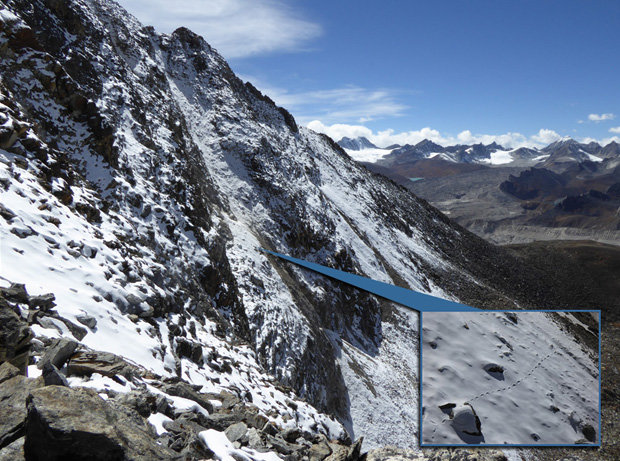
He wasn’t trying to break the law. He was on a remote trek in an accessible area, but his path took him to a high pass at 17,800 feet. Across an impassable chasm, some 200 yards away, he saw a pristine, untouched slope of snow. A place no human being had ever, or could ever, walk.
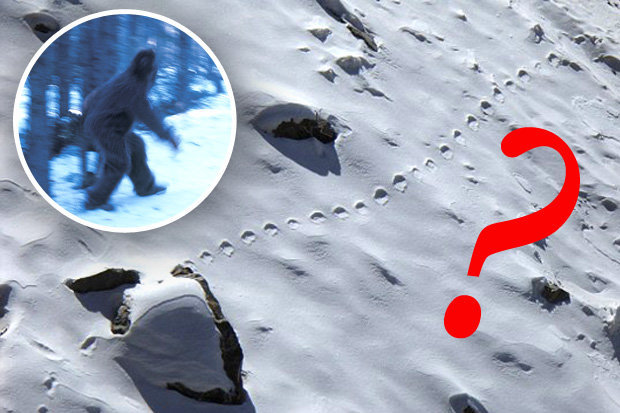
And there, etched into the virgin snow, was a line of tracks.

Berry photographed them. The pictures are bone-chilling. The prints are huge, far larger than any human foot. But that’s not the most disturbing part. The tracks are in a single file. A perfect line, one in front of the other. This is the unmistakable sign of a bipedal creature. Something that walks on two legs.
“No four-legged animal could have made that trail,” Berry stated, his voice heavy with the weight of what he’d seen. It wasn’t a bear. It wasn’t a snow leopard. It was something walking, like a man, across a landscape where no man could be.
The Sherpa’s Confirmation: A Story 11 Years in the Making
When Berry showed the photographs to his local guide, a yak herder who had spent his entire life in the shadow of those mountains, the man didn’t flinch. He didn’t seem surprised. He simply nodded.
They were Yeti tracks, he said.
Then, the herder shared his own story. A secret he had held for eleven years. He had seen it. On a high pasture, he had watched the creature itself move across the snow. The Abominable Snowman. He described it not as a monster, but as a wild man of the mountain. Something to be respected, and feared.
Think about that. In Bhutan, even the royal family acknowledges the existence of the *Migoi*, their name for the creature. To them, it isn’t a myth. It’s a part of the natural world, a rarely-seen neighbor dwelling in the places they hold sacred. The tracks on Gangkhar Puensum weren’t a mystery to the guide; they were a confirmation of a truth he already knew.
The Usual Suspects: Man, Myth, or Missing Link?
So what are we looking at here? A Spanish ghost and Himalayan footprints. Two completely different parts of the world, linked by the same impossible creature. The evidence is compelling, but the central question remains: what *is* the Yeti?
Cryptozoologists and researchers have battled over three main theories for decades. Each one is more mind-bending than the last.
Theory #1: The Ghost Bear of the Himalayas
In 2014, Oxford geneticist Bryan Sykes published a groundbreaking study. He tested DNA from hair samples attributed to the Yeti and other cryptids from around the world. The results were stunning. Many of the Himalayan samples didn’t match any known animal. Not exactly.
They were a 100% match to the DNA of an ancient polar bear jawbone found in Svalbard, Norway, that dated back at least 40,000 years. Sykes proposed that the Yeti legend might be based on a real, undiscovered species of bear, or perhaps a hybrid between the polar bear and the Himalayan brown bear. A creature that walks more upright, is more aggressive, and is far more elusive than its known cousins.
This theory is tantalizing. It gives a biological basis to the legend. But does it explain the perfectly bipedal tracks? Or the tall, man-like figure seen in countless eyewitness reports? A bear is still a bear. It walks on four legs. The Yeti, witnesses swear, walks on two.
Theory #2: The Survivor – A Living Fossil
This is the one that keeps scientists up at night. This is the big one. What if the Yeti isn’t a bear at all? What if it’s a hominid? A relic of our own evolutionary past, still clinging to life in the most remote corners of the globe.
For millions of years, a colossal ape called *Gigantopithecus* roamed across Asia. We only know it from fossilized teeth and jawbones, but from those, we can estimate it stood nearly 10 feet tall and weighed over 1,000 pounds. It was the largest primate that ever lived. It shared the planet with our own ancestors.
The official story is that *Gigantopithecus* went extinct around 300,000 years ago. But what if it didn’t? What if a smaller, more adaptable branch of its family tree retreated into the newly forming Himalayan mountain range? What if it evolved, survived, and became the creature we now call the Yeti?
A surviving prehistoric ape would explain everything. The bipedal tracks. The immense size and strength. The shaggy fur. The human-like, yet non-human, intelligence reported by witnesses. It would mean that we are not the only intelligent ape on the planet. A thought both wonderful and terrifying.
Theory #3: The Mountain’s Madness
Of course, we must consider the human mind. The high-altitude environment of the Himalayas is brutal. The air is thin, oxygen is scarce. It can induce hallucinations, paranoia, and confusion. Could the Yeti just be a trick of the light combined with an oxygen-starved brain? A case of mountain madness?
It could explain some sightings. An exhausted climber sees a strangely shaped rock and his mind fills in the blanks. But it can’t explain physical evidence. It can’t explain the tracks on Gangkhar Puensum. It can’t explain the hair samples that contain mystery DNA. And it certainly can’t explain the viral video from the Spanish Pyrenees, filmed at a comfortable, oxygen-rich resort altitude.
The madness theory falls apart when you look at the whole picture.
The Shadow Remains
The trail has not gone cold. From the shaky phone footage in Spain to the impossible footprints in Bhutan, the story of the Yeti is being written right now. It is a creature that exists in the periphery—a blur in the trees, a track in the snow, a whisper on the wind.
Skeptics can sit in their comfortable offices and dismiss it all as folklore. But for the people who live in these wild places, and for the explorers who have seen things they cannot explain, the Yeti is very, very real.
As long as mountains like Gangkhar Puensum remain forbidden, as long as there are valleys on our maps marked “unexplored,” we cannot say for certain what lives there. The world is bigger and stranger than we think. We have not conquered it. We have not cataloged all its monsters.
The shadow of the Yeti falls long from the rooftop of the world. And maybe, just maybe, it’s about time we started paying attention to what’s lurking in the dark.