The Black Sea is Steaming. But is it Just Weather… Or Something Else Entirely?
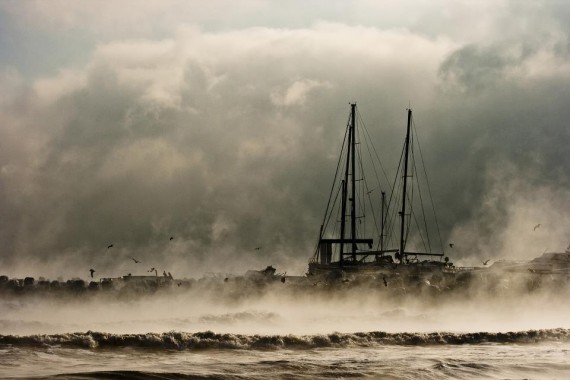
You see a picture like this. It’s haunting. Beautiful, even. A vast, dark body of water breathing out a ghostly mist into the frigid air. The official story lands on your desk in a neat little manila folder. They call it “sea smoke.”
Simple, right?
The explanation is almost insultingly mundane. When bitterly cold air, arctic-level cold, drifts over the relatively warmer water of a sea or a large lake, the water evaporates. That water vapor hits the freezing air and immediately condenses into a thick, rolling fog. It looks like the sea is boiling. Steaming. Hence, sea smoke.
Case closed. Nothing to see here, folks. Just a bit of atmospheric physics. Go back to your lattes and your nine-to-fives.
But we don’t do that here. We look closer. We ask the questions nobody else wants to ask. Because when you’re talking about the Black Sea… one of the most mysterious and historically loaded bodies of water on the entire planet… “simple physics” is never the whole story. It can’t be.
So, let’s peel back the layers. Let’s look past the easy answer and into the dark, murky depths. What if this isn’t just smoke? What if it’s a warning?
The “Official” Story They Want You to Believe
Let’s get the textbook definition out of the way first. You have to know the cover story before you can blow it wide open. Scientists, like P. M. Saunders from the Woods Hole Oceanographic Institution, will tell you it’s a known phenomenon. They even have different names for it. Over freshwater, it’s “steam fog.” Over the salty sea, it’s “sea smoke” or sometimes “arctic sea smoke.”
The conditions have to be just right. A massive temperature difference is key. We’re talking air that’s deep into the negatives Farenheit, sliding over water that’s just above freezing. The greater the difference, the more dramatic the effect. The air has to be calm, too. A strong wind would just tear the delicate fog apart.
It’s a visual illusion. It looks hot, but it’s a symptom of extreme cold. A paradox. And they love a good paradox to distract you from the truth.
A Picture Worth a Thousand Questions
This particular photograph, captured by the astonishingly talented Dan Cristian Mihailescu in Romania, is the perfect exhibit. He has a knack for being in the right place at the right time. Or maybe, just maybe, he’s captured something more profound than even he realizes.
Look at it. Really look. Does that look *natural* to you? The way the mist clings to the surface? The sheer volume of it? Internet forums and late-night researchers have pointed out anomalies. The patterns seem too organized. The “smoke” seems to rise from specific zones, not uniformly across the surface as you might expect.
It’s easy to dismiss. It’s easy to say, “It’s just a photo.” But photos can be evidence. And this piece of evidence suggests the Black Sea might not be steaming from the cold air above, but from a strange heat source below.
And when you learn what’s lurking in the depths of the Black Sea, the idea of a “heat source below” becomes terrifying.
Deep Dive: The Dead, Poisonous Heart of the Black Sea
Here’s a fun fact they don’t teach you in school. The Black Sea is a meromictic basin. Big word. Simple, horrifying meaning: the top layer of water and the bottom layer of water don’t mix.
Ever.
Because of its unique geography—fed by major rivers and only connected to the rest of the world’s oceans by the narrow Bosphorus strait—a permanent stratification has occurred. The upper layer is fresher, less dense, and contains oxygen. It supports life. Dolphins, fish, the usual.
But below about 150 to 200 meters? Welcome to the Dead Zone.
Over 90% of the Black Sea’s total volume is anoxic. That means it has zero oxygen. It is a pitch-black, dead, toxic soup of hydrogen sulfide, a gas that’s highly poisonous and smells like rotten eggs. Nothing, apart from a few specialized bacteria, can survive there. It is the largest anoxic body of water on Earth. A dead sea hidden beneath a living one.
For millennia, organic matter—dead plankton, fish, ancient trees, you name it—has sunk into this abyss and decayed without oxygen, pumping the depths full of this poison gas. It preserves things, too. Shipwrecks from the Roman and Byzantine eras have been found on the seafloor in near-perfect condition, untouched by the wood-eating organisms that require oxygen.
So, we have a massive, toxic, oxygen-free void sitting right under that “sea smoke.” Could a shift in undersea pressure or a geologic event cause some of this gas to bubble up? Could a chemical reaction with the cold air create the mist we see? The official story starts to look a little shaky, doesn’t it?
What if the Dragon is Waking Up? The Methane Hydrate Theory
It gets weirder. The Black Sea floor isn’t just full of poison gas and ancient wrecks. It’s sitting on a time bomb.
A geological treasure chest of methane hydrates. Often called “flammable ice,” this is a substance where methane gas molecules are trapped inside a crystal structure of frozen water. It looks like white ice, but if you hold a match to it, it erupts in flame.
The reserves of methane hydrate under the Black Sea are thought to be absolutely colossal. We’re talking about more fossil fuel energy than all the world’s known coal, oil, and other natural gas reserves combined.
What keeps this dragon sleeping? The immense pressure and frigid temperatures of the deep sea. But what happens if something changes? An underwater earthquake? A volcanic vent opening up on the seabed? A slow, steady increase in the water temperature from some unknown source?
A sudden release of this methane would be catastrophic, a true “clathrate gun” event that could alter the planet’s climate. But what about a slow leak? A steady, almost imperceptible bubbling of methane gas from the seabed, rising through the anoxic zone and hitting the surface water. Could this escaping gas, altering the water’s temperature and chemical composition from below, be a contributing factor to the sea smoke phenomenon?
Think about it. The “smoke” isn’t steam from heat. It’s the breath of a methane dragon, a gaseous exhalation from the planet’s depths, becoming visible only when it kisses the freezing winter air. The photo isn’t a weather event; it’s a geological one.
The Great Flood and the Lost Cities Below
The Black Sea wasn’t always a sea. This isn’t a conspiracy; it’s accepted geology. During the last ice age, it was a giant, freshwater lake, completely cut off from the Mediterranean.
Then, around 7,500 years ago, something happened. The ice dams holding back the world’s oceans melted. The Mediterranean Sea rose. And according to a compelling theory by scientists William Ryan and Walter Pitman, it broke through the Bosphorus valley with the force of 200 Niagara Falls.
A cataclysm. A wall of saltwater pouring into the freshwater lake, flooding the coastlines and submerging tens of thousands of square miles of land in a geological blink of an eye. The theory suggests this event was so traumatic, so world-altering, that it became the basis for the flood myths—from the Epic of Gilgamesh to the story of Noah’s Ark—that permeate our oldest cultures.
What does this mean for our steaming sea? It means there are Neolithic settlements, ancient farmlands, and perhaps entire towns perfectly preserved in the anoxic, muddy bottom of the Black Sea. Underwater explorer Robert Ballard, the man who found the Titanic, confirmed the existence of ancient shorelines and man-made structures deep beneath the waves.
Now, let’s connect the dots. What if these submerged lands are not entirely dead? What if geothermal vents, once active on dry land, are still active on the seabed? These vents, pumping geothermally heated, mineral-rich water into the surrounding deep, could create localized “hot spots.” This heated water would rise, creating underwater currents and temperature anomalies that mainstream science has yet to map.
The sea smoke, then, isn’t a uniform phenomenon. It’s a map. It’s a ghostly fingerprint on the surface, revealing the locations of ancient, active geology and perhaps even the ruins of a lost world far below.
Cold War Secrets and Unidentified Submerged Objects
Let’s fast forward a few thousand years. The Black Sea became one of the most tense and secretive naval theaters of the Cold War. It was the Soviet Union’s southern aquatic flank, home to the mighty Soviet Black Sea Fleet. Submarine pens were carved into the mountains of the Crimean Peninsula. Top-secret weapons were tested in its deep, sonar-muffling waters.
The stories that have trickled out since the fall of the USSR are the stuff of legend. Accounts of Soviet submarine captains reporting massive, fast-moving objects on sonar—objects they called “Kvakery” or “Quakers.” These USOs (Unidentified Submerged Objects) supposedly moved at impossible speeds and could change direction instantly, far beyond the capabilities of any known American or Soviet vessel.
Declassified files, or at least rumors of them, speak of strange energy signatures and magnetic anomalies emanating from the deepest parts of the sea. Could the Soviets have built secret underwater bases in the anoxic zone, where the unique chemistry of the water would hide them from spies and satellites?
Is it so crazy to think that what we’re seeing in this photograph is not natural at all? Could it be the thermal exhaust from a hidden power source? The discharge from a cloaked underwater facility, either Russian or… something else? The energy field of a dormant craft finally powering up? The “smoke” could be a byproduct of a technology we can’t even comprehend, a technology that finds the super-cold air the perfect medium to vent its waste heat.
The official explanation is always the simplest. And the simplest explanation is always the best cover.
Putting It All Together: What Does It Mean?
So, you have a choice.
You can look at that stunning photo and see “sea smoke.” A pretty, harmless weather event. A curiosity. You can accept the simple answer and move on.
Or you can see it for what it might really be.
- A visual sign of a massive, slow-release of methane gas from the seabed, a warning of geological instability.
- The thermal signature of undiscovered geothermal vents, marking the location of cities lost to a prehistoric flood.
- The exhaust plume from a top-secret military installation or an unknown vehicle hidden in the poisonous, oxygen-free abyss.
- A chemical reaction caused by the deep, toxic waters of the anoxic zone interacting with the surface in ways we don’t yet understand.
The truth is, the Black Sea is not like other seas. It has a dead heart. It holds ancient secrets. It was a playground for superpowers. To assume that anything that happens there is “normal” is to ignore history, geology, and a mountain of anecdotal evidence.
They give you a simple name—sea smoke—because it stops you from asking more questions. It packages the mystery up and puts it on a shelf. But the questions are still there, whispering from the depths. What is really going on in the Black Sea? What is it trying to show us? Perhaps the smoke isn’t the phenomenon. Perhaps it’s just the signal.
Look again. The truth is out there. You just have to be willing to see past the fog.