Saturday, September 5, 2026
HomeSpace & ScienceSpaceNASA's OSIRIS-REx asteroid mission launches

NASA’s OSIRIS-REx asteroid mission launches

The Billion-Dollar Space Heist That Changed Everything

Forget what you think you know about space missions. Forget the clean-room press conferences and the polite scientists in lab coats. What began in 2016 wasn’t just another launch. It was the beginning of the most audacious cosmic heist ever attempted.

A mission to steal a piece of the ancient past.

A mission to bring back a relic from a time before Earth was even born.

They called it OSIRIS-REx. A cool, technical-sounding name for a mission with stakes so high they echo through the very fabric of our existence. They told us it was about science. About understanding our origins. But when you follow the money, the clues, and the whispers in the dark corners of the web, a different picture starts to form. A picture that is far more shocking, and far more profound.

What were they *really* looking for out there in the cold, silent dark?

The Target: A Time Bomb Named Bennu

Every great heist needs a target. And NASA chose a doozy.

Its name is Bennu. A diamond-shaped chunk of carbon and rock, tumbling through space about a third of a mile wide. It’s dark. Darker than charcoal. It soaks up almost all the light that hits it, making it a ghost in the cosmic ocean.

But this isn’t just any old rock.

Bennu is what scientists call a “rubble pile” asteroid. It’s not one solid piece, but a loose collection of boulders, pebbles, and dust, all held together by a whisper of gravity. A cosmic gravel pit. And it’s old. Ancient. It’s a leftover piece from the violent birth of our solar system, over 4.5 billion years ago. A time capsule containing the raw ingredients that built worlds. Including ours.

But there’s a darker side to Bennu. It’s a Potentially Hazardous Asteroid (PHA). Its orbit crosses Earth’s path, and astronomers give it a slim—but not zero—chance of impacting our planet late in the 22nd century. A collision would be catastrophic. Unthinkable. An explosion thousands of times more powerful than the largest nuclear bomb ever detonated.

So, the official story goes like this: we need to study Bennu to understand the threat. To know our enemy. As planetary scientist Professor Dante Lauretta said back then, “We need to know everything about Bennu – its size, mass and composition. This could be vital data for future generations.”

It sounds sensible. Responsible, even. But is that the whole story? Or is the “danger” the perfect cover for a much deeper objective?

A Name Laced with Prophecy?

Let’s talk about the names. They are never an accident.

OSIRIS-REx. The official acronym stands for Origins, Spectral Interpretation, Resource Identification, Security-Regolith Explorer. A mouthful. Forget that.

Think mythology. Osiris was the Egyptian god of the underworld, death, and… resurrection. Rebirth.

And Bennu? Bennu was the ancient Egyptian deity linked to the sun, creation, and rebirth. It was a mythological bird, a phoenix, that would rise from the ashes. The soul of the sun god, Ra.

A mission named for the god of resurrection, sent to a cosmic body named for the phoenix of rebirth. Is this a coincidence? Or a message? A clue, hidden in plain sight, about the mission’s true purpose?

The Mission Plan: What They Told Us

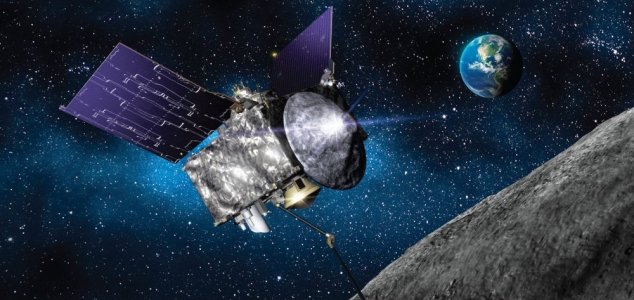
The plan was as bold as it was complex. On Thursday, September 8, 2016, a 19-story Atlas V rocket tore a hole in the Florida sky, carrying the billion-dollar OSIRIS-REx probe on its back. This was a high-prestige mission, part of NASA’s New Frontiers Program—the same family as the New Horizons probe that gave us our first stunning look at Pluto, and the Juno probe that dared to orbit the stormy giant, Jupiter.

The probe would spend two years chasing Bennu through the solar system. A silent, lonely pursuit. Once it arrived, it wouldn’t just fly by. No. It would spend 505 days in close orbit, mapping every crack, every boulder, every shadow on the asteroid’s surface with a suite of advanced cameras and scientific instruments. It would create the most detailed map of an asteroid ever conceived.

Then came the main event. The heist itself.

After picking the perfect spot—a small crater they nicknamed “Nightingale”—the probe would descend slowly. It wouldn’t land, but perform a delicate, terrifying maneuver called “Touch-And-Go,” or TAG. A robotic arm, the heart of the operation, would reach out and touch the surface for just a few seconds. In that moment, it would fire a blast of pure nitrogen gas, kicking up a cloud of ancient dust and pebbles—the regolith—and catching it in a collector head. Then, it would fire its thrusters and back away, carrying its cosmic prize.

The sample would be sealed in a capsule, and OSIRIS-REx would begin the long two-year journey home, a celestial courier carrying a message from the dawn of time.

UPDATE: The Package Has Landed

For seven years, the world watched. Waited. The probe reached Bennu. It mapped it. It performed the heart-stopping TAG maneuver on October 20, 2020. And it worked. Too well.

The collection head snagged so much material—so much of Bennu’s soul—that its little flap couldn’t close. Precious, irreplaceable black dust, older than the mountains and oceans of Earth, was leaking out into the void of space. A frantic, brilliant scramble by the mission team on the ground managed to stow the arm and its overflowing sample head safely into the return capsule, saving the mission from disaster.

And then, on September 24, 2023, it came home.

A fiery streak across the morning sky. The sample return capsule, carrying its priceless cargo, detached from the main spacecraft and plunged into Earth’s atmosphere at over 27,000 miles per hour. It blazed like a man-made meteor before its parachutes deployed, slowing it to a gentle touchdown in the Utah desert. Recovery teams, looking like they were from a sci-fi movie, raced in helicopters to secure the capsule. The clock was ticking. Every second it spent on Earth exposed it to our planet’s air, our planet’s life, risking contamination of the pure, primordial sample within.

The package was secure. The heist was a success.

Now, the real mystery begins.

The Conspiracy Corner: What Did They *Really* Bring Back?

The official line is that the sample contains abundant water trapped in clay minerals and is rich in carbon. The building blocks of life. It’s a fantastic discovery, one that supports the idea of panspermia—the theory that life on Earth may have been seeded from space, delivered by asteroids just like Bennu. It’s a neat, tidy story that fits perfectly into the scientific narrative.

But is it the *whole* story?

The internet, as it always does, is asking the questions the mainstream refuses to. When you spend over a billion dollars and wait seven years for a few handfuls of dust, you have to wonder if you’re looking for more than just “carbon.”

Deep Dive: The Hunt for Alien Life?

This is the big one. The ultimate prize. Forget “building blocks.” Are they searching for actual, fossilized extraterrestrial life? Microscopic fossils of alien bacteria, locked within the rocks of Bennu for billions of years? This wouldn’t just be a scientific breakthrough; it would be the single greatest discovery in human history. It would shatter religions, philosophies, and our sense of place in the universe forever.

Think about it. The “water and carbon” story is the perfect soft disclosure. They can slowly feed us the idea that the “ingredients” for life are common in the cosmos. It prepares the public. It softens the blow for the eventual, inevitable announcement: We are not alone. And we never were.

Was OSIRIS-REx a mission to prove a theory? Or a mission to retrieve the evidence they already knew was there?

Deep Dive: A Technological Treasure Trove?

Let’s move beyond biology. What if the value of Bennu isn’t in life, but in materials? The universe is a strange place. Could this asteroid contain elements or isotopes that don’t exist naturally on Earth? Or exist in forms with bizarre, unheard-of properties?

Imagine a stable element from the far end of the periodic table. A material that could act as a perfect room-temperature superconductor. An energy source that would make fossil fuels and nuclear power look like lighting a campfire. Such a discovery would be worth trillions. It would change the global balance of power overnight. Do you honestly believe such a find would be announced in a press release?

No. It would be whisked away to a black site, studied in secret, and weaponized long before you ever heard about it. The billion-dollar price tag starts to make a lot more sense when you think of it not as a science budget, but as a down payment on a military or technological revolution.

Deep Dive: A Message in a Bottle?

This is where things get really strange. Some theories floating online question the very nature of Bennu itself. We see a “rubble pile” asteroid. But what if that’s just a disguise? The ‘Oumuamua object, which flew through our solar system in 2017, sparked a serious debate among top astronomers about whether it could be an artificial alien probe. It had a strange shape and accelerated in a way we couldn’t explain.

What if Bennu is something similar? Not a ship, but perhaps a fragment of one. Or a piece of a long-dead artificial structure. Or maybe even a cosmic marker buoy, left by an intelligence we cannot possibly comprehend. Is it possible the sample contains not just rocks, but something manufactured? A tiny piece of technology? A message?

The mission’s name, OSIRIS-REx, brings us back to resurrection. Are they trying to resurrect a lost technology? Or decode a message from the gods?

The Truth is in the Dust

The sample capsule was opened in a specialized clean room at NASA’s Johnson Space Center in Houston. The initial reveal was stunning. They had expected a couple of ounces of material. Instead, the outside of the collector head and the inside of the capsule were coated in so much black dust and debris that they had to work for weeks just to clean it up before they could even get to the main sample inside.

They hit the jackpot.

Today, scientists around the world are poring over tiny grains of Bennu. The official results will trickle out over years, even decades. We’ll get papers on organic molecules, on water content, on mineral composition. It will fill textbooks and win awards.

But the real story, the true discovery, may never make it into a textbook. It might be locked in a vault so deep the sun will never touch it. What was learned from that cosmic dust could already be changing our future, in ways we won’t understand for a hundred years.

The mission isn’t over. Not by a long shot. The OSIRIS-REx spacecraft itself, its delivery job done, is now on a new mission, renamed OSIRIS-APEX, heading to study another asteroid, Apophis. But its legacy is now here, on Earth, sealed in nitrogen-filled containers in a Texas laboratory.

A piece of another world. A key to our past. And maybe, just maybe, a secret that will redefine our future. They stole fire from the gods. Now we just have to wait and see what they do with it.

Amit Ghosh
Amit Ghoshhttps://coolinterestingnews.com
Aloha, I'm Amit Ghosh, a web entrepreneur and avid blogger. Bitten by entrepreneurial bug, I got kicked out from college and ended up being millionaire and running a digital media company named Aeron7 headquartered at Lithuania.
RELATED ARTICLES
- Advertisment -

Most Popular

Recent Comments

Warren Pan Abbott on The legend of the Devil Monkey !
chris davies on The McPherson Tape Mystery
Reed Reedly on ET has Internet!
Bea Houseoffashion on Proof Of Time Travellers – Gallery
Marcus2012 on ET has Internet!
Reed Reedly on ET has Internet!
LaughsAtConspiracyNuts on The 9/11 Conspiracy – Myths and Facts
Alex Sliverman on Did the ancients fly?
Doctor Wholigan on Time Traveler in 1938 film
chris davies on The McPherson Tape Mystery
Archie1954 on 10 secret UFO hideouts
chris davies on Ghosts of flight 401
Marcus2012 on ET has Internet!
jason Macdonald on Proof of Time Travel? – China
chris davies on Long-Lost Pyramids Found?
Reed Reedly on ET has Internet!
Milkman on Connected Universe
Tenmiles on Baigong Pipes Mystery
Simon Foster on Sirius – The Documentary
From the 1st April on 2013 – Alien Contact date ?
SkyWatcher on Is ET ignoring us?
I Come From The Future on Obama to make UFO Alien disclouser soon ?
ÛñK?øWn on 2013 – Alien Contact date ?
Just another person on 2013 – Alien Contact date ?
Malcolm Windowcleaner on The strange case of Rudolph Fentz
Mason Servio on Strange Things on Mars
Marke Wisdom Seeker on What will we find as arctic melts?
Andrea A Elisabeth Levyne on Aliens Captured in Varginha, Brazil
Mitch Grouyeki on Amazing Space Shuttle pictures