Home Weird World Space NASA Curiosity Landing Video

NASA Curiosity Landing Video

0
63

The Day Mars Became Real: Deconstructing the First Images from a Silent World

Forget what you think you know. Forget the dusty, lifeless red ball you see in textbooks. For a single, heart-stopping moment in August 2012, Mars became something else entirely. It became a place. A real place. And it all started with a single, fuzzy photograph.

This wasn’t just another NASA mission. This was different. The Curiosity rover, a one-ton, nuclear-powered mobile laboratory, was the most sophisticated machine ever sent to another planet. Its landing was so absurdly complex, so ridiculously fraught with peril, that the engineers at the Jet Propulsion Laboratory (JPL) nicknamed it the “Seven Minutes of Terror.”

Think about it. A spaceship hurtling toward a planet at 13,000 miles per hour, needing to slow to a dead stop on the surface, all with a twenty-minute communication delay. Everything had to be perfect. Everything had to be automated. It was a Hail Mary pass thrown across 150 million miles of empty space.

And it worked. The world watched, holding its breath, as a machine the size of a small car was lowered onto the Martian surface by a freaking rocket-powered sky crane. It was pure science fiction made real. But the landing, as spectacular as it was, was just the prelude. The real story began when the rover opened its eyes.

That First Grainy Glimpse: More Than Just a Photo?

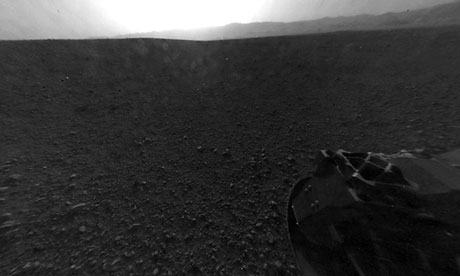
The first images that trickled back were low-resolution, black-and-white thumbnails from the rover’s hazard-avoidance cameras. They were blurry. They were distorted. But they were electrifying. They showed a wheel. Martian soil. The shadow of the rover itself, a silent alien monument cast upon an alien world. The room at JPL exploded in celebration.

But then came the image that changed everything. The first *color* image.

Look at it. Really look. The official story is simple. The photo was taken by the Mars Hand Lens Imager (MAHLI) camera at the end of the rover’s robotic arm. The landscape looks fuzzy because the camera’s removable dust cover was still on, clouded by the grit kicked up by the sky crane’s retro-rockets. In the distance, the rim of Gale Crater rises against a butterscotch sky.

A simple explanation. Maybe too simple.

This single image, released to a cheering public, became an immediate source of intense debate in the hidden corners of the internet. Why release a fuzzy, obscured photo first? Was it a simple matter of procedure, of making sure the systems worked? Or was it a deliberate choice? A way to manage expectations? A way to obscure something they saw in those first, crystal-clear moments?

The dust itself is a point of contention. We’re told it’s just pulverized rock. But what if it wasn’t? What if the chemical composition of that dust, analyzed in situ, revealed something unexpected? Something… biological? Microscopic spores, perhaps, thrown into the thin Martian air by the rover’s violent arrival? It sounds wild. But on a mission designed to search for the building blocks of life, you have to wonder if the very first sample they took was right there, clinging to a lens cap.

Deep Dive: The Sky Crane Paradox

Let’s talk about that landing system. The Sky Crane. It’s a marvel of engineering, no doubt. But it’s also completely bonkers. Firing rockets that close to the ground on another planet? Lowering your billion-dollar payload on a set of nylon cords? It’s a solution so complex it begs the question: why?

The official line is that Curiosity was too heavy for the traditional airbag-bounce landing used by previous, smaller rovers like Spirit and Opportunity. The Sky Crane was the only way. But some analysts and independent researchers have proposed a different theory. They suggest the Sky Crane wasn’t just a landing system. It was a test.

A test for what? For a future technology. A system designed to deploy not just scientific instruments, but perhaps habitats. Or military assets. Or even human crews, delivering them with pinpoint accuracy without the need for a runway. Was the “Seven Minutes of Terror” a public science mission, or was it a black-budget technology demonstration hidden in plain sight? Think of the power a perfectly reliable, heavy-lift sky crane would give a space-faring nation. It changes the game completely.

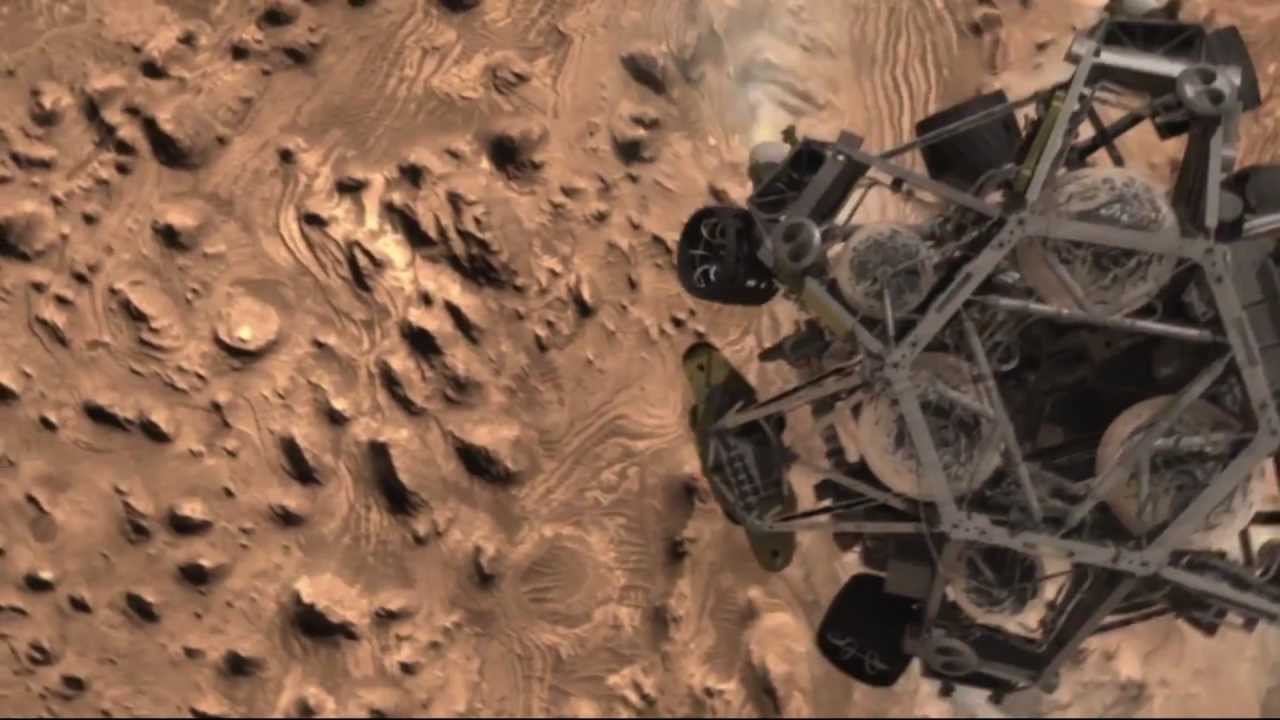
The video of the landing, once it was finally beamed back in higher resolution, only added to the mystery. It was a perspective no human had ever seen.

Watching the heat shield fall away to reveal the ochre plains below is mesmerizing. Seeing the ground rush up, the dust swirl, the cables unspool… it’s real. Too real. And it proves they could do it. But it doesn’t answer the question of *why* they did it that way.

Gale Crater: A Random Target or a Calculated Destination?

NASA didn’t just throw a dart at a map of Mars. The landing site, Gale Crater, was chosen after years of painstaking debate. It’s a 96-mile-wide basin with a gigantic, layered mountain in the middle named Aeolis Mons (or Mount Sharp). The official reason for choosing this spot is compelling: those layers represent millions, perhaps billions, of years of Martian history. By driving up that mountain, Curiosity could read the story of Mars like pages in a book, searching for evidence that the planet was once habitable.

Makes sense. But what if there’s another reason?

What if Gale Crater was chosen for something they already knew was there? Satellites had been mapping Mars in incredible detail for years. They knew its topography, its mineral composition, its gravitational and magnetic anomalies. Was there a blip in the data over Gale Crater? A strange energy signature? An unusual concentration of a specific element that hinted at something artificial buried beneath the sand?

Consider the structure of the crater itself. It’s an ancient impact site. A cataclysmic event once occurred right there. If you were an advanced civilization looking to leave a beacon or a cache of information for a developing species like us, where would you put it? Perhaps at the site of a major geological event, something that would be an obvious point of interest for future explorers. The selection of Gale Crater might not have been a search for life, but a planned rendezvous with a message left eons ago.

The Anomaly Files: What Curiosity Found Next

That first fuzzy photo was just the beginning. In the years since its landing, Curiosity has beamed back hundreds of thousands of images. And while NASA focuses on geology, a global network of “armchair astronomers” and anomaly hunters has been scanning every single frame. What they’ve found is… unsettling.

They’ve cataloged a museum of oddities that defy easy explanation. Sure, many can be dismissed as pareidolia—the human brain’s tendency to see patterns in random shapes. A rock that looks like a squirrel. Another that looks like a traffic light. But some are harder to wave away.

  • The “Martian Thigh Bone”: An object photographed in 2014 that bears an uncanny resemblance to a vertebrate femur. NASA quickly called it a rock sculpted by wind and water erosion. But the shape is so specific, so biological, it continues to fuel debate.
  • The “Floating Spoon”: A bizarre, elongated rock formation that appears to hover above the ground, casting its own distinct shadow. Geologists suggest it’s a ventifact—a rock shaped by wind—but its delicate structure and seemingly impossible physics are baffling.
  • Strange Lights: On several occasions, the rover has captured images of bright points of light on the horizon or emanating from the ground. NASA has explained them as cosmic rays hitting the camera sensor or glints of sunlight off rock facets. Yet they often appear in sequences, suggesting movement or a powered source.
  • The Methane Spikes: This one is the real kicker. Curiosity’s onboard laboratory has detected sudden, dramatic spikes in atmospheric methane. On Earth, the vast majority of methane is produced by living organisms. While there are geological processes that can also produce it, the transient, localized nature of these Martian plumes is highly suspicious and remains one of the mission’s greatest unsolved puzzles. It’s a chemical signal that screams, “Something is happening here.”

A New Mars We Have Never Seen Before

The mission scientists in 2012 promised we would see “a new Mars we have never seen before.” They had no idea how right they were. But perhaps they weren’t seeing it for the first time. Perhaps they were just confirming what they already suspected.

What if that first color photo wasn’t just a technical test? What if it was a coded signal back to certain agencies? “The dust cover is on. The view is obscured. We have plausible deniability for whatever we find in these first few days.”

Think about the possibilities. What if the *real* first color photo, the one taken seconds after the dust cover was zapped clean, showed something that would have stopped the world cold? The glint of metal? A geometric shape that could not possibly be natural? A fossilized trackway leading over a nearby dune?

We’ll never know. The public gets the curated feed. The sanitized story. We get the press releases about clay minerals and water history, all of which is genuinely fascinating science. But it might just be the cover story for the real mission. A mission to investigate a known point of interest, to confirm an anomaly detected from orbit, and to manage the eventual disclosure of what they find.

That single, fuzzy image from 2012 wasn’t the answer to a question. It was the birth of a thousand new ones. It represents a turning point in our relationship with the cosmos. It was the moment a distant world became a tangible landscape, complete with rocks, craters, dust, and secrets. So many secrets.

The rover is still there. Right now, as you read this, it’s silently crawling across the floor of Gale Crater, drilling into rocks, tasting the air, and sending its secrets back across the void. The official narrative continues. But the real story, the one written between the lines of code and hidden in the pixels of every image, is still unfolding. The truth is on Mars. We just have to know how to look.

Originally posted 2016-03-19 16:27:51. Republished by Blog Post Promoter